
Understanding Your Fifth Amendment Right to Stay Silent
Learn how the Fifth Amendment protects you from compelled self-incrimination in police interviews, court, and beyond.
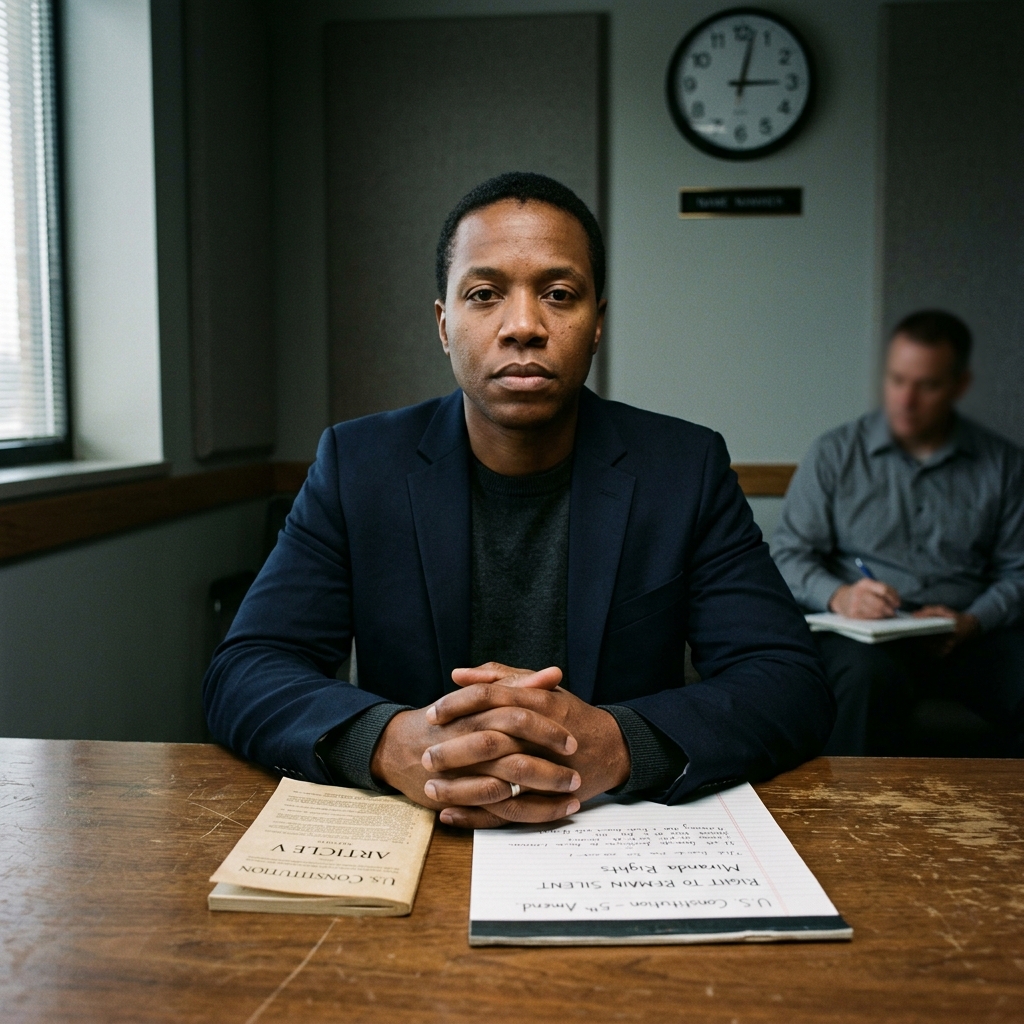
The Fifth Amendment right against self-incrimination is one of the most important protections in United States criminal law. It allows people to decline to answer questions or give testimony that could expose them to criminal charges, preserving both fairness in the justice system and personal privacy from government intrusion.
This article explains what it means to “plead the Fifth,” when the right applies, how it interacts with police interrogations and court testimony, and practical points to consider if you think your answers could be used against you.
1. The Fifth Amendment in Plain Language
The Fifth Amendment to the U.S. Constitution contains several distinct protections, including grand jury indictment, the ban on double jeopardy, due process, and just compensation for takings. The relevant part for self-incrimination states that no person:
“shall be compelled in any criminal case to be a witness against himself.”
In practical terms, this clause means the government cannot force you to provide testimonial information that could contribute to a criminal case against you.
Key protections in the Fifth Amendment
- Right against forced self-incrimination – you may refuse to answer questions that could reasonably expose you to criminal charges.
- Accusatorial, not inquisitorial system – the government must prove its case without forcing you to help build it.
- Personal privilege – the right belongs to individuals, not to corporations or other organizations.
2. What Counts as “Self-Incrimination”?
To understand when the Fifth Amendment applies, it helps to clarify what “self-incrimination” means. Incrimination involves exposing yourself to accusation or criminal prosecution, or creating a realistic danger of that outcome.
The privilege is triggered when there is a reasonable possibility that your answer, or the information implied by it, could be used in a criminal case.
Examples of potentially self-incriminating information
- Admitting you were present at the scene of a crime.
- Describing actions that could be illegal, even if you believe you did nothing wrong.
- Providing a timeline that contradicts other evidence and might suggest false statements.
- Confirming ownership or control over items that may be evidence in a criminal case.
- Giving answers that, while not directly confessions, “furnish a link in the chain of evidence” needed for prosecution.
The protection does not require that prosecution be certain or even likely; it is enough that there is a realistic possibility that your statements could contribute to criminal charges.
3. “Pleading the Fifth” – What It Means
“Pleading the Fifth” is the common phrase for invoking the Fifth Amendment privilege against self-incrimination. A witness or defendant pleads the Fifth by clearly stating that they decline to answer a question because the answer may be self-incriminating.
Courts and law enforcement generally require the assertion of the right to be clear and unequivocal. Simply remaining silent, without explanation, is often not enough.
| Situation | How the Fifth is Invoked | Key Point |
|---|---|---|
| Criminal defendant at trial | May choose not to take the witness stand at all. | Refusal to testify cannot be used as evidence of guilt. |
| Witness in criminal or civil case | Usually must appear and assert the privilege in response to specific questions. | The privilege is applied question-by-question. |
| Police interrogation | Must state clearly that they are invoking the right to remain silent or requesting a lawyer. | Ambiguous statements may not stop questioning. |
| Subpoena for testimony or documents | May assert the privilege where compliance would reveal incriminating information. | The “act of production” itself can be testimonial in some circumstances. |
4. The Fifth Amendment Outside the Courtroom: Miranda Rights
The Fifth Amendment applies not only in court but also during custodial police questioning. In Miranda v. Arizona, the U.S. Supreme Court held that when a suspect is taken into custody and subjected to interrogation, law enforcement must inform them of specific rights derived from the Fifth Amendment.
These warnings, commonly known as Miranda rights, typically include:
- The right to remain silent.
- Notice that anything said can be used against you in court.
- The right to consult with an attorney and have the attorney present during questioning.
- The right to have an attorney appointed if you cannot afford one.
Miranda rights are designed to ensure that any statements made during custodial interrogation are truly voluntary, not the result of coercion or ignorance of the right to remain silent.
When Miranda warnings are required
- Custody – the person is significantly deprived of freedom of movement, similar to formal arrest.
- Interrogation – law enforcement asks questions or uses techniques likely to elicit incriminating responses.
- If these conditions are met and warnings are not given, some statements may be excluded from evidence.
Miranda is not a separate right; it is a procedural safeguard designed to protect the existing Fifth Amendment privilege in the context of police questioning.
5. When and Where the Right Against Self-Incrimination Applies
The Fifth Amendment privilege against self-incrimination applies in a wide range of legal settings, not just criminal trials. It is recognized in both federal and state proceedings through the Fourteenth Amendment, and in criminal and civil cases where testimony could be used in a future criminal prosecution.
Common contexts where the right may be invoked
- Criminal trials – defendants may refuse to testify; witnesses may decline to answer particular questions.
- Civil lawsuits – witnesses or parties can invoke the privilege if answers might lead to criminal exposure.
- Administrative hearings – testimony before agencies or disciplinary boards may implicate criminal conduct.
- Legislative inquiries – congressional hearings and similar proceedings can involve Fifth Amendment assertions.
- Grand jury investigations – witnesses and potential targets may decline to answer incriminating questions.
While the privilege is broad, it does not apply to every type of information. It protects testimonial communications, not generally the collection of physical evidence such as fingerprints, blood samples, or handwriting exemplars.
6. The Act of Production and Documents
The Supreme Court has recognized that the act of producing documents in response to legal demands may itself have a testimonial quality. For example, handing over records can implicitly confirm that they exist, that you possess them, and that they are authentic.
Under what is sometimes called the “act of production” doctrine:
- Producing documents can reveal information about their existence, custody, or authenticity.
- If these implied statements create a realistic risk of self-incrimination, the Fifth Amendment privilege may be asserted.
- The analysis is often complex and fact-specific, and courts may weigh the government’s prior knowledge of the documents against the testimonial value of production.
Importantly, the privilege is personal. It cannot be invoked on behalf of corporations or similar entities, even when the individual is responsible for the entity’s records.
7. Limits and Responsibilities When Invoking the Fifth
The right against self-incrimination is powerful but not unlimited. Courts balance the protection against the needs of the justice system, and individuals have responsibilities when they invoke it.
Key limits on the privilege
- Reasonable fear of prosecution – there must be a realistic possibility that answers could contribute to criminal charges, not merely embarrassment or inconvenience.
- No blanket immunity for all questions – the privilege is typically asserted in response to specific questions; non-incriminating questions may still need to be answered.
- Corporations and organizations – cannot claim the privilege; it applies only to natural persons.
- Adverse inferences in civil cases – unlike criminal trials, civil courts may allow judges or juries to draw negative inferences from a party’s refusal to answer questions.
In criminal cases, however, a defendant’s choice not to testify cannot be used as evidence of guilt, and juries are instructed not to draw adverse inferences from silence.
Clear invocation is essential
Courts generally expect that the privilege be claimed explicitly. Remaining silent without explanation, or making ambiguous statements, may not be enough to stop questioning or protect against the use of statements later.
Practical ways to make your invocation clear include statements such as:
- “I am invoking my right to remain silent.”
- “I am asserting my rights under the Fifth Amendment.”
- “I do not wish to answer that question because it may incriminate me.”
- “I want to speak with a lawyer before answering any questions.”
8. Why Innocent People May Use the Fifth Amendment
Invoking the Fifth Amendment does not automatically mean a person is guilty. The privilege is designed to protect both the innocent and the guilty from coercive or misleading questioning and from unintended legal consequences.
There are several reasons why an innocent person might reasonably assert the privilege:
- Risk of misunderstanding – complex or stressful questioning can lead to statements that are misinterpreted or taken out of context.
- Incomplete information – an individual may not know all the relevant facts or how their answers fit with other evidence.
- Possibility of future charges – even if no case is pending, answers could be used later if new evidence comes to light.
- Protection against “links in a chain” – statements that seem harmless on their own may still help create a path to prosecution.
Because of these risks, legal counsel sometimes advises individuals to assert their Fifth Amendment rights even when they insist they have done nothing wrong.
9. Practical Tips for Navigating Self-Incrimination Issues
Each situation involving potential self-incrimination is unique, and legal advice from a qualified attorney is crucial. However, some general considerations can help people think about when the Fifth Amendment may be relevant.
Practical points to keep in mind
- Recognize high-risk situations – interactions with law enforcement, testimony under oath, and responding to subpoenas often carry a risk of self-incrimination.
- Do not assume casual questioning is harmless – informal conversations can still produce statements used in court.
- Be cautious with detailed narratives – answering more than necessary, or speculating, can create unintended legal exposure.
- Seek legal advice early – consulting counsel before responding to significant questioning or document demands can clarify whether the Fifth Amendment should be invoked.
- Assert rights clearly and calmly – explicit, respectful invocation is more likely to be recognized by authorities and courts.
Understanding the Fifth Amendment does not make you an expert in criminal procedure, but it can help you recognize when it may be safer to pause, seek advice, and consider asserting your right against self-incrimination.
10. Frequently Asked Questions (FAQs)
Can I use the Fifth Amendment in a civil case?
Yes. You may assert the Fifth Amendment in civil proceedings if answering a question could reasonably expose you to criminal charges. However, unlike in criminal cases, a judge or jury in a civil case may be permitted to draw adverse inferences from your refusal to answer.
Do I have to be formally charged with a crime to invoke the Fifth?
No. The privilege does not require that charges already be filed. It is enough that there is a realistic possibility that your answers could be used in a future criminal prosecution.
Is staying silent always protected by the Fifth Amendment?
Not automatically. In many contexts, you must explicitly assert the privilege for it to apply. Simply refusing to answer without explanation may not fully protect you, especially in non-custodial settings or where there is a duty to respond.
Can a company “plead the Fifth”?
No. The privilege against self-incrimination is a personal right. Corporations and similar organizations cannot invoke it. Individual employees may have personal Fifth Amendment rights, depending on the circumstances.
What happens if police don’t read me my Miranda rights?
If you are in custody and subjected to interrogation without being informed of your Miranda rights, certain statements you make may be excluded from evidence in a criminal case. The details depend on how and when the statements were obtained.
Does the Fifth Amendment protect physical evidence?
Generally, no. The privilege protects testimonial communications—what you say or write—not the collection of physical evidence like fingerprints, blood samples, or photographs.
References
- U.S. Constitution, Amendment V — Library of Congress. Accessed 2024-10-01. https://constitution.congress.gov/constitution/amendment-5/
- Self-Incrimination :: Fifth Amendment — Rights of Persons — Justia. Accessed 2024-10-01. https://law.justia.com/constitution/us/amendment-05/07-self-incrimination.html
- Fifth Amendment — Legal Information Institute, Cornell Law School. Accessed 2024-10-01. https://www.law.cornell.edu/wex/fifth_amendment
- Pleading the Fifth – the Right Against Self-Incrimination for Criminal and Civil Practitioners — Clark County Bar Association. 2022-09-01. https://clarkcountybar.org/pleading-the-fifth-the-right-against-self-incrimination-for-criminal-and-civil-practitioners/
- Fifth Amendment to the United States Constitution — Encyclopedic summary, citing primary sources. Accessed 2024-10-01. https://en.wikipedia.org/wiki/Fifth_Amendment_to_the_United_States_Constitution
- Fifth Amendment First Principles: The Self-Incrimination Clause — Michigan Law Review. 1997-06-01. https://repository.law.umich.edu/cgi/viewcontent.cgi?article=3105&context=mlr
- Understanding the Fifth Amendment Right to Remain Silent — Burnham & Gorokhov, PLLC. Accessed 2024-10-01. https://www.burnhamgorokhov.com/criminal-defense-resources/fifth-amendment/
Similar Articles








Read full bio of Sneha Tete




