
Understanding Field Sobriety Tests in DUI Stops
A clear, practical guide to common field sobriety tests, how officers use them, and what drivers should know during DUI investigations.
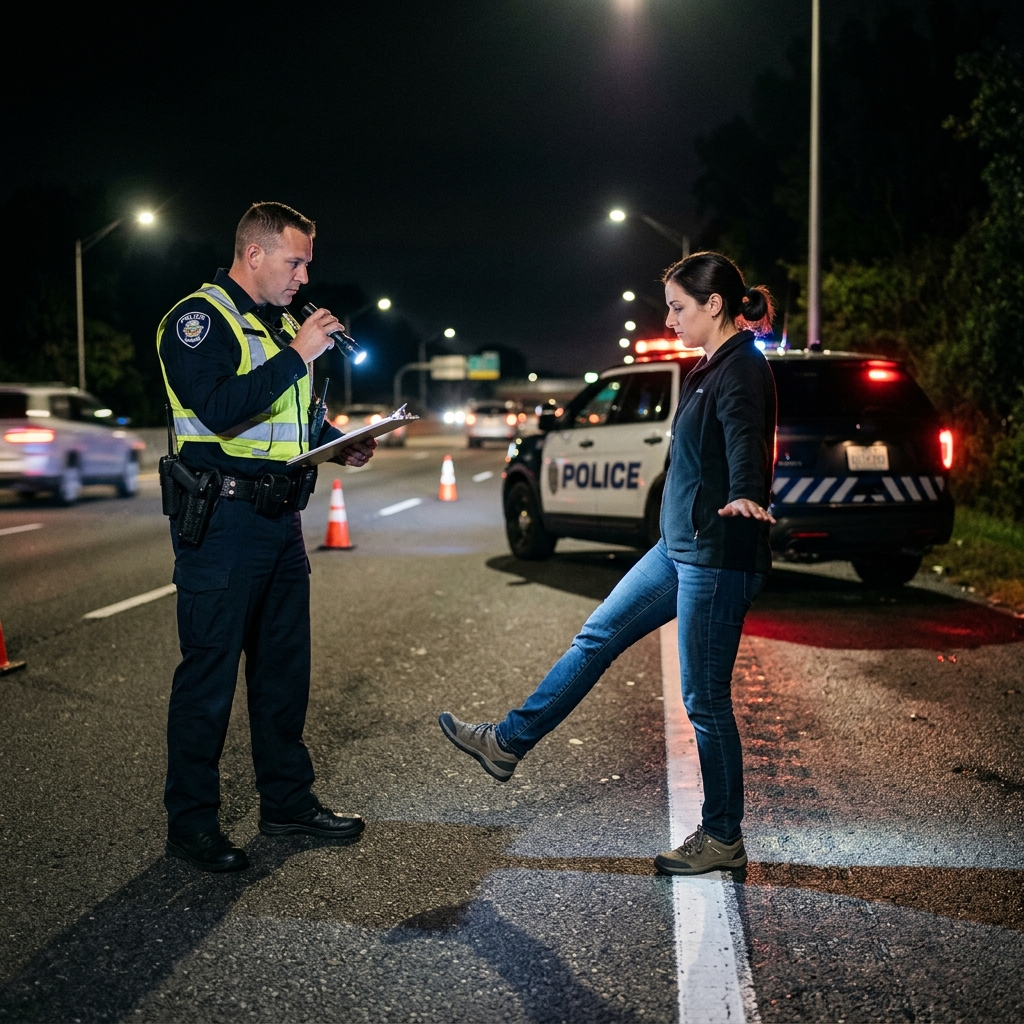
When police suspect a driver of being under the influence of alcohol or drugs, they often rely on field sobriety tests to decide whether to make an arrest and request chemical testing. These roadside assessments are designed to measure a person’s balance, coordination, eye movements, and ability to follow instructions, all of which can be affected by impairment.
This article explains what field sobriety tests are, how officers administer the most common standardized tests, what their limitations are, and what drivers should know about their legal and practical consequences.
What Are Field Sobriety Tests?
A field sobriety test (FST) is a set of physical or cognitive tasks that a law enforcement officer asks a driver to perform during a traffic stop to assess whether the driver may be impaired by alcohol or drugs. The officer observes how the person performs the tasks and notes any signs associated with intoxication.
Field sobriety tests generally aim to evaluate:
- Balance and posture – whether the driver can stand or walk without swaying or stumbling
- Coordination – ability to control limb movements and perform tasks smoothly
- Divided attention – capacity to perform physical tasks while following instructions and counting or speaking
- Eye movements – presence of involuntary eye jerking (nystagmus) that tends to increase with higher blood alcohol concentration
The results give officers additional information to decide whether there is probable cause to arrest someone for driving under the influence and to proceed with breath or blood testing.
Standardized vs. Non-Standardized Tests
Over time, many different field tests have been used, ranging from walking in a straight line to reciting part of the alphabet. Research showed that some tests are more reliable indicators of impairment than others, which led the U.S. National Highway Traffic Safety Administration (NHTSA) to develop a standardized field sobriety testing (SFST) battery.
The Three Standardized Field Sobriety Tests
The NHTSA-approved SFST battery consists of three core tests:
- Horizontal Gaze Nystagmus (HGN) – a test of involuntary eye jerking as the eyes track a moving object
- Walk-and-Turn (WAT) – a walking task that divides attention between physical movement and following directions
- One-Leg Stand (OLS) – a balance test combined with counting out loud
NHTSA training manuals describe standardized instructions, positioning, and scoring for these tests and emphasize that officers should follow the procedures closely for the results to be considered valid.
Non-Standardized Field Tests
Officers sometimes use additional, non-standardized tests, such as:
- Standing with feet together, head tilted back, eyes closed (often called a Romberg balance test)
- Touching the finger to the nose with eyes closed
- Counting backwards or reciting parts of the alphabet
These assessments may provide extra observational clues, but they do not have the same research-based scoring system as the three standardized tests and may be given less weight in court.
Horizontal Gaze Nystagmus: The Eye Movement Test
The Horizontal Gaze Nystagmus (HGN) test is based on observing an involuntary jerking of the eyes that becomes more pronounced when a person has consumed alcohol. Nystagmus can occur naturally, but alcohol tends to exaggerate this jerking and cause it to appear at smaller angles of lateral gaze.
How Officers Administer the HGN Test
According to NHTSA training materials, officers typically conduct the HGN test as follows:
- Ask the driver to remove glasses if worn and stand with feet together and hands at their sides
- Hold a stimulus, such as a pen or small light, 12–15 inches (about 30–38 cm) in front of the driver’s nose, slightly above eye level
- Instruct the person to keep the head still and follow the object with the eyes only
- Move the object horizontally across the person’s field of vision several times while watching eye movement
- Check for specific “clues,” such as lack of smooth pursuit, distinct jerking at maximum deviation, and onset of nystagmus before the eyes reach a 45-degree angle
A similar procedure, called vertical gaze nystagmus, may be used to observe eye jerking as the eyes move upward.
What Officers Look For in HGN
In the standardized protocol, officers score HGN by counting the number of nystagmus clues in each eye. A higher number of clues correlates with an increased likelihood that the driver’s blood alcohol concentration is at or above common legal limits (such as 0.08 percent).
However, several factors can affect nystagmus, including certain medical conditions, neurological issues, and some medications. Because of this, courts often treat HGN evidence in combination with the other field tests and chemical test results, rather than in isolation.
Walk-and-Turn: Divided Attention on a Straight Line
The Walk-and-Turn (WAT) test is a “divided attention” task, meaning it requires a person to concentrate simultaneously on mental instructions and physical actions. This mirrors the divided attention skills needed to drive safely, such as steering, monitoring speed, and responding to traffic signals at the same time.
Typical Walk-and-Turn Instructions
NHTSA guidance recommends that officers use a relatively dry, flat, non-slippery surface and a visible line, real or imaginary, when possible. The standard instructions generally include:
- Placing one foot on the line, heel-to-toe, then placing the other foot in front, also heel-to-toe, and maintaining that position until told to start
- Listening to the full instructions while keeping the starting stance
- Taking nine heel-to-toe steps along the line while counting each step out loud and watching the feet
- Turning around by keeping the front foot on the line and taking several small steps with the other foot
- Taking nine heel-to-toe steps back along the line
- Keeping arms by the sides and not stopping once the test begins until the steps are completed
Common Performance Clues in Walk-and-Turn
Officers look for specific observable behaviors, such as:
- Starting the test before the instructions are finished
- Stepping off the line
- Missing heel-to-toe contact
- Using arms for balance
- Stopping while walking to regain balance
- Making an improper turn
- Taking the wrong number of steps
The presence of multiple clues raises the officer’s suspicion of impairment and contributes to the overall assessment of the driver’s condition.
One-Leg Stand: Balancing on One Foot
The One-Leg Stand (OLS) test also measures divided attention by combining a balance task with mental counting. It is typically used together with HGN and Walk-and-Turn, not as a stand-alone indicator.
How the One-Leg Stand Test Works
In the standardized procedure, officers usually:
- Ask the person to stand with feet together and arms at their sides and remain in that position until instructed to start
- Instruct the driver to raise one leg (either leg) about six inches off the ground, keeping both legs straight and toes pointed forward
- Tell the driver to look at the elevated foot
- Have the person count out loud in a steady rhythm (often “one thousand one, one thousand two” and so on) until told to stop
- Time the test for about 30 seconds while observing the person’s performance
Indicators of Impairment in the One-Leg Stand
Officers typically watch for four main clues:
- Swaying while trying to keep balance
- Using arms to maintain balance
- Hopping on one foot
- Putting the raised foot down before the test is completed
As with the other tests, the number and type of clues observed contribute to the overall suspicion of impairment, especially when combined with driving behavior, speech patterns, and other physical signs like the odor of alcohol or flushed face.
Other Field Sobriety Assessments You May Encounter
Beyond the three standardized tests, officers sometimes use additional tasks to gather information. Some commonly seen non-standardized tests include:
- Romberg Balance Test – standing with feet together, head tilted back, and eyes closed while mentally estimating 30 seconds. Officers observe balance, body sway, and the person’s time estimation.
- Finger-to-Nose Test – standing with eyes closed and touching the tip of the nose with an index finger, often in a sequence directed by the officer.
- Cognitive tasks – such as counting backwards or reciting portions of the alphabet, designed to test concentration and mental processing.
These tests may support an officer’s observations but do not have the same standardized scoring or research validation as the SFST battery.
How Field Sobriety Tests Fit into a DUI Investigation
Field sobriety testing is typically part of a broader, step-by-step DUI investigation process. Police training materials often describe three phases of DUI detection:
| Phase | Primary Focus | Examples |
|---|---|---|
| Phase One | Initial observation of the vehicle and driver | Weaving, speeding, abrupt braking, difficulty stopping within lane |
| Phase Two | Face-to-face contact after the stop | Odor of alcohol, slurred speech, bloodshot eyes, difficulty locating documents |
| Phase Three | Field sobriety tests and preliminary breath testing | HGN, Walk-and-Turn, One-Leg Stand, portable breath test if used |
Based on the totality of observations from these phases, the officer decides whether there is probable cause for a DUI arrest and whether to request evidentiary breath or blood tests.
Limitations and Challenges of Field Sobriety Tests
Although standardized field sobriety tests are widely used, they are not perfect. Several factors can influence how a person performs, even without alcohol or drug use.
Physical and Medical Conditions
Certain health issues can affect balance, coordination, or eye movements, including:
- Inner ear problems or vertigo
- Neurological disorders or past head injuries
- Musculoskeletal injuries, joint problems, or age-related mobility limitations
- Vision issues and some medications that affect the central nervous system
Officers are trained to consider such conditions, but they may not always be apparent during a roadside encounter.
Environmental and Testing Factors
External circumstances can also influence test performance. Potential factors include:
- Uneven, slippery, or sloped road surfaces
- Poor lighting, heavy traffic, or bad weather
- Distractions from passing vehicles or flashing patrol lights
- Stress or anxiety from being stopped by police
NHTSA materials emphasize conducting tests under reasonably safe and controlled conditions whenever possible to reduce these influences.
Human Observation and Subjectivity
Ultimately, field sobriety tests depend on the officer’s observations and judgment. While the standardized tests include specific scoring criteria and training, there is still an element of subjectivity in deciding whether a particular movement counts as a clue or how much weight to give each observation.
Because of these limitations, field sobriety test results are generally considered one part of the evidence, rather than conclusive proof of intoxication.
Key Takeaways for Drivers
The legal rules surrounding field sobriety tests vary by jurisdiction, but there are some general practical points that drivers should understand.
- Purpose: Field sobriety tests help officers decide whether there is probable cause for a DUI arrest and whether to proceed with chemical testing.
- Standardization: The HGN, Walk-and-Turn, and One-Leg Stand tests are standardized and supported by research, but they still have limitations and must be administered correctly.
- Context matters: Test performance is interpreted in light of driving behavior, physical signs, and other evidence, not in isolation.
- Individual differences: Health conditions, injuries, age, and environment can affect results even in sober individuals.
- Legal advice: Because DUI laws are state-specific and complex, anyone facing DUI charges or questions about field sobriety testing should consult a qualified attorney in their jurisdiction.
Frequently Asked Questions About Field Sobriety Tests
1. Why do police use field sobriety tests instead of just giving a breath test?
Field sobriety tests help officers determine whether there is enough evidence to justify a DUI arrest and request a formal breath or blood test. They provide visible, documented signs of impairment (such as poor balance or inability to follow instructions) that supplement chemical test results and driving observations.
2. Are field sobriety tests scientifically validated?
The three standardized tests—HGN, Walk-and-Turn, and One-Leg Stand—were developed and evaluated through studies sponsored by NHTSA, which concluded that they can reliably help identify drivers with blood alcohol concentrations at or above certain limits when administered according to the standardized protocol. However, they are not flawless, and their accuracy can decrease when procedures are not followed precisely or when external factors interfere.
3. Can medical conditions cause someone to fail these tests even if they are sober?
Yes. Conditions affecting the inner ear, nervous system, musculoskeletal system, or vision can influence performance on field sobriety tests, as can some prescription medications. For example, balance disorders may cause swaying or stumbling, and certain neurological issues may affect eye movements. These factors are among the reasons courts typically evaluate FST results alongside medical records, officer testimony, and chemical tests.
4. Do all states use the same field sobriety tests?
Most U.S. jurisdictions train officers in the NHTSA standardized field sobriety testing battery of HGN, Walk-and-Turn, and One-Leg Stand. However, officers may also use additional non-standardized tests, and state laws differ in how courts treat each type of evidence. Local practice and training standards can influence how heavily field sobriety tests are relied on in DUI cases.
5. Are field sobriety tests required by law?
Whether a driver is legally required to perform field sobriety tests depends on state law, and the consequences of declining can vary. Some states may allow drivers to refuse FSTs, while others may treat refusal as a factor supporting probable cause. Because this is highly jurisdiction-specific, anyone with questions about their rights or obligations regarding FSTs should seek legal advice from a lawyer familiar with local DUI laws.
References
- Field sobriety test — Legal Information Institute, Cornell Law School. 2023-05-01. https://www.law.cornell.edu/wex/field_sobriety_test
- Standardized Field Sobriety Testing (SFST) Refresher Manual — National Highway Traffic Safety Administration (NHTSA). 2018-01-01. https://www.nhtsa.gov/sites/nhtsa.gov/files/documents/sfst_ig_refresher_manual.pdf
- Standardized Field Sobriety Testing — Illinois State Police. 2020-01-01. https://isp.illinois.gov/StaticFiles/docs/TrafficResources/sfst_1day_refresher.pdf
- Standardized Field Sobriety Testing Procedures: Horizontal Gaze Nystagmus Instructions — New Jersey Division of Highway Traffic Safety. 2019-01-01. https://www.nj.gov/lps/hts/downloads/SFST_Procedures.pdf
- DWI Detection and Standardized Field Sobriety Test (SFST) Resources — National Highway Traffic Safety Administration (NHTSA). 2022-06-01. https://www.nhtsa.gov/dwi-detection-and-standardized-field-sobriety-test-sfst-resources
Similar Articles








Read full bio of Sneha Tete




