
Understanding Field Sobriety Tests in DUI Stops
Learn how field sobriety tests work, what officers look for, your legal options, and how these roadside exams affect DUI investigations.
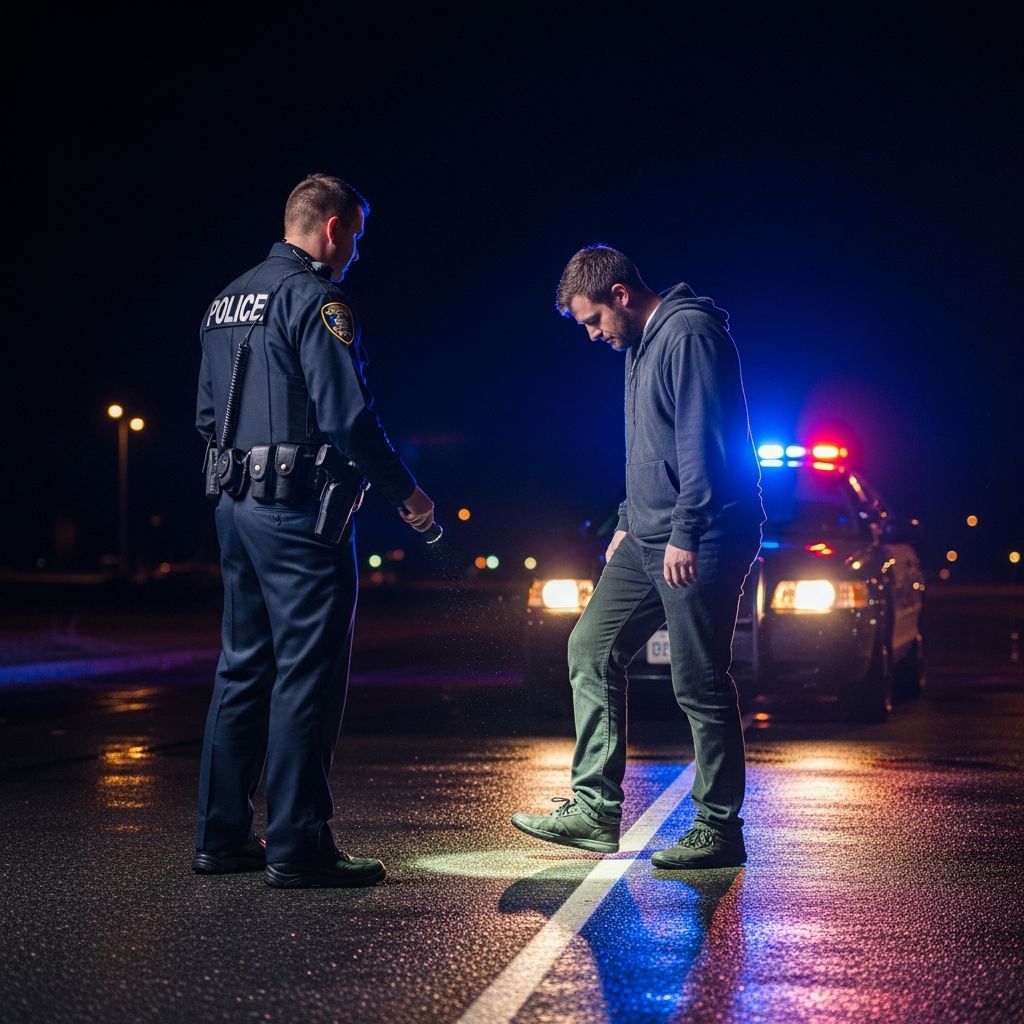
Field sobriety tests are a routine part of many drunk and drug-impaired driving investigations in the United States. Understanding what these roadside exercises are, how they are supposed to be administered, and how the results may be used in court can help you make more informed decisions if you are ever stopped on suspicion of driving under the influence.
This guide explains the major types of field sobriety tests, what officers look for, how accurate these tests are according to government research, and the legal and practical issues surrounding refusal, arrest, and courtroom use.
1. What Are Field Sobriety Tests?
A field sobriety test (FST) is a series of physical and mental tasks that a police officer asks a driver to perform during a traffic stop when the officer suspects impairment from alcohol or drugs. These tasks are designed to measure abilities such as:
- Balance and coordination
- Ability to follow instructions
- Concentration and divided attention
- Eye movements associated with intoxication
The goal is not to diagnose drunkenness scientifically at the roadside, but to help the officer decide whether there is probable cause to arrest and require a more accurate chemical test of breath, blood, or urine.
2. Standardized vs. Non-Standardized Tests
In the United States, there is a critical distinction between standardized field sobriety tests and other, non-standardized roadside exercises.
2.1 Standardized Field Sobriety Testing (SFST)
The National Highway Traffic Safety Administration (NHTSA) developed a three-test battery known as Standardized Field Sobriety Testing. These tests have specific instructions, scoring criteria, and research behind them.
- Horizontal Gaze Nystagmus (HGN)
- Walk-and-Turn (WAT)
- One-Leg Stand (OLS)
Because the procedures are standardized, officers receive formal training on how to administer and interpret them consistently.
2.2 Non-Standardized Field Tests
Officers sometimes use additional, informal tests, such as:
- Reciting the alphabet or numbers
- Counting backward from a specified number
- Finger-to-nose or finger-count exercises
- Simple questions combined with physical tasks
These non-standardized tests do not follow a nationally validated protocol and often rely heavily on the officer’s subjective impressions.
3. The Three Core Standardized Field Sobriety Tests
NHTSA-sponsored research identified three tests as most reliable when used together to help detect drivers with a blood alcohol concentration (BAC) at or above the legal limit.
| Test | Main Ability Tested | Key Features |
|---|---|---|
| Horizontal Gaze Nystagmus (HGN) | Eye movement control | Officer observes involuntary jerking of the eyes as they track a moving object. |
| Walk-and-Turn (WAT) | Divided attention | Nine heel-to-toe steps along a line, a turn, and nine steps back while following instructions. |
| One-Leg Stand (OLS) | Balance and focus | Standing on one leg while counting aloud for a set time period. |
3.1 Horizontal Gaze Nystagmus (HGN)
Horizontal Gaze Nystagmus refers to the involuntary jerking of the eyes as they move side to side. Alcohol can make this jerking more pronounced and cause it to begin at smaller angles from center.
During this test, the officer typically:
- Holds a stimulus (like a pen or small light) in front of the driver’s eyes
- Moves it slowly left and right at a consistent distance
- Watches for smoothness of tracking, eye jerking at maximum deviation, and the angle where jerking begins
Research funded by NHTSA found HGN to be the most accurate of the three standardized tests when properly administered.
3.2 Walk-and-Turn (WAT)
The Walk-and-Turn test is often described as a “divided attention” task because it requires a person to balance, walk a straight line, and follow complex instructions at the same time.
Although the exact script is standardized, the general idea is that the driver must:
- Listen to a detailed set of instructions
- Take a specified number of heel-to-toe steps along a line
- Turn in a particular way
- Take the same number of steps back while counting correctly
The officer looks for specific indicators of impairment, such as stepping off the line, losing balance, starting too soon, or using arms for balance.
3.3 One-Leg Stand (OLS)
The One-Leg Stand also tests divided attention, but focuses more heavily on balance and concentration.
In general terms, the driver is asked to:
- Stand with one foot raised off the ground
- Keep arms at their sides
- Maintain that position for a designated count while following instructions
Indicators the officer may note include swaying, hopping, putting a foot down, or losing track of the count.
4. How Accurate Are These Tests?
Field sobriety tests are not perfect, but they have been studied. NHTSA-funded research reported notable—though not flawless—accuracy rates when the standardized tests are used as intended.
- HGN was found to be correct in predicting BAC over the legal limit in about 77% of cases in one early study.
- Walk-and-Turn showed accuracy of roughly 68% in the same research.
- One-Leg Stand demonstrated about 65% accuracy.
- Using all three together increases overall reliability compared to any one test alone.
It is important to remember that these figures came from controlled conditions with trained officers following the NHTSA protocol closely. In real roadside situations, factors such as traffic, weather, surface conditions, and officer training can reduce accuracy and increase the risk of false positives.
5. Factors That Can Affect Test Performance
Many things unrelated to alcohol or drugs can make a sober person perform poorly on field sobriety tests. Some common examples include:
- Medical conditions affecting balance or eye movement (e.g., inner ear disorders, neurological conditions)
- Musculoskeletal issues or recent injuries that limit mobility
- Age and weight, which can naturally influence balance and coordination
- Uneven or slippery surfaces at the roadside
- Footwear such as high heels, sandals, or work boots
- Fatigue, stress, and anxiety from being stopped by police
Because of these variables, defense attorneys frequently challenge the interpretation of field sobriety test results, arguing that poor performance may not reflect intoxication.
6. Field Sobriety Tests and Legal Standards
Field sobriety tests sit at the intersection of traffic enforcement and constitutional rights. Several legal concepts are commonly involved.
6.1 Reasonable Suspicion and the Traffic Stop
Before an officer can ask you to perform field sobriety tests, there must typically be a legitimate basis for the stop—such as a traffic violation, an equipment issue, or observable driving behavior suggesting impairment.
6.2 Probable Cause to Arrest
If, after the stop, the officer observes signs like odor of alcohol, slurred speech, or confusion, they may ask you to complete field sobriety tests. The officer’s observations during those tests can then contribute to a finding of probable cause to arrest for DUI or DWI.
Courts often consider:
- Driving behavior before the stop
- Physical appearance and demeanor of the driver
- Performance on standardized or non-standardized tests
- Statements made by the driver
6.3 Relationship to Chemical Testing
In most U.S. jurisdictions, once a driver is lawfully arrested for suspected impaired driving, “implied consent” laws require the driver to submit to an evidentiary breath test or, in some cases, a blood test. Refusing the chemical test often carries automatic administrative penalties, such as license suspension, independent of any criminal conviction.
7. Common Questions About Refusal and Rights
State laws differ, so specific answers in your area will depend on local statutes and court decisions. However, several general issues arise frequently.
7.1 Can You Refuse Field Sobriety Tests?
In many jurisdictions, field sobriety tests are considered voluntary roadside assessments rather than mandatory scientific tests. In practice:
- You may have the legal right to decline the standardized tests in some states, though officers are not required to tell you that.
- Refusal can still be treated as a factor that increases the officer’s suspicion and may contribute to a decision to arrest.
- Some states treat refusal of certain preliminary tests (especially breath tests) as a separate offense or grounds for license suspension; this varies by jurisdiction.
Because the law is highly state-specific, it is important to consult an attorney about the rules where you live.
7.2 Do You Have to Answer Questions About Drinking?
Aside from providing identifying information and credentials (like license, registration, and proof of insurance), you generally have a right not to incriminate yourself. Politely declining to answer questions such as “How much have you had to drink?” may limit the evidence that can be used against you later.
7.3 Are You Entitled to a Lawyer at the Roadside?
In most situations, the right to counsel does not attach until you are formally in custody or being interrogated. Routine roadside questioning and testing usually happen before that point, though again, rules can vary by jurisdiction.
8. How Field Sobriety Tests Are Used in Court
If a DUI case proceeds to trial, field sobriety test performance may be presented as evidence of impairment. Typical courtroom uses include:
- Officer testimony describing how the tests were performed and what clues were observed
- Video recordings from dash cameras or body cameras, when available
- Expert witnesses explaining the NHTSA protocols, error rates, and the significance of observed clues
Defense strategies often focus on:
- Questioning whether the officer followed the standardized procedures correctly
- Highlighting environmental or medical factors that could explain poor performance
- Pointing out the test’s known error rates and subjectivity compared to laboratory-style chemical testing
9. Practical Tips If You Face a DUI Investigation
This article is not legal advice, but there are several practical points that many criminal defense attorneys recommend that drivers keep in mind:
- Remain calm and respectful in all interactions with law enforcement.
- Provide required documents and basic identifying information when requested.
- Understand that you are being observed from the moment the officer first sees your vehicle, including how you pull over.
- Remember that your statements can be used as evidence; you can politely decline to answer questions that go beyond identification.
- Promptly consult a qualified attorney if you are arrested or cited for DUI or related offenses.
10. Frequently Asked Questions (FAQs)
Q1: Are field sobriety tests scientifically proven?
NHTSA-sponsored research has validated the three standardized tests to a degree, showing moderate accuracy in predicting elevated BAC levels when performed under ideal conditions and in combination. However, they are not perfect, and their reliability can decrease if protocols are not followed or if outside factors interfere.
Q2: Is the HGN test more important than the others?
Studies have found the HGN test to be the single most accurate of the standardized tests for identifying drivers at or above common legal limits when administered correctly. Nevertheless, officers are generally trained to consider all three tests together rather than relying solely on one.
Q3: Can medical issues make me “fail” even if I am sober?
Yes. Conditions affecting balance, coordination, or eye movement—as well as age, weight, or recent injuries—can lead to poor performance on field sobriety tests unrelated to alcohol or drugs. These issues are often central to defense challenges in DUI cases.
Q4: Are field sobriety tests the same in every state?
The core standardized tests and NHTSA training are used widely across the United States, but state statutes, case law, and local policies differ. Some jurisdictions also recognize or discourage certain non-standardized tests.
Q5: How do field sobriety tests compare to a breath test?
Field sobriety tests rely mainly on officer observation and are designed to show signs of impairment, whereas evidentiary breath tests measure breath alcohol concentration with calibrated instruments. Breath and blood tests are generally viewed as more objective, though they too can be challenged if procedures are not followed properly.
References
- Field sobriety testing — Wikipedia (summary of NHTSA SFST program and test descriptions, citing primary NHTSA materials). 2024-01-29. https://en.wikipedia.org/wiki/Field_sobriety_testing
- field sobriety test | Wex | US Law — Legal Information Institute, Cornell Law School. 2020-06-01. https://www.law.cornell.edu/wex/field_sobriety_test
- Standardized Field Sobriety Testing — Office of Justice Programs, U.S. Department of Justice (Training Key No. 365). 1984-01-01. https://www.ojp.gov/ncjrs/virtual-library/abstracts/standardized-field-sobriety-testing
- Standardized Field Sobriety Testing (SFST) — Participant Manual — National Highway Traffic Safety Administration (NHTSA). 2018-04-01. https://www.nhtsa.gov/sites/nhtsa.dot.gov/files/documents/sfst_ig_refresher_manual.pdf
- Field Sobriety Test Explained: Know the 3 Standardized Tests — DUI.org. 2023-07-15. https://www.dui.org/resources-and-articles/field-sobriety-tests/
Similar Articles








Read full bio of medha deb




