
Understanding FELA and Railroad Injury Claims
A practical guide to railroad worker injury claims under the Federal Employers’ Liability Act and how FELA differs from standard workers’ compensation.
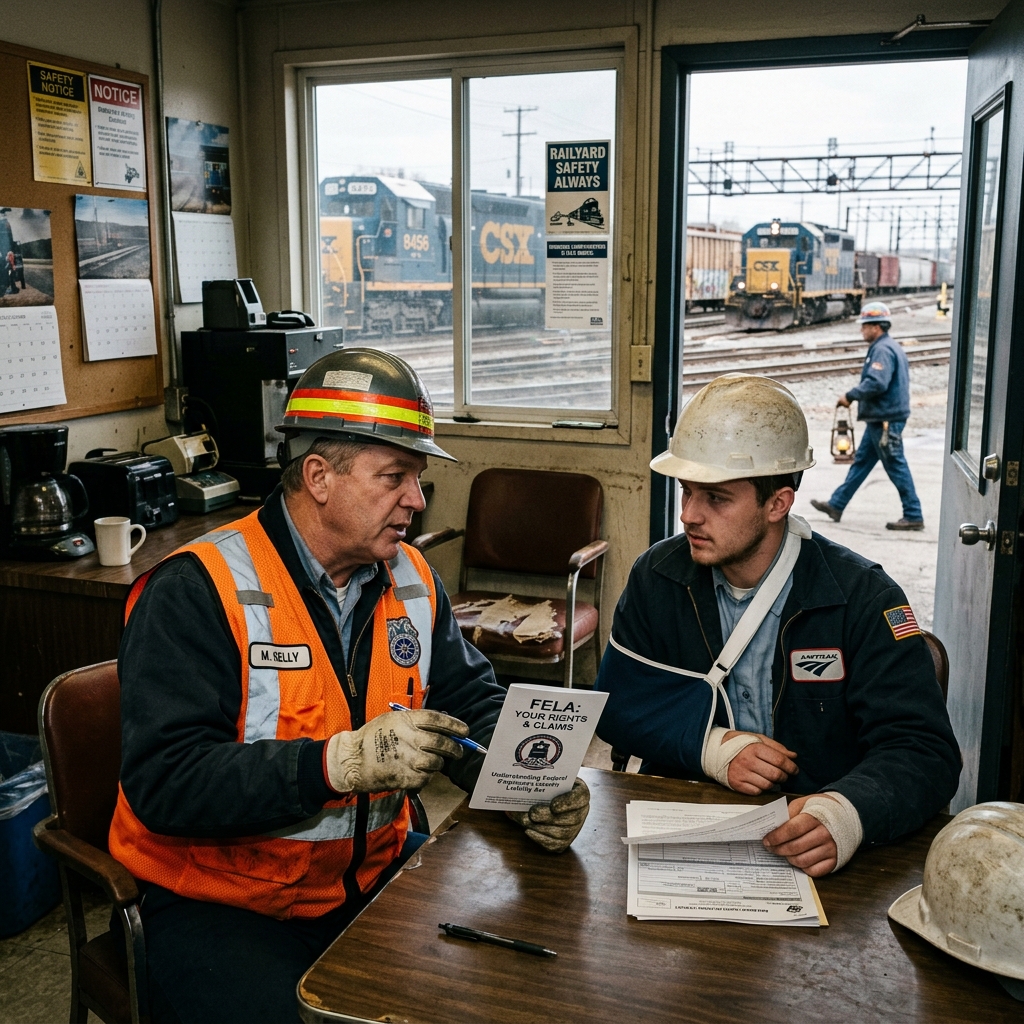
The railroad industry has long been recognized as one of the most hazardous workplaces in the United States. To address the serious risk of injury and death faced by railroad employees, Congress enacted the Federal Employers’ Liability Act (FELA), a specialized law that gives railroad workers the right to pursue compensation directly from their employers when negligence plays a role in an injury or illness.
This article offers a practical, plain‑language guide to FELA. It explains who is covered, how FELA differs from ordinary workers’ compensation, what must be proven to win a claim, the types of damages available, and the key steps workers should take after a railroad accident or occupational exposure.
Why FELA Exists and How It Fits in Workplace Injury Law
FELA was enacted in 1908 in response to extremely high rates of serious injuries and fatalities among railroad workers during the rapid expansion of rail transportation. Unlike most modern workplace injury systems that rely on state workers’ compensation laws, FELA is a federal statute that specifically governs railroad employers and employees.
Under FELA, a railroad employer may be held legally responsible when an employee’s injury or illness results, even in part, from the employer’s negligence or from unsafe conditions on the railroad. This framework reflects a policy choice: because railroad work is inherently dangerous, employers must be held to a meaningful safety standard and may be sued when they fail to meet it.
FELA vs. State Workers’ Compensation: Key Differences
Railroad workers covered by FELA generally do not use standard state workers’ compensation systems to obtain benefits. Instead, FELA provides its own path to recovery with several important differences.
| Feature | FELA (Railroad Workers) | Typical Workers’ Compensation |
|---|---|---|
| Fault requirement | Must prove employer negligence contributed to the injury, even slightly. | No-fault: worker usually does not have to prove negligence. |
| Type of claim | Civil lawsuit in state or federal court, or negotiated settlement. | Administrative claim through a state workers’ compensation agency. |
| Damages available | Broader damages, including pain and suffering and full lost earning capacity. | Generally limited benefits; pain and suffering usually not covered. |
| Burden of proof | Lower than typical negligence suits; often described as a “featherweight” standard. | No negligence proof required, but benefits are capped. |
| Contributory negligence | Worker’s own negligence can reduce but not bar recovery in most cases. | Rules vary by state; some systems consider worker fault, others do not. |
Because FELA is a fault‑based system, successful claims depend heavily on showing some form of wrongdoing or safety failure by the railroad. At the same time, FELA often allows significantly larger and more comprehensive compensation than traditional workers’ compensation.
Who Is Covered by FELA?
FELA does not apply to every worker who happens to be near a train. Coverage is targeted at employees of railroads engaged in interstate commerce—companies that operate across state lines or handle interstate freight.
Basic Eligibility Criteria
- Employment by a qualifying railroad: The worker must be employed by a railroad that operates in interstate commerce or otherwise functions as a common carrier by rail.
- Connection to railroad operations: Duties must relate to railroad operations, such as track maintenance, train operation, yard work, mechanical repairs, signal work, dispatching, or similar functions.
- Injury, illness, or death arising from employment: The worker’s injury or disease must occur in the course of employment and be linked to workplace conditions, accidents, or exposures.
- Employer negligence or unsafe conditions: There must be some evidence that the railroad’s negligence, unsafe practices, or defective equipment contributed to the harm.
FELA claims may arise from sudden traumatic incidents—such as train collisions, derailments, falls, machinery failures—or from long‑term occupational illnesses and cumulative trauma, including repetitive stress injuries and exposure‑related diseases.
Who Is Not Covered?
Not everyone working around railroad property can file under FELA. Exclusions generally include:
- Casual laborers or temporary workers who do not contribute to interstate rail operations.
- Employees of non‑railroad companies working on unrelated tasks, who may fall under regular workers’ compensation instead.
- Individuals harmed as passengers, nearby motorists, or members of the public, who pursue separate personal injury claims rather than FELA claims.
What Must Be Proven in a FELA Claim?
To succeed under FELA, an injured worker must show more than the fact of injury. Several legal elements must be established, although the burden of proof is lower than in many other negligence cases.
Core Legal Elements
- Covered employment and jurisdiction
There must be proof that the employee worked for a railroad engaged in interstate commerce and was acting within the scope of employment at the time of the incident. - Duty of care
Railroads have a legal duty to provide a reasonably safe workplace, maintain equipment and tracks, follow safety regulations, and protect workers from foreseeable hazards. - Breach of duty (negligence)
The worker must demonstrate that the railroad failed to meet its safety obligations—for example, by inadequate training, poor maintenance, ignoring known hazards, or violating safety statutes. - Causation
It must be shown that the railroad’s negligence played some part, however small, in causing the injury or illness. This is often described as a “featherweight” standard because even slight employer fault can justify liability. - Damages
The worker must document the physical, financial, and emotional harms suffered, such as medical expenses, lost wages, and reduced ability to work.
Effect of Worker’s Own Negligence
Under FELA, an employee’s own negligence does not automatically bar recovery. Instead, damages may be reduced in proportion to the worker’s share of fault, a concept known as comparative negligence. Importantly, if the railroad violates certain safety statutes, the worker’s contributory negligence may not be used to reduce or deny the claim.
Types of Compensable Railroad Injuries and Illnesses
FELA is broad enough to cover a wide spectrum of harm arising from railroad work, from catastrophic accidents to slow‑developing occupational diseases.
Traumatic Injuries
- Crush injuries and amputations from equipment or coupling mishaps.
- Head, neck, and back injuries from falls, collisions, derailments, or sudden movements.
- Fractures and soft‑tissue damage caused by slips, trips, or struck‑by incidents in yards and on tracks.
- Burns, electrical injuries, and chemical exposure from industrial accidents.
Cumulative Trauma and Repetitive Stress
- Joint and spine degeneration from years of heavy lifting, vibration, or awkward postures.
- Carpal tunnel and similar conditions from repetitive tasks.
- Hearing loss linked to persistent loud noise on locomotives or in repair shops.
Occupational Diseases
- Respiratory illnesses from prolonged exposure to diesel exhaust, dust, or fumes.
- Certain cancers associated with chemical or asbestos exposure in railroad environments, where negligence played a role in unsafe conditions.
- Chronic illnesses caused by inadequate protective equipment or failure to control known hazards.
What Damages Are Available Under FELA?
Because FELA operates through civil litigation rather than a fixed benefits schedule, the types of damages available can be more extensive than in many workers’ compensation systems.
Economic Losses
- Medical expenses: Hospital bills, surgery costs, doctor visits, rehabilitation, medications, and future medical care reasonably related to the injury or illness.
- Lost wages: Income lost while the worker is unable to perform duties, including overtime and differentials where appropriate.
- Loss of earning capacity: If the injury permanently reduces the worker’s ability to earn income, damages can account for long‑term economic impact.
Non‑Economic Losses
- Pain and suffering: Physical discomfort, limitations, and chronic pain attributable to the injury.
- Emotional distress: Anxiety, depression, post‑traumatic stress, and other psychological harm linked to the accident or illness.
- Loss of enjoyment of life: Reduced ability to participate in hobbies, family activities, and daily routines.
Wrongful Death Damages
When a railroad worker is killed in the course of employment, FELA allows a personal representative to bring a claim on behalf of surviving family members or dependents. Recoverable damages may include lost financial support, funeral costs, and loss of care, guidance, and companionship.
Time Limits and Where FELA Cases Are Filed
FELA claims are subject to a strict statute of limitations. Actions must generally be filed within three years from the date the cause of action accrues—that is, the point when the worker knew or reasonably should have known of the injury and its connection to railroad employment.
Railroad workers may bring FELA lawsuits in either federal or state courts. The statute expressly provides for concurrent jurisdiction, meaning both court systems can hear FELA cases. This flexibility allows strategic choices about where to file, based on venue, applicable procedure, and other practical considerations.
Practical Steps After a Railroad Injury or Exposure
Immediate and careful action after an accident or upon discovering an occupational illness can greatly influence the outcome of a FELA claim.
Essential Actions for Injured Railroad Workers
- Seek medical attention promptly
Your health is the priority. Early treatment helps limit harm and creates a strong medical record documenting the nature and extent of your injuries. - Report the incident
Notify a supervisor or designated manager as soon as possible, following internal reporting procedures. A timely, accurate report helps establish the fact of the accident and your involvement. - Document the scene and conditions
If it is safe to do so, gather information about what happened: photograph hazards or damaged equipment, note lighting and weather, and record any safety violations you observe. - Identify witnesses
Collect names and contact details of coworkers or bystanders who saw the incident or are familiar with the unsafe condition. Witness testimony can be crucial. - Preserve relevant records
Keep copies of medical reports, test results, work schedules, maintenance logs, and any written communications with the railroad or its claim agents. - Be cautious with company statements
Railroad claim representatives may request detailed statements. These can later be used to dispute aspects of your case, so workers often benefit from legal advice before giving extensive statements. - Consult an attorney experienced in FELA
Because FELA combines complex federal law with negligence principles, many workers choose to obtain guidance from lawyers familiar with railroad injury litigation.
Common Questions About FELA and Railroad Worker Claims
Is FELA my only option if I’m hurt working for a railroad?
For most employees of railroads engaged in interstate commerce, FELA is the primary legal framework governing workplace injury claims. Ordinary state workers’ compensation laws generally do not apply to these workers, so FELA becomes the central route to recovery.
Do I have to prove the railroad was completely at fault?
No. Under FELA, you only need to show that the railroad’s negligence contributed in any way to your injury or illness—even a small contribution can be sufficient. However, your damages may be reduced if you also bear some responsibility, unless a safety statute violation prevents such reduction.
What if a contractor caused my injury on railroad property?
Contractors working for the railroad may be considered agents of the railroad for FELA purposes, and hazardous conditions created by contractors can still give rise to FELA claims against the railroad. In some situations, both the contractor and the railroad may face responsibility.
Can FELA cover long‑term illnesses like cancer?
Yes, FELA can apply to occupational diseases if they are linked to railroad employment and employer negligence. For example, some claims involve cancers or respiratory illnesses associated with toxic exposures. Workers must still prove that employment and unsafe conditions contributed to the disease.
How long do I have to file a FELA claim?
Generally, you must file within three years of when your cause of action accrues, which is often when you know or should know both of the injury or illness and its connection to railroad work. Waiting too long can result in losing the right to pursue compensation.
Do I need a lawyer to bring a FELA claim?
FELA does not legally require you to hire an attorney, but many workers choose to do so because the law is complex, the railroad will have its own legal and claims team, and the stakes can be substantial. Experienced FELA counsel can help gather evidence, negotiate with claim agents, and litigate if necessary.
References
- Federal Employers’ Liability Act: Introduction — Villanova University Charles Widger School of Law Library. 2006-01-01. https://libguides.law.villanova.edu/FELA
- Railroad Worker Injuries & Related Lawsuits — Justia. 2024-01-01 (approx.). https://www.justia.com/injury/workplace-accidents/railroad-worker-injuries/
- Who Qualifies to File a Claim Under FELA? — Environmental Litigation Group, P.C. 2023-01-01 (approx.). https://www.elglaw.com/faq/who-qualifies-to-file-a-claim-under-fela/
- What Are FELA Claims and How Do They Protect Railroad Workers? — Sarphie Law. 2023-06-01 (approx.). https://sarphielaw.com/what-are-fela-claims-and-how-do-they-protect-railroad-workers/
- FELA Railroad Worker Injuries — Phillips Law Group. 2022-05-01 (approx.). https://phillipslaw.com/fela-railroad-workers/
- A Contractor For My Railroad Caused My Injury – Does FELA Still Apply? — Rovencamp Law. 2021-09-01 (approx.). https://rovencamp.com/blog/a-contractor-for-my-railroad-caused-my-injury-does-fela-still-apply/
Similar Articles








Read full bio of Sneha Tete




