
Understanding the Federal Victim Notification System
A practical guide to the U.S. Department of Justice’s Victim Notification System and how it helps federal crime victims stay informed and exercise their rights.
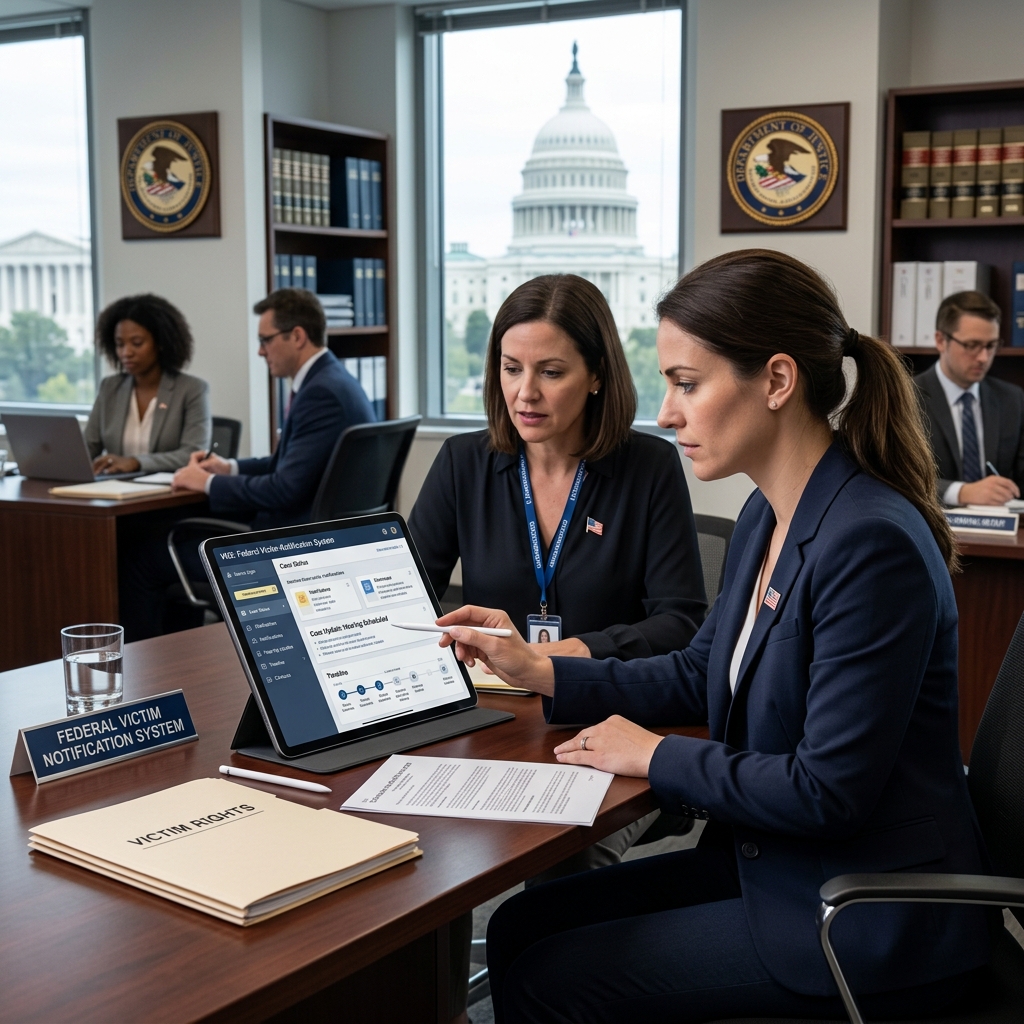
The Victim Notification System (VNS) operated by the U.S. Department of Justice is a free, automated service that keeps victims of federal crimes informed about important developments in their cases and the status of offenders. While the criminal justice process can be complex and difficult to follow, VNS is designed to give victims timely, accurate information so they can understand what is happening and make informed decisions.
Why Victim Notification Matters
Victims of crime often face uncertainty and anxiety as they wait for information about investigations, court hearings, and the offender’s custody status. Federal law recognizes that victims have a right to be told about what is happening in their cases and to receive information without having to constantly contact prosecutors or law enforcement.
Notification systems like VNS serve several important purposes:
- Respecting victims’ rights under federal law, including the Crime Victims’ Rights Act and the Victims’ Rights and Restitution Act.
- Reducing uncertainty by providing clear, reliable updates on case progress and offender status.
- Improving safety and planning by notifying victims about key events such as release, escape, or transfer of an offender.
- Supporting participation in the justice process, including opportunities to attend hearings or submit victim impact statements.
What the Federal Victim Notification System Is
The federal Victim Notification System is a computer-based, automated notification service used in many federal criminal cases accepted for prosecution by the Department of Justice. It is available at no cost to eligible victims and operates in both English and Spanish.
VNS is a cooperative effort among several federal agencies, including:
- U.S. Department of Justice Criminal Division
- Federal Bureau of Investigation (FBI)
- U.S. Postal Inspection Service
- U.S. Attorney’s Offices
- Federal Bureau of Prisons (BOP)
By linking information from these agencies, VNS can provide a more complete picture of the progress of a case and the status of federal defendants and offenders.
Key Features and Types of Information Provided
VNS focuses on giving victims concise, case-specific information that is most important to their rights and safety. Typical notifications include:
- Court event schedules, such as arraignments, plea hearings, trials, sentencings, and appeals.
- Outcomes of court proceedings, including verdicts, sentencing decisions, and significant rulings.
- Custody status of the offender, such as incarceration, transfer, release, or escape from federal custody.
- Registration and access details, including how to use the online portal and telephone system.
Although specific notifications can vary by case, the overall goal is to ensure victims know when major events are occurring and what the results are.
How Victims Access VNS
Victims do not need to build the system themselves; it is set up and managed by federal agencies. However, they do need credentials to access individualized information. Access typically involves two steps:
- Receiving a Victim Identification Number (VIN or Victim ID#) and a Personal Identification Number (PIN) by mail or through official communication.
- Using those credentials to log in via phone or the internet.
Once victims have their ID and PIN, they can use two main access routes:
- VNS Call Center (toll-free): 1-866-365-4968 (1-866-DOJ-4YOU).
- VNS Internet site: an official Department of Justice website that allows secure access to case information and notification preferences.
Telephone Access
The toll-free VNS Call Center provides automated information 24 hours a day, seven days a week. By entering their VIN and PIN, victims can:
- Hear current information about upcoming court events.
- Check on an offender’s custody status.
- Change certain notification preferences or request help.
For many victims, phone access is especially useful if they do not have regular internet service or prefer speaking directly to an automated system.
Online Access
The VNS Internet site offers more detailed and flexible access to case information. To use it, victims generally:
- Visit the official VNS website operated by the Department of Justice.
- Enter their VIN and PIN to begin registration.
- Create a new password, which replaces the PIN for future web logins.
- Verify or add an email address to receive electronic updates.
Once registered, victims can log in with their VIN and password to view case information, confirm contact details, and manage how they receive notifications.
VNS and Victims’ Legal Rights
VNS exists partly because federal law requires that certain information be provided to victims of federal crimes. The Department of Justice developed VNS to help meet these obligations in a consistent and efficient way.
Two key laws are particularly relevant:
- Crime Victims’ Rights Act (CVRA) – Recognizes victims’ rights to be reasonably informed of public court proceedings, to be heard at certain hearings, and to be treated with fairness and respect.
- Victims’ Rights and Restitution Act – Requires federal agencies to use best efforts to inform victims of services and case events and to provide information about restitution.
VNS is one tool that helps federal agencies meet these requirements by systematizing notifications and making it easier to keep victims updated as cases move through investigation, prosecution, sentencing, and corrections.
What VNS Does Not Do
Although VNS is a powerful tool, it has limits. It does not replace legal advice, direct communication with prosecutors, or emergency services. In general, victims should understand that VNS:
- Does not provide legal representation or advice; it only provides information.
- Does not cover every type of case; it focuses on federal criminal matters accepted by the Department of Justice.
- Does not control case decisions; judges and prosecutors make decisions independently of VNS.
- Does not replace state or local notification systems; victims of state crimes may need to use state systems, such as VINE or other state-specific programs.
Comparison: Federal VNS vs. Typical State Systems
Many states operate their own victim notification programs, some of which are similar to VNS but run under state authority rather than federal agencies. The table below shows some general differences.
| Feature | Federal VNS | Typical State Systems |
|---|---|---|
| Scope of cases | Federal crimes prosecuted by the Department of Justice. | State and local offenses, often focused on prison or jail custody. |
| Operating agencies | DOJ, FBI, U.S. Attorneys, BOP, Postal Inspection Service. | State departments of corrections, attorneys general, or contracted vendors. |
| Access methods | Call Center and DOJ website requiring VIN and PIN. | State websites, toll-free numbers, and sometimes text messages or email. |
| Languages | English and Spanish. | Commonly English and Spanish; varies by state. |
| Primary focus | Both court events and offender custody in federal cases. | Often emphasizes custody and release information for state offenders. |
Managing Notification Preferences and Opting Out
Victims may wish to continue receiving notifications throughout the case, but some may decide they no longer want updates. VNS allows victims to change their preferences or stop notifications altogether.
Typical ways to manage notifications include:
- Using the VNS website to select options for email notifications or to stop receiving messages.
- Calling the VNS Call Center, entering VIN and PIN, and selecting an “opt out” option.
- Contacting the agency representative whose contact information appears on prior notices.
Opting out does not affect the underlying case, but it does mean the victim will not receive further automated updates through VNS unless they re-register.
Security, Privacy, and Accuracy
Because VNS contains sensitive information about crime victims and criminal cases, security and privacy are essential. The system uses unique identification numbers and passwords to limit access to authorized users.
Victims can help protect themselves by:
- Keeping their VIN, PIN, and password confidential.
- Using the official VNS website published by the Department of Justice.
- Contacting the agency listed on their letters or notices if they have concerns or questions.
In addition, victims should be cautious of unsolicited communications that ask for money or personal financial information; official victim notification systems do not charge fees to access basic information.
Frequently Asked Questions (FAQs)
Who is eligible to use the federal Victim Notification System?
VNS is intended for victims of federal crimes in cases that have been accepted for prosecution by federal authorities, as well as certain family members and victim representatives when appropriate. Not all cases are included, but where possible, federal agencies make victim information available through VNS.
Does VNS cost anything to use?
No. VNS is a free service provided by the Department of Justice and cooperating agencies. There is no charge to call the toll-free number or access the official website.
What kind of information will I receive?
Victims can expect notices about major court events (such as trials and sentencings), important decisions, and changes in the offender’s custody status, including release or transfer. The exact content depends on the case and the stage of the proceedings.
How do I log in if I lost my PIN or Victim ID?
If a victim no longer has their PIN or ID, they should contact the agency representative listed on their most recent letter or notification, or reach out through the VNS Call Center to request assistance. For security reasons, replacement credentials must be handled through official channels.
Can I get help in a language other than English?
VNS information is available in English and Spanish, and the call center can assist victims using those languages. Some state notification systems and related services also provide support in multiple languages.
Is VNS the same as state systems like VINE?
No. VNS is a federal system focused on federal criminal cases and offenders, whereas programs such as VINE or state-specific systems like Texas IVSS or Alabama’s victim notification tools are operated by state entities and cover state and local offenders.
Do I have to participate in VNS?
No. Victims can decide whether to register, continue receiving notifications, or opt out. If they choose to stop, they can use the website, call center, or agency contact listed on their notices to change their preferences.
Practical Tips for Victims Using VNS
For victims who are newly introduced to the system, the following practical steps can make the experience smoother:
- Keep all letters and emails that mention VNS, as they contain your identification numbers and contact information.
- Register online if possible, so you can verify your email address and set a secure password.
- Update your contact details whenever you move or change phone numbers or email accounts.
- Use both phone and web access if you want flexibility in how you check your case status.
- Ask questions of the agency representative if you are unsure about any notice or need more explanation.
References
- Victim Notification System – Criminal Division — U.S. Department of Justice. 2023-10-12. https://www.justice.gov/criminal/criminal-vns/victim-notification-system
- Victim Notification Program – Criminal Division — U.S. Department of Justice. 2023-10-12. https://www.justice.gov/criminal/criminal-vns
- Victim Notification System — U.S. Department of Justice Notify Portal. 2023-08-01. https://www.notify.usdoj.gov/
- Victim Notification — Office for Victims of Crime, U.S. Department of Justice. 2022-06-15. https://ovc.ojp.gov/help-for-victims/victim-notification
- Victim Notification for Crime Victims — Office of the Attorney General of Texas. 2025-09-01. https://www.texasattorneygeneral.gov/crime-victims/victim-notification-crime-victims
- Victim Services Division – Request Victim Notification — Texas Department of Criminal Justice. 2024-03-10. https://www.tdcj.texas.gov/divisions/vs/request_victim_notification.html
- Alabama Victim Notification System — Alabama Attorney General and Alabama Law Enforcement Agency. 2023-05-20. https://victims.alabama.gov/
Similar Articles








Read full bio of medha deb




