
Understanding the Federal Rules of Evidence
Learn how the Federal Rules of Evidence shape what juries can hear, how judges decide admissibility, and why these rules matter in every trial.
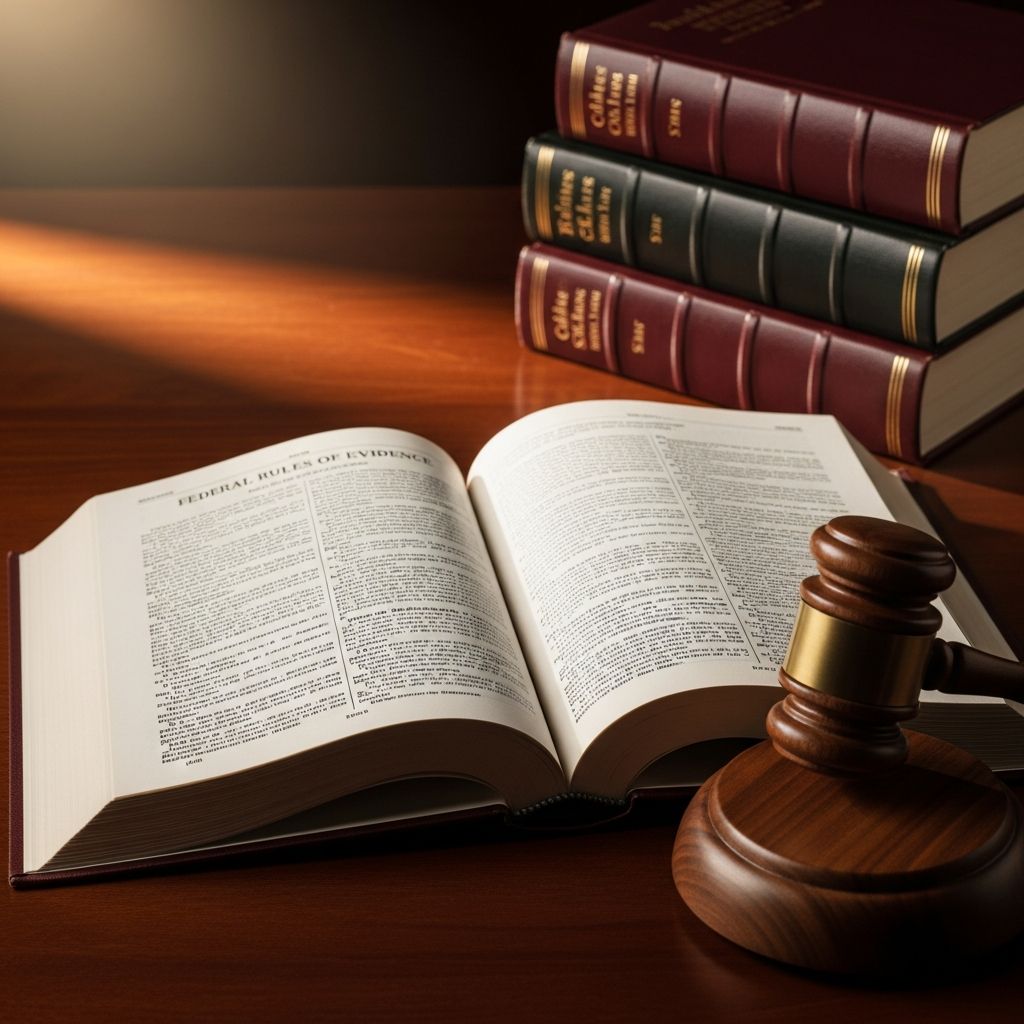
The Federal Rules of Evidence (FRE) are the backbone of trial practice in United States federal courts. They govern what information may be presented to a judge or jury, how that information must be introduced, and when otherwise relevant material still must be kept out of a case. Knowing these rules is essential for lawyers, litigants, and anyone trying to understand how trials really work.
1. What Are the Federal Rules of Evidence?
The Federal Rules of Evidence are a comprehensive set of rules that control the admission, exclusion, and use of evidence in most proceedings in U.S. federal courts. Congress enacted them in 1975 after the Supreme Court drafted a proposed version and submitted it under the Rules Enabling Act. They have since been amended numerous times to reflect new legal developments, advances in science and technology, and evolving trial practice, most recently in 2024.
These rules apply in both civil and criminal trials in federal court, unless a specific statute or rule provides otherwise. Many states have adopted evidence codes that closely resemble the FRE, so their influence extends well beyond the federal system.
1.1 Goals and Guiding Principles
Although the FRE are highly detailed, they are built around a few central ideas:
- Fairness – Trials must be conducted in a way that treats both sides justly and respects the rights of the accused in criminal cases.
- Truth-seeking – Evidence rules aim to help fact finders (usually juries) reach accurate conclusions based on reliable information.
- Efficiency – Courts must avoid needless delay, confusion, and repetition so that proceedings remain manageable.
- Consistency – Uniform rules across federal courts reduce unpredictability and arbitrary differences among courts.
Rule 102 of the FRE instructs courts to interpret the rules to “administer every proceeding fairly” and to help ascertain the truth while securing a just determination.
2. How the FRE Are Organized
The Federal Rules of Evidence are divided into 11 articles, each covering a distinct aspect of evidence law.
| Article | Main Subject | Key Focus |
|---|---|---|
| I | General Provisions | Purpose, scope, how courts handle evidentiary rulings |
| II | Judicial Notice | When courts accept facts as true without formal proof |
| III | Presumptions in Civil Cases | Effect of presumptions on burdens of proof |
| IV | Relevance and Its Limits | What evidence matters to the issues in dispute |
| V | Privileges | Protected relationships such as attorney–client |
| VI | Witnesses | Competency, oaths, and how witnesses testify |
| VII | Opinions & Expert Testimony | When lay and expert opinions are allowed |
| VIII | Hearsay | Out-of-court statements and their exceptions |
| IX | Authentication & Identification | Proof that evidence is what it claims to be |
| X | Contents of Writings, Recordings & Photographs | “Best evidence” rules and duplicates |
| XI | Miscellaneous Rules | Remaining provisions, including amendments |
3. Relevance: The First Gatekeeper
Nearly every evidentiary question begins with a basic inquiry: Is the evidence relevant? Under Rule 401, evidence is relevant if it has any tendency to make a fact of consequence more or less probable than it would be without the evidence.
3.1 When Relevant Evidence Is Still Excluded
Even when evidence is relevant, it may be excluded under Rule 403 if its probative value (its strength in proving something important) is substantially outweighed by dangers such as:
- Unfair prejudice
- Confusing the issues
- Misleading the jury
- Undue delay or wasting time
- Needlessly cumulative proof
This balancing test gives judges substantial discretion to shape what a jury hears so that trials remain fair and focused.
4. Privileges: When Relevant Evidence Is Protected
Some relationships are so important that the law protects certain communications from being revealed in court. Article V acknowledges that privileges exist but does not codify every privilege in detail, instead leaving much of the doctrine to federal common law.
Commonly recognized privileges in federal practice include:
- Attorney–client privilege – Protects confidential legal communications between a client and lawyer.
- Spousal privileges – In some circumstances, spouses may refuse to testify against each other or disclose confidential marital communications.
- Psychotherapist–patient privilege – Recognized by the Supreme Court in Jaffee v. Redmond, protecting confidential therapy communications.
Because privileges restrict access to potentially important evidence, courts often interpret them narrowly, applying them only when their elements are clearly satisfied.
5. Witnesses: Who Can Testify and How
Article VI governs witnesses. In modern practice, almost everyone is competent to testify so long as they can understand the obligation to be truthful and can communicate what they perceive. Most witnesses must testify under oath or affirmation, promising to tell the truth.
5.1 Lay Witnesses vs. Expert Witnesses
- Lay witnesses testify about what they have personally seen, heard, or otherwise perceived. They generally may not offer opinions, except in limited areas where a lay opinion might help the jury (for example, describing someone as “angry” based on appearance and tone).
- Expert witnesses are allowed under Rule 702 to give opinions when their specialized knowledge will help the jury understand the evidence or determine a fact in issue.
Expert testimony must be based on sufficient facts or data and reliable methods. Landmark decisions such as Daubert v. Merrell Dow Pharmaceuticals interpreted Rule 702 to require judges to act as “gatekeepers” for scientific and technical evidence, ensuring it is relevant and reliable before it reaches the jury.
6. Hearsay: Out-of-Court Statements
Hearsay is one of the most important and misunderstood concepts in evidence law. Under Article VIII, hearsay is usually defined as:
- An out-of-court statement
- Offered to prove the truth of what the statement asserts
As a rule, hearsay is inadmissible unless an exception or exclusion applies.
6.1 Why Hearsay Is Generally Barred
The hearsay rule exists because statements made outside of court lack the procedural safeguards of live testimony—such as cross-examination and observation of the speaker’s demeanor—making them less reliable. Allowing unlimited hearsay would risk unfairness and inaccuracy.
6.2 Major Hearsay Exclusions and Exceptions
Not every out-of-court statement that appears hearsay is treated as such. The FRE identify certain categories that are treated as non-hearsay (such as some prior statements by a witness and opposing party statements), and numerous exceptions where hearsay is admissible if other reliability factors are present.
Common exceptions include:
- Present sense impressions – Statements describing an event while the declarant is perceiving it.
- Excited utterances – Statements relating to a startling event made while under the stress of excitement caused by the event.
- Statements for medical diagnosis or treatment – Statements made for purposes of obtaining medical care, describing symptoms or causes important to diagnosis or treatment.
- Business records – Regularly kept records of a business, made near the time of the events they describe, under certain conditions.
In criminal cases, hearsay issues often intersect with the Constitution’s Confrontation Clause, which guarantees an accused the right to confront witnesses against them. That constitutional layer can bar some hearsay even when a rule-based exception might otherwise apply.
7. Authentication and the “Best Evidence” Concept
Before evidence is admitted, the proponent must show that it is what they claim it is. Article IX covers authentication—the process of providing sufficient proof that a document, recording, or object is genuine.
Article X then deals with the contents of writings, recordings, and photographs. Often called the “best evidence rule,” these provisions generally require the original document—or a reliable duplicate—when the content of the writing itself is at issue, subject to several practical exceptions.
8. The Role of Judges Under the FRE
Judges are central to the operation of the Federal Rules of Evidence. They decide preliminary questions about whether evidence is admissible, whether a witness is qualified, and what the jury may consider.
Key judicial responsibilities include:
- Applying the Rule 403 balancing test to exclude unfairly prejudicial or confusing evidence.
- Serving as gatekeepers for expert testimony under Rule 702.
- Ruling on objections raised by counsel (for example, “objection, hearsay”).
- Giving limiting instructions when evidence is admitted for one purpose but not another (e.g., allowed to show motive but not propensity).
Because evidentiary rulings often involve judgment calls, appellate courts usually review them under a deferential “abuse of discretion” standard, meaning trial judges have wide latitude as long as they stay within the framework of the FRE.
9. Why the Federal Rules of Evidence Matter
The FRE do more than regulate courtroom formalities. They influence:
- Case strategy – Lawyers design their investigations and trial plans around what evidence they expect to admit or face.
- Plea bargaining and settlements – Parties negotiate based on the strength of admissible evidence, not simply all information they possess.
- Public confidence – Transparent, uniform rules help assure the public that verdicts are based on reliable, fairly tested information.
- Development of the law – As courts interpret and apply the FRE, they shape broader doctrines in criminal procedure, civil litigation, and constitutional law.
10. Frequently Asked Questions (FAQs)
Q1: Do the Federal Rules of Evidence apply in every federal case?
In general, yes. The FRE apply in most civil and criminal proceedings in U.S. federal courts, with limited exceptions where specific statutes, other rules, or constitutional requirements control instead.
Q2: Are state courts required to follow the FRE?
No. Each state has its own rules of evidence, though many states have adopted codes modeled closely on the FRE. As a result, federal and state evidence rules are often similar, but important differences may exist from one state to another.
Q3: Can a judge let in evidence that is technically hearsay?
Yes, when a recognized exception or exclusion applies, or when the rules classify a particular statement as non-hearsay. Judges must still consider constitutional constraints, especially in criminal prosecutions.
Q4: How often are the Federal Rules of Evidence updated?
The FRE are amended periodically, not on a fixed schedule. The Rules Enabling Act process involves advisory committees, public comment, Supreme Court review, and congressional oversight. As of the latest official publication, the rules have been updated through 2024.
Q5: Where can I read the current text of the FRE?
The official, current version of the Federal Rules of Evidence is available from the Administrative Office of the U.S. Courts and is also reproduced by reputable legal resources, including educational institutions and legal information institutes.
References
- Federal Rules of Evidence — Administrative Office of the U.S. Courts. 2024-12-01. https://www.uscourts.gov/forms-rules/current-rules-practice-procedure/federal-rules-evidence
- Federal Rules of Evidence (current text, including Rule 102 and others) — Administrative Office of the U.S. Courts. 2024-12-01. https://www.uscourts.gov/sites/default/files/2025-02/federal-rules-of-evidence-dec-1-2024_0.pdf
- Federal Rules of Evidence (overview and history) — Federal Judicial Center. 2016-01-01. https://www.fjc.gov/history/work-courts/rules-federal-rules-evidence
- Federal Rules of Evidence — Legal Information Institute, Cornell Law School. 2024-01-01. https://www.law.cornell.edu/rules/fre
- Federal Rules of Evidence: Role of Judges in the Evidentiary Process — National Judicial College (Prof. Penny White). 2018-05-01. https://www.judges.org/news-and-info/judicial-news-judicial-edge-federal-rules-of-evidence/
- Federal Rules of Evidence (FRE) | Research Starter — EBSCOhost Research Starters. 2017-01-01. https://www.ebsco.com/research-starters/law/federal-rules-evidence-fre
Similar Articles








Read full bio of Sneha Tete


