
Understanding the Federal Black Lung Benefits Program
A practical guide to federal black lung benefits, eligibility, compensation rules, and how coal miners and their families can file and protect their rights.
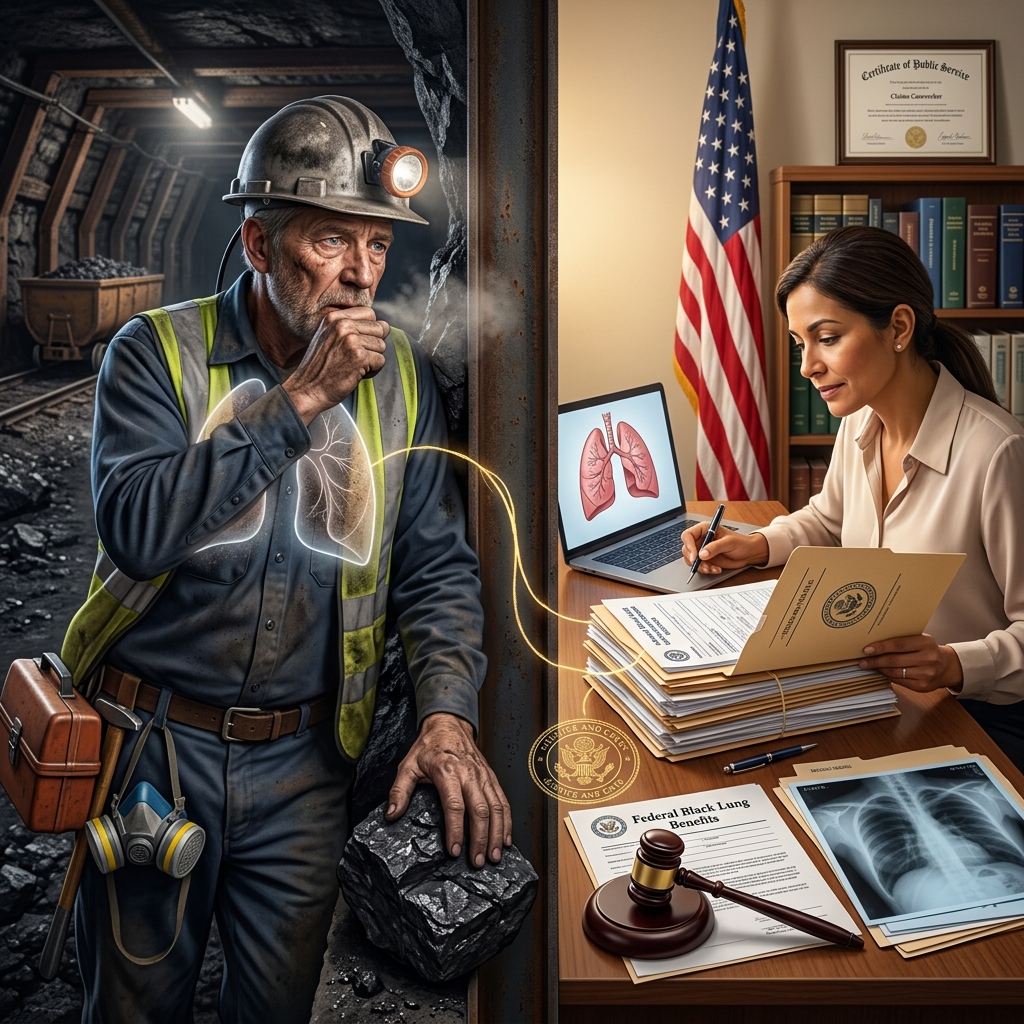
The Black Lung Benefits Program is a federal system that provides monthly payments and medical coverage to coal miners who are totally disabled due to coal workers’ pneumoconiosis, commonly called black lung disease, and to certain surviving family members of miners who died because of the disease.
This guide explains how the program works, who qualifies, what benefits are available, and how the claims and appeals process typically unfolds. It is designed for coal miners, former miners, and their families who want a clear, practical explanation of their rights under federal law.
1. What Is Black Lung Disease and Why Is There a Federal Program?
Black lung disease, or coal workers’ pneumoconiosis, is a chronic lung condition caused by long-term inhalation of coal dust, usually over many years of coal mine employment. The dust particles become embedded in the lungs, causing inflammation, scarring, and reduced lung function.
Common symptoms include:
- Shortness of breath, especially during physical activity
- Chronic cough or persistent “coal miner’s cough”
- Chest pain or tightness
- Fatigue and reduced ability to perform physical work
Because black lung is caused by coal mine employment and can permanently disable miners, Congress created a national compensation program in the Federal Coal Mine Health and Safety Act of 1969, later strengthened by the Black Lung Benefits Act of 1972. The purpose is to provide:
- Monthly income for miners who can no longer work due to black lung
- Medical treatment for lung conditions related to pneumoconiosis
- Survivor benefits for certain family members when a miner dies from the disease
2. Who Administers the Black Lung Benefits Program?
The program is administered by the Division of Coal Mine Workers’ Compensation (DCMWC), part of the Office of Workers’ Compensation Programs within the U.S. Department of Labor. This division:
- Receives and processes claims
- Arranges medical evaluations for miners who file claims
- Determines whether a miner has black lung and is totally disabled by it
- Identifies which coal mine operator is responsible for paying benefits, when applicable
- Pays benefits from the Black Lung Disability Trust Fund if no responsible operator can be assigned
3. Who Is Eligible for Black Lung Benefits?
3.1 Eligible miners
In general, a miner may qualify for federal black lung benefits if all of the following are true:
- The miner worked in coal mine employment (underground or surface) for a sufficient period of time.
- The miner has coal workers’ pneumoconiosis or a related dust disease of the lungs.
- The disease arose at least in part out of coal mine employment.
- The miner is totally disabled because of that lung disease.
“Total disability” in this context means that the miner is unable to perform his or her usual coal mine work and cannot do comparable gainful work, considering age, education, and work history, because of respiratory impairment.
3.2 Eligible survivors
Surviving family members may also qualify for benefits if the miner died due to black lung disease or if the law otherwise provides derivative entitlement. Eligible survivors can include:
- Surviving spouse
- Surviving divorced spouse (in specific circumstances)
- Certain dependent children and full orphans
- In some cases, dependent parents, brothers, and sisters of a deceased miner
Survivors generally must show that pneumoconiosis caused, contributed to, or hastened the miner’s death, unless they qualify under special statutory presumptions or derivative entitlement rules.
4. Types of Benefits: Income and Medical Coverage
4.1 Monthly benefit payments
The program pays monthly cash benefits to eligible miners and survivors. The base rate is tied by law to the federal salary schedule for grade GS-2, step 1, and equals 37.5% of that salary. The monthly amount is then adjusted depending on the number of qualifying dependents.
| Eligible person / family | Benefit basis | Example monthly rate (2016) |
|---|---|---|
| Miner or widow(er) alone | 100% of basic benefit | $644.00 |
| Miner or widow(er) + 1 dependent | 150% of basic benefit | $966.00 |
| Miner or widow(er) + 2 dependents | 175% of basic benefit | $1,127.00 |
| Miner or widow(er) + 3+ dependents | 200% of basic benefit | $1,289.00 |
Because the benefit is tied to federal pay scales, it is periodically adjusted. For example, a Congressional Research Service report indicates that in 2023 the monthly benefit for a miner with no dependents was about $737.90, and up to about $1,475.80 for a miner with three or more dependents.
Important features of the monthly benefit include:
- Non-taxable income: Payments under the Black Lung Benefits Act are generally not considered taxable income.
- Offset rules: If a miner or surviving spouse is receiving state workers’ compensation, unemployment, or disability insurance related to coal mine employment, federal black lung benefits may be reduced by those amounts.
- Dependents’ supplements: Additional amounts are payable based on the number of qualifying dependents.
4.2 Medical benefits for miners
In addition to cash payments, eligible miners are entitled to medical benefits for treatment of their black lung-related lung disease. Covered services generally include:
- Physician services for respiratory conditions caused by pneumoconiosis
- Hospital and outpatient care related to the lung disease
- Prescription medications
- Diagnostic testing such as chest X-rays, pulmonary function studies, and blood gas studies
- Durable medical equipment such as oxygen equipment where medically necessary
- Rehabilitation and nursing services for the respiratory condition
Medical benefits are usually paid directly by the responsible coal mine operator or by the Black Lung Disability Trust Fund, so the miner should not have to pay out of pocket for approved services related to the compensable lung disease.
5. How to File a Federal Black Lung Claim
5.1 Getting started with the claim
To access benefits, a miner or survivor must file a claim with the nearest district office of the Division of Coal Mine Workers’ Compensation. According to the U.S. Department of Labor:
- The claimant completes a claim form and an employment history form describing coal mine work.
- The forms are submitted to the district director’s office serving the area where the claimant lives.
There is no filing fee. Miners are encouraged to apply as soon as they suspect disabling black lung, because benefits begin no earlier than a date determined during the adjudication process.
5.2 Medical evaluation and evidence gathering
After a claim is filed, the district director will usually arrange for a complete pulmonary evaluation, at no cost to the miner. This typically involves:
- A physical examination by a qualified physician
- Chest X-rays to detect evidence of pneumoconiosis
- Pulmonary function testing (spirometry) to measure breathing capacity
- Arterial blood gas studies to assess gas exchange in the lungs
At the same time, the district director gathers evidence such as:
- Medical records and hospital reports
- Employment and wage records to verify coal mine work
- Any prior workers’ compensation or disability decisions
5.3 Proposed decision and responsible operator
The district director reviews all the evidence and then issues a proposed decision and order, which may award or deny benefits. This decision also identifies which coal mine operator, if any, is responsible for paying the benefits. If no suitable operator can be assigned, the claim may be paid from the federal Black Lung Disability Trust Fund.
Both the claimant and any identified responsible operator receive the proposed decision and have the right to challenge it.
6. Hearings and Appeals
6.1 Requesting a hearing
If any party disagrees with the district director’s proposed decision, that party may request a formal hearing before an Administrative Law Judge (ALJ) within the Department of Labor. The request must usually be made within 30 days of the proposed decision.
Once a hearing is requested:
- The claim is transferred to the Office of Administrative Law Judges.
- The ALJ issues a scheduling order describing deadlines and what evidence can be submitted.
6.2 The hearing process
The hearing resembles a small, focused trial. Key features include:
- The miner or survivor often testifies about work history, symptoms, and limitations.
- Each side may submit medical reports and expert opinions.
- The ALJ reviews medical test results, employment history, and other legal issues.
- The hearing typically lasts about an hour, though complex cases can take longer.
After the record is closed, the ALJ issues a written decision awarding or denying benefits, including findings about the existence of pneumoconiosis, its cause, and the level of disability.
6.3 Further appeals
Parties who disagree with the ALJ’s decision may appeal to the Benefits Review Board, and from there to the appropriate U.S. Court of Appeals. Each level reviews the prior decision for legal and factual errors under standards set by federal law.
7. Role of Attorneys and Representatives
Claimants have the right to represent themselves, but the Department of Labor recommends that miners or survivors obtain an attorney experienced in black lung cases if the claim goes to a hearing before an ALJ.
Important points about representation:
- Attorneys’ fees in successful claimant cases often must be approved and may be paid by the responsible operator or the Trust Fund, not directly by the miner, depending on the outcome and applicable rules.
- Non-attorney representatives, such as accredited lay advocates familiar with black lung cases, may also assist in some situations.
8. Interaction with Other Benefits
Black lung benefits can interact with other federal and state programs. Key interactions include:
- Workers’ compensation and state disability: If a miner or widow is receiving state workers’ compensation, unemployment compensation, or disability insurance payments related to coal mine work, federal black lung benefits are generally reduced by the amount of those payments.
- Social Security benefits: Black lung benefits are separate from Social Security Disability Insurance (SSDI) and retirement benefits. A miner can receive both, but each program has its own eligibility rules.
- Tax status: Black lung benefit payments are not typically counted as taxable income under federal law.
9. Common Challenges for Miners and Their Families
Despite the program’s purpose, miners may experience obstacles when seeking benefits. Government reviews and testimony have highlighted issues such as:
- Difficulty proving disease and causation: Complex medical evidence is required to show that the miner has pneumoconiosis and that it is related to coal mine employment.
- Disputes over disability level: Operators may argue that lung impairment is not severe enough to constitute total disability or that it is attributable to smoking rather than coal dust.
- Lengthy adjudication times: Some claims take years to resolve, especially when appeals and multiple medical evaluations are involved.
- Limited access to expert medical opinions: Miners in rural areas may have fewer specialists who understand black lung disease.
In response to these concerns, Congress and federal agencies have periodically updated the law and proposed reforms aimed at improving access to benefits, strengthening medical evidence standards, and stabilizing the Black Lung Disability Trust Fund.
10. Practical Tips for Potential Claimants
Coal miners and families considering a claim should keep several practical points in mind:
- Document work history: Keep records of coal mine employers, job titles, dates of employment, and types of work performed.
- Seek medical evaluation early: If you notice breathing problems, talk to a doctor and mention your coal mining history; early diagnosis can support your claim and protect your health.
- Maintain copies of all medical records: Hospital reports, test results, and treatment notes can be crucial evidence.
- Respond promptly to correspondence: Deadlines for appeals and evidence submission are strict; missing them can delay or jeopardize your claim.
- Consider legal assistance: An attorney experienced with black lung claims can help navigate complex evidentiary rules and appeals.
11. Frequently Asked Questions (FAQs)
Q1: Do I have to be retired to apply for black lung benefits?
No. A miner does not have to be retired, but must be totally disabled by black lung disease to qualify for disability benefits. Some miners apply while still working if their respiratory impairment has become severe.
Q2: Can surface miners qualify, or is this only for underground miners?
Both underground and surface coal miners can qualify for federal black lung benefits, as long as they meet the medical and disability requirements and their disease is linked to coal mine dust exposure.
Q3: Who pays my benefits if my old mine company no longer exists?
If there is no viable responsible operator—because the company is bankrupt or cannot be identified—the Black Lung Disability Trust Fund generally pays approved benefits.
Q4: Does smoking disqualify me from receiving benefits?
Not automatically. The issue is whether you have pneumoconiosis arising from coal mine employment and whether that disease is a substantial cause of your total disability or death, as shown through medical evidence. Smoking can complicate the medical analysis, but it does not bar benefits by itself.
Q5: Can survivors receive benefits if the miner did not file a claim during life?
Yes. Eligible survivors can file their own claims even if the miner never filed or was previously denied, but they must still prove that black lung disease caused or substantially contributed to the miner’s death, unless a statutory presumption applies.
Q6: Are black lung benefits permanent?
Benefits awarded to a miner generally continue as long as eligibility requirements are met. For survivors, payments typically continue while they remain within the statutory definition of a qualifying dependent (for example, until a child reaches a certain age or a spouse remarries in some circumstances).
References
- Division of Coal Mine Workers’ Compensation (DCMWC) — U.S. Department of Labor. Accessed 2024-2025. https://www.dol.gov/agencies/owcp/dcmwc
- Who is Eligible for “Black Lung” Benefits — Greeman Toomey PLLP. 2013-2014. https://greemantoomey.com/who-is-eligible-for-black-lung-benefits/
- Black Lung Benefits Program Description and Legislative History — Social Security Administration. 2016. https://www.ssa.gov/policy/docs/statcomps/supplement/2016/blacklung.html
- Black Lung Benefits Act (BLBA) — U.S. Department of Labor / Office of Administrative Law Judges (Information for Black Lung Claimants). Updated 2012 & later. https://www.dol.gov/agencies/oalj/topics/information/Information_for_Black_Lung_Claimants
- The Black Lung Program, the Black Lung Disability Trust Fund, and the Miners It Serves — Congressional Research Service (R45261). 2023-05-11. https://www.congress.gov/crs-product/R45261
- Black Lung Benefits Program: Miners Reported Experiencing Challenges with the Process for Seeking Benefits — U.S. Government Accountability Office (GAO-26-107612). 2025-01-31. https://www.gao.gov/products/gao-26-107612
- Black Lung Program – U.S. Department of Labor — U.S. Department of Labor overview page. Accessed 2024-2025. https://www.dol.gov/agencies/owcp/dcmwc
Similar Articles








Read full bio of medha deb




