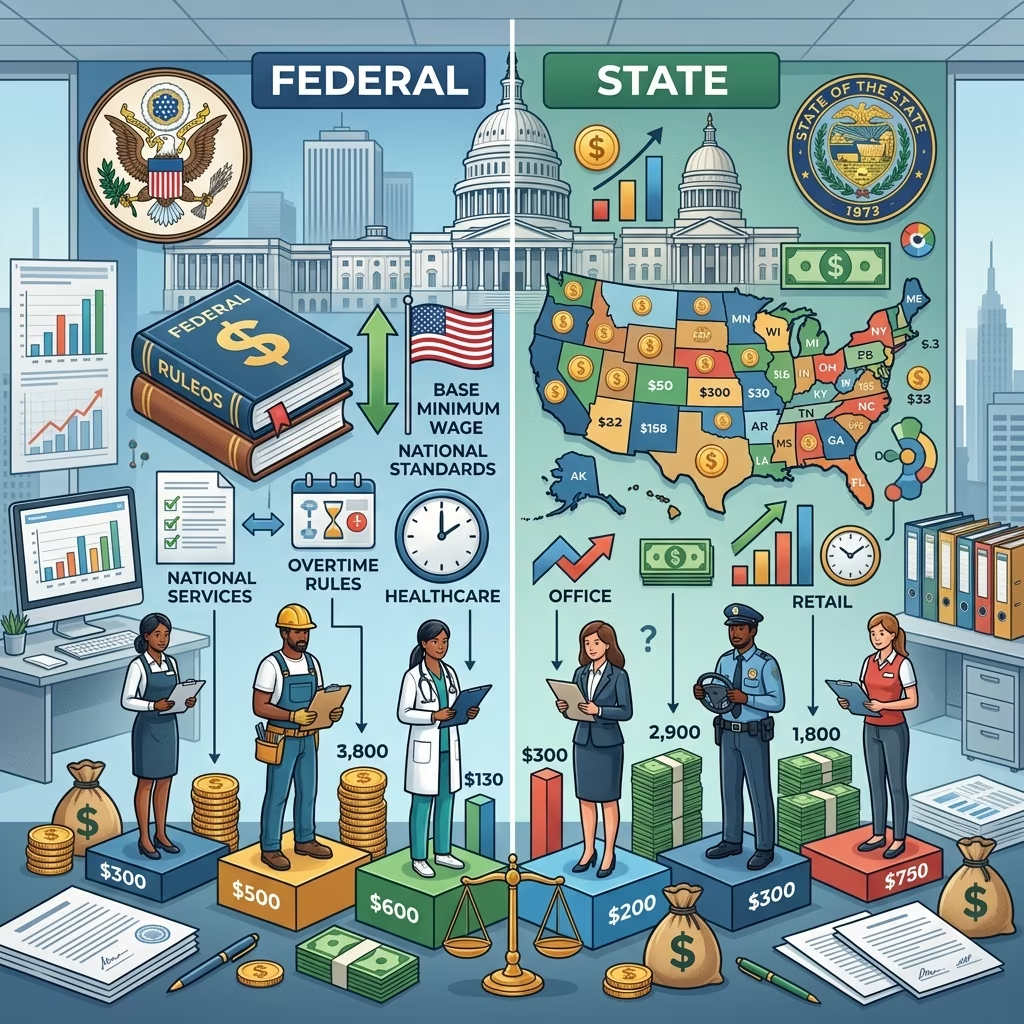
Minimum wage rules in the United States are shaped by multiple layers of law: federal statutes, state legislation, and in many places local ordinances. These rules do not compete so much as stack on top of one another, creating a framework in which workers are entitled to the highest applicable wage.
This article explains how federal and state minimum wage laws differ, how they interact, and what employers and employees need to know to navigate overlapping requirements without violating wage and hour rules.
Minimum Wage in the U.S.: The Legal Foundation
The concept of minimum wage is grounded in the idea that there should be a legal floor below which hourly pay cannot fall for covered workers. In the U.S., that floor starts with federal law and is often raised by state and local rules.
The Federal Baseline Under the FLSA
The federal minimum wage is established by the Fair Labor Standards Act (FLSA), enforced by the U.S. Department of Labor (DOL). As of the most recent federal update, the minimum wage for covered nonexempt employees is $7.25 per hour, a rate that has been in place since July 24, 2009.
- The FLSA sets national standards for minimum wage, overtime, child labor, and recordkeeping.
- Most employers engaged in interstate commerce or with sufficient annual sales are covered.
- Covered workers must be paid at least $7.25 per hour unless another applicable law requires more.
Importantly, the federal minimum wage acts as a floor, not a ceiling. States and localities are free to mandate higher rates for workers within their borders.
How State and Local Laws Fit In
States can enact their own minimum wage laws through state statutes or even constitutional provisions. Cities and counties may also adopt local wage ordinances, provided they do not conflict with federal or state law.
- Many states set minimum wages above the federal rate.
- Some states explicitly match the federal minimum wage in their statutes.
- A few states have no independent minimum wage law; federal rules apply to covered employers by default.
- Some jurisdictions have local minimum wages higher than both state and federal levels, particularly in high-cost-of-living areas.
When multiple laws apply to the same employee, the general rule is simple: that worker is entitled to the highest minimum wage among federal, state, and local requirements.
Federal vs. State Minimum Wage: Key Differences
Although federal and state minimum wages serve the same basic function, they differ in how they are set, applied, and adjusted. Understanding these differences is crucial for compliance.
Who Sets the Rules?
| Aspect | Federal Minimum Wage | State Minimum Wage |
|---|---|---|
| Law-making authority | U.S. Congress (FLSA) and DOL regulations | State legislatures and state agencies |
| Primary purpose | Establish a nationwide wage floor | Reflect local economic conditions and policy choices |
| Coverage scope | Employers subject to FLSA across all states | Employers within the state; some exemptions vary by state |
| Adjustment process | Changes only when Congress passes new legislation | Adjusted through state laws; some states index to inflation or cost of living |
Variation in Wage Levels
While the federal rate is currently $7.25 per hour, many states and local jurisdictions require more. For example, several states and Washington, D.C. have adopted minimum wages significantly higher than the federal floor, with some indexing annual increases to inflation.
States fall into several broad categories:
- Higher-than-federal states – These set a minimum wage above $7.25, often responding to regional cost-of-living or policy goals.
- Federal-matching states – Their statutes explicitly track the federal rate, rising if and when federal law changes.
- No independent minimum wage – Here, federal law provides the only applicable floor for covered employers.
- States with lower statutory rates – A small number of states have minimum wage figures below the federal amount, but covered workers in those states still must receive at least the federal rate under the FLSA.
How Overlapping Laws Work in Practice
Because multiple laws can apply at once, employers need a clear method to determine which minimum wage to pay. The basic compliance principle is: always use the highest rate that applies to the employee.
The “Highest Wage Wins” Rule
When a worker is covered by federal, state, and possibly local minimum wage laws, that worker is entitled to the highest wage among them. This rule is explicitly recognized by the U.S. Department of Labor.
- If the state minimum wage is higher than federal, the state wage must be paid.
- If a city sets a rate above the state’s, the local wage controls for work performed in that city.
- If state law is lower than the federal rate, covered workers still receive at least the federal minimum under the FLSA.
This framework ensures that federal law sets a baseline while allowing states and municipalities to grant greater protections or higher pay to workers.
Supremacy Clause and True Conflicts
In situations where a state law directly conflicts with federal law and makes it impossible for an employer to comply with both, the U.S. Constitution’s Supremacy Clause requires that federal law prevail. However, most minimum wage issues are not true conflicts: they simply reflect higher state or local standards layered on top of federal requirements.
As a result, minimum wage compliance generally means satisfying federal rules and meeting any stricter state or local requirements, rather than choosing one or the other.
Special Minimum Wage Rules and Exceptions
Minimum wage law includes various exceptions, special rates, and certificates. These do not eliminate the concept of a wage floor, but adjust it for specific categories of workers or circumstances.
Youth Minimum Wage
Under federal law, employers may pay a reduced wage to certain young workers for a limited time. The FLSA permits a minimum wage of $4.25 per hour for employees under age 20 during their first 90 consecutive calendar days of employment, provided they do not displace other workers.
- After 90 days, or once the worker turns 20 (whichever comes first), the employer must pay at least $7.25 per hour.
- Some states prohibit or restrict such sub-minimum wages, requiring higher rates; the highest applicable rule still governs.
Students, Learners, and Workers with Disabilities
The FLSA also authorizes specific programs allowing sub-minimum wages for certain categories when employers obtain certificates from the Department of Labor.
- Full-time students – Certain employers may pay at least 85% of the federal minimum wage for certified student workers.
- Student-learners in vocational education – Employers may pay at least 75% of the minimum wage, subject to certificate requirements and continued enrollment.
- Workers with disabilities – Special certificates allow adjusted wage rates based on productivity, though this area of law is evolving in some states.
Where states adopt stricter standards or ban particular sub-minimum arrangements, employers must follow the highest standard that lawfully applies.
Why States Raise Minimum Wages Above Federal Levels
States often set higher minimum wages to address economic conditions and policy goals not fully covered by federal law. Research shows that the federal rate does not reflect regional cost-of-living differences, motivating some states to adopt higher standards.
Cost of Living and Regional Variation
Living costs vary across the country, from high-rent urban centers to lower-cost rural regions. A single national wage floor cannot fully account for these differences. State and local governments use higher minimum wages to:
- Improve the ability of low-wage workers to afford housing, food, and transportation.
- Respond to local economic data and inflation trends.
- Align wages with regional labor market conditions.
Some jurisdictions index their minimum wage to measures like the Consumer Price Index (CPI), adjusting automatically each year to preserve purchasing power.
Policy Debates and Economic Tradeoffs
Minimum wage policy involves weighing benefits to workers against potential impacts on employment and business costs. Economists and policymakers debate the optimal level and pace of increases. While this article does not take a position in those debates, it is important for employers and workers to understand the framework within which such policy choices play out.
Practical Compliance Tips for Employers
Businesses operating in one or multiple jurisdictions need systematic approaches to minimum wage compliance. Failing to pay the proper minimum wage can lead to back pay obligations, penalties, and reputational risk.
Step-by-Step Approach
- Identify coverage under the FLSA – Confirm whether your business and employees are covered by federal wage and hour rules.
- Map state and local laws – For each location where employees work, determine the state minimum wage and any applicable city or county ordinances.
- Compare rates – For each employee, identify the highest applicable minimum wage among federal, state, and local requirements.
- Set payroll systems accordingly – Configure pay codes and HR software to apply the correct wage based on work location, not just business headquarters.
- Monitor legal changes – Track scheduled increases and legislative updates; many states publish annual updates to minimum wage rates.
- Keep documentation – Maintain accurate time records and wage statements to demonstrate compliance in case of audits or complaints.
Common Pitfalls
- Assuming federal law alone controls, even when state or local laws require higher wages.
- Overlooking remote workers whose “work location” is in a different jurisdiction with a higher minimum wage.
- Failing to adjust wages when state rates increase or when employees begin working inside a higher-wage city.
- Misapplying youth or student wage exceptions without proper certificates or beyond permitted time limits.
What Workers Should Know About Their Rights
Employees benefit from understanding basic minimum wage rights. While detailed legal analysis may require professional advice, workers can watch for key indicators that they are being underpaid.
- Know the minimum wage in your state and city and compare it to federal law.
- If you are covered by the FLSA, you are generally entitled to at least $7.25 per hour, and more if your state or locality requires a higher rate.
- Review pay stubs to confirm hourly rates and hours worked.
- Ask your employer or HR department how they determine the applicable minimum wage.
- Contact your state labor agency or the U.S. Department of Labor if you suspect violations; both provide complaint and enforcement mechanisms.
FAQs: Federal and State Minimum Wage
Does the federal minimum wage override state minimum wages?
No. The federal minimum wage sets a national floor. If a state or local minimum wage is higher than the federal rate, employers must pay the higher amount to covered workers.
What happens if a state’s minimum wage is lower than $7.25?
In states that list a minimum wage below the federal amount, employers covered by the FLSA must still pay at least $7.25 per hour. The lower state rate generally applies only where federal coverage does not reach, and even then, additional requirements may apply.
Are local (city or county) minimum wages legally enforceable?
Yes, where lawfully adopted and consistent with state law, local minimum wage ordinances are enforceable. If they exceed state and federal rates, employers must pay the local rate for work performed in that jurisdiction.
Who enforces minimum wage laws?
The U.S. Department of Labor’s Wage and Hour Division enforces federal minimum wage and related provisions. State labor agencies enforce state minimum wage laws, and some cities have local enforcement mechanisms for municipal wage ordinances.
Does the federal minimum wage change automatically?
No. The federal rate increases only when Congress passes a law and the President signs it. By contrast, some states and cities automatically adjust their minimum wages based on inflation or other indices.
References
- State Minimum Wage Laws — U.S. Department of Labor, Wage and Hour Division. 2024-01-01. https://www.dol.gov/agencies/whd/minimum-wage/state
- Questions and Answers About the Minimum Wage — U.S. Department of Labor, Wage and Hour Division. 2023-11-15. https://www.dol.gov/agencies/whd/minimum-wage/faq
- Minimum Wage — Legal Information Institute, Cornell Law School. 2023-06-30. https://www.law.cornell.edu/wex/minimum_wage
- Minimum Wage Rate in the US by State (2026) — Paycom. 2026-01-05. https://www.paycom.com/resources/blog/minimum-wage-rate-by-state/
- What Difference Does a Minimum Wage Make? — Federal Reserve Bank of Richmond, Econ Focus. 2021-10-01. https://www.richmondfed.org/-/media/RichmondFedOrg/publications/research/econ_focus/2021/q2-3/district_digest.pdf