
Understanding Fault and No-Fault Divorce Laws
Learn how fault and no-fault divorce systems work, what grounds are recognized, and how they affect property, support, and the overall process.
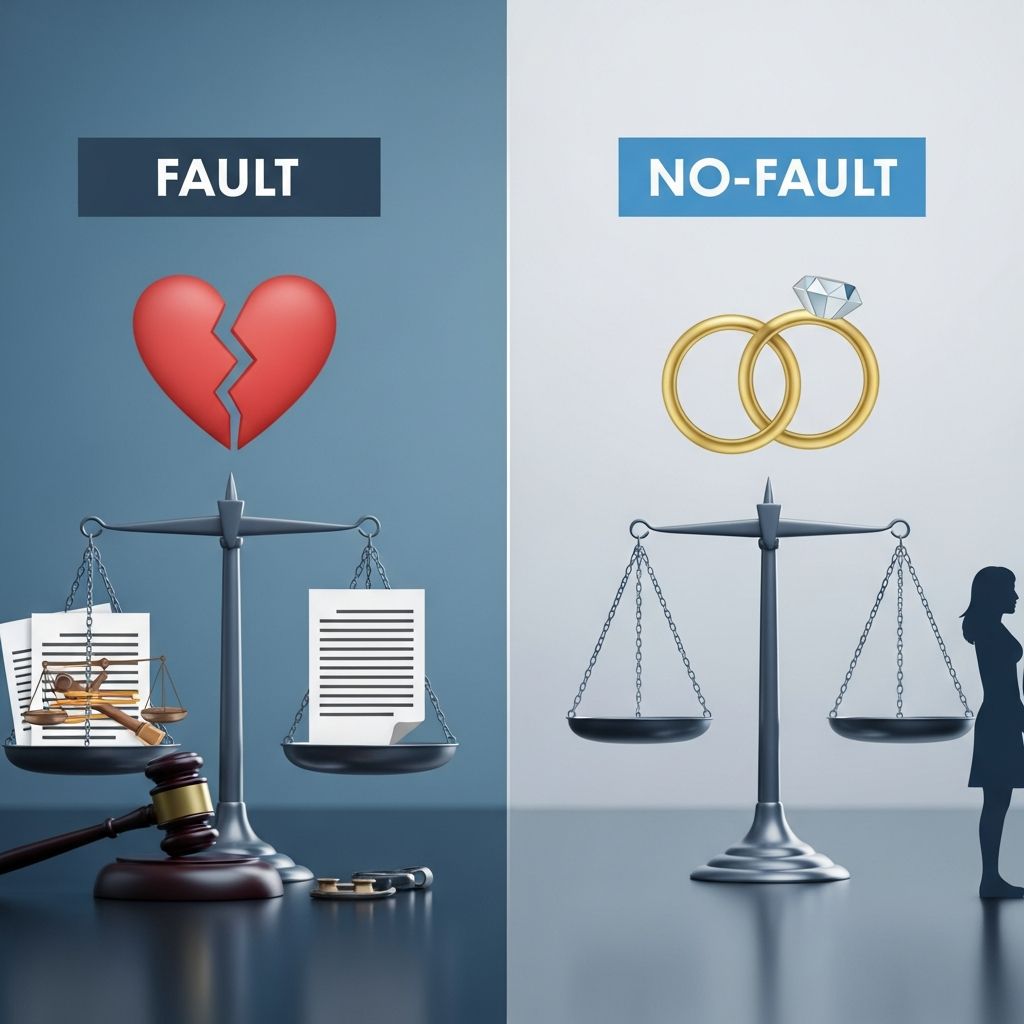
Modern divorce law in the United States is built around two basic concepts: no-fault divorce and fault-based divorce. Understanding the difference can help you make informed decisions about strategy, evidence, timing, and settlement negotiations if you are considering ending a marriage.
This guide explains how fault and no-fault systems work, the typical legal grounds for each, and how they may influence outcomes related to property, support, and child-related orders. It is general information, not legal advice; divorce rules vary significantly by state, so you should confirm local law or speak with an attorney in your jurisdiction.
1. What Lawyers Mean by “Grounds for Divorce”
Every divorce case must be based on at least one legally recognized reason, known as a ground for divorce. Grounds are created by state statutes, not by judges, and the court can only grant a divorce on one of the grounds listed in that state’s law.
- No-fault grounds: The law does not require either spouse to prove bad conduct or blame; it is enough to show that the marriage is broken beyond repair.
- Fault grounds: One spouse must prove that the other engaged in specific misconduct the law recognizes as justifying a divorce.
Beginning in the late 1960s, states gradually added no-fault grounds to reduce perjury, conflict, and delay associated with proving fault. Today all U.S. states offer some form of no-fault divorce, but not all have completely eliminated fault-based options.
2. Core Idea of No-Fault Divorce
In a no-fault divorce, neither spouse has to demonstrate that the other did anything wrong. Instead, one spouse states a legally sufficient reason such as:
- Irretrievable breakdown of the marriage
- Irreconcilable differences
- Marriage is irretrievably broken with no reasonable prospect of reconciliation
These phrases appear in many state codes and are intentionally broad so that the court does not need to examine the private details of what went wrong. In some states, there may still be a waiting period or required separation before the court will grant a final no-fault divorce.
2.1 Typical Features of No-Fault Divorce
- Blame is not required: The court does not need evidence of adultery, abuse, desertion, or similar misconduct.
- One spouse can usually proceed unilaterally: In most jurisdictions, a spouse does not need the other’s consent to file on a no-fault ground.
- Less focus on marital behavior: Hearings focus on property, support, and parenting rather than proving bad acts.
- Potential for lower conflict and cost: Because there is no need to litigate blame, many no-fault cases resolve through negotiation or mediation.
Some states, such as California, allow divorce only on no-fault grounds, meaning that proof of wrongdoing does not entitle a spouse to a divorce on a separate fault basis, although misconduct can still be relevant to certain financial or custody questions in limited circumstances.
3. How Fault-Based Divorce Works
In a fault divorce, one spouse asks the court to terminate the marriage on the basis that the other spouse’s wrongful behavior destroyed the relationship. A number of states still recognize fault as an alternative ground, even though a no-fault option is also available.
3.1 Common Fault Grounds
Exact wording differs by state statute, but typical fault grounds include:
- Adultery: Voluntary sexual relations with someone other than the spouse.
- Cruelty or inhuman treatment: Physical abuse, severe emotional abuse, or behavior that makes continued cohabitation unsafe or intolerable.
- Abandonment or desertion: Leaving the marital home without justification for a legally defined period.
- Habitual drunkenness or substance abuse: Ongoing addiction that significantly damages the marriage.
- Imprisonment: Incarceration for a certain number of years, often specified in state law.
- Bigamy or fraud in the marriage
Where fault divorce remains available, the filing spouse must present evidence that the ground exists. That can involve documents, witness testimony, expert reports, or admissions by the other spouse, and the accused spouse is entitled to contest those allegations.
3.2 Potential Reasons to Allege Fault
Even when a no-fault divorce is an option, some parties still choose to file on fault grounds, often for strategic reasons:
- Bypassing separation requirements: In a minority of states, a fault divorce may be granted more quickly than a no-fault divorce that requires a long separation period.
- Financial leverage: In some jurisdictions, proven fault can influence alimony, property division, or attorney’s fees, particularly where misconduct had a financial impact.
- Personal or moral considerations: Some spouses want the record to reflect the cause of the breakup, especially in cases of abuse or infidelity.
However, proving fault can increase the length, cost, and emotional strain of the case, so lawyers and judges often encourage parties to resolve issues under a no-fault framework unless there is a clear legal benefit.
4. Comparing Fault and No-Fault Divorce
| Feature | No-Fault Divorce | Fault-Based Divorce |
|---|---|---|
| Need to prove misconduct | Not required | Required; must show legally recognized fault |
| Typical ground | Irretrievable breakdown / irreconcilable differences | Adultery, cruelty, abandonment, etc. |
| Time and expense | Often faster and less expensive | Often longer and more expensive due to evidence and hearings |
| Emotional conflict level | Generally lower; less focus on blame | Often higher; allegations can be contested aggressively |
| Impact on financial outcomes | Misconduct usually limited relevance, but depends on state | In some states, proven fault can affect support or division |
5. How Fault and No-Fault Interact with Property, Support, and Children
Granting a divorce is only one part of a case. Courts must also address property division, spousal support, and—where children are involved—custody and child support. Whether fault matters in those decisions depends heavily on state law.
5.1 Property Division
States use different systems to divide marital property, commonly either community property or equitable distribution. In both, the emphasis is usually on financial fairness rather than moral blame.
- Community property states often divide marital assets roughly equally, but some allow consideration of conduct that dissipated or hid assets.
- Equitable distribution states divide property based on fairness factors; a minority explicitly list marital misconduct as one factor a court may consider.
Because rules vary so widely, parties who believe a spouse’s wrongdoing financially harmed the marriage (for example, by spending substantial marital funds on an affair) should obtain local advice about how to document and present those losses.
5.2 Spousal Support (Alimony)
Whether marital fault influences alimony is highly state-specific. Some statutes regard need and ability to pay as the dominant factors, while others allow limited consideration of blame.
- In many states, economic factors such as income, work history, age, health, and length of the marriage are primary.
- Some states permit the court to consider adultery or cruelty when deciding whether to award or adjust support, particularly if the misconduct had financial consequences or was extreme.
It is important to distinguish between moral wrongdoing that does not affect finances and conduct that directly damages the couple’s economic position, such as gambling away marital savings; the latter is more likely to matter in court.
5.3 Child Custody and Support
Custody and visitation decisions must be based on the best interests of the child, not on punishing either parent. Marital misconduct is relevant only to the extent it affects parenting capacity or child safety.
- Relevant behavior can include domestic violence, substance abuse, or serious mental health issues that interfere with safe caregiving.
- Irrelevant behavior usually includes private adult conduct, like consensual affairs, that does not impair parenting or endanger children.
- Child support calculations are typically formula-based, focusing on income and parenting time rather than fault.
Even in a pure no-fault system, evidence of abuse, neglect, or other harmful conduct can strongly affect custody and protective orders.
6. Examples of State Approaches
To illustrate how different states handle fault and no-fault concepts, consider two broad patterns reflected in official and academic sources.
- Primarily no-fault states: States like California allow divorce based only on no-fault grounds and have no separate fault grounds in their statutes, though evidence of misconduct can sometimes affect specific issues such as domestic violence-related orders.
- Mixed systems: Many states maintain both no-fault grounds (like irretrievable breakdown) and fault grounds (like adultery or cruelty) in their family-law codes, giving spouses a choice of how to proceed.
Because each state’s code is unique, parties should consult the actual text of the family-law statute or a competent local professional to verify what is available where they live.
7. Choosing Between Fault and No-Fault in Practice
When both options are available, the decision to allege fault is strategic. Consider these practical questions:
- Is there a clear legal and financial benefit? If fault does not materially change property or support outcomes in your state, the extra litigation cost may not be worthwhile.
- Do you have strong evidence? Courts rely on tangible proof, not suspicion. Weak evidence can backfire by undermining credibility.
- What is the likely emotional impact? Allegations of blame can intensify conflict, which may be especially harmful where co-parenting is required.
- Are there safety concerns? In situations involving domestic violence, detailed findings of abuse may support protective orders, supervised visitation, or other safeguards.
Attorneys often advise filing on a no-fault ground while still preserving the right to introduce evidence of misconduct if it becomes relevant to issues like custody or dissipation of assets.
8. Common Misunderstandings About Fault and No-Fault Divorce
- Myth: No-fault divorce means fault never matters.
In reality, no-fault rules primarily affect grounds for divorce. Conduct can still matter for specific issues such as parenting arrangements, safety, or proven financial waste, depending on state law. - Myth: Filing a fault divorce guarantees a better settlement.
Courts are limited by statute. Unless the law expressly allows fault to influence property or support, a fault claim may change very little while increasing cost and delay. - Myth: Both spouses must agree to a no-fault divorce.
In most jurisdictions, one spouse’s sworn statement of irretrievable breakdown is enough to move forward, even if the other does not consent. - Myth: Adultery automatically terminates support rights.
Some states consider adultery when deciding alimony, but many focus primarily on economic factors. Outcomes depend heavily on local statutes and case law.
9. Frequently Asked Questions (FAQs)
Q1: If my state offers both fault and no-fault divorce, which is usually simpler?
In most cases, a no-fault divorce is simpler because it avoids the need to prove wrongful conduct. The court can focus on dividing property, setting support, and, if applicable, establishing parenting arrangements, which often reduces time, expense, and emotional strain.
Q2: Can I still tell the judge what my spouse did in a no-fault case?
Courts generally limit hearings to legally relevant issues. However, if your spouse’s behavior affects finances, safety, or parenting—such as domestic violence, substance abuse, or dissipation of assets—the judge may consider that evidence even in a no-fault divorce, subject to your state’s rules of evidence and procedure.
Q3: Does fault matter in child custody decisions?
Judges must decide custody and visitation based on the best interests of the child. Conduct such as abuse, serious addiction, or neglect is highly relevant because it affects safety and parenting ability. By contrast, purely marital issues that do not impact the child, such as a discreet consensual affair, are usually given little weight.
Q4: What if my spouse refuses to cooperate with the divorce?
Most states allow a divorce to proceed even if one spouse will not participate. If your spouse fails to respond after proper legal notice, the court may grant a default judgment based on your filings, subject to safeguards in your state’s procedure rules.
Q5: Where can I find the exact divorce grounds for my state?
You can review your state’s family-law or domestic-relations statutes, which are usually available on the official website of the state legislature or court system. Many state court systems also publish self-help materials explaining available divorce grounds and procedures in plain language.
References
- American Law Institute, Principles of the Law of Family Dissolution — American Law Institute. 2002-01-01. https://www.ali.org/publications/show/family-dissolution-divorce/
- Weitzman, Lenore J. The Divorce Revolution — Free Press. 1985-01-01. https://lccn.loc.gov/84025971
- California Family Code — California Legislative Information. (current through 2024). https://leginfo.legislature.ca.gov/faces/codesTOCSelected.xhtml?tocCode=FAM&tocTitle=+Family+Code
- Divorce and Separation — U.S. Courts, Federal Judiciary. 2021-06-10. https://www.uscourts.gov/services-forms/bankruptcy/bankruptcy-basics/divorce-and-separation
- Lawrence J. Golden, Equitable Distribution of Property — American Bar Association. 2019-01-01. https://www.americanbar.org/products/inv/book/381807863/
- Child Custody and Parenting Time — National Conference of State Legislatures. 2021-08-24. https://www.ncsl.org/human-services/child-custody-and-parenting-time
Similar Articles








Read full bio of Sneha Tete


