Fair Use: 4 Key Factors Every Creator Must Know
Navigate the complexities of fair use doctrine: Learn when you can legally use copyrighted material without permission.
Understanding Fair Use in Copyright Law
Fair use is a critical legal principle in United States copyright law that allows limited use of copyrighted material without obtaining permission from the rights holder. Codified in Section 107 of the Copyright Act, it balances the rights of creators with the public’s interest in accessing and building upon existing works. This doctrine is essential for activities like criticism, education, and commentary, fostering innovation and free expression.
The Origins and Purpose of Fair Use
The fair use doctrine emerged from English common law and was formalized in the U.S. through judicial decisions before being enshrined in statute in 1976. It serves as a flexible exception to copyright exclusivity, preventing overly restrictive control that could hinder cultural progress. Unlike rigid permissions systems, fair use provides a defense against infringement claims, evaluated case-by-case using four statutory factors.
At its core, fair use promotes the First Amendment by enabling transformative uses that add new value, such as parodies or scholarly analysis. Courts view it not just as a shield but as an authorized right, as affirmed in key rulings like Lenz v. Universal Music Corp., where fair use must be considered before issuing takedown notices under the DMCA.
Breaking Down the Four Factors of Fair Use
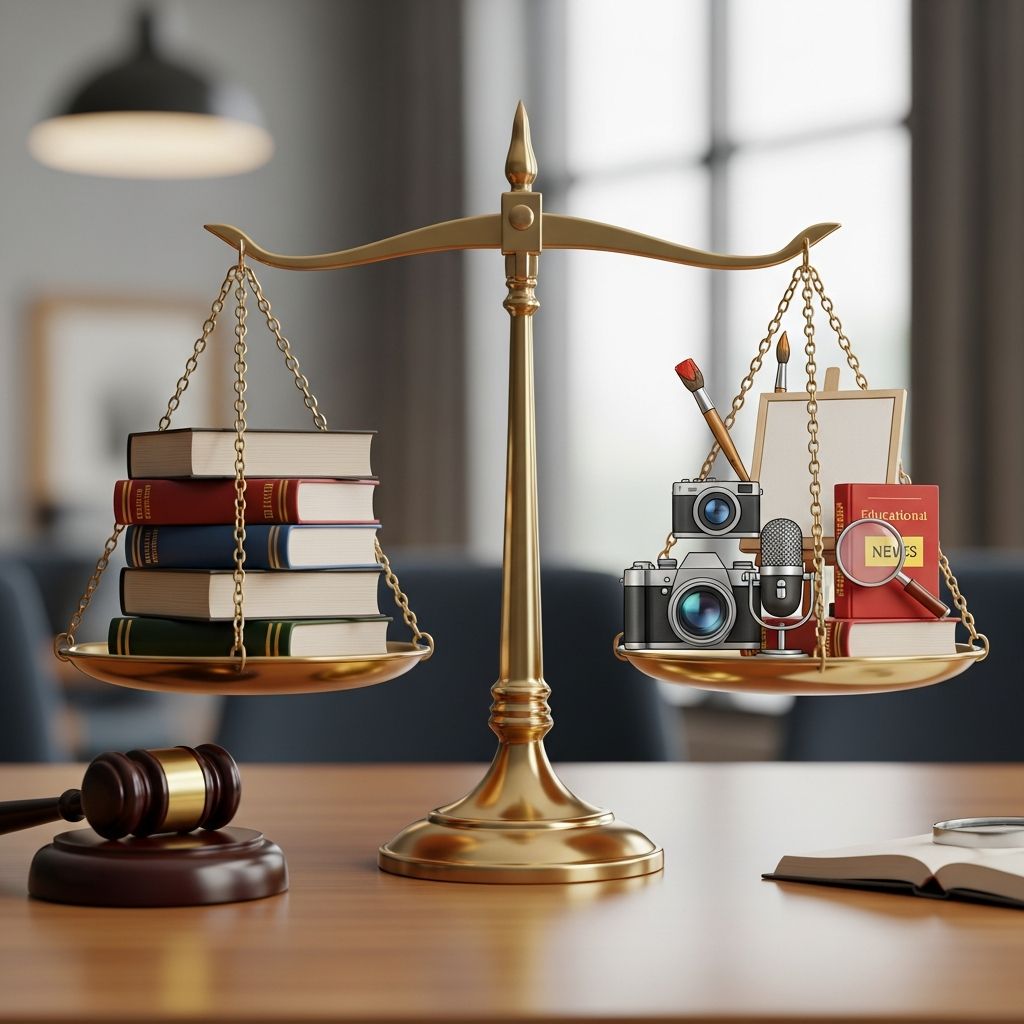
Section 107 outlines four factors courts weigh to determine fair use. No single factor is decisive; they are balanced holistically. Here’s a detailed examination:
Factor 1: Purpose and Character of the Use
This factor assesses whether the use is transformative—adding new expression, meaning, or message—and if it’s commercial or nonprofit. Transformative uses, like criticism or parody, strongly favor fair use. For instance, nonprofit educational purposes weigh positively, while purely commercial exploitation weighs against.
- Transformative examples: A book review quoting key passages to analyze themes.
- Non-transformative: Copying an entire photo for a stock image site.
Courts emphasize whether the use supplants the original or serves a different audience.
Factor 2: Nature of the Copyrighted Work
Creative works like fiction, art, or music receive stronger protection than factual ones such as news articles or technical manuals. Published works are more amenable to fair use than unpublished ones, as the latter reflect the author’s intent to control first release.
| Work Type | Fair Use Favorability | Reason |
|---|---|---|
| Factual (e.g., biography) | High | Less creative expression protected |
| Fictional (e.g., novel) | Low | High originality and creativity |
| Published | Neutral/High | Public already has access |
| Unpublished | Low | Author’s control over debut |
Factor 3: Amount and Substantiality of the Portion Used
Courts evaluate both quantity and quality of the borrowed material relative to the whole. Small amounts are safer, but even brief excerpts can infringe if they capture the ‘heart’ of the work, like a song’s iconic chorus. Necessity ties back to purpose: more may be justifiable for critique.
- Use only what’s essential for your purpose.
- Wholesale copying rarely qualifies unless highly transformative.
Factor 4: Effect on the Market for the Original
The most influential factor examines if the use harms the copyright owner’s market or potential licensing revenue. Direct substitutes hurt this factor; uses that don’t compete (e.g., parody) help it. Courts consider both current and future markets.
In Campbell v. Acuff-Rose Music, Inc., the Supreme Court ruled that 2 Live Crew’s parody of ‘Oh, Pretty Woman’ didn’t harm the market, favoring fair use.
Common Applications and Real-World Scenarios
Fair use applies across contexts:
- Education: Teachers photocopying articles for class discussion, if limited and transformative.
- News and Commentary: Quoting in blogs or videos to critique public figures.
- Parody and Satire: Humorous takes that comment on the original.
- Research: Sampling data for academic studies.
However, streaming full movies in a review or republishing articles verbatim typically fails the test.
Landmark Court Cases Shaping Fair Use
Judicial precedents illustrate application:
- Sony Corp. v. Universal City Studios (1984): Home VCR recording for time-shifting was fair use, not market harm.
- Lenz v. Universal (2015): Copyright holders must evaluate fair use before DMCA takedowns.
- Authors Guild v. Google (2015): Digitizing books for search snippets was transformative and fair.
These cases underscore fair use’s adaptability to technology.
Limitations and Myths About Fair Use
Fair use isn’t a blanket permission:
- Myth: 10% rule. No numerical safe harbor exists; it’s qualitative.
- Myth: Attribution suffices. Credit doesn’t equal permission.
- Risk: It’s a defense, so you may face litigation first.
For certainty, seek licenses or use public domain/CC materials.
Fair Use in the Digital Age
Online platforms complicate fair use. DMCA safe harbors protect hosts if they remove infringing content promptly, but users must assert fair use counter-notices. AI training on copyrighted data raises new questions, often debated under transformative use.
Fair Use Evaluation Checklist
Use this tool for self-assessment:
- Is your use transformative or nonprofit?
- Is the source factual/published?
- Did you use minimal necessary amount?
- Does it impact the original’s sales?
Weigh factors; consult a lawyer for high-stakes uses.
Frequently Asked Questions
Is fair use the same worldwide?
No, the U.S. fair use is broader than ‘fair dealing’ in countries like Canada or the UK, which list specific exceptions.
Can I use memes under fair use?
Often yes, if transformative and non-commercial, but commercial merch may not qualify.
Does fair use apply to images and music?
Yes, same factors apply to all media.
What if I’m not in the U.S.?
Fair use is U.S.-specific; check local laws.
Is parody always fair use?
Not automatically; it must comment on the original and not harm the market.
Best Practices for Creators and Educators
To minimize risk:
- Document your four-factor analysis.
- Link instead of copying when possible.
- Use Creative Commons or open licenses.
- Get permissions for borderline cases.
Educators can leverage tools like fair use checklists from the U.S. Copyright Office.
References
- Fair use – Wikipedia — Wikipedia contributors. 2026 (continuously updated). https://en.wikipedia.org/wiki/Fair_use
- Copyright and Fair Use — Harvard University Office of the General Counsel. Accessed 2026. https://ogc.harvard.edu/pages/copyright-and-fair-use
- What Is Fair Use — Copyright Alliance. Accessed 2026. https://copyrightalliance.org/faqs/what-is-fair-use/
- Fair Use and The Four Factors Explained — Mount Holyoke College Library Guides. Accessed 2026. https://guides.mtholyoke.edu/copyright/fair-use
- Fair Use Index — U.S. Copyright Office. Accessed 2026. https://www.copyright.gov/fair-use/
- Fair Use (FAQ) — U.S. Copyright Office. Accessed 2026. https://www.copyright.gov/help/faq/faq-fairuse.html
Similar Articles






Read full bio of medha deb