
Understanding Drug Trafficking and Distribution Charges
A practical guide to how U.S. law defines, prosecutes, and punishes drug trafficking and distribution offenses.
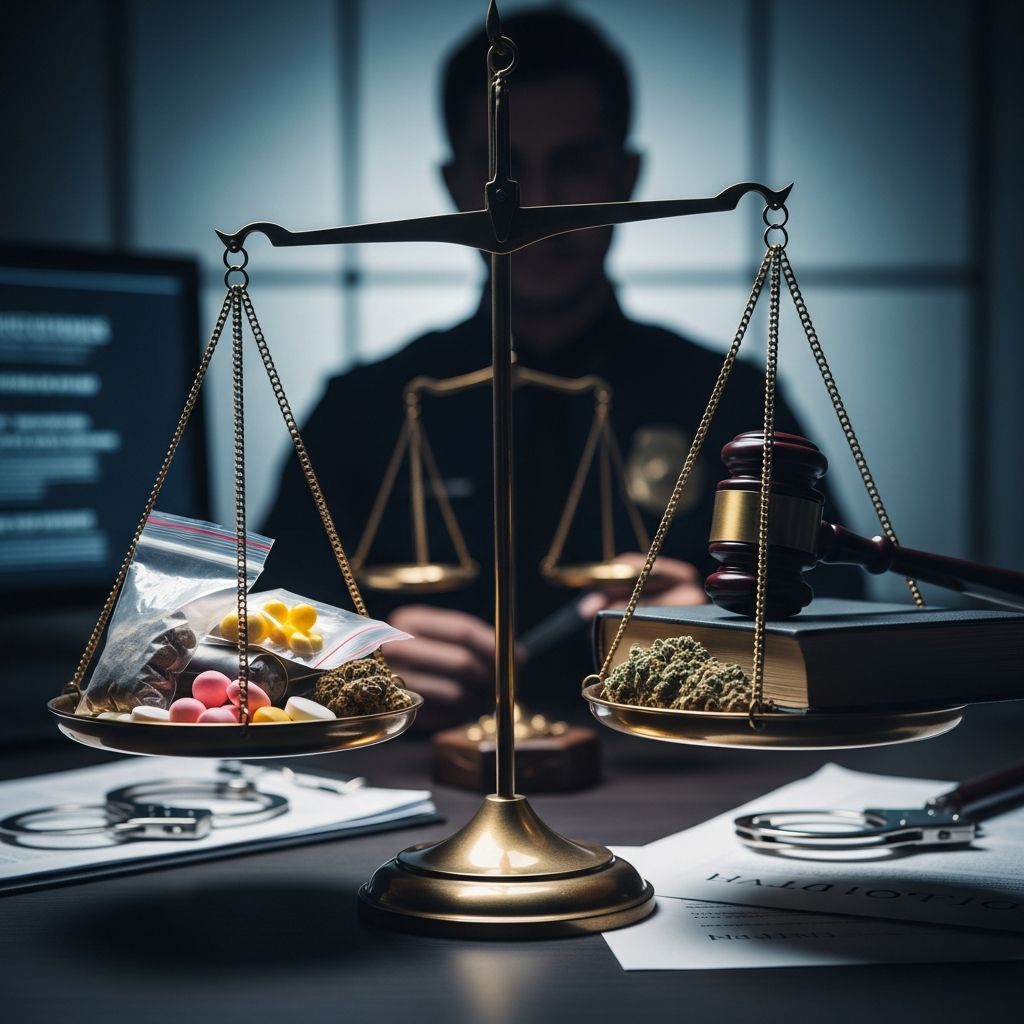
Drug trafficking and drug distribution are among the most aggressively prosecuted offenses in U.S. criminal law. Federal and state statutes make it a serious crime to manufacture, transport, sell, or deliver controlled substances, and penalties increase sharply as the drug quantity and level of organization rise.
This guide offers a clear overview of how these offenses are defined, what prosecutors must prove, how penalties are calculated, and which factors can make a sentence harsher or, in some cases, lighter.
What the Law Means by “Drug Trafficking” and “Distribution”
Although people often use the terms interchangeably, trafficking and distribution are legally distinct concepts with overlapping elements.
Core Legal Definitions
- Drug distribution: generally refers to delivering, selling, or transferring a controlled substance to another person, including possession with intent to distribute.
- Drug trafficking: typically involves the manufacture, import, export, or large-scale transportation and distribution of controlled substances, often exceeding specific quantity thresholds.
- Controlled substance: a drug or chemical listed in federal or state controlled substances schedules, such as heroin, cocaine, methamphetamine, certain prescription opioids, and many others.
Both trafficking and distribution can be charged even when no money changes hands. Giving drugs away, or simply agreeing to provide them, can be enough to trigger liability in many jurisdictions.
How Trafficking Differs from Distribution
The distinction between trafficking and distribution usually turns on the scale of the conduct and the quantities involved.
| Feature | Distribution | Trafficking |
|---|---|---|
| Typical conduct | Sale, delivery, or transfer to another person | Manufacturing, importing, exporting, or large-scale supply chains |
| Quantity requirement | No fixed minimum; even small amounts with intent to sell | Often requires meeting or exceeding statutory weight thresholds |
| Proof of intent | Prosecutor usually must show intent to distribute | In many laws, possession of a threshold weight automatically implies trafficking |
| Usual penalty range | Severe, but typically less than trafficking | Among the harshest sentences in drug law, often with mandatory minimums |
Common Elements of Drug Distribution Charges
Distribution cases often grow out of simple possession investigations that escalate once police believe the drugs were meant for others rather than for personal use.
Typical Conduct Prosecuted as Distribution
- Selling illegal drugs or diverted prescription medications.
- Delivering drugs to another person, even without payment.
- Transporting drugs from one place to another with the intent to supply others.
- Possessing drugs in amounts and circumstances suggesting resale rather than personal consumption.
In many states, simply providing a controlled substance to a friend, or sharing it at a party, may be legally treated as a form of distribution.
Proving Intent to Distribute
Where no hand-to-hand sale is observed, prosecutors typically rely on circumstantial evidence to show an intent to distribute rather than just possess.
Courts may consider:
- Quantity of the drug: an amount far beyond what is typical for personal use.
- Packaging: multiple baggies, vials, or individually wrapped doses.
- Equipment: digital scales, measuring tools, or cutting agents.
- Cash: large sums of money, especially in small denominations.
- Communications: texts, calls, or messages about prices, quantities, or meeting places.
The combination of these factors often forms the basis for a charge of possession with intent to distribute, which usually carries felony-level penalties.
Key Features of Drug Trafficking Offenses
Trafficking laws are designed to target higher-level suppliers, large-scale transporters, and organizations that move drugs across regions, states, or countries.
Typical Trafficking Activities
- Importing or exporting illegal drugs across national borders.
- Transporting large quantities between states or within a state for resale.
- Operating or supplying manufacturing operations, such as methamphetamine labs.
- Coordinating wholesale-level distribution to local dealers or networks.
Because trafficking cases often involve interstate or international conduct, federal agencies such as the Drug Enforcement Administration (DEA) and federal prosecutors may take the lead.
Quantity Thresholds and Automatic Trafficking
Many trafficking statutes use weight or dosage thresholds. Possessing more than the specified amount of a given substance can automatically qualify as trafficking, regardless of whether a sale is proven.
Examples from state and federal practice (amounts vary by jurisdiction) include:
- Grams-level thresholds for heroin or cocaine that trigger trafficking charges.
- Pounds or multiple plants in the case of marijuana.
- Specified tablet counts for substances such as LSD or MDMA.
Under federal law, crossing these thresholds can also trigger mandatory minimum prison sentences for certain controlled substances.
Who Brings the Case: State vs. Federal Jurisdiction
Drug offenses can be prosecuted in state or federal court, and sometimes both. Jurisdiction depends on how the conduct is defined and where it occurred.
When State Law Typically Applies
- Smaller-scale sales or transfers within a single state.
- Local street-level or neighborhood distribution.
- Cases initiated by municipal or state police without federal investigation.
When Federal Law Often Applies
- Trafficking across state lines or international borders.
- Large, organized networks with multiple participants.
- Cases involving particularly large quantities or especially harmful substances.
- Investigations led or assisted by federal agencies such as the DEA or FBI.
Federal cases generally carry higher statutory maximums and more frequent use of mandatory minimum sentences, making them especially high-stakes for defendants.
Penalties and Sentencing Factors
Sentences for trafficking and distribution vary by jurisdiction and by statute, but several recurring factors shape the penalty range.
Main Factors That Influence Punishment
- Type of drug: Schedule I and II substances (such as heroin, cocaine, and some opioids) often result in the harshest penalties.
- Quantity: higher weights trigger higher sentencing ranges and sometimes mandatory minimums.
- Role in the offense: organizers and leaders are usually punished more severely than minor participants.
- Criminal history: prior drug convictions or violent offenses can sharply increase prison time.
- Use of weapons or violence: carrying a firearm, threats, or actual harm generally adds enhancements.
- Location and victims: distributing near schools, involving minors, or causing overdoses can lead to extra penalties.
Typical Consequences of Conviction
Consequences go far beyond the initial term of incarceration or probation. A conviction for trafficking or distribution may lead to:
- Lengthy prison sentences, sometimes decades in serious federal trafficking cases.
- Substantial fines, which can reach hundreds of thousands or more in large cases.
- Asset forfeiture, including seizure of cash, vehicles, and real property linked to the crime.
- Loss of professional licenses or employment, especially in regulated fields.
- Immigration consequences for non-citizens, such as removal or inadmissibility.
- Long-term difficulties with housing, education, and credit due to a felony record.
How Prosecutors Build a Trafficking or Distribution Case
Law enforcement agencies rely on a mix of physical, digital, and testimonial evidence to prove trafficking or distribution beyond a reasonable doubt.
Common Types of Evidence
- Seized drugs tested and weighed by a laboratory to establish substance identity and quantity.
- Packaging and equipment such as baggies, scales, ledgers, or counting machines.
- Financial records indicating unexplained income or patterns of deposits.
- Communications data from phones, messaging apps, and email referring to prices, quantities, or deliveries.
- Witness statements, including cooperating co-defendants or confidential informants.
- Surveillance and controlled buys conducted by undercover officers.
The defense may challenge how evidence was obtained, the reliability of laboratory testing, or the credibility of witnesses, especially informants who receive benefits for their cooperation.
Frequently Invoked Defenses and Legal Strategies
Every case is fact-specific, but some themes recur in the defense of drug trafficking and distribution charges.
Contesting the Stop, Search, or Seizure
The U.S. Constitution protects against unreasonable searches and seizures. If police obtained drugs or other evidence without a valid warrant or an applicable exception, a court may suppress that evidence, which can significantly weaken the prosecution’s case.
- Unlawful traffic stops that led to vehicle searches.
- Improperly executed search warrants.
- Searches based only on vague or unreliable tips.
Challenging Possession or Knowledge
To convict, prosecutors ordinarily must show that the accused knowingly possessed or controlled the drugs and understood their nature. The defense may argue that:
- The drugs belonged to someone else with access to the same location.
- The defendant did not know the item contained illegal drugs.
- The government cannot reliably connect the accused to the seized drugs.
Disputing Intent to Distribute
Where the main charge is possession with intent to distribute, the defense can seek to reframe the case as simple possession. That may involve:
- Explaining the quantity with evidence of personal use patterns.
- Showing that scales or packaging had innocent uses.
- Demonstrating that texts or messages are being misinterpreted.
Reclassification from distribution or trafficking to simple possession can dramatically lower sentencing exposure.
Negotiating Plea Agreements and Cooperation
In many systems, a large percentage of drug trafficking and distribution cases are resolved by plea, not trial. Possible resolution strategies include:
- Pleading to a lesser charge with reduced sentencing ranges.
- Seeking dismissal of some counts in exchange for a guilty plea on others.
- Providing substantial assistance in other investigations, which can sometimes lead to sentence reductions in federal and state systems (subject to court approval).
Practical Considerations if Charged
Facing trafficking or distribution allegations is a high-stakes legal crisis. Some immediate practical issues often arise:
- Right to counsel: Because of the complexity and severity of these cases, obtaining qualified legal representation quickly is critical.
- Preserving evidence: Potentially helpful messages, receipts, or witnesses should be documented and shared with counsel.
- Limiting statements: Anything said to law enforcement or others can be used in court; defendants generally have the right to remain silent and request an attorney.
- Bail and pretrial release: Courts may consider factors such as flight risk, danger to the community, and the seriousness of the charge when setting conditions of release.
Frequently Asked Questions (FAQs)
Q: Can I be charged with distribution if I never sold drugs for money?
Yes. Many laws criminalize furnishing, delivering, or giving controlled substances to others, even without a cash transaction. Sharing drugs with a friend can, in some jurisdictions, be enough for a distribution charge.
Q: What is the difference between possession and possession with intent to distribute?
Simple possession focuses on holding drugs for personal use, usually with lower penalties. Possession with intent to distribute involves proof—often based on quantity, packaging, cash, or communications—that the drugs were meant to be sold or supplied to others, and it is typically a felony offense.
Q: Do prosecutors have to prove I actually completed a sale to convict me of trafficking?
Not necessarily. In many trafficking statutes, possessing more than a threshold quantity of a controlled substance is enough to qualify as trafficking, even if no specific sale is identified. In addition, conspiracy or attempt laws can reach planned but incomplete transactions.
Q: Why are some drug cases in federal court and others in state court?
Federal prosecutors usually focus on large-scale or interstate operations, or cases involving international import/export. Smaller or purely local cases are more often handled under state law. The presence of federal agencies like the DEA, or interstate conduct, often signals a federal case.
Q: Are mandatory minimum sentences always applied in trafficking cases?
Mandatory minimums apply only when the statutory criteria—such as specific drug types and threshold quantities—are met in the charged offense. In other cases, judges have more discretion. Even where minimums exist, certain forms of cooperation or safety-valve provisions may allow courts to depart below them in limited circumstances.
References
- Drug trafficking — Bureau of Justice Statistics, U.S. Department of Justice. 2023-05-18. https://bjs.ojp.gov/taxonomy/term/drug-trafficking
- California Drug Distribution Laws — Foos Gavin Law Firm. 2022-09-01 (approx. last updated). https://www.foosgavinlaw.com/blog/351-california-drug-distribution-laws
- Drug Distribution vs. Trafficking: Key Differences — Sieben Edmunds Miller PLLC. 2023-07-10 (approx. last updated). https://siebenedmunds.com/understanding-the-difference-between-drug-distribution-and-drug-trafficking/
- What’s the Difference Between Drug Trafficking and Drug Distribution Charges? — J.P. Cannon & Associates, P.C. 2022-06-15 (approx. last updated). https://jpcannonlawfirm.com/okc-criminal-defense/drug-crimes/drug-trafficking/what-is-the-difference-between-drug-trafficking-and-drug-distribution-charges/
- Drug Possession vs. Drug Distribution: Key Legal Differences in Criminal Defense — Richard L. Cooper, P.C. 2021-11-03. https://richardlcooper.com/blog/drug-possession-vs-drug-distribution-key-legal-differences-in-criminal-defense/
- Laguna Beach Drug Trafficking Lawyer — The Law Office of Pilchman & Kay, A Professional Law Corporation. 2020-08-20 (approx. last updated). https://www.oc-criminallawyer.com/criminal-defense/drug-crimes/drug-trafficking/
- Differences Between Drug Possession, Trafficking, and Distribution — Eppes & Plumblee, P.A. 2022-03-08. https://www.eppesandplumblee.com/blog/differences-between-drug-possession-trafficking-and-distribution/
Similar Articles








Read full bio of medha deb




