
Understanding Domestic Partnerships in the United States
Learn how domestic partnerships work, what rights they provide, and how they compare with marriage in different U.S. jurisdictions.
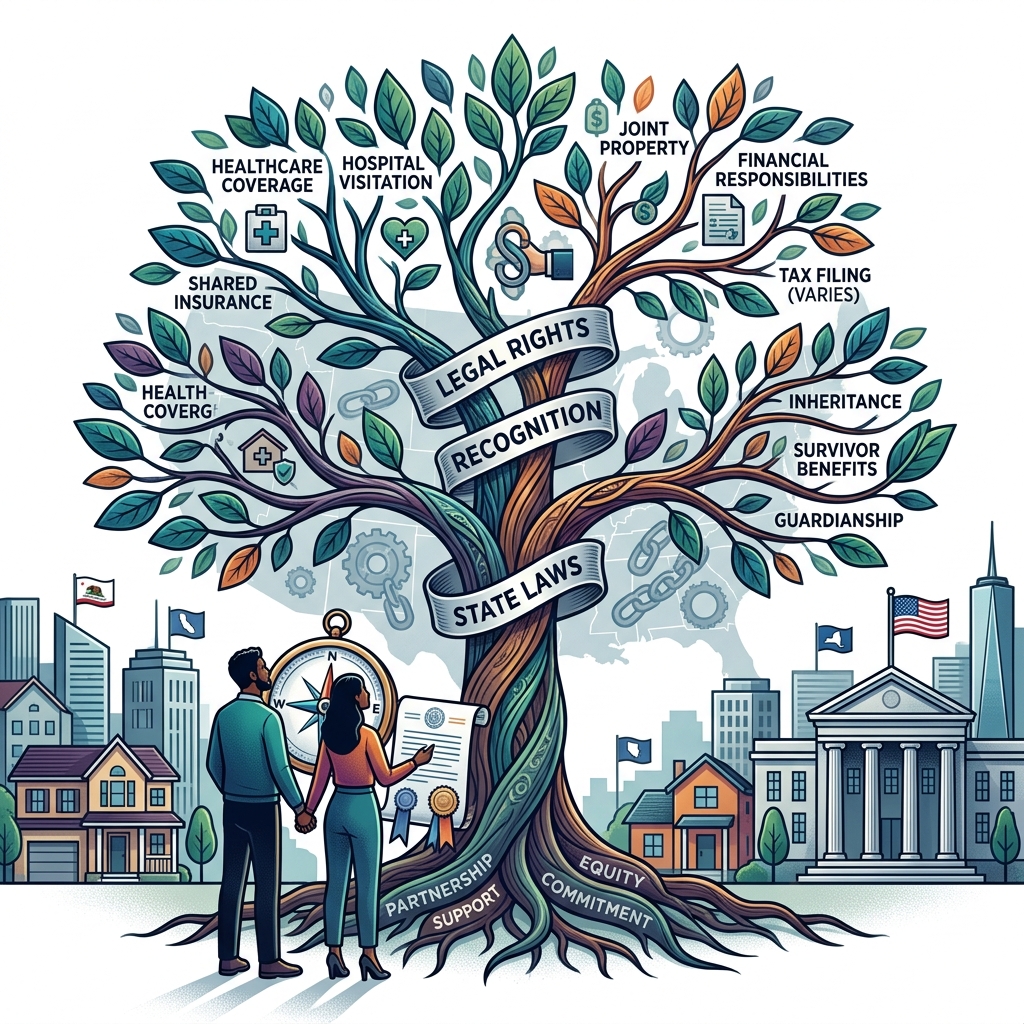
Many couples share their lives, finances, and homes without choosing formal marriage. For some of them, a domestic partnership offers a way to obtain legal recognition and limited rights similar to those of married spouses. This guide explains what domestic partnerships are, how they work, and how they differ from marriage across the United States.
What Is a Domestic Partnership?
A domestic partnership is generally a legally recognized relationship between two adults who live together, maintain an intimate and committed life together, and are not married. It is designed to give certain protections to couples who either:
- Prefer not to marry for personal, cultural, or financial reasons.
- Previously could not marry under state law (historically, some same-sex couples).
- Want legal recognition for cohabitation without entering a full marital status.
Domestic partnerships exist only where authorized by state or local law. Some jurisdictions treat registered domestic partners similarly to spouses for many state-level rights, while others offer only a narrow set of benefits.
Key Features of Domestic Partnerships
While the details vary, domestic partnerships tend to share several core characteristics:
- Registration or formal declaration: Most jurisdictions require filing a declaration or affidavit with a government office, such as a city clerk or secretary of state.
- Eligibility criteria: Couples usually must be adults, not closely related, unmarried to others, and living together in a committed relationship.
- Limited legal rights: Domestic partners often receive some rights involving healthcare, property, or employment benefits but rarely all rights associated with marriage.
- State-based recognition: Domestic partnerships are primarily creatures of state or municipal law; they generally are not recognized by federal law.
- Formal termination: Ending a registered domestic partnership may require a legal process similar to divorce in some places.
Domestic Partnership vs. Marriage: Core Differences
Domestic partnerships and marriages both create legally recognized relationships, but they are not identical. The table below highlights common distinctions seen in many U.S. jurisdictions.
| Aspect | Domestic Partnership | Marriage |
|---|---|---|
| Legal status | Recognized in specific states or cities; usually not recognized by federal law. | Recognized nationwide with full federal and state status. |
| Scope of rights | Some state or local rights; the breadth of benefits varies widely. | Comprehensive rights at both state and federal levels (tax, Social Security, immigration, etc.). |
| Creation | Often requires filing a registration or affidavit, paying a fee, and meeting eligibility criteria. | Requires a marriage license and ceremony in compliance with state law. |
| Termination | May need a formal dissolution process; in some states this can be similar to divorce. | Requires divorce or annulment, subject to family law procedures. |
| Federal benefits | No automatic federal spousal benefits, including Social Security and immigration sponsorship. | Eligible for federal spousal benefits and recognition. |
| Social perception | Often viewed as an alternative or step toward marriage, or a choice for couples who prefer not to marry. | Traditionally recognized as the default formal relationship institution. |
Common Rights and Benefits for Domestic Partners
The exact benefits of a domestic partnership depend on specific state or municipal law and the policies of employers or institutions. However, several types of protections are widely associated with domestic partnerships.
Healthcare and Medical Decision-Making
- Hospital visitation: Partners may be recognized as family for visitation purposes when a partner is hospitalized.
- Medical decision-making authority: In some jurisdictions or under specific healthcare directives, a domestic partner can make medical decisions if the other becomes incapacitated.
- Health insurance coverage: Employers or benefit plans may allow a domestic partner to be added to health insurance, providing coverage similar to that offered to spouses.
Employment and Leave Benefits
- Sick leave usage: In certain states, registered domestic partners can use paid sick leave or family leave to care for a seriously ill partner.
- Employer benefit programs: Some public and private employers treat domestic partners like spouses for purposes of voluntary benefit plans, such as dental or vision insurance.
Property, Housing, and Financial Protections
- Shared property or tenancy rights: Domestic partners may have rights related to jointly occupied housing or shared leases, particularly in jurisdictions that recognize tenancy protections.
- Community or marital-like property rules: In some states, property acquired during a registered domestic partnership can be treated similarly to marital property, with shared ownership and shared responsibility for debts.
- Pensions and death benefits: Certain retirement or workers’ compensation systems extend survivor or death benefits to recognized domestic partners.
Family and Parenting-Related Rights
Some jurisdictions grant domestic partners limited family-law rights. For example, when a child is born or adopted into a registered partnership, there may be legal presumptions that both partners are parents, similar to marriage.
- Presumed parentage of children born during the partnership in some states.
- Possible rights and obligations regarding child support or custody if the partnership ends, where state law provides for such recognition.
Limitations and Gaps in Domestic Partnership Rights
Despite the protections they offer, domestic partnerships typically do not recreate the full legal framework of marriage. Couples considering this option should carefully evaluate its limitations.
- No federal spousal status: Domestic partnerships are not recognized as marriages by the federal government. This means no automatic eligibility for federal tax benefits, Social Security spousal or survivor benefits, or immigration sponsorship based on the partnership.
- Variability across jurisdictions: Rights available to domestic partners differ significantly from one state or city to another. A couple with rights in one jurisdiction may have far fewer or no rights in another.
- Limited recognition as “family”: In some contexts, domestic partners may not be treated as family members under law or policy, limiting rights such as certain types of leave or inheritance without additional planning.
- Possible absence of statewide recognition: Some states do not provide statewide domestic partnership status at all, leaving couples dependent on local ordinances or private contracts.
Where and How Domestic Partnerships Are Recognized
Every state determines its own family law framework, including whether domestic partnerships are recognized and what rights they confer.
States with Robust Domestic Partnership Systems
Some states, notably California, have established comprehensive domestic partnership registries. Under California law, registered domestic partners generally have rights and responsibilities similar to those of spouses at the state level, including many protections under the family code.
- Domestic partners must register with the state to access those rights.
- California provides many marital-like rights, but federal benefits still do not apply unless the couple is married.
States with Limited or No Domestic Partnership Recognition
Other states have reduced or eliminated domestic partnership recognition, particularly after the nationwide legalization of same-sex marriage. For example, Florida does not have a statewide domestic partnership law, although some municipalities have enacted local protections.
- No universal statewide status, making rights heavily dependent on local rules and private agreements.
- Unmarried couples often must rely on contracts and estate planning documents for protection.
Municipal or Employer-Based Partnerships
In jurisdictions without statewide recognition, couples may find domestic partnership frameworks at the city level or within employer policies. City registries and employer benefit programs sometimes recognize domestic partners for specific purposes, such as health insurance or visitation rights.
Eligibility and Registration Requirements
To establish a domestic partnership, couples typically must satisfy legal criteria and complete registration formalities. While requirements vary, common elements include.
- Age: Both partners must be adults (often at least 18), and in some states one partner may need to be above a certain age threshold when using domestic partnership instead of marriage.
- Capacity: Each partner must have the mental capacity to consent to the partnership.
- Marital status: Neither partner can be married to or in another registered domestic partnership with someone else.
- Relationship: Partners generally must have a close, committed, and financially interdependent relationship, living together and not closely related by blood.
- Registration procedure: Typical steps include filing a declaration or affidavit with a government office, paying a fee, and sometimes appearing in person or providing proof of co-residence.
Once registration is complete, couples usually receive a certificate or file-stamped declaration that proves their domestic partnership status for legal or administrative purposes.
Ending a Domestic Partnership
Just as with marriage, domestic partnerships can come to an end. The termination process depends on the jurisdiction and the nature of the rights linked to the partnership.
- Voluntary termination: Some registries allow partners to file a termination or dissolution form when both agree to end the partnership.
- Court-based dissolution: In jurisdictions where domestic partners have substantial marital-like rights, ending the partnership may require a court proceeding similar to divorce, involving property division, support, and potentially parenting orders.
- Joint dissolution with marriage: Where a couple is both married and registered as domestic partners, some courts permit dissolving both statuses in a single case.
Because domestic partnership dissolution can carry financial and family consequences, legal advice is often recommended before filing to terminate the relationship.
Private Agreements and Planning for Unmarried Couples
Domestic partnerships are not available everywhere, and even where they exist they may not fully address a couple’s needs. Many unmarried partners use private legal documents to clarify expectations and protect each other.
Common Planning Tools
- Cohabitation or domestic partner agreements: Contracts that outline how partners will share property, handle expenses, and divide assets or debts if they separate.
- Wills and estate plans: Documents specifying how assets should pass at death, ensuring a partner is included as an heir if desired.
- Powers of attorney: Legal authorizations allowing a partner to make financial or legal decisions on the other’s behalf during incapacity.
- Advance healthcare directives: Instructions and designations that give a partner authority to make medical decisions and record end-of-life wishes.
These tools can be important even when a domestic partnership is registered, because partnership status alone may not guarantee complete protections, especially outside the recognizing jurisdiction or at the federal level.
Is a Domestic Partnership Right for You?
Choosing between marriage, domestic partnership, or remaining legally unrelated involves legal, financial, and personal considerations. Couples may wish to reflect on:
- Location: Does your state or city recognize domestic partnerships, and what rights are offered?
- Desired protections: Are you primarily seeking healthcare and employment benefits, or broader property and family-law rights?
- Federal benefits: Are federal tax rules, Social Security, or immigration sponsorship critical to your situation? If so, marriage may be necessary.
- Personal values: How do you and your partner view marriage and domestic partnership culturally or philosophically?
- Future plans: Would you consider marrying later, or do you prefer to rely on domestic partnership and private agreements long term?
Consulting a family law attorney or legal aid organization familiar with local rules can help you understand the practical consequences of each option and design a plan that matches your goals.
Frequently Asked Questions (FAQs)
Do domestic partnerships exist in every U.S. state?
No. Domestic partnership recognition is determined by state and sometimes city law. Some states, like California, have robust statewide systems, while others offer only limited or local recognition, and some provide none at all.
Can domestic partners receive federal benefits like Social Security?
Generally, registered domestic partners cannot rely on their partnership status to obtain federal spousal benefits. Federal law uses marriage, not domestic partnership, as the basis for spousal Social Security, tax, and immigration benefits.
Are domestic partnerships only for same-sex couples?
No. Domestic partnerships can be available to both same-sex and different-sex couples, depending on the jurisdiction’s rules. Historically, some systems were created to protect same-sex couples before marriage equality, but many now are open to any qualifying couple.
Can we convert a domestic partnership into a marriage?
In some jurisdictions, domestic partners can marry each other, and their prior partnership may affect certain rights or procedures. In California, for example, partners who are both married and registered can sometimes dissolve both statuses together, but the exact rules depend on state law.
What if our state does not recognize domestic partnerships?
If your state lacks a domestic partnership framework, you may still be able to register locally in certain cities or rely on employer-based recognition. However, many couples in this situation use contracts, wills, and healthcare directives to protect themselves instead of or in addition to any local status.
References
- Domestic partnership — Various jurisdictions summarized. 2023-05-01. https://en.wikipedia.org/wiki/Domestic_partnership
- Frequently Asked Questions – Domestic Partners Registry — California Secretary of State. 2022-01-10. https://www.sos.ca.gov/registries/domestic-partners-registry/frequently-asked-questions
- Unmarried Couples & Their Legal Rights — Justia Family Law Center. 2021-08-15. https://www.justia.com/family/domestic-partners-unmarried-couples/
- State Laws: Domestic Partnerships — FindLaw Family Law. 2020-11-30. https://www.findlaw.com/family/domestic-partnerships/state-laws-domestic-partnerships.html
- Registered Domestic Partnerships: The Basics — Washington Law Help. 2020-06-01. https://www.washingtonlawhelp.org/en/registered-domestic-partnerships-basics
- What is a Domestic Partnership: Legal Implications in Manhattan, NY — Levoritz Law Firm. 2023-03-10. https://www.levoritzlaw.com/blog/what-is-a-domestic-partnership-legal-implications-in-ny/
- How Domestic Partnerships Are Treated in Florida Family Law — Bonderud Law Firm. 2022-09-05. https://www.bonderudlaw.com/blog/how-domestic-partnerships-are-treated-in-florida-family-law/
Similar Articles








Read full bio of medha deb


