
Understanding the DOJ Equitable Sharing Program
How federal asset forfeiture proceeds are shared with state, local, and tribal law enforcement—and the rules that govern their use.
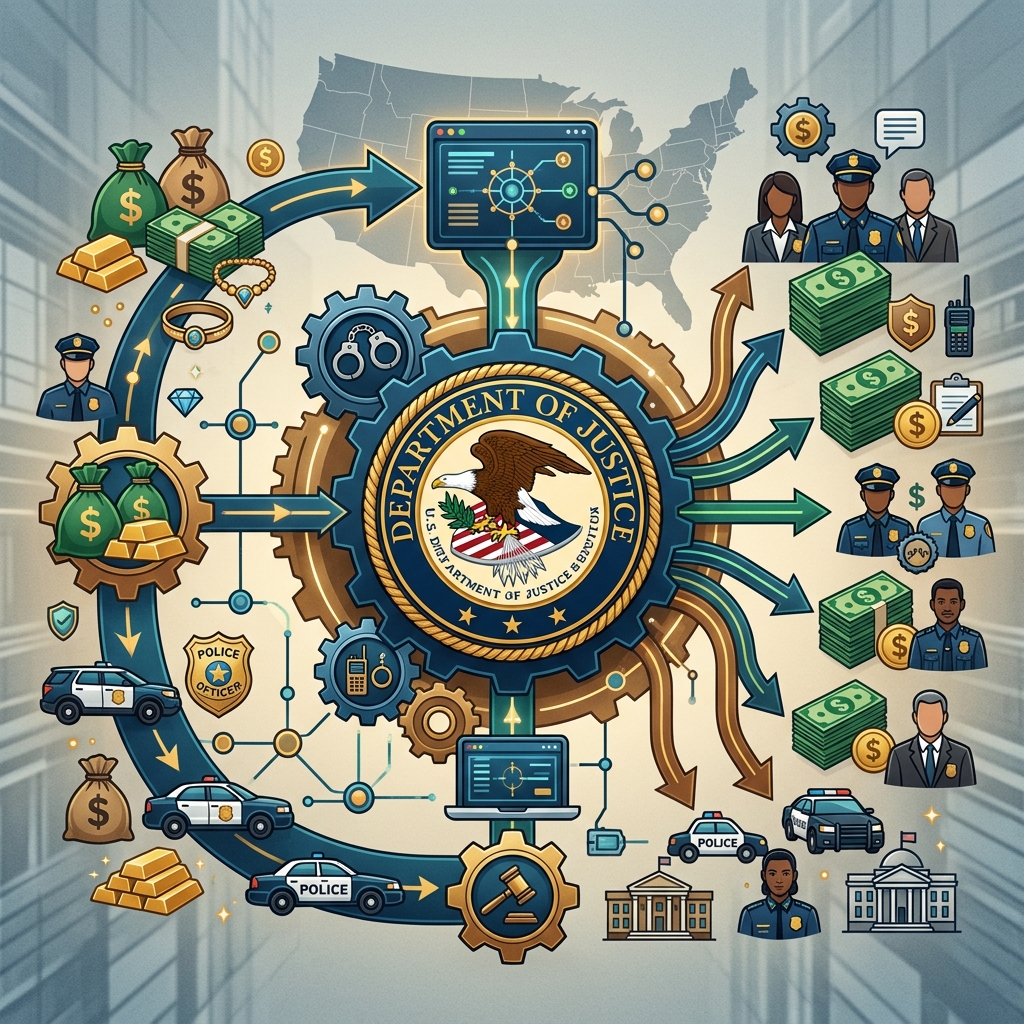
The Equitable Sharing Program administered by the U.S. Department of Justice (DOJ) is a key component of the federal Asset Forfeiture Program, allowing federal authorities to share a portion of forfeited assets with state, local, and tribal law enforcement agencies that help enforce federal law. It is designed to encourage interagency cooperation, bolster public safety, and ensure that criminal proceeds are reinvested into legitimate law enforcement purposes rather than general government spending.
1. Asset Forfeiture and Equitable Sharing: The Basics
Federal asset forfeiture is the legal process through which the government seizes property that represents the proceeds of crime or that was used to facilitate criminal activity. Once a forfeiture is completed under federal law, the value of the property is deposited into the Justice Assets Forfeiture Fund (AFF), which is managed by the Attorney General pursuant to 28 U.S.C. § 524(c). From this fund, the DOJ can allocate resources to support law enforcement operations, victim compensation, and other authorized uses.
Equitable sharing occurs when a portion of the net proceeds from these federal forfeitures is distributed to non-federal law enforcement agencies that directly contributed to the investigation or seizure. Participation is voluntary, and sharing is discretionary—agencies have no automatic entitlement to a portion of the proceeds, even if they assisted in the case.
| Concept | Purpose | Key Legal Basis |
|---|---|---|
| Asset Forfeiture | Remove criminal proceeds and instrumentalities from circulation and deter crime. | 28 U.S.C. § 524(c); various federal forfeiture statutes. |
| Equitable Sharing | Share federal forfeiture proceeds with participating non-federal law enforcement agencies. | Statutory authority granted to the Attorney General and Secretary of the Treasury. |
2. Core Goals of the DOJ Asset Forfeiture Program
The equitable sharing framework operates within the broader objectives of the DOJ Asset Forfeiture Program. According to DOJ policy, this program pursues four primary goals:
- Punish and deter crime by depriving offenders of assets gained through or used in illegal activities.
- Promote cooperation between federal, state, local, tribal, and foreign law enforcement agencies.
- Recover property for victims when authorized, so that forfeited assets can help compensate those harmed by crime.
- Ensure lawful and ethical administration of forfeiture in a manner consistent with professional standards and sound public policy.
Equitable sharing supports these goals by giving partner agencies a financial stake in dismantling criminal enterprises and by providing additional resources that can expand their investigative and operational capacity.
3. How Equitable Sharing Works in Practice
Only agencies that play a direct role in a law enforcement action that results in a federal forfeiture may request a share of the proceeds. This can include participation in joint investigations, task forces, or providing substantial assistance such as investigative support, intelligence, or manpower.
3.1 Eligibility to Request a Share
Eligible entities include:
- State police and highway patrol agencies.
- County sheriffs and municipal police departments.
- Tribal law enforcement agencies recognized by the federal government.
- Other specialized state or local law enforcement entities with arrest, investigative, or prosecutorial authority.
To be considered, the agency must cooperate with a federal seizing agency—such as the FBI, DEA, or another DOJ component—and the property must ultimately be forfeited under federal law.
3.2 Requesting Equitable Sharing Funds
Requests for equitable sharing from DOJ must be submitted electronically using the designated forms and systems. For DOJ forfeitures, state, local, and tribal agencies typically use the DAG-71 (Application for Transfer of Federally Forfeited Property), filed through the Department’s secure online portal.
Key procedural features include:
- Agencies must submit a separate request for each asset for which they seek a share.
- Requests generally must be filed no later than 45 days after the date of forfeiture; late submissions require a written waiver request explaining the delay.
- Agencies must describe their contributions to the case, including work hours and a narrative of the assistance provided.
- When a task force agreement or memorandum of understanding (MOU) governs the partnership, that agreement is submitted along with the sharing request.
The federal agency that led the seizure and forfeiture evaluates the request, considers the level of non-federal participation, and recommends an equitable distribution.
4. Determining Equitable Shares and Limits
Federal law authorizes the Attorney General to share net proceeds of federal forfeitures with participating agencies, but the exercise of this authority is discretionary and constrained by statute and DOJ policy. To maintain national consistency and avoid excessive payments, sharing is subject to both percentage guidelines and annual caps.
4.1 Factors Influencing the Share
The precise percentage awarded to any agency depends on several factors, including:
- The degree of direct participation in the investigation and seizure.
- Whether the agency initiated the case or significantly developed the underlying intelligence.
- The amount of manpower, specialized expertise, or operational resources contributed.
- Any governing task force agreements or written sharing understandings.
DOJ policy seeks to ensure that sharing is truly equitable—that is, proportionate to actual contributions rather than simply tied to jurisdiction or formal titles.
4.2 Annual Caps on Payments
To prevent over-reliance on equitable sharing as a funding stream, the DOJ and the Department of the Treasury cap the total amount that any one agency can receive per fiscal year. Under current guidance, a participating agency may receive up to a specified maximum from each department’s forfeiture fund; for example, DOJ’s guidance has referenced a cap of $10 million per year in Justice funds and $10 million in Treasury funds for a single agency, with any calculated sharing amounts above those caps remaining in the respective federal forfeiture funds.
| Source of Forfeiture | Administering Department | Typical Annual Cap per Agency |
|---|---|---|
| DOJ-administered forfeitures | Department of Justice | Up to $10 million in sharing funds per fiscal year. |
| Treasury-administered forfeitures | Department of the Treasury | Up to $10 million in sharing funds per fiscal year. |
5. Appropriate Use of Equitable Sharing Funds
A core principle of the program is that equitable sharing funds are intended to supplement, not replace, an agency’s regularly appropriated budget. DOJ policy bars agencies from using shared funds to pay for items that their governing body is obligated to fund as basic operational expenses, such as standard salaries or general municipal services.
5.1 Permissible Uses
While the full list is detailed in DOJ’s guidance documents, typical authorized uses of equitable sharing proceeds include:
- Law enforcement equipment and technology (e.g., radios, body armor, surveillance tools).
- Specialized training for officers and investigators.
- Task force operations, including overtime related to joint investigations.
- Investigative purchases, informant payments, and other case-related expenses.
- Law enforcement facilities and infrastructure improvements directly tied to public safety missions.
These expenditures must be consistent with DOJ’s authorized categories and documented thoroughly for audit and oversight purposes.
5.2 Prohibited or Restricted Uses
Equitable sharing funds are not a general-purpose revenue stream. Common restrictions include prohibitions on:
- Covering routine operating expenses that should come from the agency’s normal budget.
- Paying salaries or benefits of existing positions unrelated to specific law enforcement projects.
- Funding political or lobbying activities.
- Providing direct cash grants to non-law-enforcement entities unless specifically authorized.
These restrictions are designed to reduce financial incentives that might distort policing priorities and to keep forfeiture proceeds focused on genuine public safety needs.
6. Oversight, Accountability, and Reporting
Because asset forfeiture and equitable sharing involve significant sums and potential risks of misuse, DOJ and Treasury both maintain robust oversight frameworks. Participating agencies must agree to detailed compliance conditions in order to receive funds, and they may be audited or reviewed for adherence to program rules.
6.1 Reporting Requirements
Agencies receiving equitable sharing funds generally must:
- Maintain separate accounting records for forfeiture proceeds and property.
- Submit periodic reports detailing balances, expenditures, and program uses.
- Certify annually that funds were used only for authorized law enforcement purposes.
- Cooperate with federal reviews or audits, providing documentation upon request.
Failure to comply can result in sanctions, including suspension from the program, demands for repayment of misused funds, or other corrective actions.
6.2 Policy Updates and Guidance
Both DOJ and the Department of the Treasury issue policy updates, program guides, and administrative guidance to clarify how equitable sharing should operate. These materials address topics such as accounting rules, allocation criteria, asset management, and the interplay between federal and state forfeiture law.
For instance, Treasury maintains a dedicated asset forfeiture and equitable sharing page summarizing current policies and linking to program guidance. DOJ likewise publishes the Guide to Equitable Sharing for State, Local, and Tribal Law Enforcement Agencies, which provides detailed operational instructions.
7. Interaction with State Law and Policy Debates
Equitable sharing exists alongside state-level forfeiture laws, and agencies sometimes have a choice of pursuing forfeiture under state or federal law. Critics have raised concerns that federal equitable sharing may allow some agencies to circumvent stricter state-level reforms, such as higher burdens of proof or requirements that forfeiture proceeds go to general funds or education rather than law enforcement.
Research by policy organizations and scholars has highlighted several key points:
- Federal equitable sharing can be attractive to local agencies because they may receive up to 80% of the proceeds in some federally adopted forfeiture cases.
- States that restrict local retention of forfeiture proceeds may still see substantial flows of forfeiture revenues through federal sharing.
- Reforms at the state level, such as requiring criminal convictions for forfeiture, do not automatically limit federal equitable sharing, unless the state specifically restricts participation.
In response, reform proposals often focus on increasing transparency, tightening state-level participation rules, or enhancing auditing so that the public can see how forfeiture funds are obtained and spent.
8. Practical Considerations for Participating Agencies
For law enforcement agencies, participation in the DOJ Equitable Sharing Program can offer substantial benefits, but it also carries responsibilities and reputational risks. Agencies considering or managing participation should prioritize the following practices:
- Develop clear internal policies on when to pursue federal forfeiture and how to document contributions to joint cases.
- Train financial and command staff on DOJ and Treasury rules for requesting, receiving, and spending shared funds.
- Maintain transparency by sharing annual forfeiture and expenditure reports with local governing bodies and, where appropriate, the public.
- Guard against conflicts of interest by ensuring that enforcement priorities are driven by public safety and not by potential revenue.
- Coordinate with prosecutors to choose the most appropriate legal forum—state or federal—based on the facts and the public interest, not solely financial considerations.
When managed properly, equitable sharing can augment specialized enforcement capabilities such as cybercrime units, narcotics task forces, and complex financial investigation teams. It allows agencies to reinvest criminal proceeds into tools and training that enhance community protection.
9. Frequently Asked Questions (FAQ)
Q1. What is the main purpose of the DOJ Equitable Sharing Program?
The primary purpose is to reward cooperative law enforcement efforts by sharing a portion of federally forfeited assets with state, local, and tribal agencies that directly assist in federal investigations and seizures. This is intended to enhance interagency collaboration, disrupt criminal enterprises, and support legitimate law enforcement activities.
Q2. Who decides how much money a local agency receives?
The decision is made by federal authorities. The lead federal agency and DOJ review the equitable sharing request—including documented contributions, task force agreements, and statutory limits—and then determine the amount to be awarded in accordance with federal law and DOJ guidelines.
Q3. Can equitable sharing funds be used for any local government expense?
No. Equitable sharing proceeds must be used for authorized law enforcement purposes and may not be treated as general revenue. DOJ guidance restricts spending to specific categories such as equipment, training, and investigative support, and prohibits use for routine budgetary obligations unrelated to law enforcement.
Q4. Does an agency automatically receive funds if it helps in a federal case?
No. Participation creates eligibility but not entitlement. Agencies must submit a timely and properly documented request (such as a DAG-71) and the federal government has discretion to approve or deny sharing, and to determine the percentage awarded.
Q5. How is transparency ensured?
Transparency is promoted through reporting requirements, audits, and program guidelines. Agencies must maintain separate accounts, file periodic and annual reports, and certify compliance with program rules. Federal oversight bodies may conduct reviews or audits, and many agencies voluntarily disclose their forfeiture and equitable sharing data to the public.
References
- Equitable Sharing Program — U.S. Department of Justice, Criminal Division. 2023-05-01. https://www.justice.gov/criminal/criminal-mnf/equitable-sharing-program
- Guide to Equitable Sharing for State, Local, and Tribal Law Enforcement Agencies — U.S. Department of Justice, Criminal Division. 2018-03-01. https://www.justice.gov/criminal/media/1044326/dl
- Equitable Sharing — U.S. Department of the Treasury, Asset Forfeiture. 2024-03-01. https://home.treasury.gov/policy-issues/terrorism-and-illicit-finance/asset-forfeiture/equitable-sharing
- Equitable Sharing — Institute for Justice, Policing for Profit Report. 2020-11-17. https://ij.org/report/policing-for-profit-4/equitable-sharing/equitable-sharing/
- Assistance Listing: Equitable Sharing Program — SAM.gov, U.S. General Services Administration. 2021-09-30. https://sam.gov/fal/e0d9595d7d1f1c8eb5e6f2a1f7140689/view
Similar Articles








Read full bio of Sneha Tete




