
Delaware Traffic Laws: 5 Practical Tips To Avoid Fines In 2025
A practical guide to Delaware’s traffic rules, speed limits, point system, and right-of-way laws for safer, more informed driving.
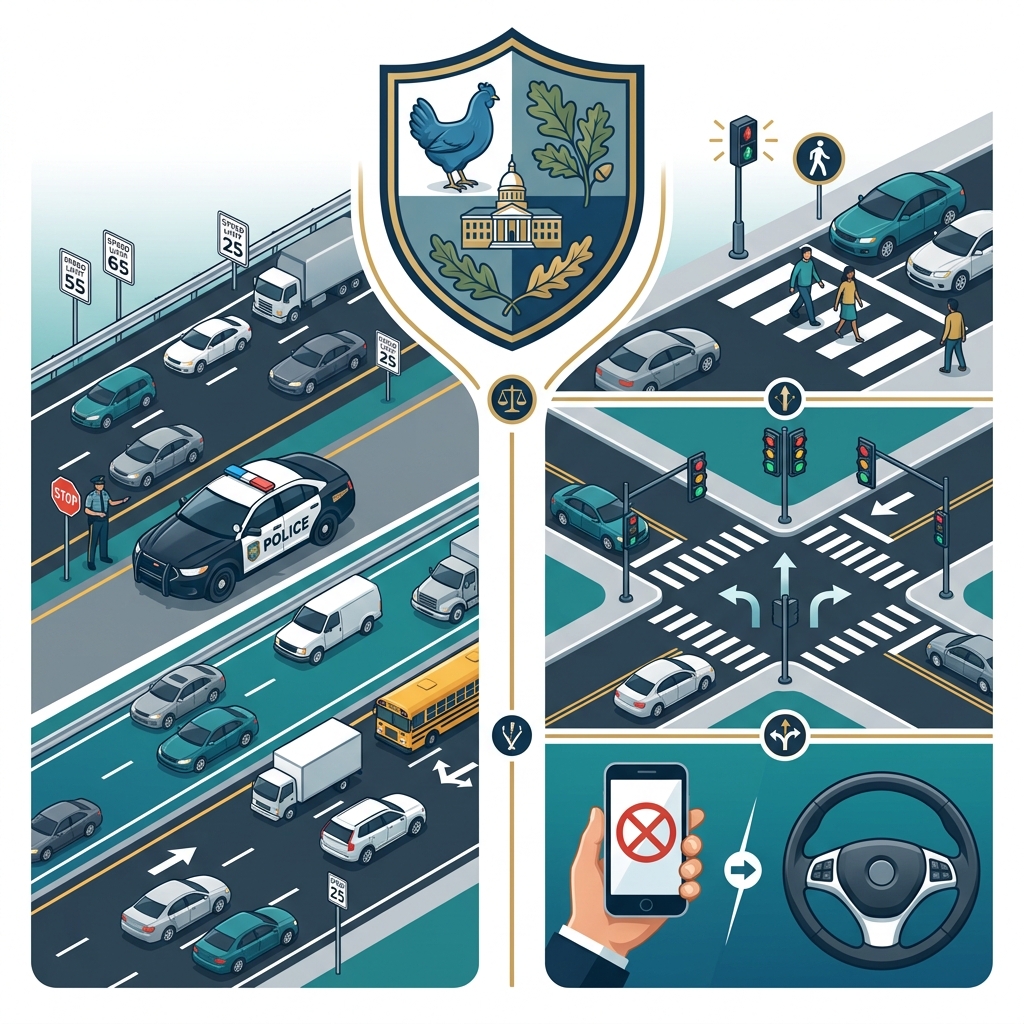
Delaware traffic laws shape everything from how fast you may drive to how many chances you get before your driver’s license is suspended. These rules are collected primarily in Title 21 of the Delaware Code, which sets out definitions, registration requirements, rules of the road, and enforcement procedures for motorists in the state. Delaware also publishes official guidance through the Division of Motor Vehicles (DMV) to help drivers understand and follow these laws.
This article explains the core features of Delaware’s traffic law system in clear, practical terms. You will learn about speed limits, how traffic tickets and points work, basic right-of-way rules, and what to expect during a traffic stop. While this is not legal advice, it will help you recognize common problem areas and drive more confidently on Delaware roads.
1. The Legal Framework for Driving in Delaware
Delaware treats driving as a regulated privilege rather than an absolute right. To drive legally, you must comply with a set of statutes and regulations that govern how vehicles are registered, who may operate them, and how drivers must behave on public roads.
1.1 Title 21: Motor Vehicles
Title 21 of the Delaware Code is the main body of law dealing with motor vehicles and traffic. It is divided into parts and chapters addressing issues such as:
– key legal terms and basic rules. - Vehicle registration and titling – requirements for legally placing a vehicle on the road.
- Driver licensing – eligibility, testing, and license classes.
- Rules of the road – how drivers must operate vehicles, including speed, right-of-way, and signal use.
- Traffic enforcement and penalties – fines, points, suspensions, and criminal offenses.
The Rules of the Road chapter sets out detailed obligations such as keeping right, obeying signals, and yielding when required. Understanding these provisions is key to avoiding violations.
1.2 Licensing Basics
Delaware law prohibits driving a motor vehicle on public streets and highways without a valid license to operate it. The DMV oversees licensing, including:
- Vision, knowledge, and road tests for new drivers.
- Graduated licensing for younger drivers.
- Suspension and reinstatement procedures when laws are violated.
If your license is suspended due to points or other violations, continuing to drive can lead to further penalties and potential criminal charges, so tracking your status carefully is important.
2. Delaware Speed Limits and Safe Driving Expectations
Speed management is a central part of Delaware’s traffic safety strategy. The state uses statutory maximum speed limits, combined with enforcement and penalties, to reduce crashes and protect pedestrians, cyclists, and other drivers.
2.1 Typical Maximum Speed Limits
Delaware law sets general maximum speed limits for different types of roads, subject to change where posted signs show different limits. Common limits include:
- 20 mph in school zones when the reduced limit is actively in effect.
- 25 mph on most local residential and many commercial area roads.
- 50 mph on typical two-lane roads.
- 55 mph on many four-lane roads and divided highways.
Drivers must always follow posted signs, which can override these default limits for safety reasons, construction, or special conditions.
2.2 Driving Too Fast – and Too Slow
Speeding gets much of the attention, but driving significantly below the normal speed of traffic can also be a violation. Delaware’s traffic code aims to prevent drivers from traveling so slowly that they delay the normal movement of traffic. This includes:
- Unnecessarily slow driving on higher-speed roads.
- Obstructing traffic when other safe options exist, such as using turnouts or changing lanes.
Conversely, traveling faster than the posted limit, or too fast for conditions like rain, ice, or heavy traffic, can lead to citations and increased risk of crashes.
2.3 Sample Speed and Penalty Comparison Table
Exact fines and point values depend on the specific statute section and circumstances, but the table below illustrates how speed-related issues generally escalate in seriousness:
| Driving Behavior | Typical Legal Concern | Potential Consequences |
|---|---|---|
| Driving at or below the limit, matching traffic flow | Lawful, expected behavior | No penalties; safer conditions |
| Moderate speeding above posted limit | Standard traffic offense | Fines, points added to license, possible insurance impacts |
| Excessive speeding or aggressive driving | Heightened risk, possible aggressive driving designation | Larger fines, more points, potential suspension and mandatory courses |
| Driving too slowly and obstructing traffic | Failure to maintain normal traffic flow | Possible citation for impeding traffic |
3. How Delaware’s Traffic Ticket Point System Works
Delaware uses a point system to track drivers who repeatedly break traffic laws. Each qualifying conviction adds points to your driving record. Accumulating too many points within a set time period can trigger warnings, mandatory courses, or license suspensions.
3.1 Points for Traffic Violations
Every moving violation that is subject to the point system is assigned a specific value. More serious offenses carry more points; for example, offenses classified as aggressive driving are weighted heavily.
Key features of the system include:
- Full value for the first 12 months after a conviction.
- Half value for the second 12 months following the same violation.
- No further impact on your point total after two years, although the conviction may remain on your record.
For instance, a violation worth six points counts fully in the first year, then only three points in the second year before aging out of the active total.
3.2 Thresholds That Trigger Suspensions
Points are not merely symbolic; they lead to specific administrative actions when they reach certain levels.
- Accumulating 12 points within 24 months can trigger a mandatory defensive driving course or a license suspension of at least two months.
- Higher totals within the same period can lead to longer suspension durations.
- Repeat serious violations, such as aggressive driving or certain signal violations, may carry escalating penalties for subsequent offenses.
The DMV uses these thresholds to identify drivers who may pose an elevated risk on the road and to encourage them to change their driving behavior through education or temporary loss of driving privileges.
4. Obeying Signs and Signals: Right-of-Way and Control Devices
Traffic control devices—signals, signs, and lane markings—exist to organize the movement of vehicles and pedestrians. Delaware law requires strict obedience to these devices, and violations can carry both fines and points.
4.1 Traffic Signal Rules
Delaware’s traffic-control signal rules specify what drivers and pedestrians must do at green, amber, and red indications. Under 21 Del. C. § 4108, the following basic rules apply:
- Green indication: Drivers may proceed straight or turn right or left unless a posted device prohibits that specific turn. They must still yield to vehicles and pedestrians lawfully in the intersection or adjacent crosswalk when the green signal appears.
- Amber indication: A steady amber generally warns that the signal is about to change to red; vehicles should prepare to stop when safe.
- Red indication: Drivers must stop and may not enter the intersection, except as specifically allowed by law (such as certain right turns on red when permitted and safe).
- Lane use control signals: Drivers may only travel in lanes showing a green signal, must leave lanes showing a steady amber when safe, and must not enter lanes with a red indication.
Making a prohibited movement—such as driving into a lane marked by a red lane signal—is unlawful and can result in fines and potential further penalties for repeat offenses.
4.2 Basic Right-of-Way Expectations
Beyond signals, Delaware’s rules of the road set out right-of-way obligations at intersections, crosswalks, and when turning. While specific statutes govern many situations, general principles include:
- Yielding to pedestrians lawfully in crosswalks when turning or proceeding on green.
- Using caution at uncontrolled intersections and yielding when the law requires, such as to vehicles already in the intersection or approaching from certain directions.
- Waiting for oncoming traffic to clear before completing left turns, unless protected by a specific signal and signage.
Failure to yield the right-of-way can lead to collisions and liability. Delaware courts and law enforcement pay close attention to whether drivers honored their right-of-way duties when assessing fault.
5. Delaware Rules of the Road and Everyday Driving Conduct
While major offenses like DUI draw headlines, many citations arise from everyday driving behaviors: lane use, following distance, and distraction. Delaware’s Rules of the Road chapter addresses these practical issues.
5.1 Lane Use, Passing, and Following Distance
Delaware law generally requires drivers to keep as far to the right as practicable, allowing passing on the left when safe and lawful. Some key expectations include:
- Pass other vehicles on the left when possible and safe, moving fully into the passing lane before returning.
- Keep to the right when traveling slower than the normal speed of traffic to avoid impeding flow.
- Maintain a following distance that is “reasonable and prudent,” taking into account speed, traffic, and road conditions.
These rules aim to reduce sudden lane changes, tailgating, and other behaviors that contribute to rear-end crashes and road rage incidents.
5.2 Electronic Devices and Distraction
Delaware restricts the use of handheld electronic devices while driving. Activities such as manual texting, emailing, and viewing images on a handheld phone are prohibited when the vehicle is in motion. Hands-free devices are typically allowed, provided the driver does not hold the device in their hand.
Distracted driving is a major safety concern nationally and within Delaware. Eliminating manual phone use and other distractions is critical for reducing crashes and keeping points off your record.
6. Traffic Stops and Enforcement Practices
Understanding what happens during a traffic stop can reduce anxiety and promote safety for both drivers and law enforcement officers. Delaware’s DMV provides detailed guidance on how motorists should respond when signaled to pull over.
6.1 How to Respond When You Are Pulled Over
When you see emergency lights behind you while driving in Delaware:
- Stay calm and activate your turn signal.
- Pull safely to the right side of the roadway or another safe area as soon as practicable.
- Turn off your ignition and radio, and remain in the vehicle unless the officer instructs you to exit.
- Keep both hands visible on the top of the steering wheel; ask passengers to stay calm and keep their hands in plain view.
These steps support a safe interaction and reduce misunderstandings.
6.2 Interaction with the Officer
During the stop, the officer may use spotlights or request that you turn on interior lights to see inside your vehicle at night. They may ask for:
- Your driver’s license.
- Proof of insurance.
- Vehicle registration.
If these documents are not within easy reach, tell the officer where they are before reaching. If you have a weapon in the vehicle, inform the officer upon first contact. If the officer is not in uniform, you may ask to see law enforcement credentials.
At the end of the encounter, the officer may issue a warning or a traffic ticket. If you disagree with the citation, Delaware DMV guidance stresses that you should not argue on the roadside; you can contest the ticket later through the legal process.
7. Practical Tips to Avoid Delaware Traffic Tickets
Although Delaware’s traffic laws are extensive, a few practical habits can significantly reduce your risk of receiving a ticket or accumulating points.
- Monitor speed closely – Learn typical limits (20 mph in school zones, 25 mph in residential areas, 50 mph on two-lane roads, 55 mph on many divided highways) and adjust for signs that impose lower limits.
- Minimize distractions – Use hands-free technology if necessary, but prioritize keeping your eyes on the road.
- Respect right-of-way – Yield to pedestrians in crosswalks and vehicles where required, especially at intersections and when turning left.
- Keep a buffer of points – Avoid repeated violations within a two-year period to prevent triggering mandatory courses or suspensions.
- Cooperate during traffic stops – Follow DMV guidance to ensure safe, professional interactions.
8. Frequently Asked Questions About Delaware Traffic Laws
8.1 Do Delaware’s speed limits change in school zones?
Yes. School zones often have a reduced 20 mph limit that applies when the school zone is active, typically indicated by flashing lights or posted time periods. Drivers should watch carefully for these signals and slow down accordingly.
8.2 How long do points from a violation stay on my record?
Points typically remain in full effect for 12 months after the conviction, then drop to half value for the next 12 months. After two years, the points from that specific conviction no longer count toward new suspension thresholds, although the record of the violation may still exist.
8.3 Can I lose my license just from traffic tickets?
Yes. If you accumulate enough points within the specified period—such as 12 points in 24 months—you may face mandatory defensive driving courses or license suspension. More serious or repeated offenses can lead to longer suspension periods.
8.4 What should I do if I believe a traffic ticket is unfair?
Delaware DMV guidance recommends cooperating with the officer at the scene and avoiding arguments. If you disagree with the ticket, you can challenge it later through the appropriate court or administrative process, potentially with the help of a legal professional.
8.5 Are Delaware’s traffic laws different from neighboring states?
Yes. While basic concepts such as speed limits and right-of-way are similar, specific limits, point systems, and enforcement practices vary by state. If you drive regularly between Delaware and other jurisdictions, it is wise to review each state’s laws.
References
- Title 21 – Motor Vehicles — State of Delaware Code Online. 2025-01-01. https://delcode.delaware.gov/title21/index.html
- Chapter 41 – Rules of the Road — State of Delaware Code Online. 2025-01-01. https://delcode.delaware.gov/title21/c041/index.html
- 21 Delaware Code § 4108 – Traffic-control signal legend — Justia / Delaware Code. 2025-01-01. https://law.justia.com/codes/delaware/title-21/chapter-41/subchapter-ii/section-4108/
- Motor Vehicle Laws & Regulations — Delaware Division of Motor Vehicles. 2018-07-01. https://dmv.de.gov/Laws-Regs/index.shtml?dc=sb168_2018
- Delaware Traffic Laws — FindLaw. 2024-01-01. https://www.findlaw.com/state/delaware-law/delaware-traffic-laws.html
- 7 Delaware Traffic Laws Drivers Commonly Ignore — Injury Claim Coach. 2023-03-01. https://www.injuryclaimcoach.com/delaware/traffic-laws.html
- Motor Vehicle Laws & Regulations (General) — Delaware Division of Motor Vehicles. 2022-01-01. https://dmv.de.gov/Laws-Regs/index.shtml
Similar Articles








Read full bio of medha deb


