
Creative Commons Licenses: 6 Key Types, Uses, And How To Apply
Learn how Creative Commons licenses work, what each license type allows, and how creators and users can safely share, reuse, and remix copyrighted works.
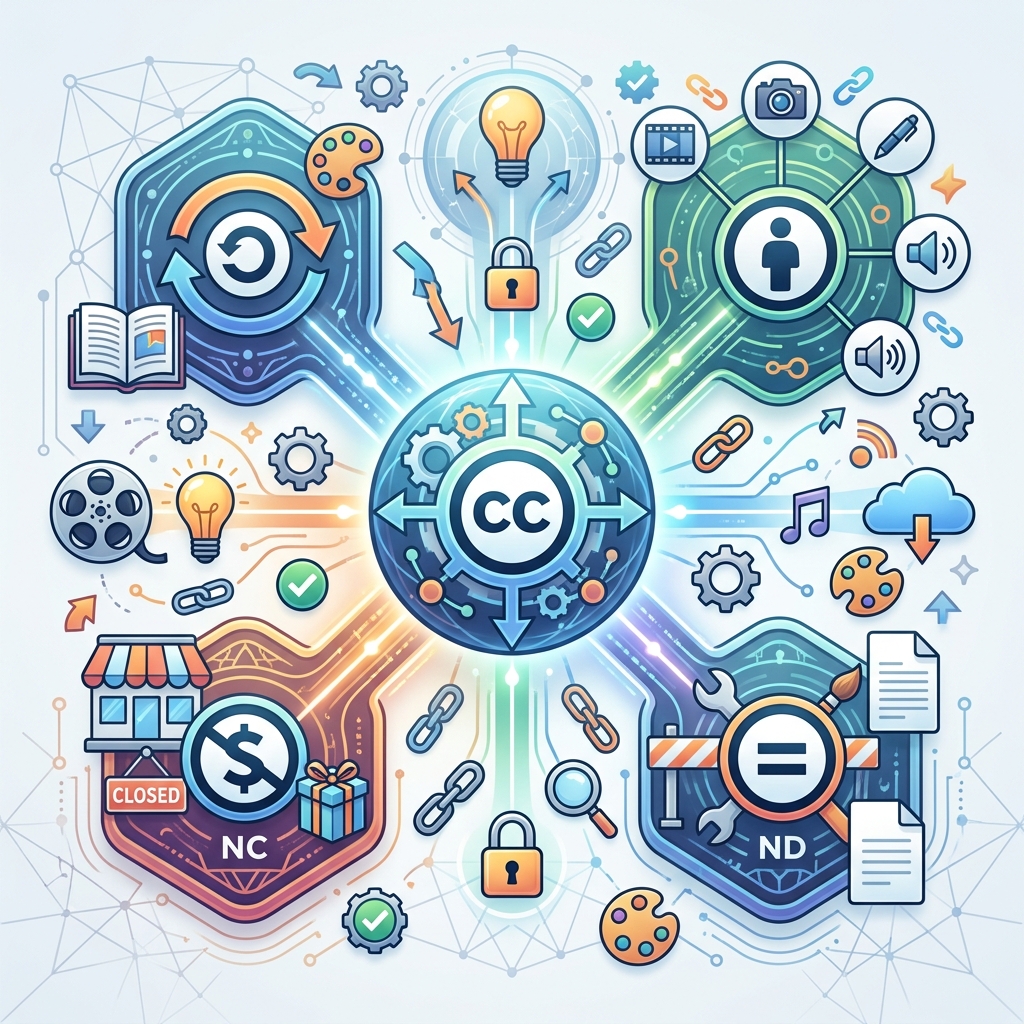
Creative work such as writing, photos, music, videos, and artwork is automatically protected by copyright from the moment it is created. However, in the digital age, many creators want their work to be shared and reused more openly, without having to negotiate an individual contract with every user. Creative Commons licenses provide a standardized, legally enforceable way to grant those permissions in advance while the creator keeps their copyright.
This guide explains what Creative Commons (CC) licenses are, the conditions they use, how the six main license types differ, and how both creators and users can apply them correctly and safely.
What Is a Creative Commons License?
A Creative Commons license is a public copyright license that enables a creator to tell the world exactly how their work may be used without people needing to ask for permission each time. These licenses are built on copyright law, not a replacement for it: the author retains ownership but grants defined rights to everyone who encounters the work.
Under a Creative Commons license:
- The creator chooses which uses are allowed in advance (for example, commercial use, remixing, or sharing).
- Anyone who complies with the stated conditions may use the work without individually contacting the creator.
- The license is non-exclusive and generally worldwide, so many people can use the same work at the same time.
- Users who ignore the license terms may be infringing copyright and can lose the benefit of the license.
In other words, a Creative Commons license is a standard form agreement between the creator and the public. It turns what would normally be a restricted copyrighted work into one that can be shared and reused under clear rules.
Creative Commons and Copyright: How They Fit Together
To understand Creative Commons licensing, it helps to see how it interacts with ordinary copyright law:
- Copyright remains in place: The creator keeps their rights and can still enforce them against uses that fall outside the license.
- License grants permissions: The CC license tells the public what they can do without further permission, such as copying, distributing, or adapting the work.
- Not all uses are covered: Uses that are already allowed under copyright limitations (such as fair use or fair dealing in some jurisdictions) do not require the CC license.
- Irrevocability: Once a CC license is applied, existing copies typically remain licensed on those terms, even if the creator later changes their mind, because users have already relied on the permissions given.
Because CC licenses are grounded in copyright, only someone who holds the copyright — usually the creator or an assignee — can apply a CC license to a work. If you do not own the rights, you cannot validly license the work under Creative Commons.
The Building Blocks: Core Creative Commons License Conditions
Creative Commons licenses are built from four core conditions. These conditions combine in different ways to form the six main license types.
| Condition | Code | What It Allows or Requires |
|---|---|---|
| Attribution | BY | Users must credit the creator and provide basic information about the source and license. |
| ShareAlike | SA | Adaptations must be released under the same license terms, keeping the work freely reusable in future. |
| NonCommercial | NC | Use is permitted only for non-commercial purposes; commercial exploitation requires separate permission. |
| NoDerivatives | ND | Users may copy and share the work as-is, but may not distribute modified versions. |
Attribution: The Universal Requirement
All current Creative Commons licenses require attribution, meaning users must give appropriate credit to the creator. A common best-practice guideline is summarized by the acronym TASL:
- Title of the work
- Author or creator
- Source (such as a URL or publication where the work appears)
- License name and version (for example, “CC BY 4.0”) with a link to the license text
Good attribution should also indicate whether the work has been modified and must not suggest that the creator endorses the user or their project.
The Six Main Creative Commons Licenses
By combining the conditions above, Creative Commons offers six standard licenses, listed from most open to most restrictive. Each license is recognizable by a short code such as CC BY or CC BY-NC-SA.
1. CC BY – Attribution
CC BY is the most permissive standard license. It allows others to copy, distribute, display, perform, and adapt the work, including for commercial purposes, as long as they provide proper attribution. This license is widely used in open access publishing and educational resources because it maximizes reuse.
- Commercial use: Allowed.
- Adaptations: Allowed; may be released under any terms.
- Main obligation: Attribution (TASL).
2. CC BY-SA – Attribution-ShareAlike
CC BY-SA adds a ShareAlike condition. Users may remix and build upon the work, including commercially, but any derivative must be licensed under the same CC BY-SA terms.
- Commercial use: Allowed.
- Adaptations: Allowed; must be CC BY-SA.
- Common use: Collaborative projects and open culture initiatives that want improvements to remain freely reusable.
3. CC BY-ND – Attribution-NoDerivs
CC BY-ND permits redistribution, both commercial and non-commercial, provided the work is passed on unchanged and in whole, with attribution. It does not allow users to share modified versions.
- Commercial use: Allowed.
- Adaptations: Not allowed for distribution; private modifications may be possible, but sharing them publicly is restricted.
- Typical use: Statements, official documents, or works where integrity of the original must be preserved.
4. CC BY-NC – Attribution-NonCommercial
CC BY-NC allows others to copy, distribute, and adapt the work for non-commercial purposes only, with attribution. Commercial use requires a separate license from the copyright holder.
- Commercial use: Not allowed without additional permission.
- Adaptations: Allowed for non-commercial use; may be licensed under different non-commercial terms.
- Often used by: Individual artists, educators, or nonprofits who want sharing but wish to retain control over commercial exploitation.
5. CC BY-NC-SA – Attribution-NonCommercial-ShareAlike
CC BY-NC-SA combines NonCommercial with ShareAlike. Users can modify and share the work for non-commercial purposes, but any derivatives must use the same CC BY-NC-SA license.
- Commercial use: Not allowed.
- Adaptations: Allowed non-commercially; must remain CC BY-NC-SA.
- Preferred for: Educational and community projects that want sharing and improvement but not commercial exploitation.
6. CC BY-NC-ND – Attribution-NonCommercial-NoDerivs
CC BY-NC-ND is the most restrictive standard CC license. It allows users to download and share the work with attribution, but no commercial use and no distribution of modified versions are permitted.
- Commercial use: Not allowed.
- Adaptations: Not allowed for public sharing.
- Typical situation: Creators who want broad access but wish to maintain full control over how the work is altered or monetized.
CC0 and the Public Domain
In addition to the six licenses, Creative Commons offers a separate tool called CC0, or “No Rights Reserved.” CC0 allows a copyright holder to waive their rights to the maximum extent permitted by law and dedicate the work to the public domain.
With CC0:
- Anyone may use the work for any purpose, without attribution or restrictions, unless local law requires attribution.
- The creator effectively gives up control over reuse as a matter of copyright, making the work as free as possible.
CC0 is often used for datasets, scientific materials, or reference resources that are meant to be freely integrated into new projects, research, or tools.
Choosing the Right Creative Commons License for Your Work
As a creator, selecting a license is a strategic decision. Your choice should align with your goals, your audience, and your comfort level with commercial use and modification.
Key Questions to Consider
- Do you want to allow commercial use? If yes, avoid NC licenses. If no, choose one of the NC options.
- Are you comfortable with your work being remixed or translated? If you want to prevent modifications, consider ND. If you want to encourage adaptation, avoid ND.
- Do you want improvements to remain open? ShareAlike (SA) ensures that derivative works stay under the same license, which can foster an open ecosystem.
- Is maximum reach your priority? CC BY and CC BY-SA are commonly used to maximize reuse and dissemination.
Creative Commons provides an online license chooser that helps creators select the appropriate license and generates HTML and icons to mark their work clearly.
How Users Should Comply with Creative Commons Licenses
Users who want to reuse CC-licensed content need to understand and follow the license conditions carefully. Doing so not only respects the creator’s rights but also protects the user from potential infringement claims.
Practical Steps for Using CC Content
- Read the license: Look for the exact CC code (e.g., CC BY-NC-SA 4.0) and review the official license text on the Creative Commons website.
- Provide clear attribution: Use TASL, including title, author, source, and license, and state if you made changes.
- Check commercial vs. non-commercial: If your use involves selling, advertising, or any revenue-generating activity, avoid NC materials or seek separate permission.
- Respect modification restrictions: For ND licenses, do not distribute adapted versions (such as cropped images, edited audio, or translated texts).
- Maintain ShareAlike where required: If you adapt a BY-SA or BY-NC-SA work, license your contribution under the same terms.
Benefits of Creative Commons Licensing
Creative Commons licenses have become integral to education, research, journalism, open source projects, and the wider creative community.
Advantages for Creators
- Greater reach and impact: Open licensing makes it easier for others to share and build on your work, which can increase visibility and citation.
- Reduced administrative burden: Creators no longer need to negotiate individual permissions for common uses.
- Control over key aspects: By combining conditions, creators can strike a balance between openness and protection.
Advantages for Users
- Legal clarity: Users know exactly what they may do without needing to contact the rights holder, provided they follow the license.
- Access to high-quality resources: Many universities, research organizations, and cultural institutions distribute work under CC licenses.
- Support for innovation: The ability to remix, translate, and adapt content drives creativity and collaboration.
Common Misunderstandings and How to Avoid Them
Despite their simplicity, Creative Commons licenses are sometimes misinterpreted. Being aware of typical misunderstandings helps both creators and users act responsibly.
- “If it’s online, it’s free to use”: Not true. Only works explicitly marked with a CC or similar license are covered, and standard copyright still applies to everything else.
- “NonCommercial means no profit at all”: NC focuses on whether the use is primarily intended for commercial advantage or monetary compensation; borderline cases may require legal advice.
- “Attribution is optional”: It is a core requirement for all current CC licenses, except where the creator has waived it in specific circumstances.
- “ShareAlike applies to everything I combine”: SA applies to adaptations of the licensed work itself. When combining multiple works, licensing can be complex and sometimes requires careful legal interpretation.
SEO-Friendly FAQs About Creative Commons Licenses
FAQ 1: Are Creative Commons licenses free to use?
Yes. Creative Commons licenses are offered by the Creative Commons organization as free legal tools. Creators do not pay to apply them, and users do not pay to rely on them, though they must follow all license conditions.
FAQ 2: Can I change the conditions in a Creative Commons license?
No. The standard CC licenses come with fixed terms. As a creator, you may choose which standard license to apply or offer a separate, custom license outside the CC framework, but you cannot alter the legal text of an official CC license itself.
FAQ 3: Do Creative Commons licenses apply worldwide?
Creative Commons designs its licenses to operate across many jurisdictions by relying on international copyright principles. The licenses are intended to be globally valid and non-exclusive, though local laws may affect specific details.
FAQ 4: Can I revoke a Creative Commons license once people are using my work?
Creators may stop distributing their work under a CC license in the future, but they generally cannot retroactively withdraw permissions already granted to people who obtained the work earlier under that license. Those users may continue using it under the original terms.
FAQ 5: How do I properly attribute a Creative Commons image or article?
Follow the TASL model: include the title of the work, the creator’s name, a source (such as a URL), and the exact CC license, preferably with a link to the license text. Also note any changes you made and avoid implying endorsement.
References
- Creative Commons licenses — Creative Commons. 2024-01-01. https://creativecommons.org/cc-licenses/
- Creative Commons Licenses — Creative Commons. 2024-01-01. https://creativecommons.org/share-your-work/use-remix/cc-licenses/
- Creative Commons license — Creative Commons / Wikipedia (summary of official licenses). 2023-08-01. https://en.wikipedia.org/wiki/Creative_Commons_license
- Creative Commons Licenses — Pennsylvania State University, Copyright Information. 2022-06-15. https://copyright.psu.edu/copyright-basics/creative-commons/
- A Simple Guide to Creative Commons — The Ohio State University. 2022-09-10. https://teaching.resources.osu.edu/teaching-topics/simple-guide-creative-commons
- What Is a Creative Commons License — Copyright Alliance. 2021-05-01. https://copyrightalliance.org/faqs/what-is-creative-commons-license/
- What are Creative Commons (CC) licenses? — Nature Publishing Group Support. 2020-03-01. https://support.nature.com/en/support/solutions/articles/6000273348-what-are-creative-commons-cc-licenses-
Similar Articles








Read full bio of Sneha Tete


