
Understanding Contracts for Deed in Home Buying
Learn how contracts for deed work, their risks, and key questions to ask before using this alternative path to homeownership.
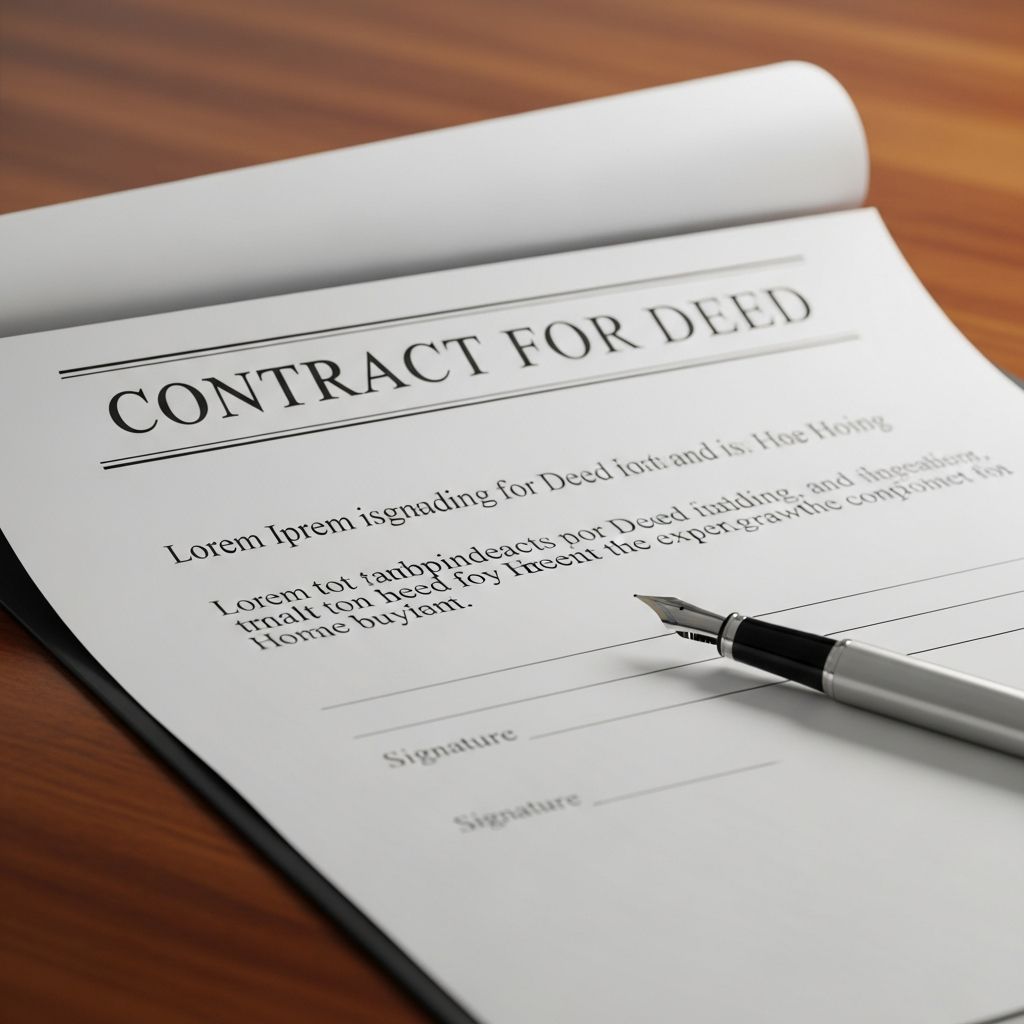
A contract for deedland contract, installment land contract, or bond for deed, is a way to buy a home by making payments directly to the seller over time instead of getting a traditional mortgage from a bank. In many of these deals, the buyer moves into the home right away, but the seller keeps the legal title until the buyer pays the full amount owed.
This arrangement can look like a shortcut to homeownership for people who cannot easily qualify for a loan, but it also carries serious risks and fewer legal protections than a standard mortgage in many states.
What Is a Contract for Deed?
At its core, a contract for deed is a seller-financed real estate agreement. Instead of borrowing from a lender and paying the seller all at once, the buyer agrees to make installment payments to the seller over months or years.
- The buyer and seller sign a written contract that sets the purchase price, payment schedule, interest rate (if any), and other terms.
- The buyer typically takes possession of the home and lives in it, but does not receive the deed or legal title until the contract is fully paid.
- The seller keeps the deed during the contract term and transfers it only when all payments and other obligations are completed.
Because the seller is effectively providing the financing, contracts for deed are often used when buyers cannot easily obtain a conventional mortgage, such as when they have limited credit history, past credit problems, or difficulties documenting income.
How a Contract for Deed Works in Practice
Although details vary by state law and individual contract, most arrangements follow a similar pattern.
Typical Steps in the Transaction
- Negotiation – Buyer and seller agree on the sale price, down payment (if any), monthly payment amount, interest rate, and length of the contract.
- Signing the contract – Both parties sign a written agreement. In many states, the contract must be in writing, signed, and often notarized to be enforceable.
- Possession of the home – The buyer moves in and begins using the property like an owner, even though the seller still holds the deed.
- Ongoing payments – The buyer pays the seller directly—usually monthly—for principal, interest, and in some cases, additional fees.
- Final payment or refinance – At the end of the term, the buyer either makes the last scheduled payment or, if a large lump sum is required, refinances with a mortgage to pay off the balance.
- Transfer of deed – Once the contract is satisfied, the seller delivers a deed and the buyer becomes the legal owner of record.
Key Features at a Glance
| Feature | Contract for Deed | Traditional Mortgage |
|---|---|---|
| Who provides financing? | Seller finances the purchase | Bank or mortgage lender |
| Who holds legal title during payments? | Seller keeps title, buyer has possession | Buyer holds title; lender has lien |
| Monthly payments paid to | Seller directly | Lender or loan servicer |
| Protections if buyer defaults | Often fewer protections; can lose payments and property quickly in many states | Foreclosure process with statutory protections; timelines can be longer |
| Regulation | Rules vary widely by state; often less oversight | Heavily regulated by federal and state law |
Your Responsibilities as the Buyer
Even though you do not hold the deed yet, many contracts for deed require the buyer to take on most or all of the responsibilities of an owner.
- Property taxes – Buyers are commonly required to pay the property taxes directly or reimburse the seller.
- Homeowners insurance – The contract may require maintaining insurance on the home, often naming the seller as an additional insured.
- Repairs and maintenance – Buyers are usually responsible for keeping the property in good condition and paying for repairs.
- Utilities and services – Buyers typically pay all utility bills and local fees (water, trash, etc.).
Because the buyer may bear all these costs in addition to monthly payments, it is essential to calculate the full monthly and yearly expense before signing any agreement.
Common Risks and Pitfalls
Contracts for deed can be risky, especially when they are used as a substitute for a mortgage without fully understanding the terms. Consumer protection agencies and legal aid organizations have highlighted several recurring problems.
1. Losing the Home and Your Payments
In many states, if a buyer falls behind on payments or violates the contract, the seller can cancel the contract and remove the buyer from the property more quickly and with fewer protections than in a mortgage foreclosure.
- Missing even a few payments can be treated as a breach of contract.
- Buyers might lose all money paid—including any down payment and improvements made to the home—and may be evicted.
- The process and timelines depend on state law; some states have added protections, while others still allow quick termination.
2. Balloon Payments and Refinancing Risk
Some contracts require a large balloon payment at the end of a relatively short term (for example, three to five years). This is a single, large payment of the remaining balance.
- If you cannot qualify for a mortgage when the balloon payment comes due, you may not be able to pay the remaining balance.
- Failure to make this payment can lead to cancellation of the contract and loss of the home and equity you built.
3. Title and Existing Mortgage Problems
Because the seller keeps legal title, you depend on the seller to keep their own financial obligations current. If the seller has an existing mortgage and stops paying it, the lender could foreclose on the property even if you have made all of your contract payments on time.
- You could be forced out of the home through no fault of your own.
- Without checking title records, you might not know about other liens or legal claims on the property.
4. Lack of Inspections and Overpaying
Some buyers enter these deals without a professional inspection or appraisal. This increases the risk of:
- Discovering major repairs after you move in.
- Paying more than the property is worth.
- Owning (eventually) a home that is hard to refinance or resell at the price you paid.
Comparing Contracts for Deed and Mortgages
Understanding the differences between these financing methods can help you decide which is safer for your situation.
- Ownership and title – With a mortgage, you receive the deed at closing and the lender records a lien. With a contract for deed, the seller keeps the deed until you finish paying.
- Legal protections – Mortgages are covered by extensive federal and state consumer protection rules, including disclosure requirements, servicing standards, and foreclosure protections. Contracts for deed often fall outside many of these rules.
- Closing and costs – Contract-for-deed deals may have fewer traditional closing costs, but that does not mean they are cheaper overall, particularly if the interest rate is high or the property needs major repairs.
- Credit review – Because there may be less formal underwriting, some buyers enter contracts that they realistically cannot afford over the long term.
Smart Steps Before You Sign
If you are considering a contract for deed, treat it with the same seriousness as any major loan. Consumer advocates and state agencies recommend several precautions.
Investigate the Property and Seller
- Check title records – Search public land records or hire a title company to see who owns the property and whether there are existing mortgages, tax liens, or other claims.
- Confirm property taxes – Verify that property taxes are current and find out how much they are each year.
- Ask about existing loans – If the seller has a mortgage, ask whether the lender allows this type of arrangement and what happens if the loan is not paid.
Evaluate the Home and the Price
- Get an inspection – Hire a licensed home inspector to identify structural, plumbing, electrical, or safety problems.
- Obtain an appraisal or market analysis – Understanding the fair market value can help you avoid overpaying.
- Estimate repair and maintenance costs – Factor future work into your budget.
Review the Contract in Detail
- Payment terms – Confirm the purchase price, down payment, interest rate, payment schedule, and whether there is a balloon payment.
- Default rules – Read what counts as a default (late payments, unpaid taxes, insurance lapses) and what rights the seller has to cancel the contract.
- Responsibility for taxes, insurance, and repairs – Make sure these duties are clearly spelled out, and understand your total monthly obligation.
- Recording – Ask if the contract will be recorded with the local land records office; in some states, this can offer additional protections to the buyer.
- Right to cure – Some state laws require that buyers be given time to catch up on missed payments before cancellation; find out what applies where you live.
Seek Independent Advice
- Legal review – A local real estate or consumer law attorney can explain how your state’s laws treat contracts for deed and identify unfair terms.
- Housing counseling – HUD-approved housing counselors can help you compare this option to FHA, VA, or other more traditional loans.
Is a Contract for Deed Ever a Good Option?
In some situations, a contract for deed may help a buyer who is close to being mortgage-ready but temporarily unable to qualify—if the property is fairly priced, the terms are reasonable, and state law provides meaningful protections.
- It may allow time to rebuild credit while living in the home.
- Closing can be faster and less formal.
- Terms can sometimes be customized between the buyer and seller.
However, because of the risks, many consumer advocates recommend exploring safer alternatives first, such as FHA-insured loans, state down-payment assistance programs, or credit-building strategies that move you toward a conventional mortgage.
Frequently Asked Questions (FAQs)
Q: Do I own the home under a contract for deed?
A: You usually have the right to live in and use the property, but the seller keeps legal title until you complete all payments and other obligations in the contract.
Q: Can I be evicted if I miss payments?
A: Yes. In many states, missing payments or failing to meet other contract terms allows the seller to cancel the contract and have you removed from the property, often faster than a traditional foreclosure process.
Q: What happens if there is a balloon payment and I cannot refinance?
A: If you cannot pay the balloon amount when it is due—and cannot renegotiate—you may lose the home and the equity you built, including prior payments and improvements.
Q: Should a contract for deed be recorded?
A: Many state agencies recommend recording the contract in the local land records, when possible, because it can give public notice of your interest and may provide additional protections if something goes wrong.
Q: How can I tell if a contract for deed offer is fair?
A: Compare the interest rate and total cost to what you might pay with a mortgage, review the property’s market value, check for balloon payments, and ask a lawyer or housing counselor to review the terms before you sign.
References
- What is a contract for deed? — Consumer Financial Protection Bureau. 2021-11-15. https://www.consumerfinance.gov/ask-cfpb/what-is-a-contract-for-deed-en-2149/
- Contract For Deed — Minnesota Office of the Attorney General. 2022-03-01. https://www.ag.state.mn.us/Consumer/Publications/ContractForDeed.asp
- Contract for Deed — TexasLawHelp.org (Texas Legal Services Center). 2022-05-20. https://texaslawhelp.org/article/contract-for-deed
- Contract for Deed / Minnesota Department of Commerce — Minnesota Department of Commerce. 2022-08-10. https://mn.gov/commerce/business/real-estate/contract-deed/
- A Guide to Contract for Deed — DocuSign, Inc. 2023-02-14. https://www.docusign.com/blog/guide-to-contract-deed
Similar Articles








Read full bio of medha deb


