
Understanding CC&R Violations, Enforcement, and Homeowner Remedies
A practical homeowner’s guide to covenant violations, HOA enforcement tools, and your legal options when conflicts arise.
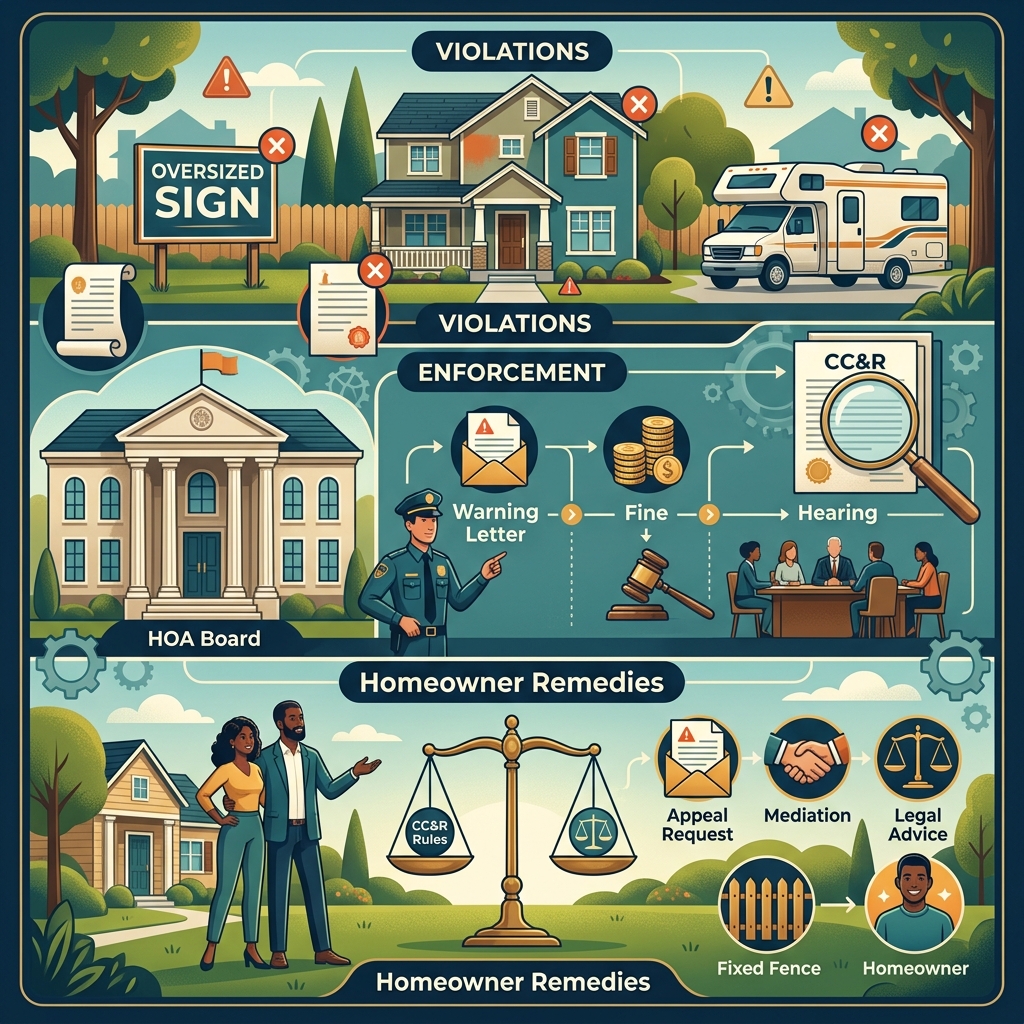
Many homes in planned communities, condominiums, and subdivisions are governed by covenants, conditions, and restrictions (CC&Rs). These rules shape how property can be used, what owners must do to maintain their homes, and how disputes are resolved when someone allegedly breaks the rules. Buying into such a community means accepting both the benefits and the burdens of this system.
This article explains how CC&R violations are identified, how homeowners associations (HOAs) or property owners’ associations typically enforce them, and what remedies are available to both owners and associations when conflicts arise. While specific procedures vary by state and by governing documents, there are common patterns and legal concepts that appear across the United States.
What CC&Rs Are and Why They Matter
CC&Rs are private, legally binding restrictions recorded against property in a community. They are usually drafted by the developer and later administered by an association’s board of directors. When you purchase a home in such a community, you agree to abide by these restrictions, even if you did not negotiate them personally.
- Use restrictions: Limitations on activities, such as rental rules, business use, or parking policies.
- Architectural controls: Requirements for exterior appearance, additions, fences, or landscaping.
- Maintenance obligations: Duties to keep the property in good repair and prevent nuisances.
- Association powers: Authority to adopt rules, levy assessments, impose fines, and initiate legal action.
Because CC&Rs are typically recorded in land records, they function as a form of private zoning. Courts often enforce them when associations or owners seek legal remedies, provided they are not unconscionable or contrary to public policy.
Common Types of CC&R Violations
Violations arise when an owner’s conduct or property condition conflicts with a covenant, rule, or architectural standard. While each community has its own priorities, certain categories are widespread:
- Appearance-related issues: Unapproved exterior paint colors, visible clutter, or failure to maintain landscaping.
- Construction and modifications: Building additions, sheds, or structural changes without architectural committee approval.
- Use and occupancy problems: Short-term rentals, home businesses, or occupancy limits contrary to CC&Rs.
- Parking and vehicles: Oversized vehicles, street parking limits, or inoperable cars stored on site.
- Nuisances and behavior: Excessive noise, pet violations, or hazardous activities.
In many states, CC&Rs authorize boards to adopt additional operating rules or “house rules” that supplement recorded covenants, as long as the rules are consistent with the grants of authority in the CC&Rs themselves. However, disputes often arise over whether a particular rule is properly authorized or overbroad.
How Associations Typically Respond to Alleged Violations
Most associations follow a progressive enforcement process designed to resolve issues informally before resorting to litigation. Although the sequence may vary, owners can usually expect several predictable steps.
1. Observation and Initial Contact
Violations are frequently identified by board members, property managers, or neighbors. Once a potential violation is observed, the association usually confirms whether the conduct or condition conflicts with specific CC&R provisions or rules.
- Verbal communication: A casual conversation or phone call requesting correction.
- Courtesy notice: An informal written reminder outlining the issue and expected remedy.
At this stage, many problems are resolved quickly, especially when owners were not aware of the rule or when correction is easy.
2. Formal Written Notice of Violation
If the issue persists, the association usually issues a formal notice of violation. In some jurisdictions, statutes require specific information in this notice before fines or other penalties can be imposed.
A typical violation notice includes:
- A clear description of the alleged violation and the relevant CC&R or rule section.
- The date by which the owner must correct the issue to avoid sanctions.
- Information about the owner’s right to request a hearing before the board.
- Potential consequences if the violation is not cured, such as fines or legal action.
Providing adequate notice is important not only for fairness but also because courts often scrutinize whether associations complied with statutory requirements and their own procedures before imposing penalties.
3. Hearings and Internal Dispute Resolution
When an owner disputes a violation or believes the association is acting unfairly, many governing documents and state statutes provide a right to a hearing before the board or a designated committee.
At a hearing:
- The association presents evidence of the alleged violation (photos, inspection reports, prior notices).
- The owner may explain their position, present counter-evidence, or argue that the rule is misapplied.
- The board deliberates and issues a decision, which may include dismissal, a cure deadline, or sanctions.
Some states encourage or require non-judicial dispute resolution mechanisms, such as mediation, before parties proceed to court, particularly for community association disputes.
Enforcement Tools Available to Associations
When informal measures fail, associations rely on a range of enforcement tools, usually defined in the CC&Rs and supplemented by statute. The appropriateness of each remedy depends on the violation’s severity, the governing documents, and the board’s enforcement policy.
| Enforcement Tool | Typical Use | Key Considerations |
|---|---|---|
| Monetary fines | Ongoing or repeated violations, minor to moderate severity. | Must be reasonable, follow a written fine policy, and comply with notice and hearing rules. |
| Suspension of privileges | Non-essential rights such as pool access or clubhouse use. | Usually cannot suspend basic rights like access to one’s home; must be authorized by governing documents. |
| Self-help remedies | Correcting exterior issues, such as landscaping or removing unauthorized improvements. | Permitted only if expressly authorized and typically requires careful adherence to procedural safeguards. |
| Civil lawsuits | Serious or persistent violations where other measures fail. | May seek injunctions, specific performance, or damages; costly and time-consuming. |
Monetary Fines
Fines are among the most common enforcement methods for CC&R violations. Associations often adopt a written fine schedule, outlining the amount for first, second, and subsequent violations and distinguishing between minor and serious infractions.
- Progressive structure: Fines may increase for repeated or persistent violations.
- Reasonableness requirement: Courts may review fines to ensure they are proportionate and not punitive beyond what statutes or documents allow.
- Collection options: Unpaid fines may be collected as assessments in some jurisdictions, though the ability to lien and foreclose for fines alone often depends on state law.
Suspension of Voting and Use Rights
Some CC&Rs permit associations to suspend non-essential privileges—such as voting rights, serving on the board, or using recreation facilities—when owners are in violation or delinquent on assessments. These suspensions are typically temporary and designed to encourage compliance rather than permanently disenfranchise owners.
Self-Help Remedies
Self-help occurs when the association directly corrects a violation, such as trimming overgrown landscaping or removing signage, and then charges the owner for the costs.
Because self-help can be intrusive and may expose the association to liability, it is usually reserved for clear, exterior violations and is permitted only when:
- The CC&Rs expressly authorize self-help for specific types of violations.
- Advance notice and an opportunity to cure are provided.
- The association acts reasonably and documents the condition and costs.
Civil Lawsuits and Court Remedies
When voluntary compliance cannot be achieved, associations may file a civil lawsuit seeking court enforcement of CC&Rs. Common claims include breach of covenant and requests for equitable relief.
- Injunctive relief: A court order requiring the owner to stop the violation or take specific actions to comply.
- Specific performance: A type of equitable remedy that compels a party to perform their obligations under the covenants.
- Damages: Monetary compensation for harm caused by violations, sometimes including statutory penalties when authorized.
Courts may also award attorneys’ fees to the prevailing party if the CC&Rs or statutes provide for fee-shifting, which can significantly affect the financial impact of litigation on both sides.
Owner Defenses and Limitations on Enforcement
Owners facing enforcement actions are not powerless. They may respond by raising legal and procedural defenses that challenge the association’s authority or the fairness of its actions.
Procedural Defects
Many disputes turn on whether the association followed its own procedures and applicable statutes. Common procedural issues include:
- Failure to provide required written notice or an opportunity for a hearing.
- Improperly adopted rules or fine schedules that were not enacted according to governing documents.
- Inadequate documentation of violations or inconsistent enforcement records.
Owners can often strengthen their position by reviewing association records, including meeting minutes and prior violation notices, to identify inconsistencies.
Selective Enforcement and Waiver
Selective enforcement occurs when similar violations are treated differently, such as enforcing a rule against one owner but not others with comparable conditions. Courts sometimes view pervasive non-enforcement as evidence that a restriction has been waived or effectively abandoned.
- Pattern of non-enforcement: When an association routinely ignores similar violations, its ability to enforce later may be limited.
- Unequal treatment: Disparate enforcement may be challenged as arbitrary or inconsistent with the association’s duty to treat owners fairly.
Documenting neighboring properties and past board decisions can be an important step in proving selective enforcement.
Statute of Limitations
Like most legal claims, enforcement actions are subject to a statute of limitations—the time limit within which a lawsuit must be filed. In at least one jurisdiction, courts have applied a multi-year limitations period to CC&R violations, running from the time the association knew or reasonably should have known of the violation.
Once the limitations period expires, the association may lose its right to seek judicial enforcement, even if the violation continues.
Substantive Challenges
Owners may also argue that a rule or covenant is unreasonable, conflicts with superior law, or was not properly authorized by the CC&Rs. Examples include:
- Rules that contradict recorded covenants or exceed the board’s rulemaking authority.
- Restrictions that violate fair housing laws or other public policies.
- Overly vague provisions that fail to provide clear notice of prohibited conduct.
Courts often attempt to uphold community standards but may invalidate or narrow provisions that are inconsistent with statutory protections or constitutional rights.
Remedies for Homeowners When Associations Fail to Enforce
Associations have a duty to enforce their governing documents, but they also retain discretion in prioritizing violations and choosing enforcement tools. When boards consistently refuse to enforce CC&Rs or do so in an arbitrary manner, homeowners may seek their own remedies.
- Demand for enforcement: A written request asking the board to act on specific violations.
- Internal political remedies: Voting in board elections, organizing owners, or seeking recall of directors.
- Civil actions: Suits for damages or injunctions compelling the association to enforce its covenants in some jurisdictions.
Courts have recognized claims where a homeowner sues an association for failing to enforce restrictions, seeking both compensation and an order requiring the board to fulfill its enforcement responsibilities. However, they also acknowledge boards’ need for discretion, particularly where enforcement costs and community relations must be balanced.
Practical Tips for Homeowners Facing CC&R Disputes
Whether you are alleged to be in violation or you believe the association is ignoring important rules, a systematic approach can improve outcomes.
- Study your governing documents: Review CC&Rs, bylaws, and rules to understand what is actually required and what enforcement powers exist.
- Communicate early and in writing: Respond promptly to notices and keep records of all communications with the association.
- Gather evidence: Take photographs, retain copies of notices, and collect meeting minutes or prior decisions relevant to your situation.
- Request a hearing: Use procedural rights to present your case directly to the board, when available.
- Seek legal advice: For serious disputes, consult an attorney familiar with community association law in your state.
Frequently Asked Questions (FAQs)
Can my HOA enforce rules that are not written in the CC&Rs?
Often, yes—but only if the CC&Rs grant the board authority to adopt additional rules and those rules are reasonably related to the covenants’ purposes. If the board adopts rules beyond what the CC&Rs authorize, owners may challenge them as invalid or unenforceable.
Do I have to pay a fine if I never received a proper notice?
In many states, statutes require written notice and an opportunity for a hearing before an association can levy fines. If notice requirements were not met, an owner may argue that the fine is procedurally defective and should be cancelled or reduced.
What happens if the association refuses to enforce CC&Rs against a neighbor?
Owners can request enforcement and, in some jurisdictions, may sue the association for failing to enforce restrictions, seeking damages and an order compelling action. However, courts often respect boards’ discretion, so not every non-enforcement decision will be overturned.
Can the HOA enter my property to fix a violation?
Associations generally may use self-help only if the CC&Rs expressly authorize entry and correction for particular types of violations. Even then, they must act reasonably and usually provide notice and an opportunity to cure before entering.
Is litigation always necessary to resolve CC&R disputes?
No. Many disputes are resolved informally through communication, hearings, or mediation. Litigation is typically a last resort due to cost and community impact. Understanding your rights and documenting the dispute often makes negotiated solutions more likely.
References
- CC&R Enforcement and Remedies — FindLaw. 2023-05-01. https://www.findlaw.com/realestate/owning-a-home/cc-r-enforcement-and-remedies.html
- Property Owners’ Associations: Restrictive Covenants — Texas State Law Library. 2022-08-10. https://guides.sll.texas.gov/property-owners-associations/ccrs
- CC&R Enforcement & Defense — Bay Legal PC. 2021-04-15. https://baylegal.com/practice-areas/hoa-law/ccr-enforcement-defense/
- Failure to Enforce — FindHOALaw. 2020-09-30. https://findhoalaw.com/failure-to-enforce/
- Using CC&Rs Against Your HOA: Turning Their Rules Into Your Weapon — L.S. Carlson Law. 2023-02-20. https://www.lscarlsonlaw.com/articles/using-ccandrs-against-your-hoa-turning-their-rules-into-your-weapon
- Enforcing Your HOA’s CC&Rs — Scottsdale Neighborhood College / Shaw & Lines, LLC. 2020-03-01. https://www.youtube.com/watch?v=yRnzhfuBa8s
Similar Articles








Read full bio of medha deb


