
Understanding the New Car Loan Interest Deduction for 2026 Taxes
A practical guide to the 2025–2028 car loan interest deduction, who qualifies, how much you can claim, and how to report it correctly.
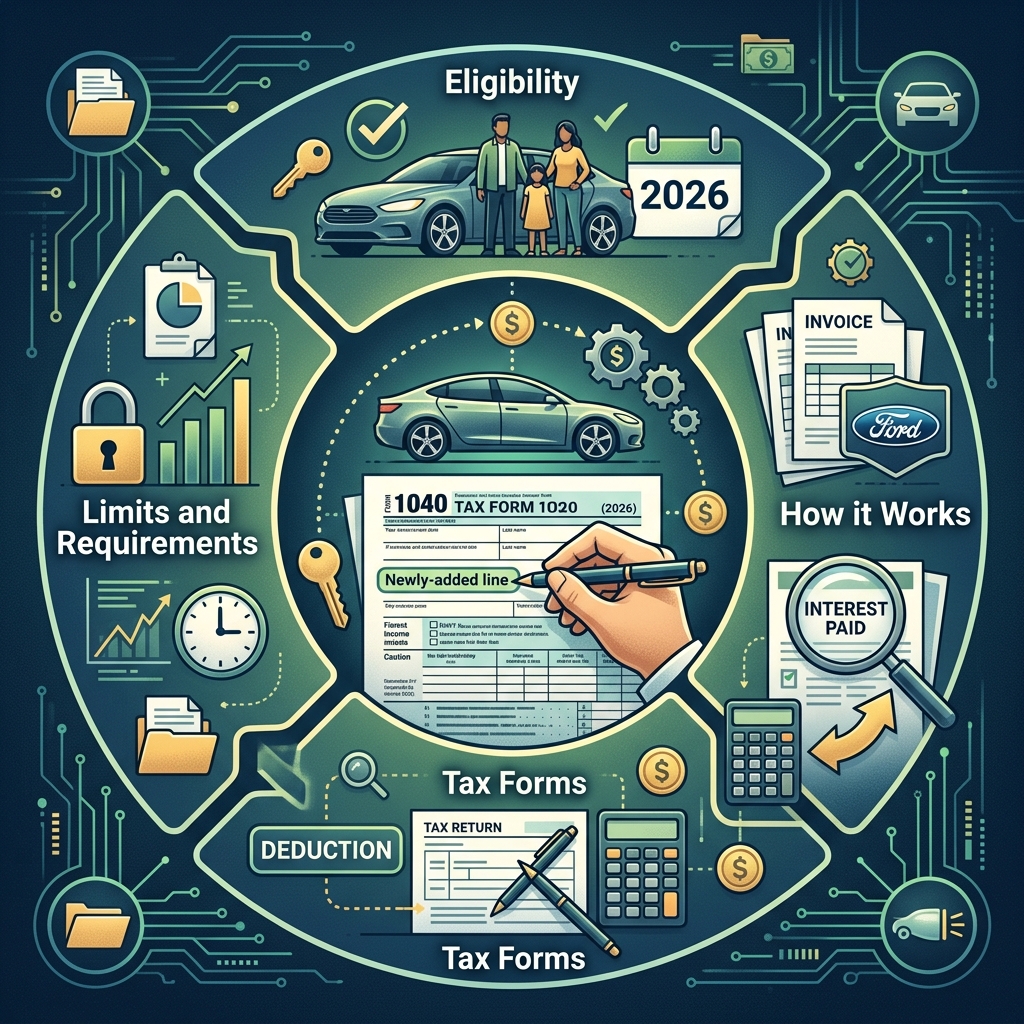
The federal tax rules now allow many vehicle owners to deduct a portion of their car loan interest for tax years 2025 through 2028, including the 2026 filing season. This new deduction can be worth up to $10,000 per year if you meet the eligibility criteria. It applies to personal-use vehicles and is available whether you itemize deductions or claim the standard deduction. Understanding how it works will help you avoid mistakes and maximize your benefit.
Big Picture: What the Car Loan Interest Deduction Does
The car loan interest deduction is part of a broader set of tax changes designed to provide relief to working families and individual taxpayers. In simple terms, it allows qualifying taxpayers to deduct interest paid on a loan used to purchase a new, personally used vehicle that meets specific requirements.
- Years covered: Interest paid on qualifying vehicle loans during tax years 2025–2028 may be deductible.
- Maximum deduction: Up to $10,000 of interest per tax return, per year can be claimed.
- Standard or itemized: You can claim this deduction even if you take the standard deduction; itemizing is not required.
- Personal use only: The vehicle must be for personal use, not leased and not primarily for business.
Because the deduction is limited to interest and not principal, you will need to distinguish the interest portion of your payments from the amount applied to the loan balance.
Which Vehicles Qualify?
Not every car, truck, or motorcycle is eligible. The IRS, in official guidance, defines a qualified vehicle using several technical requirements. To qualify, your vehicle must satisfy all of the following:
- Type of vehicle: Cars, minivans, vans, SUVs, pickup trucks, or motorcycles with a gross vehicle weight rating (GVWR) of less than 14,000 pounds.
- Final assembly location: The vehicle must have undergone final assembly in the United States. This is typically verified using the Vehicle Identification Number (VIN) and official tools such as the NHTSA VIN decoder.
- New vehicle requirement: The deduction applies only to new vehicles. Used vehicles, even if new to you, do not qualify.
- Purchase date: The vehicle must be purchased after December 31, 2024.
- Personal-use loan: The loan must be used to purchase a personal-use vehicle, not one primarily for business.
Leased vehicles are explicitly excluded: lease payments do not qualify for this deduction.
Checking Final Assembly in the United States
Final assembly requirements can be confusing, especially for foreign-branded cars that may be assembled domestically. The IRS encourages taxpayers to use official VIN decoding tools to confirm U.S. assembly.
Key points for verifying assembly:
- Use a trusted VIN decoder provided by regulatory authorities to see where the vehicle was built.
- Retain printed or digital proof of the VIN decoding results with your tax records as supporting documentation.
Loan Requirements and Interest Rules
Even if your vehicle itself qualifies, your loan must meet certain conditions for the interest to be deductible.
- Origination date: The loan must be originated after December 31, 2024, to finance the purchase of a qualifying new vehicle.
- Secured by the vehicle: The loan must be a typical vehicle loan secured by the car (not an unsecured personal loan).
- Interest only: Only the interest portion of the payments is deductible. Principal repayments do not count.
- Interest paid during the year: You can only deduct interest that you actually paid or accrued in the tax year.
- Refinancing: If a qualifying vehicle loan is later refinanced, interest on the refinanced amount generally remains eligible, so long as the underlying vehicle continues to meet all requirements.
Income Limits and Phaseout Rules
The deduction is targeted toward low- and middle-income taxpayers. For higher earners, the benefit is gradually reduced and can disappear entirely.
| Filing Status | Phaseout Begins (MAGI) | Deduction Fully Phased Out (MAGI) |
|---|---|---|
| Single, Estates, Trusts | $100,000 | $150,000 |
| Married Filing Jointly | $200,000 | $250,000 |
Once your modified adjusted gross income (MAGI) crosses the lower threshold, the maximum deduction begins to decrease. Under one commonly cited formula in guidance and calculators, the deduction is reduced systematically until it reaches zero at the upper limit.
Practical implications:
- If your MAGI is below $100,000 as a single filer (or below $200,000 on a joint return), you can typically claim the full amount of qualifying interest up to the $10,000 cap.
- If your MAGI falls between the threshold and the upper limit, your allowable deduction will be reduced using the phaseout calculation on the IRS form or instructions.
- If your MAGI exceeds $150,000 (single) or $250,000 (joint), the deduction is reduced to $0.
How Much Can You Deduct?
The maximum car loan interest deduction is $10,000 per tax return, per year, across all qualifying vehicles and loans. This is not a per-vehicle limit. If you have multiple qualifying cars, the total interest across all loans is still capped at $10,000.
Important mechanics:
- You tally all qualifying interest paid during the year on eligible loans, up to the maximum cap.
- The total is then adjusted according to the income phaseout formula if your MAGI exceeds the relevant threshold.
- The resulting allowable amount is the deduction you report on the designated tax schedule (Schedule 1-A).
Example Scenarios (Conceptual)
While specific numerical examples are provided in various tax guides and calculators, the general structure works as follows:
- Moderate income driver: A single filer with $80,000 MAGI who paid $6,000 in qualifying interest can typically deduct the full $6,000, assuming all other conditions are met.
- Higher income household: A married couple filing jointly with $220,000 MAGI who paid $10,000 in qualifying interest would see their maximum deduction reduced significantly by the phaseout mechanism and may only claim a smaller portion.
Documents You Will Need
To claim the car loan interest deduction accurately, you must gather and retain specific documentation. Several official and private guidance documents emphasize the importance of recordkeeping.
- Vehicle Loan Interest Statement: Starting in 2026, lenders issue Form 1098-VLI (Vehicle Loan Interest Statement) by January 31 if you paid $600 or more in interest in a year. This form shows the total interest paid.
- Loan contracts: Keep your purchase agreement and loan documentation showing the vehicle, origination date, and terms.
- VIN information: You must report your Vehicle Identification Number (VIN) when claiming the deduction.
- Proof of U.S. assembly: Store documentation confirming the vehicle’s final assembly in the United States (such as VIN decoder results or manufacturer information).
- Income records: W-2s, 1099s, and other income statements that determine your MAGI for the phaseout calculation.
Filing: Where and How to Claim the Deduction
The IRS created a specific reporting mechanism for this deduction. For individual filers, the deduction is claimed on Form 1040, Schedule 1-A (Additional Deductions), in a section commonly described as the “No Tax on Car Loan Interest” area.
Broad filing steps based on current guidance:
- Step 1 – Confirm eligibility: Verify that your vehicle and loan meet all requirements: new vehicle, personal use, U.S. assembly, purchased after December 31, 2024, and within the 2025–2028 window.
- Step 2 – Gather interest data: Use Form 1098-VLI or equivalent lender statements to identify the total interest you paid in the tax year.
- Step 3 – Enter VIN and vehicle details: On Schedule 1-A, report the VIN and other requested information to show the vehicle qualifies.
- Step 4 – Apply income phaseout: Follow the IRS instructions on Schedule 1-A to calculate your allowable deduction, taking the MAGI thresholds into account.
- Step 5 – Transfer total: Report the final deduction amount from Schedule 1-A on the appropriate line of Form 1040.
Common Pitfalls to Avoid
Because this deduction is relatively new, taxpayers may misunderstand key rules. Review these frequent mistakes to stay on track.
- Claiming interest on used cars: Only new vehicles qualify. Used vehicles are not eligible, even if you are the first owner in your household.
- Including lease payments: Lease contracts do not qualify. Only interest on secured vehicle loans is deductible.
- Ignoring U.S. assembly: Failing to verify final assembly in the United States can lead to an improper claim. Always check your VIN through reliable tools.
- Mixing principal and interest: Deducting the full payment amount rather than the interest portion is incorrect. Use lender statements to separate interest from principal.
- Overlooking income limits: If your MAGI exceeds the thresholds, your deduction may be reduced or eliminated; ignoring the phaseout rules can result in errors or IRS notices.
Strategic Considerations for Tax Planning
While this deduction is primarily intended as relief rather than a planning tool, it can influence how and when you purchase a vehicle.
- Timing of purchase: Buying a new, qualifying vehicle during the 2025–2028 window allows you to benefit from the deduction over multiple years of interest payments.
- Loan structure: Choosing a loan with clear, standard amortization and easily tracked interest may simplify annual reporting and documentation.
- Income management: If your income fluctuates near the phaseout thresholds, you may want to pay attention to total MAGI when deciding on vehicle financing or additional taxable income.
Frequently Asked Questions (FAQs)
Is this deduction available if I take the standard deduction?
Yes. Official IRS guidance confirms that the car loan interest deduction is available to taxpayers who claim either the standard deduction or itemized deductions. You do not need to itemize to benefit.
Can I deduct interest on more than one vehicle?
You can deduct interest on multiple qualifying vehicles, but your combined deduction is capped at $10,000 per return per year. The limit applies to your total qualifying interest, not to each vehicle separately.
What if I refinance my car loan?
If the original loan qualifies and you refinance it, interest on the refinanced amount generally remains eligible for the deduction, provided the refinanced loan still secures the same qualifying vehicle and all other conditions remain satisfied.
Do business vehicles qualify?
The primary focus of this deduction is personal-use vehicles. If you use a vehicle for business, different rules may apply under business interest deductions and depreciation. Business-specific treatment should be evaluated separately with reference to IRS business tax guidance.
How do I know my car was assembled in the United States?
Regulatory and policy resources recommend using a VIN decoder, such as the official NHTSA tool, to check final assembly information. This helps you confirm whether your vehicle meets the U.S. assembly requirement and provides documentation for your records.
What form will my lender send me?
For 2026 and later tax years, lenders must issue Form 1098‑VLI (Vehicle Loan Interest Statement) by January 31 if you paid $600 or more in interest during the year. This form summarizes the interest you paid and supports your deduction claim.
References
- Working Families Tax Cuts – Individuals and workers — Internal Revenue Service. 2025-01-01. https://www.irs.gov/newsroom/working-families-tax-cuts-individuals-and-workers
- Publication 6126: No Tax on Car Loan Interest — Internal Revenue Service. 2026-01-01. https://www.irs.gov/pub/irs-pdf/p6126.pdf
- 2025–2028 Vehicle Loan Interest Deduction: What You Need to Know — Thomson Reuters Tax & Accounting. 2025-09-10. https://tax.thomsonreuters.com/news/2025-2028-vehicle-loan-interest-deduction-what-you-need-to-know/
- IRS Rules for the One Big Beautiful Bill Car Loan Interest Deduction — Intuit TurboTax. 2025-08-20. https://turbotax.intuit.com/tax-tips/tax-deductions-and-credits/irs-rules-for-the-obbb-car-loan-interest-deduction-what-you-need-to-know/c7PzL4pUY
- Auto loan interest tax deduction for 2025–2028 — U.S. Bank. 2025-06-15. https://www.usbank.com/vehicle-loans/auto-loans/auto-loan-tax-deduction.html
- The Auto Loan Interest Deduction: How Claiming and Reporting Work — Bipartisan Policy Center. 2025-07-01. https://bipartisanpolicy.org/explainer/the-auto-loan-interest-deduction-how-claiming-and-reporting-work/
- Tax Deduction for Car Loan Interest — H&R Block. 2025-08-05. https://www.hrblock.com/tax-center/filing/adjustments-and-deductions/deducting-car-loan-interest/
Similar Articles








Read full bio of medha deb




