
Understanding the CAN-SPAM Act: Email Rules for Businesses
Learn how the CAN-SPAM Act regulates commercial email and what senders must do to protect consumers from unwanted messages.
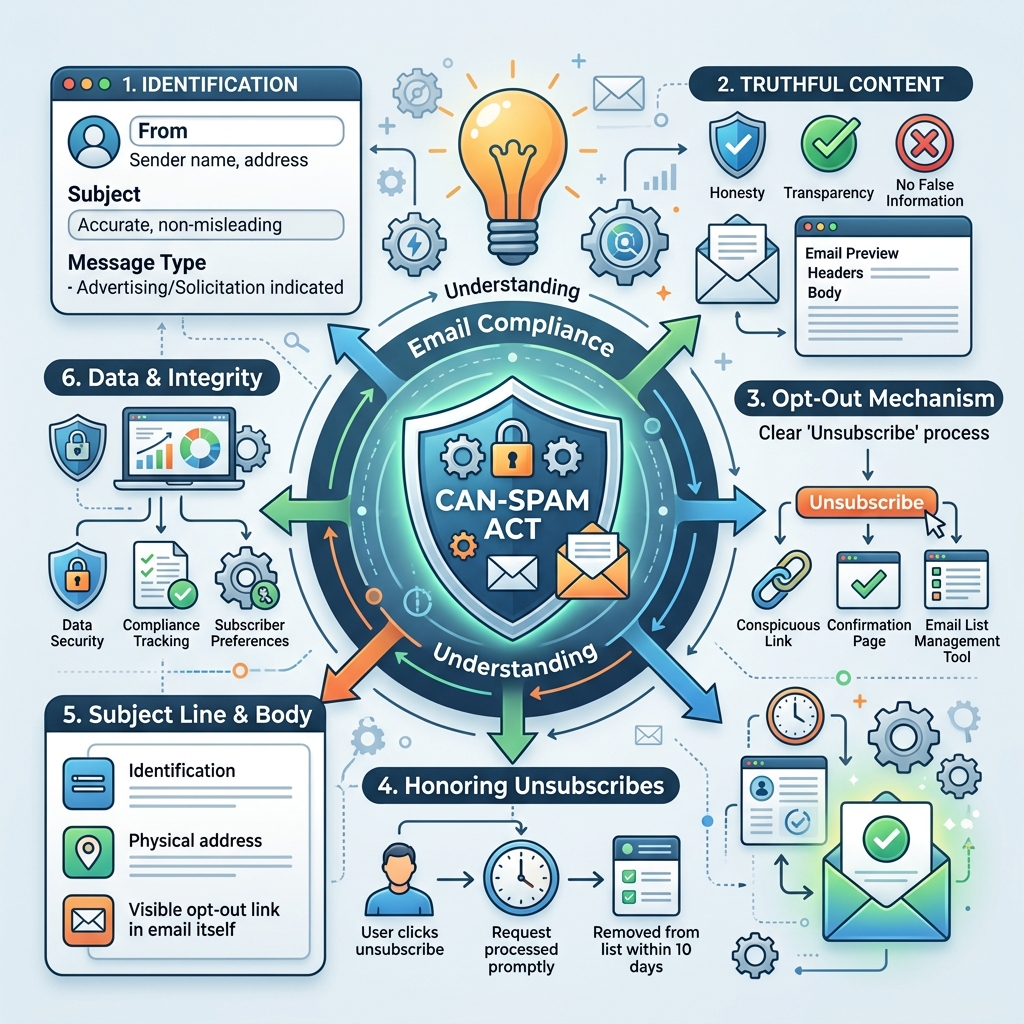
The CAN-SPAM Act of 2003 is the primary federal law in the United States that governs how businesses, marketers, and other organizations send commercial email and certain text messages to consumers and other recipients. It was enacted to address the growing problem of unsolicited and deceptive electronic messages by setting national standards for what is and is not acceptable in commercial email.
Although the name refers to “spam,” this law does not ban bulk email outright. Instead, it focuses on preventing abusive practices such as misleading headers, deceptive subject lines, and the failure to honor opt-out requests. It also gives recipients clear rights to say no to future messages and establishes enforcement powers and penalties for violations.
What the CAN-SPAM Act Is and Why It Matters
The full name of the statute is the Controlling the Assault of Non-Solicited Pornography and Marketing Act, commonly shortened to CAN-SPAM. It is a federal law, meaning its rules apply nationwide and override any conflicting state laws on commercial email. The Act aims to balance two interests:
- Protecting consumers from deceptive, abusive, and unwanted commercial messages.
- Allowing legitimate businesses to continue using email and other electronic channels for advertising, as long as they follow clear standards.
For consumers, the law is important because it guarantees a right to opt out and requires transparency about who is contacting them and for what purpose. For businesses, it is equally important because noncompliance can lead to significant civil penalties per violating message, reputational damage, and possible lawsuits.
Which Messages Are Covered by the CAN-SPAM Act?
The CAN-SPAM Act applies to commercial messages, broadly defined by the Federal Trade Commission (FTC) as any electronic mail whose primary purpose is the advertisement or promotion of a commercial product or service. This includes both business-to-consumer and business-to-business email.
Key categories of messages considered under the law include:
- Commercial emails – Email whose main content is marketing, promotions, offers, or sales language.
- Transactional or relationship messages – Messages that primarily convey information related to an existing transaction or account (such as receipts, shipping updates, or account notices) but that may still contain promotional elements.
- Mixed-content messages – Messages that blend transactional information with marketing content, where regulators look at the primary purpose to determine how CAN-SPAM applies.
The Act also extends to some text messages and commercial messages sent to wireless devices, pursuant to rules issued by the Federal Communications Commission (FCC). In practice, any organization using email or certain mobile messaging channels for advertising to U.S. recipients must assess whether its communications fall under CAN-SPAM.
Core Requirements for Lawful Commercial Email
CAN-SPAM sets out a series of standards that commercial email senders must follow to remain compliant. These requirements focus on truthful information, clear identification, and meaningful control for recipients.
1. Truthful Header and Routing Information
Header information includes the “From,” “To,” “Reply-To,” and routing data such as the originating domain name and email address. Under CAN-SPAM, this information:
- Must accurately identify the person or business initiating the message.
- Cannot be materially false or misleading, such as disguising a marketing email as a message from a friend or unrelated organization.
Using misleading sender information is a hallmark of deceptive spam and is explicitly prohibited. Honest routing data is a basic obligation for any compliant sender.
2. Honest Subject Lines
The subject line must realistically reflect the content of the message and cannot be deceptive. Examples of noncompliant practices include:
- Promising something that the email does not actually contain (e.g., “Your invoice” for a pure promotion).
- Using scare tactics or false alerts to trick recipients into opening the email.
- Implying that the email is personal or urgent when it is standard marketing content.
Regulators assess whether the subject line would reasonably mislead a typical recipient about what the message contains.
3. Clear Identification as Advertisement
When a message is primarily promotional, it must be identified as an advertisement or marketing communication in a clear and conspicuous way. There is flexibility in wording, but the notice should be easy to see and understand, rather than buried in fine print.
This requirement helps recipients quickly distinguish commercial content from transactional or personal messages when they scan their inbox.
4. Inclusion of a Valid Physical Postal Address
Every compliant commercial email must contain a valid physical postal address for the sender. Acceptable options include:
- A current street address of the business or organization.
- A post office box registered with the U.S. Postal Service.
- A private mailbox registered with a commercial mail receiving agency under postal regulations.
This requirement promotes accountability by giving recipients a tangible way to identify and reach the sender beyond an email address.
5. Functional and Easy Opt-Out Mechanism
CAN-SPAM grants recipients a clear right to opt out of future commercial email from a sender and requires that every covered message include a simple way to exercise that right.
A compliant opt-out mechanism must:
- Be clearly visible and understandable (commonly implemented as an unsubscribe link).
- Process requests for at least 30 days after the message is sent.
- Allow recipients to opt out without paying a fee or providing unnecessary personal information.
- Not require steps beyond replying to an email or visiting a single web page to submit the request.
Once an opt-out request is received, the sender must stop sending commercial emails to that address.
6. Timely Honor of Opt-Out Requests
Under CAN-SPAM, senders must honor opt-out requests within 10 business days. During this period, businesses should ensure their systems update suppression lists and that no further promotional messages go to that recipient.
Importantly, a sender cannot transfer an unsubscribed address to another marketer for continued promotion, and opt-out preferences generally apply across affiliated brands or campaigns operated by the same entity.
7. Ban on Certain Address-Harvesting Practices
CAN-SPAM makes it illegal to acquire or generate email addresses through certain abusive automated techniques, such as:
- Harvesting addresses from websites or services that prohibit such collection.
- Using automated scripts to assemble address lists from domain names or common name combinations.
These practices are associated with bulk spam operations and are incompatible with responsible email marketing.
Regulators and Enforcement Powers
Multiple agencies have roles in enforcing CAN-SPAM:
- Federal Trade Commission (FTC) – Primary enforcement authority for most commercial email practices and deceptive marketing under the Act.
- Federal Communications Commission (FCC) – Responsible for rules and enforcement related to certain wireless and text-based commercial messages, as directed by section 14 of CAN-SPAM.
- State authorities and other federal agencies – In some cases, state attorneys general or sector-specific regulators may bring actions, particularly when violations overlap with other consumer protection laws.
Enforcement focuses on significant violations, patterns of noncompliance, and operations that rely heavily on deceptive or abusive tactics. However, even small organizations can face scrutiny if complaints accumulate or violations are egregious.
Penalties and Legal Consequences
Violations of the CAN-SPAM Act can lead to substantial financial penalties. The FTC has authority to seek civil penalties for each noncompliant message, and the amount can be considerable. Some guidance documents and industry sources cite potential fines that exceed tens of thousands of dollars per violating email.
Common consequences of noncompliance include:
- Civil fines per offending email, which can quickly escalate for high-volume campaigns.
- Lawsuits by government agencies, and in some instances by affected parties, competitors, or partners.
- Blacklist inclusion by internet service providers (ISPs), making it difficult for future messages to reach inboxes.
- Reputational damage, causing loss of trust among customers and stakeholders.
Another critical point is that multiple parties can be held liable for the same message, including both the company whose product is promoted and the third-party marketing service that sent the email. Liability cannot simply be outsourced; businesses must supervise vendors and ensure adherence to CAN-SPAM standards.
CAN-SPAM Compliance Checklist for Businesses
For organizations engaged in email marketing, compliance is not just a legal obligation but also an important step toward building trust with recipients. The following checklist summarizes practical actions that align with CAN-SPAM requirements.
- Verify sender information: Ensure “From” and reply-to fields clearly identify your organization.
- Review subject lines: Confirm that each subject line accurately reflects the message content.
- Label promotional messages: Indicate when a message is an advertisement or marketing communication.
- Include a physical address: Place your valid postal address in a visible part of the email footer.
- Implement a clear unsubscribe option: Provide an easy-to-find link or method for opt-out.
- Honor opt-outs within 10 business days: Update internal lists promptly and cease sending promotions to unsubscribed addresses.
- Avoid dubious list-building tactics: Do not purchase lists or use automated harvesting methods that violate CAN-SPAM.
- Monitor vendors: Ensure external email services follow your compliance policies and CAN-SPAM rules.
Comparison: CAN-SPAM Requirements vs. Good Email Marketing Practice
Many CAN-SPAM obligations overlap with widely accepted best practices in email marketing. The table below compares legal requirements with broader strategic considerations.
| Legal Requirement Under CAN-SPAM | Related Best Practice |
|---|---|
| Accurate sender and routing information. | Build brand recognition by consistently using your official name and domain. |
| Non-deceptive subject lines. | Use clear, benefit-oriented subjects that set realistic expectations. |
| Identification of promotional content. | Segment promotional vs. informational campaigns to respect recipient preferences. |
| Valid physical postal address in each email. | Reinforce legitimacy and offer multiple contact channels, such as phone and website. |
| Functional, easy opt-out mechanism with timely processing. | Offer granular preference options to reduce complete unsubscribes and improve satisfaction. |
| Prohibition of certain address-harvesting methods. | Rely on permission-based list building, such as sign-up forms and customer opt-ins. |
Frequently Asked Questions (FAQs) about the CAN-SPAM Act
Does CAN-SPAM require prior consent before sending commercial email?
Unlike some international regulations, CAN-SPAM does not generally require a sender to obtain explicit opt-in consent before sending commercial email. However, once a recipient is contacted, they must be given a clear opportunity to opt out, and the sender must honor that choice. Many organizations still choose to adopt opt-in models as a best practice for trust and deliverability.
Are transactional emails subject to the same rules?
Messages whose primary purpose is transactional or related to an existing relationship, such as receipts or account notifications, are treated differently than pure promotional emails. However, if marketing content is prominent, CAN-SPAM requirements can still apply. In mixed-content messages, businesses should treat the message as commercial for compliance purposes if advertising is a significant portion of the content.
Does CAN-SPAM apply to emails sent outside the United States?
The law applies to commercial electronic messages sent to recipients in the United States, regardless of whether the sender is located domestically or abroad. Foreign businesses marketing to U.S. customers via email are expected to comply with CAN-SPAM when targeting U.S. addresses.
What if I hire a third-party service to send my emails?
Using an email service provider or marketing agency does not remove legal responsibility. Under CAN-SPAM, both the company whose products are promoted and the service that sends the messages can be held liable for violations. Businesses should establish clear compliance expectations and regularly review vendor practices.
How long must the unsubscribe mechanism remain active?
The opt-out mechanism included in a commercial email must be able to process requests for at least 30 days after the message is sent. During that time, recipients should be able to click or use the method provided to request no further promotional contact.
References
- CAN-SPAM Act of 2003 — Federal Trade Commission (summary and rule). 2004-01-01 (original enactment; still authoritative for statutory standards). https://www.ecfr.gov/current/title-16/chapter-I/subchapter-C/part-316
- CAN-SPAM Act of 2003 — Wikipedia summary (used for contextual understanding; not cited directly for legal authority). Last updated 2024. https://en.wikipedia.org/wiki/CAN-SPAM_Act_of_2003
- What is the CAN-SPAM Act? — Cloudflare. 2022-11-10. https://www.cloudflare.com/learning/privacy/what-is-the-can-spam-act/
- CAN-SPAM Act: A Compliance Guide for Businesses — Shopify. 2025-01-15. https://www.shopify.com/blog/can-spam-act
- CAN-SPAM — Federal Communications Commission. 2021-08-30. https://www.fcc.gov/general/can-spam
- CAN-SPAM Compliance Guide — UnsubCentral. 2023-06-02. https://www.unsubcentral.com/can-spam-compliance/
- What is CAN-SPAM? — Kajabi Help Center. 2023-09-18. https://help.kajabi.com/articles/marketing/email-campaigns/what-is-can-spam
Similar Articles








Read full bio of medha deb


