
The Foundation of American Identity: Birthright Citizenship
A deep dive into the historical origins, legal battles, and modern controversies surrounding the 14th Amendment's guarantee of citizenship.
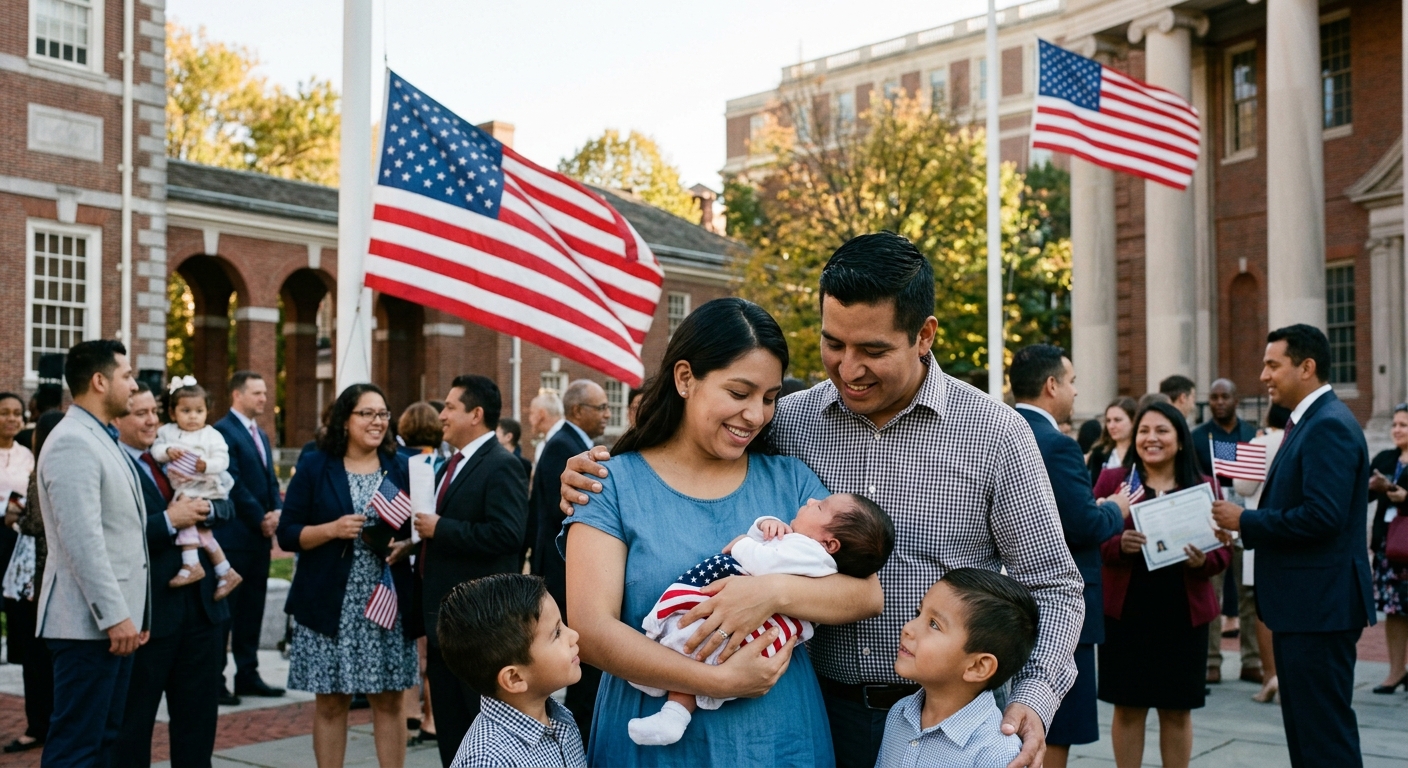
The Geography of Belonging: An Introduction to Birthright Citizenship
At the core of any sovereign nation’s legal framework lies a profound and fundamental question: Who truly belongs? In the United States, the answer is famously etched into the very fabric of the Constitution. Unlike numerous nations across the globe that determine national belonging strictly through bloodline, ancestry, or parental heritage, the United States relies primarily on the geography of a person’s birth. This concept, known as birthright citizenship, ensures that nearly anyone who takes their first breath on U.S. soil is automatically granted the permanent rights, privileges, and responsibilities of an American citizen.
The legal bedrock for this inclusive practice is the 14th Amendment, ratified in the turbulent aftermath of the American Civil War. Yet, despite its long-standing and well-documented presence in the Constitution, the policy of birthright citizenship remains a frequent target of political rhetoric, legislative attacks, and legal misinterpretation. By closely examining its tragic historical precursors, its foundational Supreme Court precedents, and the modern controversies that continue to surround it, we can fully understand why birthright citizenship is widely considered by historians and legal scholars to be the ultimate engine of American assimilation and equality.
The Dark Precursor: The Dred Scott Era
To accurately understand the necessity of the 14th Amendment, one must first confront the darkest and most exclusionary chapter in American judicial history. Before the eruption of the Civil War, the United States Constitution conspicuously lacked a clear, unified, and national definition of citizenship. The founding fathers left the matter tragically ambiguous, effectively allowing individual states to dictate who was—and who was not—considered a legal citizen of the republic.
This dangerous ambiguity culminated in the infamous 1857 Supreme Court case, Dred Scott v. Sandford. Dred Scott, an enslaved Black man, bravely sued for his freedom after his enslaver transported him into a free territory where slavery was illegal. In a devastating and widely condemned ruling, Chief Justice Roger B. Taney declared that individuals of African descent, whether enslaved or free, could never be considered citizens of the United States. Consequently, the Court ruled that Black individuals possessed no constitutional rights that a white man was bound to respect, meaning they could not even sue for their basic human rights in federal court.
The Dred Scott decision functionally codified a race-based caste system into federal law, actively denying birthright citizenship to millions of people born on American soil. It took the bloodiest conflict in the nation’s history—the American Civil War—to tear down the oppressive legal framework established by Taney’s court. Following the war, Reconstruction-era lawmakers recognized that relying on individual states or unpredictable future court rulings to protect the fundamental rights of newly emancipated Black Americans was utterly insufficient. A permanent, ironclad constitutional mandate was required.
The Dawn of the 14th Amendment
The arduous path to the 14th Amendment initially began with the passage of the Civil Rights Act of 1866. This groundbreaking legislation boldly declared that all persons born in the United States, and not subject to any foreign power, were unequivocally citizens, without regard to race, color, or previous condition of slavery. However, mindful that future hostile Congresses could easily repeal a mere statute with a simple majority vote, the visionary architects of Reconstruction sought to cement this principle directly into the foundational text of the Constitution.
Passed by Congress in the summer of 1866 and fully ratified on July 9, 1868, the 14th Amendment fundamentally and permanently rewrote the American social contract. Its opening line, widely known as the Citizenship Clause, explicitly states: “All persons born or naturalized in the United States, and subject to the jurisdiction thereof, are citizens of the United States and of the State wherein they reside.”
This singular, powerful sentence single-handedly obliterated the abhorrent Dred Scott precedent. It forcibly shifted the nation from a localized, racially exclusionary model of belonging to a nationalized, geographically bound system based on the principle of jus soli (the right of the soil). No longer could a rogue state or prejudiced court deny citizenship based on race, national origin, or lineage. If you were born within the recognized borders of the United States and under its laws, you were unquestionably an American.
Testing the Bounds: United States v. Wong Kim Ark
While the 14th Amendment was explicitly crafted to protect emancipated Black Americans, its sweeping, universal language immediately invited intense questions about how far the umbrella of citizenship extended. The most profound and lasting test of the Citizenship Clause arrived at the end of the 19th century, amid a surging wave of intense anti-immigrant sentiment aimed primarily at Asian communities.
In 1882, the U.S. government enacted the Chinese Exclusion Act, a racially motivated and highly restrictive law that barred Chinese laborers from entering the country. Crucially, the act explicitly prohibited Chinese immigrants already residing in the United States from ever naturalizing to become voting citizens. In this deeply hostile and xenophobic climate, a man named Wong Kim Ark was born in San Francisco in 1873 to Chinese immigrant parents.
In 1894, Wong Kim Ark traveled to China for a temporary visit to see his family. Upon attempting to return to his lifelong home in California, federal customs officials abruptly denied him entry. The government argued that because his parents were subjects of the Chinese Emperor and structurally barred from U.S. citizenship by the Exclusion Act, Wong Kim Ark was also deemed a Chinese subject, not an American citizen, regardless of his birth in San Francisco.
The resulting legal battle, United States v. Wong Kim Ark, reached the highest court in the land in 1898. In a landmark 6-2 decision, the Supreme Court ruled firmly in Wong’s favor. Justice Horace Gray, writing for the majority, emphasized that the 14th Amendment’s phrasing was entirely intentional, historical, and absolute. Because Wong was born on U.S. territory, and his parents were neither foreign diplomats nor members of an occupying hostile army, he was born “subject to the jurisdiction” of the United States.
This 1898 decision serves as the absolute linchpin of modern American immigration and citizenship law. It decisively and permanently established that the 14th Amendment grants automatic citizenship to the children of non-citizens born on U.S. soil, regardless of the parents’ race, nationality, or precise legal immigration status.
Modern Controversies: The Attack on Birthright Citizenship
Despite the explicit clarity of the 14th Amendment and well over a century of settled Supreme Court precedent, birthright citizenship frequently resurfaces as a volatile flashpoint in contemporary political debates. Restrictionist politicians and conservative legal commentators routinely argue that birthright citizenship serves as a powerful “magnet” for unauthorized immigration, popularizing the derogatory and dehumanizing term “anchor babies” to describe U.S.-born children of undocumented parents.
In recent years, these fiery debates have escalated dramatically from cable news rhetoric to actionable, high-stakes legal threats. Various presidential administrations and federal lawmakers have repeatedly floated the controversial idea of ending birthright citizenship for the children of undocumented immigrants, either through sweeping executive orders or novel statutory legislation. For example, prominent political proposals frequently attempt to radically redefine the 14th Amendment by claiming the phrase “subject to the jurisdiction thereof” implies a requirement of formal political allegiance—meaning only children of existing citizens or lawful permanent residents would qualify.
However, mainstream legal scholars, constitutional historians, and the judicial branch have repeatedly dismantled this fringe argument. Being “subject to the jurisdiction” of the United States simply means being subject to its laws and legal authority. When a foreign national—whether documented, undocumented, or a tourist—commits a crime in the United States, they are arrested, charged, and tried in U.S. courts precisely because they are under U.S. jurisdiction. Therefore, their children, born on U.S. soil, are undeniably subject to that exact same jurisdiction.
Furthermore, attempting to end or alter birthright citizenship via executive action is widely considered by bipartisan legal experts to be glaringly unconstitutional. The bedrock text of the U.S. Constitution cannot be unilaterally rewritten by a president’s pen stroke, nor can a simple act of Congress override a fully ratified constitutional amendment. Altering this fundamental right would require passing a brand-new constitutional amendment—a monumental procedural task requiring a two-thirds majority vote in both chambers of Congress and subsequent ratification by three-fourths of all state legislatures.
The Global Context of Jus Soli
It is a remarkably common misconception that the United States is entirely unique in its generous application of birthright citizenship. However, taking a broader global perspective reveals a distinct, fascinating geographic divide in how national citizenship is conferred across the world.
Internationally, there are primarily two contrasting legal frameworks used to establish citizenship at birth:
- Jus Soli (Right of the Soil): Citizenship is automatically determined by the physical geographic place of a child’s birth.
- Jus Sanguinis (Right of Blood): Citizenship is legally inherited and determined exclusively by the nationality or legal status of one or both parents.
According to comprehensive data compiled by nonpartisan research organizations, unrestricted jus soli remains the dominant standard across the Western Hemisphere, even as it is relatively rare in other parts of the world.
| Global Region / Nations | Dominant Citizenship Model | Contextual Notes |
|---|---|---|
| United States & Canada | Unrestricted Jus Soli | Unconditional citizenship granted to anyone born on sovereign soil, regardless of parental status. |
| Most of South & Central America | Unrestricted Jus Soli | A widespread, historical practice adopted by most countries across the Americas to encourage population growth and assimilation. |
| European Union Nations | Jus Sanguinis / Conditional | Many EU nations require parents to have resided in the country legally for a strict period of years before a locally born child can acquire citizenship. |
| Parts of Asia & the Middle East | Strict Jus Sanguinis | Citizenship is heavily restricted to ancestral bloodlines, frequently leading to generational statelessness for large migrant populations. |
Why Birthright Citizenship is Vital for a Healthy Democracy
Beyond the endless legal debates, historical precedents, and political posturing, the practice of unconditional birthright citizenship plays a profoundly vital role in shaping the social and cultural fabric of the United States. At its very core, the policy acts as a highly efficient engine for civic integration and democratic participation.
When the children of newly arrived immigrants are automatically recognized and embraced as full citizens, they are instantly invested in the future success of the nation. They are true societal stakeholders. They can attend local public schools without the paralyzing fear of deportation, they can eventually vote in local and federal elections, they can serve proudly in the U.S. military, and they can participate fully in the open economy.
Conversely, nations that rely exclusively on jus sanguinis (bloodline citizenship) frequently struggle with the grim creation of a permanent, disenfranchised underclass. When generation after generation of a marginalized migrant group is actively denied citizenship, they remain politically invisible and socially isolated. This exclusionary practice can lead to the creation of deeply vulnerable “stateless” populations—people who possess no recognized nationality, no legal passport, and severely restricted access to basic human rights. By rigorously maintaining the 14th Amendment’s broad, inclusive protections, the United States actively prevents the establishment of an inherited caste system, ensuring that every single generation starts with a clean slate and equal standing under the law.
Frequently Asked Questions (FAQs)
1. Are there any exceptions to the 14th Amendment’s birthright citizenship?
Yes, but the exceptions are exceedingly narrow and rare. The constitutional phrase “subject to the jurisdiction thereof” intentionally excludes children born to foreign sovereign entities who are absolutely immune from U.S. law. Historically and legally, this specifically refers to the children of accredited foreign diplomats who possess diplomatic immunity, or the children of soldiers belonging to an occupying hostile foreign army.
2. Does birthright citizenship apply to the children of tourists or undocumented immigrants?
Yes, absolutely. The Supreme Court decisively established in United States v. Wong Kim Ark that the specific legal immigration status of the parents does not dictate the citizenship rights of the child. If the child is born on sovereign U.S. territory, and the parents are not foreign diplomats with immunity, the child is undeniably a U.S. citizen from birth.
3. Can the President sign an Executive Order to end birthright citizenship?
No. A presidential executive order fundamentally cannot override, erase, or alter a ratified Constitutional Amendment. Legal scholars, constitutional historians, and civil rights organizations universally agree that attempting to end birthright citizenship via executive action directly violates both the 14th Amendment and the statutory laws governing the Immigration and Nationality Act. Removing this right would require the arduous process of passing a brand-new Constitutional Amendment.
4. Can a U.S.-born child immediately prevent their undocumented parents from being deported?
No. The political concept that immigrants have children in the U.S. solely to secure immediate family migration pathways is a widespread myth. Having a U.S. citizen child provides absolutely no immediate legal protection from deportation for an undocumented parent. Under current U.S. immigration law, a citizen child must turn 21 years old before they can even begin the highly complex, multi-year process of petitioning to sponsor a foreign-born parent for legal residency—and approval is never guaranteed.
References
- 14th Amendment to the U.S. Constitution: Civil Rights (1868) — National Archives. 2024-03-06. https://www.archives.gov/milestone-documents/14th-amendment
- United States v. Wong Kim Ark, 169 U.S. 649 (1898) — GovInfo / Library of Congress. 1898. https://www.loc.gov/item/usrep169649/
- U.S.-style birthright citizenship is uncommon around the world — Pew Research Center. 2026-03-31. https://www.pewresearch.org/
- Supreme Court will decide fate of Trump’s birthright citizenship order — Associated Press (AP News). 2025-12-05. https://apnews.com/
Similar Articles








Read full bio of Sneha Tete


