
Understanding Ban-the-Box Laws Across the U.S.
How ban-the-box and fair chance hiring rules limit early criminal history questions and reshape job applications nationwide.
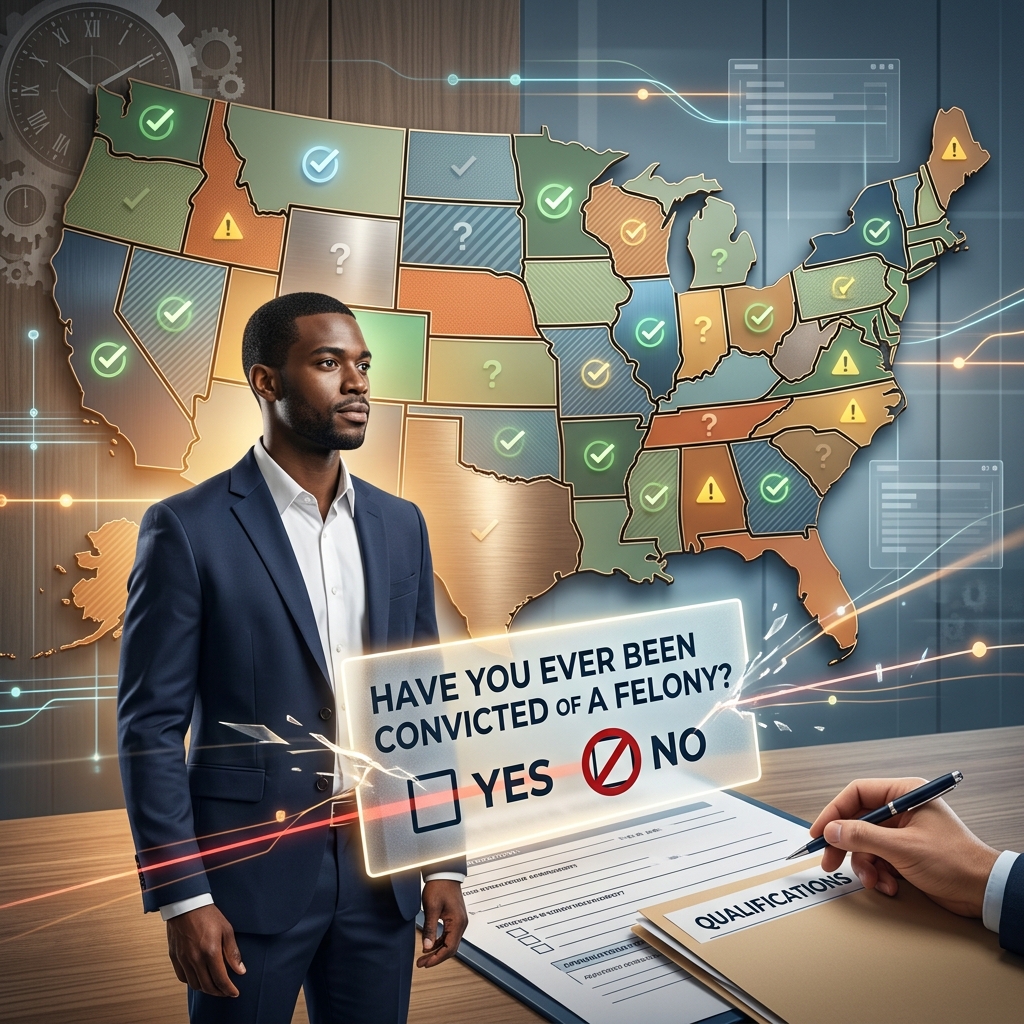
Across the United States, lawmakers have adopted ban-the-box and broader fair chance hiring policies to change how employers use criminal history in the hiring process. These rules typically prevent employers from asking about arrests or convictions on initial job applications and delay background checks until later in recruitment. The goal is to give applicants with records a genuine opportunity to be judged on their qualifications before stigma enters the conversation.
What Does “Ban the Box” Mean?
The phrase ban the box refers to removing the check box or question on job applications that asks whether the applicant has a criminal record, such as “Have you ever been convicted of a crime?” Instead of asking this up front, covered employers must wait until a specified point in the hiring process.
Although details vary by jurisdiction, ban-the-box and fair chance laws generally share three core features:
- Delayed criminal history inquiries – Employers cannot ask about criminal records on initial applications and often must wait until after an interview or a conditional job offer.
- Context-based evaluation – When employers do review criminal history, they are encouraged or required to consider factors like the age of the offense, its relation to the job, and evidence of rehabilitation.
- Procedural protections – Some laws require written notice when adverse action is based on criminal history and provide candidates a chance to respond or correct inaccuracies.
Why These Laws Were Introduced
Ban-the-box policies emerged from the work of community and advocacy groups, including initiatives such as All of Us or None, to reduce structural barriers to employment for people with criminal records. Policymakers and researchers observed that even minor or older offenses could make it nearly impossible for otherwise qualified candidates to get interviews, especially when employers use blanket exclusions.
Key motivations behind these laws include:
- Reducing discrimination and stigma by preventing automatic rejection at the application stage just because a box is checked.
- Supporting successful reentry for people leaving incarceration by improving access to stable employment, which is strongly associated with lower recidivism.
- Encouraging individualized assessments instead of one-size-fits-all rules that ignore the specifics of the offense or rehabilitation.
- Expanding the talent pool for employers who might otherwise miss skilled candidates due to early, uncontextualized criminal record screening.
Federal Fair Chance Rules
In addition to state and local laws, the federal government has adopted fair chance policies. Congress enacted the Fair Chance to Compete for Jobs Act of 2019, which restricts when certain federal employers and contractors may ask about criminal history.
Under this federal law:
- Most federal agencies cannot request criminal history information from applicants until after making a conditional offer of employment.
- The law also applies to many federal contractors, aligning government hiring with fair chance principles.
- These federal rules do not prevent private employers generally from asking about criminal history, but many private employers are affected by state and local ban-the-box laws.
How Widespread Are Ban-the-Box Laws?
Ban-the-box and fair chance policies have moved from isolated initiatives to mainstream practice. According to national policy guides, 37 states and more than 150 cities and counties have adopted some form of ban-the-box or fair chance law or policy.
Among these jurisdictions:
- At least 35 states have rules covering public employers, such as state agencies and local government offices.
- 15 states and the District of Columbia extend ban-the-box requirements to private employers.
- Over 267 million people in the U.S. live in areas with some form of fair chance or ban-the-box policy.
States with Ban-the-Box Coverage for Private Employers
Private-sector coverage is particularly significant because it affects a broad range of job opportunities. A leading national guide reports that 15 states have statewide laws removing conviction history questions from private job applications.
Those states are:
- California
- Colorado
- Connecticut
- Hawaii
- Illinois
- Maine
- Maryland
- Massachusetts
- Minnesota
- New Jersey
- New Mexico
- Oregon
- Rhode Island
- Vermont
- Washington
In addition, the District of Columbia regulates private employers, requiring that questions about criminal history be delayed until after a conditional offer.
Illustrative State Approaches (Private Sector)
| State / Jurisdiction | When Employers May Ask About Criminal History | Notable Provisions |
|---|---|---|
| California | After a conditional offer of employment. | Employers must consider factors like time since conviction and job-relatedness; notice is required before rescinding an offer. |
| Hawaii | After a conditional offer of employment. | Only certain recent felony and misdemeanor convictions may be considered, with limits tied to offense age. |
| Illinois | After the applicant is found qualified and selected for an interview, or after a conditional offer if no interview. | Private employers may not inquire into criminal history earlier and must base disqualification on a substantial relationship to the position. |
| Maryland | Typically after an initial interview. | State law limits early inquiry by certain private employers; many localities have additional fair chance rules. |
| District of Columbia | After a conditional offer of employment. | Applies to many private employers and includes enforcement mechanisms and remedies. |
Local Fair Chance Ordinances
Even in states without broad private-sector coverage, numerous cities and counties have adopted ban-the-box or fair chance rules that apply to local government and sometimes private employers.
Examples of local jurisdictions with such ordinances include:
- Major cities such as Los Angeles, San Francisco, New York City, Portland, and Austin.
- County-level policies in various states that apply to county agencies and contractors.
- Smaller cities that regulate private employers, sometimes based on employer size thresholds.
Because local rules can be more stringent than state laws, employers are expected to review both statewide and municipal requirements to understand their obligations fully.
Typical Employer Obligations Under Ban-the-Box Laws
While the specifics depend on the jurisdiction, employers covered by ban-the-box or fair chance laws generally need to adjust both their application forms and hiring procedures.
Common Requirements
- Remove criminal history questions from initial job applications for covered positions.
- Delay background checks until after an interview, conditional offer, or other defined stage.
- Conduct individualized assessments of any relevant convictions, considering:
- How long ago the offense occurred.
- The nature and seriousness of the offense.
- Whether the offense is directly related to the duties of the position.
- Evidence of rehabilitation and recent work history.
- Provide written notices if an employer intends to deny employment based on criminal history in some jurisdictions, including an opportunity for the applicant to respond or dispute inaccuracies.
- Retain records related to adverse decisions and hiring practices for possible review by enforcement agencies.
Important Exceptions
Most ban-the-box regimes recognize that certain roles require early criminal history checks due to safety, security, or legal requirements. For example, Illinois law permits earlier inquiry where other laws mandate exclusions from particular positions or where bonding requirements make certain convictions disqualifying.
Common exceptions may include:
- Positions for which federal or state law expressly bars individuals with specified offenses (e.g., some banking or childcare roles).
- Jobs requiring professional licenses subject to criminal history review.
- Roles requiring standard fidelity bonds or similar bonds where particular convictions affect eligibility.
Practical Steps for Employers
Employers operating in multiple jurisdictions must navigate a patchwork of laws. To reduce risk and support fair hiring, many organizations choose to design a system that complies with the strictest applicable rules.
Recommended Compliance Actions
- Audit existing applications and forms to ensure they do not request criminal history at a stage prohibited by law.
- Map applicable laws at federal, state, and local levels for each workplace location, relying on authoritative legal and policy sources.
- Update hiring policies to specify when background checks may be initiated and how results will be evaluated.
- Train recruiters and hiring managers on fair chance principles, including avoiding informal questions about arrests or convictions before the permitted stage.
- Coordinate with background check vendors to ensure timing and content align with legal requirements.
What Applicants With Records Should Know
Ban-the-box laws do not guarantee a job offer, but they can change the way applicants with criminal records navigate the hiring process. Many policies are designed to prevent automatic rejection and allow candidates to present their skills first.
Strategic Considerations for Job Seekers
- Review your state and local laws to understand whether employers can ask about criminal history on initial applications or must wait until later.
- Prepare an explanation for any convictions that may arise in later stages, focusing on rehabilitation, time passed, and positive work or education history.
- Track notice requirements in your jurisdiction. If an employer is required to give written notice or allow a response before taking adverse action, use that opportunity to correct errors or provide context.
- Emphasize relevant qualifications in resumes and interviews, taking advantage of application stages where criminal history is not discussed.
Frequently Asked Questions (FAQ)
Are ban-the-box laws the same in every state?
No. Ban-the-box and fair chance laws vary widely. Some states only cover public employers; others extend to private employers; many localities have additional rules. Employers and applicants should check the specific laws in their state and city.
Do these laws forbid employers from ever considering criminal history?
Generally, no. Most laws delay when employers can ask or run background checks but still allow consideration of criminal history later in the process, often with guidance to focus on job-related, recent, and serious offenses.
Which employers are covered by private-sector ban-the-box laws?
Coverage depends on the jurisdiction. For example, Illinois applies its Job Opportunities for Qualified Applicants Act to certain private employers and employment agencies, restricting when they may inquire about criminal records. Many other states set thresholds based on employer size or industry.
Do ban-the-box rules apply to volunteer positions or independent contractors?
In most cases, these laws focus on employment relationships. Whether volunteers or independent contractors are covered depends on statutory definitions in each jurisdiction. Organizations should consult the text of applicable laws or qualified counsel.
Can an employer still reject an applicant because of a conviction?
Yes, in many jurisdictions an employer may deny employment based on relevant criminal history, but they may be required to evaluate whether the conviction is substantially related to the position and to follow specified procedures. Some laws encourage employers to consider rehabilitation and provide reasons for denial.
Key Takeaways
- Ban-the-box and fair chance laws seek to ensure that criminal history is not an automatic barrier at the earliest stages of hiring.
- Coverage is extensive: 37 states and over 150 cities and counties have adopted some form of these policies, including laws impacting private employers in 15 states.
- Compliance requires careful timing of criminal history questions and background checks, individualized assessments, and attention to exceptions.
- Applicants with records gain a fairer opportunity to present their qualifications and explain their histories once employers are allowed to inquire.
References
- Ban the Box: U.S. Cities, Counties, and States Adopt Fair Hiring Policies — National Employment Law Project. 2021-12-01. https://www.nelp.org/insights-research/ban-the-box-fair-chance-hiring-state-and-local-guide/
- Ban the Box Policies and Legislation: A Brief Overview — UNC School of Government, Criminal Justice Innovation Lab. 2021-10-01. https://cjil.sog.unc.edu/resource/ban-the-box-policies-and-legislation-a-brief-overview/
- Ban the Box — National Conference of State Legislatures. 2023-05-10. https://www.ncsl.org/civil-and-criminal-justice/ban-the-box
- Job Opportunities for Qualified Applicants Act — Illinois Department of Labor. 2020-09-15. https://labor.illinois.gov/laws-rules/fls/job-opportunities-for-qualified-applicants-act.html
- Ban the Box Laws by State and Jurisdiction – Interactive Map — Accurate Background. 2024-01-01. https://www.accurate.com/ban-the-box/
- Ban the Box Laws by State in 2026 — iProspectCheck. 2026-01-10. https://iprospectcheck.com/ban-the-box-laws/
- Ban the Box laws by state for employers — TestGorilla. 2024-06-01. https://www.testgorilla.com/blog/ban-the-box-laws-by-state/
Similar Articles








Read full bio of medha deb




