
Understanding ARM Rate Caps on Adjustable-Rate Mortgages
Learn how ARM rate caps limit interest changes, protect your budget, and shape long-term mortgage costs.
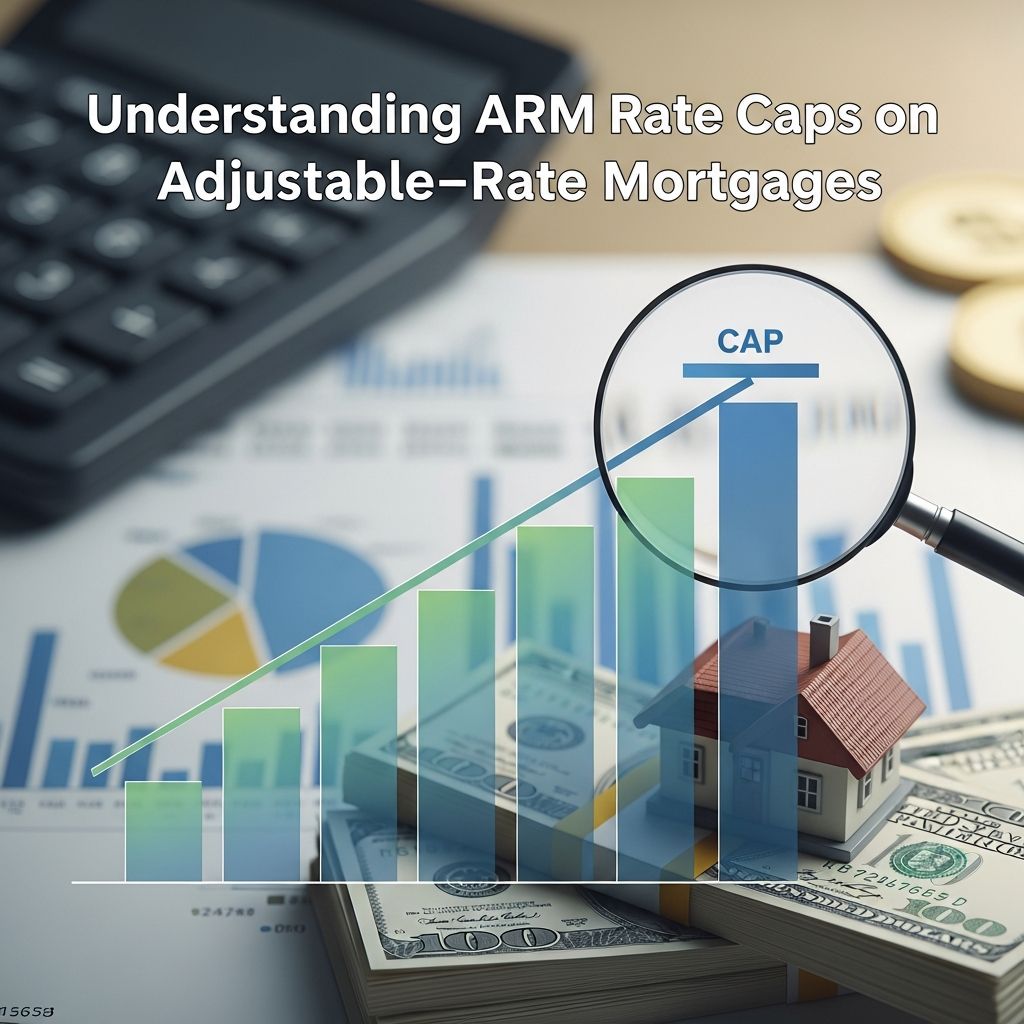
An adjustable-rate mortgage (ARM) can give you a lower initial interest rate than a fixed-rate loan, but that lower rate does not last forever. After the introductory period ends, your interest rate can rise or fall at scheduled adjustment dates. To keep those changes from becoming extreme, ARMs usually include rate caps that limit how much the rate can move at each stage of the loan.
Understanding these caps is essential: they determine your worst-case interest rate and how quickly your monthly payment could increase over time.
What Is a Rate Cap on an ARM?
A rate cap is a built-in limit on how much the interest rate on your adjustable-rate mortgage can increase or decrease when it resets. These caps are defined in your loan contract and apply for the entire life of the mortgage.
In practical terms, caps control:
- How big the first rate jump can be after the fixed introductory period
- How much the rate can move at each later adjustment
- The highest rate you can ever be charged over the life of the loan
By limiting interest-rate changes, caps reduce the risk that your payment will suddenly spike beyond what you can afford, even if market rates rise sharply.
Common Types of ARM Rate Caps
Most mainstream ARMs use a three-part cap structure. While wording can differ by lender, the concepts are widely standardized across the U.S. mortgage market.
| Cap Type | When It Applies | What It Limits | Typical Range |
|---|---|---|---|
| Initial adjustment cap | First adjustment after fixed period ends | Maximum rate change at that first reset | About 2%–5% above/below initial rate |
| Periodic (subsequent) cap | Each later adjustment date | Rate change from one adjustment to the next | Often 1%–2% per adjustment |
| Lifetime cap | Entire life of the loan | Total increase from the original rate | Commonly 5% above initial rate |
1. Initial Adjustment Cap
The initial adjustment cap limits how much your rate can change the first time it adjusts after the introductory fixed-rate period ends.
Key points:
- Applies only at the first reset, right after the fixed period (for example, after 5 years on a 5/6 ARM).
- Often set between 2 and 5 percentage points above or below the starting rate.
- Protects you from a very large jump right at the moment your payment first becomes variable.
2. Periodic (Subsequent) Adjustment Cap
The periodic cap—sometimes called the subsequent adjustment cap—limits how much the rate can change at each adjustment after the first one.
- Applies at every adjustment after the initial reset.
- Commonly set around 1%–2% per adjustment period.
- Prevents the rate from jumping too quickly, even if the underlying index moves more than that amount.
3. Lifetime Cap
The lifetime cap sets the absolute ceiling on how high your interest rate can ever rise compared with your initial rate.
- Applies for the entire life of the mortgage.
- Usually expressed as a number of percentage points above the starting rate, often around 5%.
- Defines your maximum possible rate and therefore your worst-case payment if rates rise significantly.
How ARM Rate Caps Are Written: The 2/1/5 Style
Lenders typically summarize rate caps using a three-number format such as 2/1/5 or 2/2/5. Each number corresponds to one of the caps described above.
- First number: Initial adjustment cap (first reset only)
- Second number: Periodic cap for later adjustments
- Third number: Lifetime cap over the entire term
For example, a 5/6 ARM with a 2/1/5 cap structure typically means:
- At the first adjustment after year 5, the rate can increase by at most 2 percentage points above the initial rate.
- At every 6-month adjustment after that, the rate can change by at most 1 percentage point from the previous rate.
- Over the entire life of the loan, the rate can never rise more than 5 percentage points above the initial rate.
Where Rate Caps Show Up in Your Mortgage Documents
Rate caps are not hidden; creditors must provide clear disclosures of how your ARM can change over time. Federal rules require lenders to give a Loan Estimate and a Closing Disclosure that show, among other things, how and when your interest rate can adjust and the maximum rate you may pay.
Look for cap information in:
- The ARM program disclosure you receive when you apply
- The Loan Estimate form provided early in the process
- The Closing Disclosure you receive before signing
- The adjustable-rate note or rider in your final loan documents
How Rate Caps Affect Your Monthly Payment
Because your mortgage payment is heavily driven by the interest rate, caps directly affect how quickly your payment can increase and how high it might eventually go.
Payment Impact at the First Adjustment
During the fixed period, your payment is based on the initial interest rate. At the first reset:
- If market rates are higher than your current rate, the new rate will rise but cannot exceed the initial adjustment cap limit.
- If market rates are lower, your rate may fall, although some loans also include a rate “floor” that limits how low it can go.
Payment Impact Over Time
In later years, the combination of the periodic cap and lifetime cap shapes your long-term payment risk:
- The periodic cap moderates year-to-year (or month-to-month) changes so that increases are more gradual.
- The lifetime cap tells you the highest monthly payment you might end up paying if rates remain high.
Why Rate Caps Matter When Comparing ARMs
Two ARMs can have the same starting rate but very different long-term costs depending on their cap structures. When you compare offers, it is not enough to look only at the introductory rate or the first year of payments.
Key Questions to Ask
- What are the exact caps (for example, 2/1/5, 5/2/5)?
- How often does the rate adjust after the fixed period?
- What is the highest rate I could ever pay under the lifetime cap?
- How much could my payment increase at the first adjustment?
- Do I plan to keep this mortgage long enough for multiple adjustments to matter?
Trade-Offs Between Lower Intro Rates and Higher Caps
Some ARMs offer very attractive introductory rates but pair them with more aggressive cap structures or shorter fixed periods. Others may have slightly higher initial rates but lower or more consumer-friendly caps.
When you evaluate your options, consider:
- Your tolerance for payment changes in future years
- Your plans to sell, refinance, or stay in the home long term
- Your ability to handle the maximum possible payment under the lifetime cap
Other Features That Interact With Rate Caps
Rate caps are one part of a broader ARM structure. Several other features interact with caps to determine your overall risk.
Index and Margin
The index is a published benchmark interest rate (such as SOFR or another market index) that moves with market conditions. The margin is a fixed number of percentage points that your lender adds on top of the index to set your actual ARM rate.
At each adjustment date, your new rate is calculated as:
New Rate = Current Index + Margin (subject to caps and any floors)
Rate caps apply after this calculation, limiting how much the new rate can differ from the previous rate or the initial rate.
Rate Floors
Some ARMs also include a rate floor, which is the lowest rate the loan can ever have. Even if the index falls significantly, your rate will not go below this floor.
This means that while caps protect you from very large increases, floors can limit the benefit you receive from falling market rates.
Adjustment Frequency
Different ARMs reset on different schedules. Common structures include:
- 5/6 ARM: Fixed for 5 years, then adjusts every 6 months
- 7/6 ARM: Fixed for 7 years, then adjusts every 6 months
- 3/1, 5/1, 7/1 ARMs: Fixed for 3, 5, or 7 years, then adjust annually
The more often your rate can change, the more frequently the periodic cap will come into play.
Practical Tips for Borrowers Considering an ARM
Rate caps can make ARMs safer, but they do not eliminate all risk. Before you choose an ARM, consider these practical steps.
- Model the worst case: Ask your lender to estimate your payment at the maximum lifetime rate, and make sure that number fits your budget.
- Check your time horizon: If you expect to sell or refinance before the fixed period ends, the caps beyond the first adjustment may be less important—but plans can change.
- Compare with a fixed-rate loan: Weigh the potential savings from the lower initial ARM rate against the risk of higher payments in future years.
- Understand all three caps: Do not focus only on the first number (initial cap). The periodic and lifetime caps are just as important.
- Review disclosures carefully: Read your Loan Estimate and Closing Disclosure to confirm the cap structure and adjustment schedule.
Frequently Asked Questions About ARM Rate Caps
Do all ARMs have rate caps?
Most consumer ARMs offered by major lenders include some form of rate cap structure, particularly for home purchase and refinance loans. Caps are a standard way to limit interest-rate risk for borrowers, although the exact numbers can vary from one lender or product to another.
Can my rate go up even if there is a cap?
Yes. Caps do not prevent increases; they simply limit how large or how fast those increases can be. If market rates rise enough, your ARM rate can still reach the lifetime cap over time, but it will do so in controlled steps defined by the initial and periodic caps.
Can my rate also go down with an ARM?
In many ARMs, the rate can decrease when the underlying index falls, and the same caps that limit increases may also limit how far it can drop at a single adjustment. However, if your loan has a rate floor, that floor will prevent the rate from falling below a certain level.
Is a lower cap always better?
Lower caps generally reduce your interest-rate risk, but loans with more protective caps may have slightly higher starting rates or different terms. The best choice depends on your budget, risk tolerance, and how long you plan to keep the mortgage.
Where can I see the exact caps for my loan?
Your specific cap structure appears in your ARM disclosures, the Loan Estimate, the Closing Disclosure, and the adjustable-rate note or rider you sign at closing. If anything is unclear, ask your loan officer for a written explanation before you commit.
References
- Adjustable-Rate Mortgages (ARMs) — State Employees’ Credit Union. 2024-01-01. https://www.ncsecu.org/loans/mortgages/adjustable-mortgages.html
- Mortgage ARM Caps: What To Know — JPMorgan Chase Bank, N.A. 2023-09-12. https://www.chase.com/personal/mortgage/education/financing-a-home/adjustable-rate-mortgage-rate-caps
- Do Adjustable-Rate Mortgages Have Rate Caps? — Experian. 2023-08-10. https://www.experian.com/blogs/ask-experian/do-adjustable-rate-mortgages-have-rate-caps/
- Considering an Adjustable-Rate Mortgage? Here’s What You Should Know — Freddie Mac. 2023-06-05. https://myhome.freddiemac.com/blog/homebuying/considering-adjustable-rate-mortgage-heres-what-you-should-know
- Interest Rate Caps: What Are They and How Do They Work? — Rocket Mortgage. 2025-11-05. https://www.rocketmortgage.com/learn/interest-rate-cap
Similar Articles








Read full bio of medha deb


