
Arkansas Traffic Laws: 10 Essential Rules Drivers Need To Know
A plain‑English guide to Arkansas traffic rules, points, penalties, and safe driving responsibilities for every motorist.
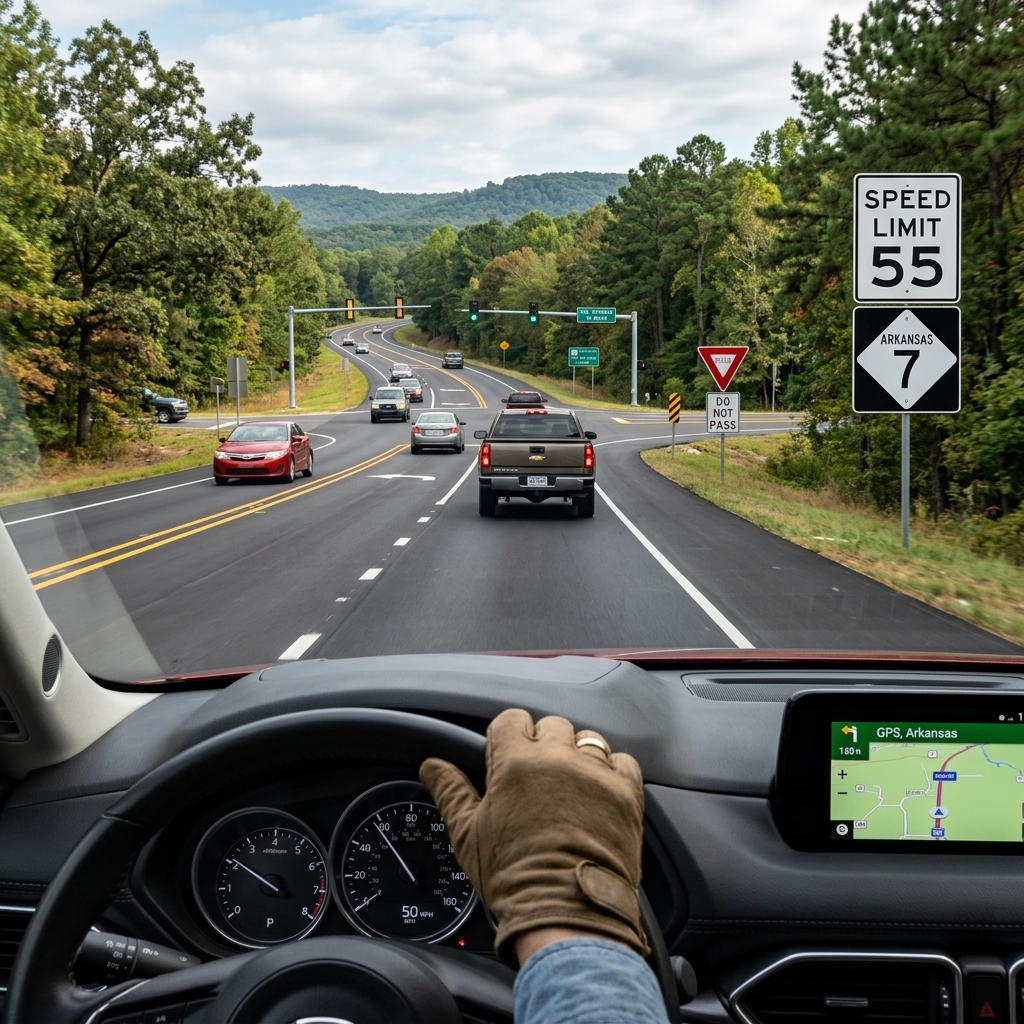
Arkansas traffic laws regulate how drivers, cyclists, and pedestrians share the road, assigning responsibilities and penalties to promote safety and reduce crashes. Knowing these rules is essential not only to avoid tickets and fines, but also to protect yourself and others whenever you drive.
This guide explains key Arkansas traffic rules in clear language, including speed limits, impaired driving, lane usage, seat belt and child restraint requirements, and how the driver’s license point system works. It is meant for general information and is not a substitute for legal advice.
1. How Arkansas Traffic Laws Are Organized
Most Arkansas traffic rules are contained in Title 27 of the Arkansas Code, especially Subtitle 4, which covers motor vehicular traffic. The Arkansas Department of Transportation and Arkansas Highway Police also publish a digest of motor vehicle and traffic laws used by officers and drivers.
- Statutes: Laws passed by the Arkansas General Assembly (Ark. Code Ann. § 27‑49‑101 and following).
- Regulations: Rules adopted by the State Highway Commission and other agencies implementing those statutes.
- Local ordinances: Cities and counties may adopt additional rules, such as local speed limits or parking restrictions, as long as they comply with state law.
When officers issue citations, they typically refer to specific code sections within this framework.
2. Speed Limits and Speeding Violations
Arkansas uses both basic and absolute speed limit rules. This means you can be ticketed for driving too fast for conditions even if you are under the posted limit, and you can also be cited for exceeding the posted limit itself.
2.1 Basic Speed Rule
The basic rule requires drivers to travel at a speed that is reasonable and prudent for existing conditions, taking into account traffic, road design, weather, and visibility. If conditions are poor—such as heavy rain, fog, or snow—you must slow down even if the speed limit sign allows a higher speed.
2.2 Typical Posted Speed Limits
Arkansas law sets maximum speeds for different types of roads, and signs often reflect these statutory limits. Common limits include:
- 25 mph in school zones when children are present.
- 35 mph in many urban districts, unless signs state otherwise.
- 55 mph for large trucks on some open roadways.
- 65 mph for cars and many trucks on other highways, depending on location and signage.
Always follow the posted sign if it specifies a different limit, and be prepared to reduce speed further for conditions such as road construction, sharp curves, or heavy traffic.
2.3 Consequences of Speeding
Speeding violations can lead to fines, court costs, points on your driving record, and, in serious cases, jail time. For example, Arkansas law allows fines of up to several hundred dollars and possible jail time for excessive speeding, especially when speeds are 15 mph or more over the posted limit.
Recent legislation can also increase fines in special zones. Under laws such as Act 327 of 2025, fines for certain moving violations committed in designated work zones may be doubled, reflecting the increased risk to road workers and other drivers.[10]
| Type of Violation | Potential Consequences |
|---|---|
| Driving slightly above limit (e.g., 5–10 mph over) | Fine, court costs, points added to driver record |
| 15 mph or more above limit | Higher fine, potential short jail sentence, more points |
| High speed in work or school zone | Enhanced fines (including doubled fines in designated zones), possible license consequences |
3. Arkansas Driver’s License Point System
Arkansas uses a point system to track repeated traffic violations. Each conviction adds a certain number of points to your driving record, and accumulating too many points within a specified period can lead to license suspension.
3.1 How Points Are Assigned
Different offenses carry different point values. For example, minor speeding may be assessed fewer points than reckless driving or leaving the scene of a crash. While the exact schedule can change, typical patterns include:
- Lower points for minor speeding or lane violations.
- Higher points for major offenses like racing, excessive speeding, or hit-and-run.
- Automatic suspension or very high points for serious violations such as DUI (driving under the influence).
3.2 Impact of Points on Your License
As points accumulate, the Office of Driver Services may issue warnings, require driver improvement courses, or suspend your license for a period of time.
- Fewer points: May result in a warning or increased insurance premiums.
- Moderate accumulation: You could be required to attend a driver safety program.
- High accumulation: Your driving privileges may be suspended for a defined term.
Insurance companies often review your motor vehicle record, meaning that higher point totals can lead to increased insurance costs even if your license remains valid.
4. Lane Usage, Following Distance, and Right-of-Way
Safe lane discipline and proper spacing between vehicles are central to Arkansas traffic law. Many crashes can be prevented by obeying these basic rules.
4.1 Right Lane Travel and Passing
Arkansas generally requires vehicles to travel in the right-hand lane of multi-lane roads, using the left lane primarily for passing. After passing, you should return to the right lane when it is safe to do so.
Drivers must also signal lane changes, avoid weaving through traffic, and yield to faster traffic when appropriate, especially in the left lane.
4.2 Safe Following Distance
State law prohibits following another vehicle more closely than is reasonable and prudent, considering the speed of traffic and road conditions. For large trucks and vehicles towing another unit, the law sets a specific minimum following distance of 200 feet outside business or residence districts.
Safety agencies in Arkansas recommend using the “two-second rule” in good conditions and increasing that distance in poor weather or heavy traffic.
- Good conditions: At least two seconds behind the vehicle ahead.
- Inclement weather or night driving: At least four seconds.
- Very poor conditions (heavy rain, dense fog, heavy snow): Six seconds or more.
4.3 Right-of-Way Basics
Arkansas law includes detailed right-of-way rules at intersections, crosswalks, and when entering highways. Some general principles include:
- Yield to pedestrians legally in crosswalks.
- At four-way stop intersections, the first vehicle to stop usually proceeds first.
- When turning left, yield to oncoming traffic that is close enough to be a hazard.
- Emergency vehicles with lights and sirens activated have priority; drivers must pull to the right and stop when possible.
5. Seat Belts, Child Restraints, and Occupant Safety
Arkansas law requires many vehicle occupants to wear restraints. Police may stop a vehicle specifically for seat belt violations in certain circumstances, and failure to use restraints can lead to fines and increase the severity of injuries in collisions.
5.1 Adult Seat Belt Requirements
State law generally requires front-seat occupants to wear seat belts, with some limited exceptions. Wearing a seat belt is one of the simplest ways to reduce serious injury or death in a crash, as documented by federal safety data.
5.2 Child Safety Seats and Restraints
Arkansas has specific requirements for restraining children in vehicles based on age and weight. Common requirements include:
- Young children under a certain age and under approximately 60 pounds must ride in an appropriate child safety seat or booster seat.
- Children and teenagers up to a defined age must use a seat belt or child restraint that is suitable for their size.
Parents and caregivers are responsible for properly installing child seats, using manufacturer instructions and, when needed, guidance from certified child passenger safety technicians.
6. DUI and Impaired Driving in Arkansas
Driving under the influence of alcohol or drugs is a serious offense in Arkansas, with strict blood alcohol concentration (BAC) limits and escalating penalties for repeat offenses.
6.1 Legal Blood Alcohol Limits
| Driver Category | Maximum Legal BAC |
|---|---|
| Age 21 and older (non-commercial) | 0.08 or higher may result in DUI charge. |
| Under 21 | 0.02 or higher can trigger an underage DUI allegation. |
| Commercial drivers (CDL) operating commercial vehicles | 0.04 or higher is typically enough for a violation. |
6.2 Penalties for DUI Offenses
DUI penalties increase with each conviction and may include license suspension, fines, jail time, mandatory education programs, and ignition interlock requirements.
- First offense: License suspension (often around six months), fine, possible short jail term, and court-ordered education.
- Second offense within five years: Longer suspension (such as two years), higher fines, and more severe incarceration possibilities.
- Third offense: Extended suspension (for example, 30 months), substantial fines, and higher likelihood of jail.
- Multiple offenses (e.g., four in five years): Potential permanent revocation of driving privileges.
Arkansas also enforces implied consent laws, meaning that drivers who refuse chemical testing after a lawful DUI arrest can face additional license consequences.
7. Lighting, Hazard Lights, and Work Zones
Proper use of vehicle lights helps make your vehicle visible and signals your intentions to others. Arkansas law addresses headlights, hazard lights, and special rules in work zones.[10]
7.1 When Headlights Are Required
Motor vehicles (other than motorcycles) must use headlights:
- From one-half hour after sunset to one-half hour before sunrise.
- Whenever there is not enough light to clearly see people or vehicles at 500 feet.
- Whenever windshield wipers are used due to rain, snow, or similar precipitation.
7.2 Using Hazard Lights
Arkansas law restricts use of hazard lights while driving. Hazard lights generally should only be used to indicate a traffic hazard, such as when a vehicle is stopped on the shoulder or disabled. Safety officials advise drivers not to drive in the rain with hazard lights on; instead, keep headlights on and maintain a safe speed and following distance.
7.3 Work Zone Rules and Enhanced Penalties
To protect road workers, Arkansas imposes stricter penalties for moving violations inside designated work zones. Recent legislation—such as Act 327 of 2025—allows doubled fines for certain traffic offenses committed in mobile work zones, including reckless driving and speeding.[10] Drivers should slow down, obey temporary signs, and be prepared for lane shifts or flagger instructions.
8. Driving Without a Valid License
Operating a motor vehicle without a valid driver’s license is prohibited in Arkansas and can result in fines, court costs, and even jail time in some cases.
Situations that may count as driving without a valid license include:
- Never having been issued a driver’s license.
- Driving with an expired license.
- Driving while your license is suspended, revoked, or canceled.
- In some circumstances, failing to have your physical license in your possession can also lead to a citation, though this may be treated differently than driving while suspended.
Penalties can escalate when a driver continues to operate a vehicle after suspension or revocation, particularly if the original suspension involved DUI or other serious offenses.
9. Practical Tips to Avoid Violations
Following Arkansas traffic laws is largely a matter of staying alert and using common sense. The following practical steps can help you stay compliant and safe:
- Watch for signs: Speed limits, lane use, and work zone instructions are posted; adjust your driving promptly.
- Slow down in poor conditions: Use the basic speed rule—never assume the posted limit is always safe.
- Maintain safe following distance: Use at least the two-second rule in good weather and increase distance when visibility or traction is reduced.
- Always buckle up: Make sure everyone in the vehicle is properly restrained, especially children.
- Designate a sober driver: Avoid any level of impairment if you plan to drive. Even below the legal limit, substances can affect reaction time.
- Keep your license and registration current: Renew on time and address any suspensions or points problems promptly.
10. Frequently Asked Questions About Arkansas Traffic Laws
10.1 Can I be ticketed for speeding if I am below the posted limit?
Yes. Under Arkansas’s basic speed rule, you can be cited if your speed is not reasonable for current conditions, even if it is below the posted limit. For example, driving at the full posted speed in heavy fog or on icy roads might violate this rule.
10.2 What happens if I get multiple traffic tickets in a short time?
Each conviction adds points to your driving record. Accumulating too many points within a certain period can lead to warnings, required driver education, higher insurance premiums, and, ultimately, license suspension. The exact consequences depend on the nature of the offenses and your prior record.
10.3 Are seat belts mandatory for everyone in the vehicle?
Arkansas law generally requires front-seat occupants to wear seat belts and imposes specific requirements for children based on age and weight. Some older vehicles and certain occupants may have exceptions, but the safest approach is to ensure every person in the vehicle is buckled up on every trip.
10.4 How long will my license be suspended for a first DUI?
For many first DUI offenses, Arkansas law provides for a license suspension of around six months, along with fines and possible jail time. However, exact penalties depend on the circumstances, including your BAC, whether there was a crash, and any prior history. Courts may also require ignition interlock devices or alcohol education programs.
10.5 When am I allowed to use my hazard lights while driving?
Hazard lights should generally only be used to indicate that your vehicle is a traffic hazard, such as when stopped on the shoulder due to mechanical problems. Arkansas law does not allow hazard light use simply to signal reduced visibility while driving; instead, use your headlights and adjust your speed.
10.6 Where can I read the full text of Arkansas traffic laws?
The complete Arkansas traffic statutes are available in Arkansas Code Title 27, particularly Subtitle 4 on motor vehicular traffic. The Arkansas Department of Transportation and Arkansas Highway Police publish digests of relevant laws, and official state websites provide free access to statutes and some regulations.
References
- Arkansas Motor Vehicle and Traffic Laws and State Highway Commission Regulations — Act 300 — Arkansas Department of Transportation / Arkansas Highway Police. 2021. https://ardot.gov/divisions/communications/publications/motor-vehicle-and-traffic-laws-and-state-highway-commission-regulations-act-300/
- Arkansas Code Title 27 – Transportation, Subtitle 4 – Motor Vehicular Traffic — State of Arkansas / Justia (statutory compilation). 2024. https://law.justia.com/codes/arkansas/title-27/subtitle-4/
- Arkansas Traffic Laws — FindLaw. 2023 (updated). https://www.findlaw.com/state/arkansas-law/arkansas-traffic-laws.html
- Learn the Law 15 – Following Too Close — Arkansas Highway Safety Office / Toward Zero Deaths Arkansas. 2022. https://tzdarkansas.org/learn-the-law-15/
- Learn the Law 19 – Headlights and Hazard Lights — Arkansas Highway Safety Office / Toward Zero Deaths Arkansas. 2022. https://tzdarkansas.org/learn-the-law-19/
- The 5 Traffic Laws Broken Most Often by Arkansas Drivers — McMath Woods P.A. (Arkansas law firm). 2021. https://www.mcmathlaw.com/blog/the-5-traffic-laws-broken-most-often-by-arkansas-drivers/
- New Arkansas traffic safety laws take effect August 5 — FOX16 (KLRT). 2025-07-25. https://www.fox16.com/news/state-news/new-arkansas-traffic-safety-laws-take-effect-august-5/
Similar Articles








Read full bio of Sneha Tete


