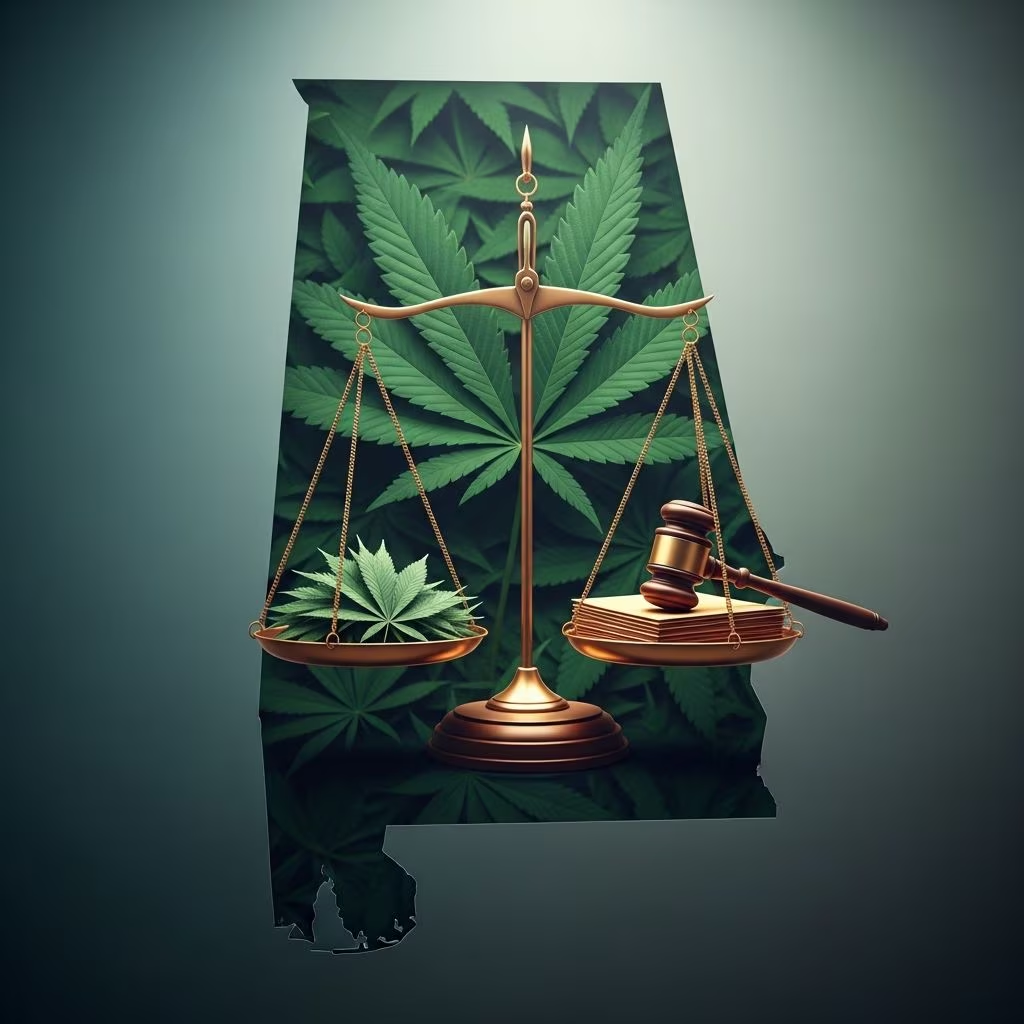
Alabama maintains some of the strictest marijuana laws in the United States. Recreational cannabis remains illegal, and penalties for possession, sale, and trafficking can be severe, including jail or prison time, substantial fines, and a mandatory driver’s license suspension after any conviction. This guide explains how Alabama law treats marijuana, what conduct is criminalized, and the potential consequences for adults and minors.
1. Overall Legal Status of Marijuana in Alabama
Under Alabama law, marijuana is classified as an illegal controlled substance for recreational purposes. While Alabama has taken limited steps toward medical cannabis, the state continues to criminalize most possession, cultivation, and distribution.
- Recreational use: Illegal for possession, use, or distribution in any amount.
- Medical cannabis: Restricted, regulated by state law and not a broad authorization to possess or grow marijuana.
- Decriminalization: Alabama has not decriminalized marijuana; even small amounts can lead to criminal charges.
Any conviction for a marijuana offense in Alabama also triggers a mandatory six-month driver’s license suspension under state law, sometimes referred to as the “smoke a joint, lose your license” rule.
2. Personal-Use Possession vs. Non-Personal Use
Alabama law makes an important distinction between possession for personal use only and possession that is considered other than personal use (commonly associated with intent to sell or distribute).
2.1 Personal-Use Possession (Second-Degree Possession)
Unlawful possession of marijuana for personal use only is addressed in Alabama Code § 13A-12-214.
- Definition: Possessing marijuana for one’s own personal consumption, without evidence of intent to distribute.
- Classification: Class A misdemeanor under current law.
- Potential penalties:
- Up to 1 year in jail.
- Fine up to $6,000.
- Mandatory 6-month driver’s license suspension if convicted.
First-time offenders are commonly charged under this section if the state can show the marijuana was for personal use only.
2.2 Non-Personal Use or Repeat Possession (First-Degree Possession)
More serious possession charges fall under Alabama Code § 13A-12-213, often called first-degree possession.
- Applies when:
- The marijuana is possessed for reasons other than personal use, such as intent to sell or distribute.
- The defendant has a prior conviction for possession and is again found with marijuana for personal use.
- Classification:
- Class C felony for non-personal use possession (e.g., intent to distribute).
- Can also be treated as a Class D felony in some repeat-offense circumstances.
- Potential penalties:
- Mandatory minimum of 1 year and 1 day in prison that cannot be fully suspended.
- Maximum sentence up to 10 years for a Class C felony.
- Fines up to $15,000 depending on classification.
- Mandatory 6-month license suspension upon conviction.
| Type of Possession | Typical Circumstances | Charge Level | Possible Incarceration | Possible Fine |
|---|---|---|---|---|
| Personal use (first offense) | Small amount, no distribution evidence | Class A misdemeanor | Up to 1 year in jail | Up to $6,000 |
| Personal use (after prior conviction) | Repeat possession; prior non-personal or possession conviction | Felony (often Class C or D) | 1 year and 1 day up to 5–10 years | Up to $7,500–$15,000 |
| Other than personal use | Evidence of sale, distribution, or larger quantities | Class C felony | 1 year and 1 day up to 10 years | Up to $15,000 |
3. Laws on Sale, Distribution, and Trafficking
Alabama imposes harsher penalties when marijuana is sold, distributed, or possessed in large quantities that indicate trafficking.
3.1 Sale or Delivery of Marijuana
- Sale of any amount:
- Class B felony.
- Mandatory minimum 2-year prison sentence.
- Maximum sentence up to 20 years.
- Possible fine up to $30,000.
- Sale to a minor:
- Significantly enhanced penalties.
- Possible sentencing range from 10 years to life imprisonment.
- Potential fine up to $60,000.
- Sales near schools or public housing:
- Additional prison time when sale occurs within a specified distance of a school or public housing project.
Because even small-quantity sales are treated as serious felonies, a distribution charge can result in lengthy incarceration, especially where minors or school zones are involved.
3.2 Trafficking Offenses
Trafficking charges are based primarily on the weight of marijuana involved.
- Threshold for trafficking: Possession of more than a specified number of pounds (for example, anything above roughly 2.2 pounds can trigger trafficking levels).
- Felony classification: All trafficking levels are felonies and carry mandatory minimum prison terms.
- Examples of penalty ranges:
- Several years of mandatory prison time even at the lowest weight tier.
- Longer mandatory minimums and higher fines as weight increases.
- Very large quantities can lead to potential life imprisonment.
4. Cultivation, Hashish, and Concentrates
Growing marijuana or producing concentrated forms such as hash or oils is treated as a serious felony in Alabama.
4.1 Cultivation and Manufacture
- Cultivation: Growing marijuana plants is prosecuted under manufacturing or trafficking laws rather than simple possession.
- Manufacture-related charges:
- Manufacturing in the second degree typically carries 2–20 years in prison and substantial fines (often treated as a Class B felony).
- Manufacturing in the first degree can carry 10 to 99 years of imprisonment and very high fines.
4.2 Hashish and THC Concentrates
- Possession of concentrates: Often treated more harshly than leaf marijuana; possession can be classified as a felony with potential multi-year prison exposure and large fines.
- Manufacture of concentrates: Usually considered manufacture of a controlled substance in the second degree, treated as a Class B felony, with 2–20 years in prison and fines up to tens of thousands of dollars.
5. Drug Paraphernalia and Related Offenses
Alabama also criminalizes the possession, sale, or use of items defined as drug paraphernalia when tied to marijuana or other controlled substances.
5.1 Possession or Use of Paraphernalia
- Typical items: Pipes, bongs, rolling papers, scales, or other devices used to ingest, prepare, or package marijuana.
- Possession with intent to use:
- Generally charged as a misdemeanor when tied to personal use.
- Can lead to up to 1 year in jail and fines up to several thousand dollars.
5.2 Sale or Delivery of Paraphernalia
- Sale or delivery: Often a misdemeanor but can escalate with aggravating factors.
- Delivery to a minor: May be charged as a felony with penalties that include substantial prison sentences and higher fines.
- Paraphernalia linked to manufacture: Using or possessing paraphernalia to manufacture controlled substances can result in felony charges, especially where firearms are involved.
6. Driver’s License Suspension and Other Collateral Consequences
In addition to criminal penalties, marijuana convictions carry important non-criminal consequences.
6.1 Mandatory Driver’s License Suspension
- Automatic suspension: Any marijuana conviction in Alabama triggers a mandatory six-month suspension of the offender’s driver’s license.
- Applies to:
- Misdemeanor possession.
- Felony possession or sale.
- Marijuana-related paraphernalia convictions.
6.2 Additional Long-Term Impacts
Although not spelled out in cannabis statutes themselves, a marijuana conviction in Alabama can affect many areas of life:
- Employment and professional licensing opportunities.
- Eligibility for certain public benefits or housing.
- College financial aid and admissions decisions.
- Immigration status for non-citizens.
7. Medical Marijuana and Limited Exceptions
Alabama has taken limited steps toward allowing medical cannabis, but its program is narrow compared to many other states.
- No general right to possess: The existence of a medical cannabis law does not authorize unlicensed cultivation or broad personal possession of marijuana.
- Strict regulatory framework: Medical cannabis in Alabama is regulated by state agencies with tight controls on production, distribution, and qualifying conditions.
- Conflict with federal law: Marijuana remains a Schedule I substance under federal law, and federal property or facilities in Alabama may prohibit any marijuana use or possession, even if state law allows limited medical use.
Individuals who qualify under the medical program must still comply with specific rules regarding product type, dosage, and purchase through authorized channels. Unauthorized possession, even for health reasons, may still lead to criminal charges in Alabama courts.
8. Federal Property and Special Locations in Alabama
On federal property in Alabama—such as certain training centers or facilities—marijuana remains strictly prohibited regardless of state law.
- Federal supremacy: Federal agencies enforce national drug laws on federal land, so state-level medical provisions do not apply.
- Possible penalties: Individuals found with marijuana on federal property may face federal charges, in addition to administrative consequences like ejection from the facility.
9. Recent Reform Proposals and Legislative Trends
There have been ongoing legislative discussions in Alabama about adjusting marijuana penalties, including proposals to reduce penalties for small amounts of marijuana for personal use.
- Example proposal: A recent bill in the Alabama Legislature sought to reclassify second-degree possession (personal-use cases under a certain weight, such as less than one ounce) as a violation instead of a Class A misdemeanor, with only a modest fine and no jail time.
- Goal of reforms: To reduce the long-term impact of low-level possession convictions while maintaining penalties for trafficking and distribution.
These proposals demonstrate an evolving policy conversation, but until changes are formally enacted and signed into law, the existing criminal penalties remain in force.
10. Practical Tips for Alabama Residents and Visitors
Because Alabama marijuana laws are strict, understanding risk and potential exposure is critical.
- Do not assume out-of-state rules apply: Having purchased marijuana legally in another state does not make possession legal in Alabama.
- Weight matters: Even a small difference in quantity can shift a case from misdemeanor possession to a felony or trafficking level.
- Location matters: Sales near schools or to minors can trigger severe enhancements.
- Paraphernalia can be enough: Possession of pipes or other paraphernalia alone may result in separate criminal charges.
- Licensing consequences: Expect a driver’s license suspension following any marijuana conviction.
Frequently Asked Questions About Alabama Marijuana Laws
Q1: Is any amount of recreational marijuana legal in Alabama?
No. Alabama law makes recreational marijuana illegal in all quantities. Possessing even a small amount for personal use can lead to a Class A misdemeanor charge, up to one year in jail, fines up to $6,000, and a six-month driver’s license suspension.
Q2: What happens if I am caught with marijuana for the first time?
A first-time personal-use possession case is typically charged as second-degree possession, a Class A misdemeanor. Penalties can include up to one year in jail, a fine up to $6,000, court costs, probation, and mandatory license suspension for six months if convicted.
Q3: How is intent to distribute determined in Alabama?
Prosecutors may argue that larger quantities, packaging materials, scales, or communications about sales show possession “other than personal use.” Such cases can be charged as first-degree possession or sale, both felonies, rather than a misdemeanor personal-use offense.
Q4: Does Alabama’s medical marijuana law allow me to grow my own plants?
No. Alabama’s medical cannabis framework does not authorize personal cultivation. Only licensed entities may grow, process, and distribute approved medical products. Unauthorized growing remains illegal and can be treated as manufacture, which is a felony.
Q5: Are marijuana laws different on federal property within Alabama?
Yes. On federal property, such as certain training or preparedness facilities, federal law applies. Federal agencies prohibit marijuana possession and use regardless of Alabama’s medical program or any state-level changes, and violations can lead to federal or administrative penalties.
References
- Alabama Laws and Penalties — NORML. 2024-01-01. https://norml.org/laws/alabama-penalties/
- Cannabis in Alabama — Wikipedia (summarizing Alabama statutes). 2024-06-01. https://en.wikipedia.org/wiki/Cannabis_in_Alabama
- Marijuana Possession in Birmingham — Polson & Polson, P.C. 2023-05-10. https://www.polsonlawfirm.com/locations/birmingham-criminal/drug-crimes-birmingham/al-marijuana-possession/
- SB42 Introduced (2024 Regular Session) — Alabama Legislature. 2024-02-01. https://www.legislature.state.al.us/pdf/SearchableInstruments/2024RS/SB42-int.pdf
- Alabama Code § 13A-12-214 (2024) – Unlawful Possession of Marihuana in the Second Degree — Justia / Alabama Legislature. 2024-01-01. https://law.justia.com/codes/alabama/title-13a/chapter-12/article-5/division-2/section-13a-12-214/
- Alabama Drug Laws and Penalties 2025 Explained — Brad Phillips Law. 2025-01-15. https://www.bradphillipslaw.com/blog/alabama-drug-laws-and-penalties/
- Medical Marijuana Notice — U.S. Department of Homeland Security, Center for Domestic Preparedness. 2022-08-01. https://cdp.dhs.gov/medical-marijuana-notice