
Understanding Alabama Living Wills and Advance Directives
Learn how Alabama living wills and advance directives work, who can create them, and how they guide end-of-life medical decisions.
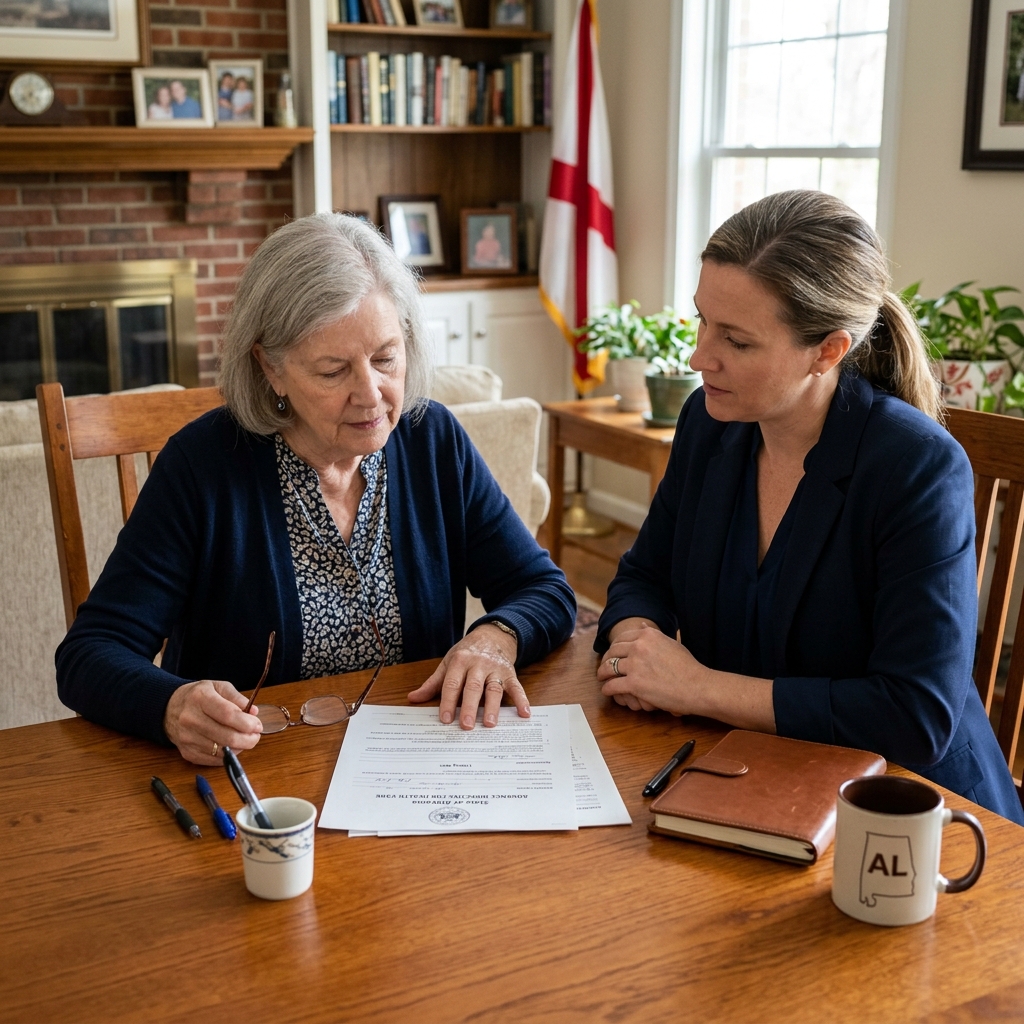
Alabama law gives adults the power to decide in advance what medical care they want if they become unable to communicate those wishes themselves. Living wills and other forms of advance directives are the tools that make those decisions legally enforceable, ensuring that health care providers and family members have clear guidance in moments of crisis.
What Is a Living Will in Alabama?
In Alabama, a living will is a type of advance directive for health care that states whether you want life-sustaining treatment, artificial nutrition, or hydration if you are terminally ill or permanently unconscious and unable to speak for yourself. It is not about ordinary medical care; it focuses on critical situations where treatment may only prolong the dying process or sustain life when recovery is not expected.
Alabama law treats living wills as part of a broader category called an advance directive for health care, which can also include naming someone to make decisions for you and other written expressions of your wishes.
- Primary purpose: To direct when life-sustaining treatment should be provided, withheld, or withdrawn.
- Secondary purpose: To state preferences about artificial nutrition and hydration, if you choose to address them explicitly.
- Scope: Applies when you cannot communicate decisions and are in specified medical conditions such as terminal illness or permanent unconsciousness.
Advance Directives Beyond Living Wills
While living wills are central, Alabama recognizes several ways to express health care choices in advance. Collectively, these are referred to as advance directives and can be written or, in certain circumstances, oral.
Common forms of advance directives in Alabama include:
- Living Will: Written instructions about life-sustaining treatment and artificial nutrition/hydration.
- Health Care Proxy / Health Care Agent: A person you appoint to make health care decisions on your behalf if you cannot.
- Durable Power of Attorney for Health Care: A legal document granting someone broader authority to make medical decisions for you.
- Other Written or Oral Directives: Memoranda to a physician, verbal statements in the presence of witnesses, or other documented expressions of your wishes.
Alabama law is flexible about form, but a written living will or formal advance directive generally provides the clearest and most reliable guidance.
Who Can Create a Living Will in Alabama?
Alabama law sets specific requirements for who may execute a valid living will or advance directive for health care. These rules are designed to ensure that the person making the directive understands the consequences of their decisions and is acting voluntarily.
| Requirement | Alabama Rule |
|---|---|
| Minimum age | You must be at least 19 years old. |
| Mental capacity | You must be reasonably alert and able to understand the consequences of your medical decisions. |
| Status | You must be a competent adult at the time you sign the directive. |
A person who meets these criteria can direct the providing, withholding, or withdrawal of life-sustaining treatment and artificial nutrition or hydration through a living will or similar advance directive.
Formalities: Signing and Witness Requirements
To be enforceable, a living will must follow certain signing and witnessing procedures. Alabama law focuses on making sure the directive is genuine and the product of the patient’s free choice.
Witnesses and Notarization
- Two witnesses: A living will should be signed in the presence of at least two witnesses who see you sign the document.
- No mandatory notarization: Alabama law does not require a living will or advance directive to be notarized, although some people choose notarization for additional assurance.
- Competent witnesses: Witnesses should be adults and capable of understanding their role in attesting to your signature and apparent capacity.
Some institutions and forms allow either two witnesses or notarization, but Alabama’s core legal requirement is satisfied with proper witnessing.
Choosing a Health Care Proxy or Agent
In addition to a living will, many people appoint a health care proxy (also known as a health care agent) to make decisions if they are unable to do so. Alabama law allows you to designate someone to act on your behalf, subject to certain restrictions.
Key points about appointing a proxy in Alabama include:
- The proxy must generally be an adult; in Alabama, that means at least 19 years old.
- It is wise to choose someone you trust who understands your values regarding end-of-life care and medical treatment.
- The proxy should be willing to honor your wishes, even if other family members disagree.
- You can combine the proxy designation with a living will to give both written instructions and decision-making authority.
When properly documented, a proxy’s decisions are treated as an extension of your own choices, guided by medical standards and the instructions in your advance directive.
Life-Sustaining Treatment, Nutrition, and Hydration
One of the most sensitive issues addressed in Alabama living wills is the use of life-sustaining treatment and artificial nutrition or hydration. These measures can keep a person alive when natural bodily functions would otherwise fail.
Under Alabama law:
- Any competent adult may direct that life-sustaining treatment be provided, withheld, or withdrawn in specified circumstances.
- Artificially provided nutrition and hydration (for example, through feeding tubes) will not be withheld or withdrawn unless the directive explicitly addresses them.
- Medical teams must interpret the directive in light of reasonable medical standards and the patient’s specific condition.
This means that if you have strong feelings about artificial nutrition or hydration, you should clearly state those preferences in your living will or advance directive.
If You Do Not Have a Living Will: Surrogate Decision Makers
When a patient has no living will, health care proxy, or durable power of attorney for health care, Alabama law turns to a surrogate decision maker. This is usually a close relative chosen according to a legal priority list.
In practice, Alabama uses an order of priority similar to the following when appointing a surrogate for health care decisions:
- Guardian: A judicially appointed guardian has first priority.
- Spouse: The patient’s spouse, if not legally separated and not in ongoing divorce proceedings.
- Adult children: One or more adult children, typically acting together or by consensus.
- Parents: If there is no spouse or adult children able to decide.
- Adult siblings: Brothers or sisters if parents and children are unavailable or unable to act.
- Other adult relatives: Surviving adult relatives of the next closest degree of kinship when closer relatives are not available.
- Committee: If no relatives can be found after reasonable inquiry, a committee of the attending physician and other designated professionals may act.
This structure provides a default decision-making framework but may not reflect your preferred decision-maker. Creating an advance directive or living will allows you to choose who should speak for you.
Obligations and Rights of Health Care Providers
Alabama law regulates how doctors, hospitals, and other health care providers must respond to living wills and advance directives. These rules balance patient autonomy with providers’ professional and ethical responsibilities.
Duty to Ask About Advance Directives
Health care providers in Alabama are required to ask patients whether they have an advance directive when appropriate, especially in settings such as hospitals and nursing homes. This helps ensure that existing directives are located and followed when serious medical decisions arise.
Following or Declining to Follow a Living Will
When a valid living will is in place, doctors and facilities are generally required to honor the patient’s instructions or transfer the patient promptly to another provider who will.
- Compliance obligation: Hospitals, nursing homes, and physicians must either carry out the directive or arrange a timely transfer.
- Conscience protections: If a physician or other provider is unwilling to comply due to moral or religious reasons, they are not liable for refusing to remove life-sustaining treatment, but they must allow a transfer so the patient’s wishes can be honored elsewhere.
- Non-discrimination: It is unlawful for health care providers to discriminate in the treatment and services offered based on a patient’s decision about a living will or other advance directive.
These provisions support patient choice while respecting individual providers’ ethical boundaries.
Legal Protections, Immunities, and Penalties
Alabama law addresses liability concerns for physicians and others who follow or disregard living wills, and it provides penalties for serious misconduct involving advance directives.
Immunity for Good-Faith Compliance
A doctor who acts in good faith, consistent with reasonable medical standards, and follows an apparently valid advance directive or the decisions of a designated health care agent is generally protected from criminal, civil, or professional liability.
This protection encourages physicians to honor patient directives without fear of punishment when they reasonably believe the directive is valid and applicable.
Criminal Penalties for Interference
Alabama law also addresses intentional interference with a patient’s advance directive or living will. In particular, when someone knowingly causes life-sustaining treatment, artificial nutrition, or hydration to be removed against the patient’s wishes in order to hasten death, the offense can be treated as a Class C felony, subject to significant prison time and fines.
Class C felonies in Alabama may carry penalties of one to ten years in prison and fines up to $15,000. This underscores the seriousness of tampering with, falsifying, or disregarding a patient’s clearly expressed health care instructions.
Practical Steps for Creating and Using a Living Will
For Alabama residents considering a living will or advance directive, a few practical steps can make the process smoother and ensure that the directive is effective when needed.
- Discuss with your doctor: Talk to your physician about likely medical scenarios, treatment options, and how a living will would apply.
- Clarify your values: Reflect on what matters most to you—comfort, independence, longevity, or avoiding burdensome treatments—and express those values clearly in your directive.
- Use a recognized form: Hospitals, health associations, and reputable organizations provide sample advance directive forms tailored to Alabama law.
- Sign with witnesses: Execute the document in the presence of two qualified witnesses, following any guidance provided with the form.
- Share copies: Give copies to your doctor, hospital, health care proxy, and close family members so they can access the document quickly in an emergency.
- Review and update: As long as you are competent, you may change or revoke your directive at any time. If you update it, destroy old copies and share the new version with everyone who needs to know.
Frequently Asked Questions (FAQs)
Does a living will in Alabama have to be notarized?
No. In Alabama, living wills and other advance directives generally do not have to be notarized, but they must be signed in the presence of two witnesses to be effective.
Can I use any form for my advance directive?
Yes. Alabama law does not require a single official form. Any written or oral statement can be accepted as an advance directive if it clearly expresses your wishes and meets legal requirements for competence and age. However, standardized forms available from hospitals and health organizations often make it easier for providers to interpret and apply your instructions.
What happens if my doctor disagrees with my living will?
If a doctor is unwilling to carry out your living will for moral or religious reasons, Alabama law protects that provider from liability but requires a timely transfer to another doctor or facility that will honor your directive.
Can I change my living will after I sign it?
Yes. As long as you are able to speak for yourself and have decision-making capacity, you may change your mind about what you have written. If you revise your directive, you should destroy older versions and distribute updated copies to your doctor, hospital, and family.
Is a lawyer required to create a living will in Alabama?
No. You may create a living will or advance directive without a lawyer, using available forms or your own written statement. That said, consulting an attorney can be helpful if your situation is complex or if you want to integrate your living will with a broader estate plan.
Who decides my care if I have no living will or proxy?
If you have no living will, health care proxy, or similar document, Alabama law relies on a surrogate—typically a guardian, spouse, adult child, parent, sibling, or other close relative—to make decisions for you in order of legal priority.
References
- Alabama Code § 22-8A-4 – Advance Directive for Health Care — State of Alabama. 2025-01-01. https://law.justia.com/codes/alabama/title-22/title-1/chapter-8a/section-22-8a-4/
- Alabama Living Wills Laws — FindLaw. 2024-01-01. https://www.findlaw.com/state/alabama-law/alabama-living-wills-laws.html
- Advance Directive (Living Will) — Mizell Memorial Hospital. 2023-01-01. https://www.mizellmh.com/getpage.php?name=advancedirective
- Advance Directives — Alabama Hospital Association. 2022-01-01. https://www.alaha.org/advance-directives/
- Advance Directive for Health Care Booklet — Huntsville Hospital. 2021-01-01. https://www.huntsvillehospital.org/images/PDFs/AdvanceDirectiveBooklet.pdf
- What is an advance directive? — UAB Medicine. 2022-06-01. https://www.uabmedicine.org/plan-your-visit/before-your-stay/what-is-an-advance-directive/
- Alabama Advance Directive Forms — CaringInfo (National Hospice and Palliative Care Organization). 2023-05-01. https://www.caringinfo.org/planning/advance-directives/by-state/alabama/
Similar Articles








Read full bio of Sneha Tete


