
Understanding Alabama Drug Trafficking Laws
A clear, practical overview of Alabama drug trafficking laws, penalties, and options when facing serious controlled substance charges.
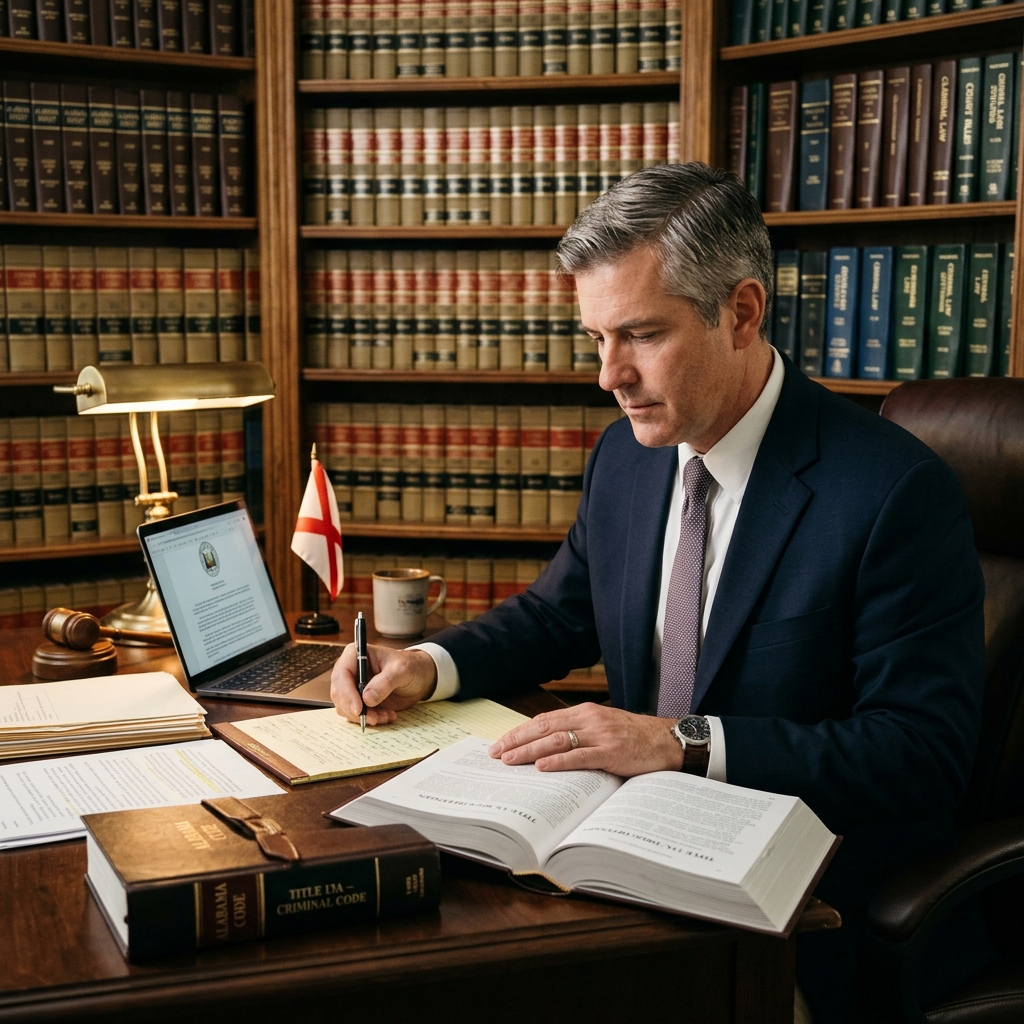
Alabama treats drug trafficking as one of the most serious criminal offenses in its justice system. The law focuses heavily on the type and weight of controlled substances, and even a relatively small quantity of certain drugs can trigger trafficking charges and lengthy mandatory prison sentences. This guide explains how trafficking is defined, what penalties apply, and what practical issues defendants and families should understand.
1. Big Picture: How Alabama Approaches Drug Trafficking
Under Alabama law, trafficking is not limited to large-scale international operations. Instead, the crime is defined primarily by whether a person sells, manufactures, delivers, brings into the state, or possesses specific minimum amounts of certain drugs. When those thresholds are met, the offense is classified as a felony known as trafficking in cannabis, cocaine, illegal drugs, amphetamine, methamphetamine, or synthetic controlled substances, depending on the substance involved.
- Trafficking charges can arise even when there is no evidence of distribution, because quantity alone may be enough.
- Most trafficking offenses are treated at least as serious felonies, with some reaching the level of a Class A felony depending on the drug and quantity.
- Mandatory minimum sentences and fines are set directly in the statute and limit judicial discretion.
The governing statute for trafficking is Alabama Code § 13A-12-231, located in the state’s Criminal Code, under offenses against public health and morals.
2. Legal Definition: What Counts as Trafficking?
Alabama law defines trafficking by looking at specific conduct combined with specified quantities. A person may be charged with trafficking if they knowingly:
- Sell a controlled substance,
- Manufacture or produce it,
- Deliver it to another person,
- Bring it into Alabama, or
- Are in actual or constructive possession of it in the threshold amount.
Actual possession generally means having the drugs physically on the person or in immediate reach. Constructive possession typically involves having control over a location where the drugs are found, such as a vehicle or residence, even if they are not on the person at the time.
| Element | What Prosecutors Must Show |
|---|---|
| Knowledge | That the accused knew of the presence of the drug and its nature as a controlled substance. |
| Conduct | Sale, manufacturing, delivery, transport into Alabama, or possession (actual/constructive). |
| Quantity | That the amount met or exceeded statutory trafficking thresholds for the specific drug. |
Importantly, the law does not require proof that the defendant intended to sell the drugs in order to charge trafficking. Simply having the threshold quantity can be enough.
3. Quantity Thresholds for Major Drug Categories
Different drugs have different threshold amounts that trigger trafficking charges. These thresholds are set out in detail in Alabama Code § 13A-12-231. While the statute is highly specific, the general pattern is that higher weights lead to more severe mandatory minimum sentences and larger fines.
3.1 Cannabis (Marijuana)
For cannabis, trafficking charges arise when a person is involved with amounts starting around one kilogram (2.2 pounds) or more. At these quantities, the law requires mandatory prison time and substantial fines.
- More than approximately 2.2 pounds of marijuana can trigger a mandatory term of imprisonment starting at three years.
- As the weight increases into the hundreds of pounds, sentencing escalates to higher minimums and longer maximums.
3.2 Cocaine, Methamphetamine, and Similar Stimulants
For drugs such as cocaine and methamphetamine, the thresholds are often expressed in grams. Alabama law treats possession of 28 grams or more of cocaine or methamphetamine as trafficking.
- Starting at about 28 grams, mandatory minimum sentences can begin at three years.
- At higher quantities (for example, 500 grams of cocaine or more), the offense can be prosecuted as a Class A felony with minimum terms in the 10-year range or more, and fines up to or exceeding $60,000.
3.3 Heroin, Morphine, Fentanyl, and Other Opiates
Opiates and synthetic opioids are treated especially seriously. For heroin, morphine, and similar substances, four grams or more can qualify as trafficking.
- Four grams or more of heroin or morphine (including mixtures) is enough for a trafficking charge.
- The same statute now addresses fentanyl and fentanyl analogues; even very small amounts can trigger trafficking because of their high potency.
- At higher quantities, sentences can reach life without parole in the most severe cases.
3.4 LSD, PCP, and Other Hallucinogens
Hallucinogens such as LSD and PCP also carry trafficking thresholds at low weights.
- Four grams or more of LSD or PCP, or any mixture containing those substances, is classified as trafficking.
- Penalties escalate with the quantity, in parallel to other illegal drugs.
3.5 Pills and Capsules (Hydromorphone and Others)
Alabama law includes specific provisions for certain prescription opioids when possessed in large quantities. For example, trafficking in hydromorphone can be charged when a person has hundreds or thousands of pills.
- Possession of at least 500 pills or capsules of hydromorphone can be enough for a trafficking charge.
- As the number of pills increases into the thousands, mandatory minimum sentences and fines increase, with possible penalties approaching 25 years or more.
4. Mandatory Minimum Sentences and Fines
One of the defining features of Alabama’s drug trafficking laws is the use of mandatory minimum sentences. Judges typically must impose at least the minimum prison term and fine specified in the statute when the defendant is convicted of trafficking.
4.1 Typical Sentencing Ranges
While the exact penalties vary by drug type and quantity, some common mandatory minimum levels include:
- 3-year minimum: Applied to lower-tier trafficking quantities, such as 28 grams but less than 500 grams of cocaine or 2.2 pounds but less than 100 pounds of cannabis, with fines that may be $25,000 or $50,000 depending on the substance.
- 5-year to 10-year minimums: Applied at mid-level quantities, often combined with fines ranging from $50,000 up to $100,000.
- 15-year and 25-year minimums: Used for high quantities or aggravated forms of trafficking.
- Life imprisonment or life without parole: Reserved for the most extreme quantities of certain drugs, such as large amounts of opiates or fentanyl mixtures.
| Mandatory Minimum Level | Common Context | Approximate Fine Range |
|---|---|---|
| 3 years | Lower trafficking thresholds (e.g., 28g cocaine, 2.2 lbs cannabis). | $25,000–$50,000 |
| 5–10 years | Mid-range quantities of cocaine, meth, heroin, and similar drugs. | $50,000–$100,000 |
| 15–25 years | High-level trafficking, large quantities, or multiple enhancements. | $100,000 or more |
| Life / Life without parole | Extreme quantities (especially certain opiates and fentanyl). | Often accompanied by the highest statutory fines. |
Because these minimums are set by statute, judges generally cannot reduce the sentence below the required floor, even if the defendant has no prior criminal record. Some enhancements, such as the presence of a weapon, can add additional years to the mandatory term.
5. Trafficking vs. Possession: Where the Line Is Drawn
It is important to distinguish between simple possession and trafficking. In Alabama, possession is typically related to drugs intended for personal use, whereas trafficking implies larger quantities and often distribution.
- Possession can be charged as a misdemeanor or felony, depending on the drug type and quantity.
- Trafficking is always a felony and can reach Class A severity, especially for cocaine, methamphetamine, heroin, fentanyl, and related substances.
- A case that starts as a possession arrest may be upgraded to trafficking once lab results or weight measurements show the amount meets statutory thresholds.
Even if a person insists the drugs were solely for personal use, the law may treat them as a trafficker based on weight alone, which is why early legal advice is critical for anyone facing such charges.
6. Additional Consequences of a Trafficking Conviction
Beyond the mandatory prison terms and fines, trafficking convictions have significant personal and collateral consequences.
- Felony record: Trafficking is a serious felony, often a Class A, which can limit employment, housing, and professional licensing opportunities.
- Parole limitations: Mandatory minimum sentences and statutory restrictions can delay or severely limit parole eligibility.
- Financial burden: Fines can range from tens of thousands to hundreds of thousands of dollars, often accompanied by court costs and fees.
- Social impact: Long incarceration and a felony record can affect family relationships and future prospects.
For non-citizens, a trafficking conviction can also create serious immigration consequences, including inadmissibility or removal under federal law.
7. Defending Against Trafficking Charges
Because trafficking charges rely heavily on quantity and possession, defense strategies often focus on challenging the government’s evidence in those areas.
- Contesting possession: Arguing that the defendant did not have actual or constructive possession of the drugs, or that they were unaware of their presence.
- Disputing weight and testing: Examining the accuracy of weight measurements, lab analysis, and chain of custody to determine whether the threshold was truly met.
- Search and seizure issues: Challenging the legality of traffic stops, vehicle searches, or home searches under constitutional standards. Evidence obtained unlawfully may be suppressed.
- Plea negotiations: In some cases, counsel may negotiate for reduced charges, especially if the evidence is weak or the defendant has a limited prior record.
Given the severe mandatory minimums in Alabama, obtaining experienced legal counsel early in the process is essential to fully understand available defenses and strategic options.
8. Federal vs. State Prosecution
Most drug trafficking cases involving Alabama are handled under state law, including Alabama Code § 13A-12-231. However, some cases may be prosecuted in federal court instead of, or in addition to, state court.
- Federal charges are more likely when the conduct involves crossing state lines, international supply chains, large conspiracies, or major networks.
- Federal sentencing guidelines and mandatory minimums may differ from Alabama’s rules, sometimes leading to even more severe penalties.
- Coordination between state and federal authorities can affect how and where a case is charged.
Because concurrent or successive state and federal prosecutions can be complex, defendants facing possible federal involvement should discuss these risks with their attorney.
9. Frequently Asked Questions About Alabama Drug Trafficking Laws
9.1 Does having a smaller amount of drugs ever count as trafficking?
Trafficking laws are triggered only when the quantity meets or exceeds the specific threshold for that substance. For example, a few grams of marijuana for personal use would not qualify, but a relatively small amount of heroin or fentanyl can reach the threshold quickly because those thresholds are set at low gram levels.
9.2 Can a first-time offender receive probation instead of prison?
Because trafficking carries mandatory minimum sentences, probation or a fully suspended sentence may not be available for many trafficking convictions. The judge is generally required to impose at least the statutory minimum prison term and fine. The availability of alternative programs depends on the exact charge, quantity, and any applicable special statutes.
9.3 What if the drugs belonged to someone else in the vehicle or home?
Constructive possession allows prosecutors to argue that a person had control over an area where drugs were found. A strong defense may focus on showing that the defendant did not know the drugs were present or did not control the space where they were located. Specific facts of the case and witness testimony are critical.
9.4 Are all trafficking crimes treated as Class A felonies?
No. Trafficking is always a felony, but not every trafficking offense is Class A. The classification and sentencing range depend on the type of drug and the amount. However, trafficking involving certain quantities of methamphetamine, fentanyl, heroin, or cocaine may be prosecuted as Class A felonies with possible sentences from 10 years up to life.
9.5 Do weapon allegations change trafficking penalties?
Yes, the presence of a weapon can enhance penalties. Alabama law and practice recognize that a weapon found in connection with trafficking may add several years to the mandatory sentence, making the total punishment significantly longer.
10. Key Takeaways for Defendants and Families
Alabama drug trafficking laws are complex and extremely strict. The most important points to remember include:
- Trafficking is defined primarily by quantity and possession, not only by evidence of distribution.
- Even modest amounts of heroin, fentanyl, or similar drugs can trigger trafficking due to very low gram thresholds.
- Mandatory minimum sentences and fines sharply limit judicial flexibility and can lead to long prison terms, often measured in decades.
- Early, informed legal advice is crucial to protect rights, examine the evidence, and explore potential defenses or plea options.
Anyone facing a trafficking investigation or charge should avoid making statements to law enforcement without counsel and promptly seek assistance from a qualified criminal defense attorney familiar with Alabama drug laws.
References
- Alabama Code § 13A-12-231 (2025) — Alabama Legislature / Alabama Code via Justia. 2025-01-01. https://law.justia.com/codes/alabama/title-13a/chapter-12/article-5/division-3/
- Alabama Code § 13A-12-231 (Historic text) — Alabama Code via Justia. 2006-01-01. https://law.justia.com/codes/alabama/2006/13297/13a-12-231.html
- Alabama Code § 13A-12-231 — FindLaw Codes. 2025-01-01. https://codes.findlaw.com/al/title-13a-criminal-code/al-code-sect-13a-12-231/
- Drug Trafficking in Alabama: Meth, Fentanyl, Heroin, and Cocaine — Ingram Law. 2025-08-01. https://joeingramlaw.com/articles/2025/august/drug-trafficking-in-alabama-meth-fentanyl-heroin-and-cocaine/
- Alabama Drug Laws: Possession, Trafficking, and Penalties — Amari Law. 2024-04-01. https://amarilaw.com/alabama-drug-laws/
- Drug Trafficking: Possession — Polson Law Firm. 2023-06-01. https://www.polsonlawfirm.com/practice-areas/alabama-drug-lawyer/drug-possession/drug-trafficking-possession/
- SB188 Introduced — Alabama Legislature. 2025-02-27. https://alison.legislature.state.al.us/files/pdf/SearchableInstruments/2025RS/SB188-int.pdf
Similar Articles








Read full bio of Sneha Tete




