
Trump Twitter Ban And The First Amendment: 4 Key Lessons Today
A clear look at the legal divide between government speech and private-platform moderation.
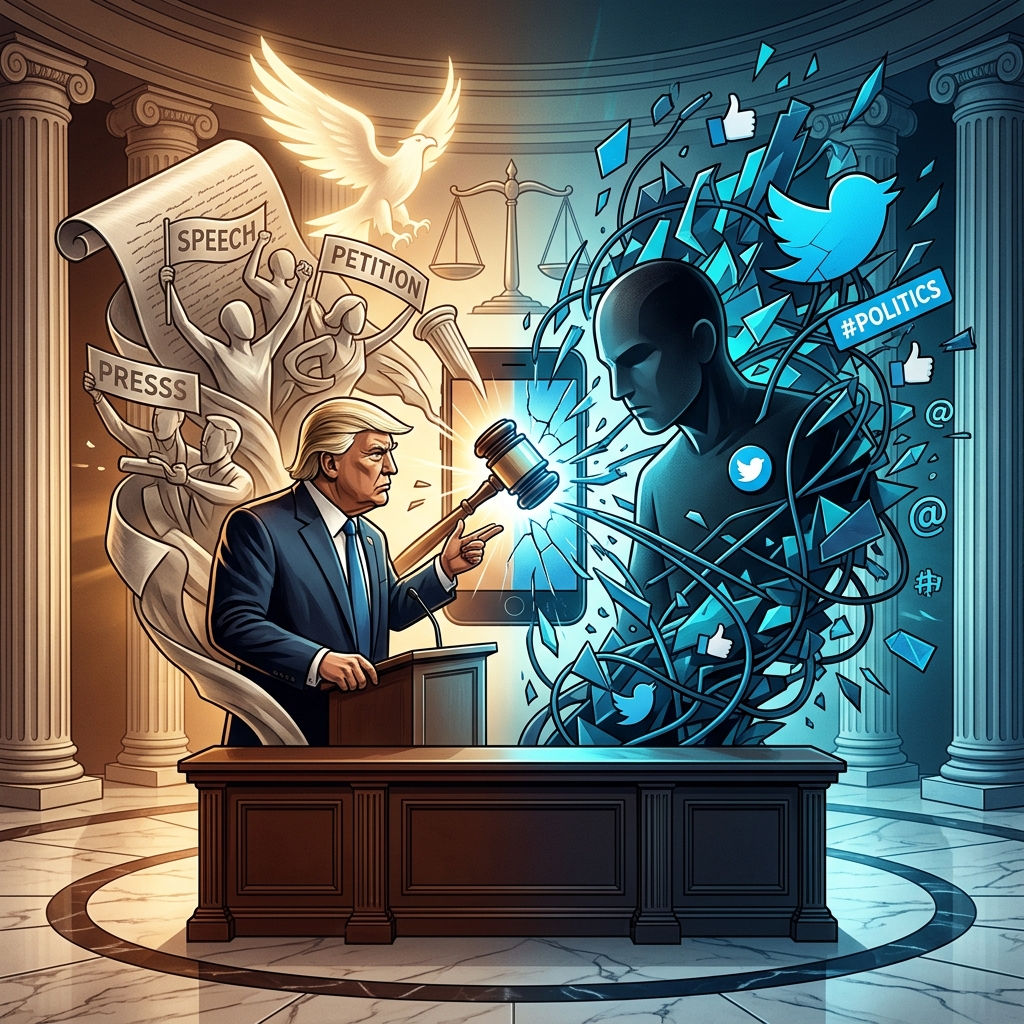
The dispute over Donald Trump’s removal from Twitter raised a familiar but difficult question: when does online moderation become a free-speech problem? The short answer is that the First Amendment limits government censorship, not the editorial choices of a private company, which is why courts rejected Trump’s challenge to Twitter’s ban.
Why the controversy mattered
Trump’s social media presence was not just personal branding; it functioned as a political megaphone. Twitter became one of the most visible channels for his statements, reactions, and direct messaging to supporters, journalists, and critics alike.
That made the ban feel bigger than an ordinary account suspension. For many observers, the decision affected not only one user’s access to a platform, but also the broader debate over how much power a private company should have over political speech in the digital age.
The legal question at the center of the fight
The central legal issue was whether Twitter’s decision could be treated as government action. Under constitutional law, the First Amendment restricts state actors, meaning public officials and government entities, but it generally does not apply to private businesses making their own moderation decisions.
Trump argued that the platform had effectively silenced him in a way that implicated free-speech rights. Courts did not accept that theory because Twitter is a private company, not a government agency, and there was no sufficient showing that it was acting on behalf of the state.
What Twitter said about the suspension
Twitter said it permanently suspended Trump’s account after reviewing his recent posts and their broader context, concluding that there was a risk of further incitement of violence.
That explanation mattered because it framed the decision as a platform-enforcement action tied to internal rules rather than a political punishment. Once a company enforces its own policies, the legal analysis usually turns to contract terms, platform rules, and private editorial discretion rather than constitutional free-speech doctrine.
Why courts said the First Amendment did not help Trump
In Trump’s lawsuit challenging the ban, a federal judge ruled that he had not shown Twitter violated his First Amendment rights.
The court’s reasoning followed a basic principle: constitutional free-speech protections do not usually bind private companies simply because they host public discussion. A private platform may host speech, remove speech, or limit access according to its own rules, so long as it is not acting as the government itself.
The judge also rejected the idea that Twitter was functioning as a state actor. That mattered because state-action arguments are one of the few ways a private entity can be treated like the government for constitutional purposes, and Trump did not establish that connection.
How the earlier Twitter-blocking case shaped the debate
The Trump suspension did not emerge in a vacuum. Before Twitter removed him, another major case had already examined Trump’s use of the platform from the opposite angle: not his right to post, but whether he could block users from viewing and replying to his account.[10]
In that earlier litigation, a court held that Trump’s account operated as a public forum for First Amendment purposes and that blocking users because of their viewpoints violated the Constitution.[10]
That decision was important, but it involved a government official using social media in an official capacity. The later suspension case was different because the actor restricting speech was the private company itself, not the president or another public official.
Private moderation versus government censorship
This distinction is the key to understanding the whole controversy. A government official cannot typically suppress speech just because of disagreement with its message, but a private platform can set rules for what content it will host.
In practical terms, this means two legal questions are often being asked at once. First, can a public official block citizens from an official account? Second, can a social media company remove a user who violates its policies? The answer to the first question can implicate the First Amendment, while the second usually does not.
What this meant for social media law more broadly
Trump’s suspension became a symbol of a much larger issue: the enormous influence of major online platforms over public debate. Twitter was not the only company under scrutiny, but its decision was especially visible because Trump had relied on the service so heavily for political communication.
Legal scholars pointed out that the case exposed a tension between the public importance of digital platforms and their private ownership. Even when a platform functions like a modern public square, courts have continued to treat it as a private entity unless lawmakers change the governing rules.
Why the outcome was unsurprising in constitutional terms
From a doctrinal standpoint, the result was predictable. The First Amendment is a limitation on the government, and Twitter is not part of the government.
That does not mean the decision was socially insignificant. It simply means the legal system separates two different kinds of power: the power of the state to censor and the power of a private company to moderate its own service. Only the first is ordinarily a constitutional issue.
How platform rules became the real battleground
Once the constitutional claim ran into the private-company barrier, the discussion shifted toward Twitter’s own policies. Twitter said Trump’s posts violated its rules because they created a risk of further violence.
That shift is common in social media disputes. When a user cannot successfully frame the matter as government censorship, the next question is whether the platform followed its terms of service, applied them consistently, and acted within the discretion those terms give it.
A comparison of the two major legal theories
| Issue | Trump blocking users from his account | Twitter suspending Trump’s account |
|---|---|---|
| Who acted? | A public official | A private company |
| Core legal question | Was the account used as a public forum? | Does the First Amendment limit the platform? |
| Constitutional result | Blocking could violate the First Amendment | No First Amendment violation shown |
| Main legal reason | Viewpoint discrimination by a government actor | No state action by the private company |
Why the state-action doctrine matters so much
The state-action doctrine is one of the most important gatekeeping rules in constitutional law. It decides whether a dispute is truly about constitutional rights or instead about private governance, contractual terms, or statutory regulation.
In the Twitter dispute, this doctrine effectively controlled the outcome. If Twitter had been acting as the government, the case would have looked very different. Because it was not, Trump could not convert a private moderation choice into a constitutional violation.
What the case did not decide
The ruling did not answer every question about platform power. It did not establish that social media companies should be free from public criticism, regulation, or legislative reform. It only held that Trump’s particular lawsuit did not show a First Amendment violation by Twitter.
Nor did the decision resolve the larger policy debate over whether a handful of private companies should have so much influence over political communication. That debate continues in academia, Congress, and public discourse.
What users and public officials can learn from the dispute
- Government actors cannot usually block critics from official channels because of viewpoint disagreement.[10]
- Private platforms may enforce their own content rules, even against highly prominent users, if they are not acting as the state.
- Online speech disputes often require separating constitutional claims from terms-of-service claims.
- High-profile status does not by itself create a First Amendment right to stay on a private platform.
Frequently asked questions
Did Twitter violate Trump’s First Amendment rights?
No court found that Twitter violated Trump’s First Amendment rights in the suspension challenge, because the platform was treated as a private company rather than a government actor.
Why was Trump allowed to sue if Twitter is private?
A person can sue a private company, but winning a constitutional claim requires showing that the company’s conduct should be treated as state action. Trump did not make that showing successfully.
Was Twitter’s explanation about violence important?
Yes. Twitter said it acted because of the risk of further incitement of violence, which helped frame the suspension as enforcement of platform policy rather than censorship by the government.
Did an earlier court say Trump had free-speech rights on Twitter?
An earlier case held that Trump could not block users from his official account based on viewpoint because he was a government actor using a public forum.[10]
Does this mean platforms can remove anyone they want?
Not automatically. Platforms are still bound by their own rules, relevant statutes, and other legal constraints, but the First Amendment usually does not force them to host a user’s speech.
The bigger legal legacy
The Trump-Twitter conflict remains a useful case study in modern free-speech law. It shows that the internet has blurred the line between public conversation and private control, but it has not erased the constitutional distinction between government action and private moderation.
As long as that distinction remains central, courts are likely to keep treating disputes like Trump’s suspension as questions about private platform authority unless lawmakers create a different legal framework.
References
- Court Rules on Trump, Twitter, & the 1st Amendment — Relativity Blog. 2018-05-23. https://www.relativity.com/blog/data-law-court-rules-on-president-trump-twitter-first-amendment/
- Twitter, Trump, and the Question of the First Amendment — Syracuse Law Review. 2021-01-08. https://lawreview.syr.edu/twitter-trump-and-the-question-of-the-first-amendment/
- Federal judge rejects Trump’s lawsuit challenging Twitter ban — PBS NewsHour / AP. 2022-05-13. https://www.pbs.org/newshour/nation/federal-judge-rejects-trumps-lawsuit-challenging-twitter-ban
- Twitter Permanently Suspends Trump, Citing ‘Risk Of Further Incitement Of Violence’ — NPR. 2021-01-08. https://www.npr.org/2021/01/08/954760928/twitter-bans-president-trump-citing-risk-of-further-incitement-of-violence
- Lessons from Trump’s Suspension: How Twitter Should Clarify and Apply Its World Leaders Policy — Harvard Journal of Law & Technology. 2021. https://jolt.law.harvard.edu/assets/articlePDFs/v35/Holmberg-Lessons-from-Trumps-Suspension.pdf
- Knight First Amendment Institute v. Trump — Congressional Research Service. 2018. https://www.congress.gov/crs_external_products/LSB/HTML/LSB10141.web.html
Similar Articles








Read full bio of medha deb


