
Trucking Workers’ Comp Risks: Contractor or Employee?
How driver classification in the trucking industry shapes workers’ compensation coverage, legal exposure, and business risk.
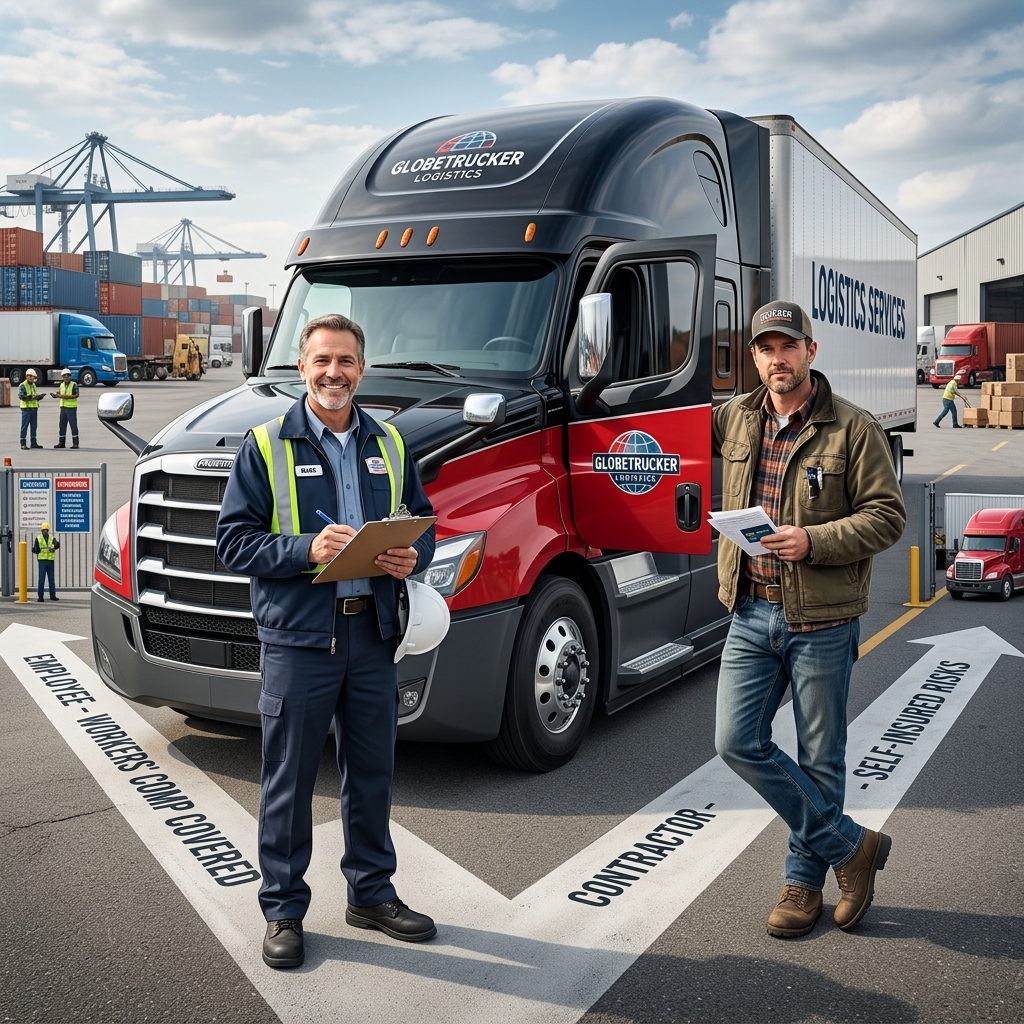
The line between employee and independent contractor has become one of the biggest legal pressure points in the trucking industry. How a driver is classified determines who pays for injuries, who carries insurance, and who is responsible when something goes wrong on the road. When the classification is wrong, both trucking companies and drivers face serious workers’ compensation and liability exposure.
This article explains how classification works in practice, why trucking is a hotbed of misclassification, and how that decision connects directly to workers’ compensation risk. It is written for motor carriers, brokers, owner-operators, in-house counsel, and risk managers who need a practical, legally informed overview.
1. Why Classification Matters So Much in Trucking
Trucking is an industry built on tight margins, unpredictable freight demand, and heavy regulatory oversight. That environment has made the use of owner-operators and other so‑called independent contractors extremely common. At the same time, regulators now treat misclassification as a significant threat to worker protections and public policy goals, including safety and fair pay.
1.1 What is worker misclassification?
Misclassification occurs when a company labels a worker as an independent contractor even though, under the applicable legal tests, that person should be treated as an employee. A misclassified driver may appear, on paper, to be in business for themselves, but in reality they:
- Depend on one carrier for most or all of their income
- Follow dispatch instructions and routing set by the company
- Have little say over rates, schedules, or loads
- Perform work that is central to the carrier’s core trucking operations
Government agencies treat misclassification as a gateway problem: once a worker is labeled a contractor, they often lose rights to overtime, minimum wage, workers’ compensation, and other legal protections they would receive as employees.
1.2 Direct impact on workers’ compensation
Workers’ compensation insurance generally applies to employees, not to genuine independent contractors. If drivers are classified as contractors, a carrier might not obtain workers’ comp coverage for them. That decision has three immediate consequences:
- No automatic medical and wage coverage for the driver: Injured drivers must rely on their own health insurance, personal disability coverage, or lawsuits against whoever is legally responsible.
- Greater liability for the company if misclassification is proven: If a driver later wins a misclassification claim, the carrier can be held liable for unpaid benefits, retroactive workers’ comp premiums, and penalties.
- Increased litigation risk: Without workers’ comp exclusivity, injured drivers may sue carriers in tort, exposing companies to larger verdicts, especially after serious crashes.
2. Legal Tests That Decide: Employee or Independent Contractor?
No single, universal test governs driver classification. Instead, companies must navigate overlapping standards from federal and state law. However, most tests focus on control and economic dependence.
2.1 The economic dependence framework
The U.S. Department of Labor and courts often focus on whether a worker is economically dependent on the company or operates an independent business. Relevant questions include:
- Does the driver rely on one carrier for most of their income?
- Can the driver meaningfully negotiate rates or choose loads?
- Does the driver advertise or haul for multiple customers independently?
- Who bears the risk of loss and investment in equipment?
The more the driver depends on one entity for steady work and compensation, the more likely they are to be treated as an employee under wage and hour laws.
2.2 Multi-factor control tests
Other frameworks use a multi‑factor analysis. While the exact list differs by jurisdiction, courts and agencies frequently consider whether:
- The company dictates how, when, and where the driver works
- Driving is central to the company’s regular business
- The relationship is long-term or project-based
- The driver invests in and controls their own equipment
- The driver has a real opportunity for profit or loss based on managerial skill
- The parties’ written agreement matches the practical reality
No single factor is determinative; instead, decision-makers weigh the totality of circumstances. In trucking, these factors often tilt toward employee status, particularly where carriers exercise tight dispatch and operational control.
2.3 Presumptions of employee status
Some jurisdictions have adopted rules that presume workers are employees unless the company proves otherwise, especially in transportation and gig work sectors. For example:
- “ABC”-style tests require companies to show that the worker is free from control, performs work outside the company’s usual course of business, and is customarily engaged in an independent trade.
- Recent Canadian federal labor standards reforms presume that anyone paid by an employer is an employee unless the employer can demonstrate independent contractor status.
These presumptions put the burden squarely on carriers to justify their use of contractors rather than employees.
3. How Misclassification Amplifies Workers’ Compensation Risk
Misclassification in trucking does more than violate paper rules; it directly shapes how workplace injuries are handled and who ultimately pays the bill. Three risk categories are particularly important: coverage gaps, retroactive liability, and spillover legal consequences.
3.1 Coverage gaps for injured drivers
When a driver is treated as a contractor, the carrier may not carry workers’ compensation for them. If the driver is hurt in a crash or while loading freight, they may find that:
- The carrier’s workers’ comp carrier denies coverage because the driver is listed as a contractor
- Occupational accident policies, if any, provide more limited benefits or exclude certain injuries
- Personal health insurance imposes deductibles, co-pays, or occupational injury exclusions
The driver may then seek to prove they were, in reality, an employee, in order to access workers’ comp benefits and possibly other labor protections.
3.2 Retroactive premiums, penalties, and back benefits
When a court or agency determines a driver was misclassified, carriers may be liable for:
- Unpaid workers’ compensation premiums for the period of misclassification
- Back payment of workers’ comp benefits, including medical costs and wage replacement
- Civil penalties and fines from labor and tax authorities for misclassification and under-reporting payroll
- Unpaid overtime, minimum wage differentials, and related damages
Studies of port trucking, for example, have shown that misclassification enables companies to shift a substantial share of labor, equipment, and benefits costs onto drivers, but those short-term savings convert into major liabilities when regulators or courts intervene.
3.3 Spillover into other legal and regulatory domains
Misclassification also has indirect effects that increase risk exposure for trucking businesses:
- Tax compliance: Misclassifying drivers can lead to unpaid payroll taxes, with interest and penalties.
- Employment standards compliance: Misclassified drivers may have been denied overtime, vacation pay, and breaks mandated by law.
- Collective action limitations: Contractors generally cannot unionize under traditional labor law frameworks, which can itself raise red flags where misclassification is systemic.
Once one agency launches an inquiry, other regulators—including tax authorities and labor standards offices—may follow, amplifying the consequences of past classification decisions.
4. Comparing Employees and Independent Contractors in Workers’ Comp
The table below highlights how workers’ compensation and related risks typically differ between employee and contractor classifications in the trucking context.
| Issue | Employee Driver | Independent Contractor Driver |
|---|---|---|
| Workers’ compensation coverage | Generally mandatory; employer must provide coverage for work injuries. | Usually not covered by carrier’s workers’ comp policy; may rely on occupational accident or personal coverage. |
| Injury handling | Administrative workers’ comp claim process, with predefined benefits. | Possible tort litigation, claim against carrier’s liability policy, or dispute over employment status. |
| Cost allocation | Employer and insurer bear medical and wage replacement costs. | Driver may bear costs personally unless coverage or liability is established against a company. |
| Regulatory oversight | Subject to workers’ comp boards, labor agencies, and audits. | Greater scrutiny if regulators suspect misclassification; potential retroactive reclassification. |
| Litigation risk to carrier | Workers’ comp exclusivity typically limits injury claims to the comp system. | Higher risk of personal injury lawsuits and class actions if misclassification is alleged. |
5. Practical Steps for Carriers to Reduce Misclassification Risk
Because regulators increasingly presume employee status and scrutinize trucking relationships, carriers should adopt proactive strategies. The goal is not to eliminate contractor models entirely, but to ensure that whenever drivers are treated as contractors, the relationship genuinely meets legal standards.
5.1 Align contracts with actual practice
Written agreements alone do not determine legal status, but they are important evidence when disputes arise. To reduce risk:
- Ensure contractor agreements avoid language that gives the carrier day‑to‑day control over routes, schedules, or methods of work.
- Clearly describe the contractor’s right to accept or decline loads and to work for multiple customers, where legally permissible.
- Specify which party is responsible for insurance, maintenance, and registration of equipment.
- Avoid boilerplate that contradicts how the relationship operates in practice.
Most importantly, actual operations must match the contract. A paper label of “independent contractor” will not carry much weight if everything about dispatch, control, and compensation looks like an employment relationship.
5.2 Implement classification audits
Regular internal reviews can uncover misclassification risks before a regulator or court does. An effective audit might include:
- Mapping all driver relationships and identifying who is treated as an employee versus contractor
- Applying the relevant federal and state tests to current contractor arrangements
- Reviewing communications, policies, and dispatch practices for signs of excessive control over contractors
- Checking that appropriate insurance (including workers’ comp) aligns with the actual risk distribution
Where audits reveal gray areas, carriers can either adjust practices to make the independent contractor structure more genuine or convert drivers to employee status with full workers’ comp coverage.
5.3 Use vetted compliance frameworks
Some companies adopt standardized compliance frameworks designed for transportation operations. These frameworks generally emphasize:
- Partnering with drivers who operate as legitimate business entities (such as corporations or LLCs)
- Maintaining proper motor carrier authority and licensing documentation
- Ensuring contractors carry adequate liability, cargo, and occupational accident insurance
- Maintaining complete records of contracts, payments, and assignments
While these steps do not guarantee a favorable classification, they demonstrate an effort to structure relationships as genuine business-to-business arrangements rather than disguised employment.
5.4 Consult specialized legal counsel
Because classification standards vary and evolve, companies should work with counsel experienced in transportation, labor, and workers’ compensation law. Counsel can help:
- Identify which tests apply in each jurisdiction
- Update contracts and operational policies
- Respond to audits, investigations, or demand letters from drivers and regulators
- Develop transition plans if converting contractors into employee roles
The cost of proactive legal review is often modest compared to multi-year liability for misclassified drivers.
6. What Drivers Should Understand About Their Status
Drivers also need to understand the stakes of how they are classified. The label affects their access to workers’ compensation, social protections, and legal remedies.
6.1 Red flags that suggest misclassification
A driver who is called an independent contractor but experiences the following conditions may want to seek legal advice or contact labor authorities:
- They work exclusively, or almost exclusively, for one carrier
- The company sets routes, schedules, and work methods
- The driver cannot realistically reject loads without risking termination
- Equipment is owned or controlled by the carrier, not the driver
- They receive set rates and have limited ability to negotiate terms
- They are denied workers’ comp, overtime, or other basic protections offered to employees
Many jurisdictions provide mechanisms for workers to challenge misclassification, and some government agencies have hotlines or complaint portals devoted to this issue.
6.2 Weighing independence against protection
Some drivers value the flexibility and entrepreneurial potential of operating as owner-operators. However, they should realistically assess whether they:
- Have multiple customers and the ability to turn work down
- Set their own work schedule and routes
- Control equipment and business decisions
- Carry sufficient insurance to cover injuries and liability exposure
If the practical reality looks more like employment, drivers may prefer the stability of employee status, including workers’ compensation, unemployment insurance, and clearer legal protections.
7. Frequently Asked Questions (FAQs)
Do all employee truck drivers automatically receive workers’ compensation?
In most jurisdictions, yes. Employers are generally required to provide workers’ compensation coverage for their employees, including truck drivers, although there can be limited exceptions depending on state law and fleet size.
If a contract says I am an independent contractor, can I still be an employee under the law?
Yes. Courts and regulators focus on how the relationship functions in reality, not just the contract label. If the company controls your work and you are economically dependent on them, you may be treated as an employee even if you signed a contractor agreement.
What happens if regulators find that a trucking company misclassified its drivers?
The company can face retroactive workers’ compensation premiums, back payment of benefits, unpaid wages and overtime, tax assessments, and civil penalties. It may also need to reclassify drivers as employees going forward and adjust its insurance and payroll practices.
Can independent contractor drivers obtain their own workers’ compensation?
In some places, independent contractors can opt into workers’ compensation schemes or purchase alternative coverage such as occupational accident insurance, but the protections and benefit levels may differ from standard workers’ comp. Drivers should consult local rules and insurance professionals.
How do environmental and labor enforcement priorities affect trucking misclassification?
Research, particularly in port trucking, shows that misclassification can contribute to poor working conditions and environmental harms, which has prompted agencies to increase enforcement in this sector. This heightened attention makes it more likely that misclassification issues will be investigated and sanctioned.
References
- Truck Driver Misclassification: Climate, Labor, and Environmental Justice — UC Berkeley Labor Center. 2022-09-15. https://laborcenter.berkeley.edu/truck-driver-misclassification/
- Misclassification in the Road Transportation Industry: Awareness Kit — Employment and Social Development Canada. 2024-06-20. https://www.canada.ca/en/employment-social-development/corporate/portfolio/labour/programs/labour-standards/reports/misclassification-trucking.html
- Truck Drivers, Have You Been Misclassified? — Fieger Law. 2023-04-10. https://www.fiegerlaw.com/blog/truckers-misclassified/
- Mounting Pressure on the Use of Owner-Operators — Franklin & Prokopik. 2023-01-05. https://www.fandpnet.com/mounting-pressure-on-the-use-of-owner-operators/
- The Push to Correct the Misclassification of Commercial Truck Drivers — Federal Bar Association. 2015-07-01. https://www.fedbar.org/wp-content/uploads/2015/07/LE-pdf-1.pdf
- Independent Contractor vs. Employee: Understanding Classification and Legal Risks — McDowell, Rice, Smith & Buchanan. 2023-06-12. https://msblawkc.com/independent-contractor-vs-employee-understanding-classification-and-legal-risks/
- Avoiding Misclassification of Independent Contractors – Transportation Compliance Guide — Openforce. 2023-02-08. https://oforce.com/blog/avoiding-misclassification-of-independent-contractors-transportation-compliance-guide
Similar Articles








Read full bio of Sneha Tete




