
Traveling With Firearms: Essential Legal Rules
Understand the key legal rules, risks, and best practices before you travel anywhere with a firearm in your vehicle or luggage.
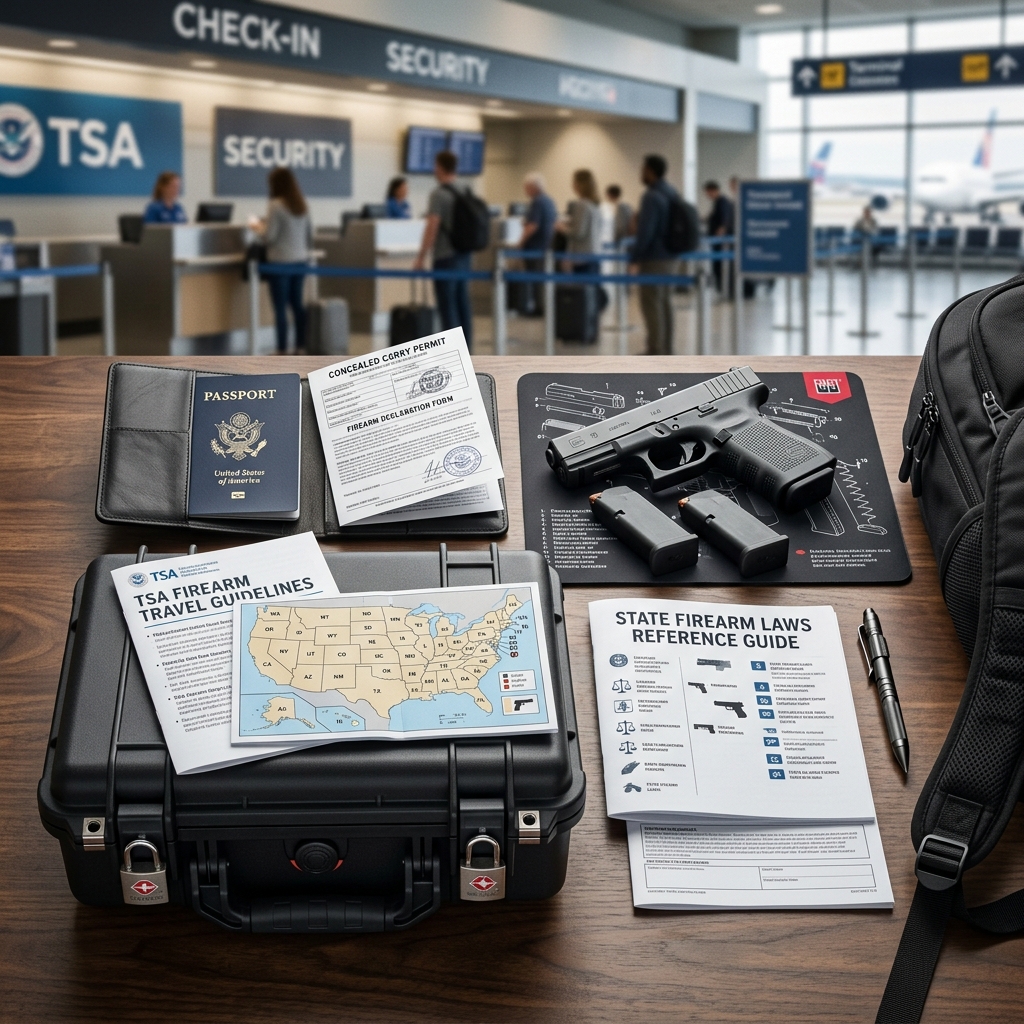
Carrying a firearm is a serious responsibility, and that responsibility does not disappear when you get into a car, board a flight, or cross state lines. Transporting guns for hunting trips, shooting competitions, relocation, or self-defense can expose you to complex and sometimes conflicting laws. Misunderstanding those rules can turn an otherwise lawful gun owner into a criminal defendant overnight.
This article provides a practical overview of how firearm transportation is regulated, focusing on federal protections, typical state rules for guns in vehicles, and best practices that reduce your legal risk when you travel.
Why Gun Transportation Law Is So Complicated
Firearms law in the United States is a patchwork. Federal law sets broad boundaries, but each state – and often cities or counties – can add their own conditions. What is legal in your home state may be restricted or even banned in another jurisdiction, especially for certain handgun types, magazine capacities, or carry methods.
Three factors usually drive that complexity:
- Federal vs. state authority – Congress regulates interstate commerce and sets some baseline protections, while states regulate most day-to-day possession and transport.
- Local policy choices – States choose very different approaches to firearms, from permissive to highly restrictive, which directly affects travelers.
- Enforcement practices – Even where federal protections exist, travelers may still be stopped or arrested and must raise those protections as a legal defense later.
Because of this, responsible gun owners need to think about transportation law in at least two layers: what federal law guarantees and what each state or locality adds on top.
Federal Baseline: The Firearm Owners Protection Act (FOPA)
The cornerstone of federal protection for gun transport is the Firearm Owners Protection Act (FOPA), codified at 18 U.S.C. § 926A. In simple terms, FOPA creates a narrow safe passage rule for law-abiding gun owners who transport firearms across state lines.
Core Requirements Under FOPA
FOPA does not create a general nationwide right to carry a gun wherever you go. Instead, it protects specific transportation scenarios if all of the following conditions are met:
- You can legally possess the firearm at your point of origin.
- You can legally possess the firearm at your destination.
- The firearm is unloaded while you travel.
- The firearm is not readily accessible from the passenger compartment – often meaning it is locked in a container or stored in the trunk.
When these conditions are satisfied, FOPA is designed to protect your right to travel between those lawful points, even if you pass through jurisdictions where local law would normally treat your firearm as illegal or heavily restricted.
Limits of Federal Protection
Despite its importance, FOPA is limited:
- It applies to transport of unloaded firearms, not to carrying loaded guns for immediate self-defense.
- It does not override every state or local regulation; it protects certain travel scenarios but may still require you to defend yourself in court if arrested.
- Courts and enforcement agencies have disagreed at times about how far FOPA reaches, especially where a traveler stops overnight or leaves the direct route.
Recent regulatory efforts, such as clarifying rules for interstate transportation under the Gun Control Act, continue to refine how FOPA applies to modern travel scenarios, including vehicles and aircraft baggage compartments.
Typical Rules for Guns in Motor Vehicles
While federal law looks at interstate travel, states focus heavily on how firearms are stored and accessed inside vehicles. Many states distinguish sharply between loaded and unloaded firearms, as well as whether a gun is accessible to the driver or passengers.
Common Themes in State Vehicle Laws
Although specific rules vary, several recurring patterns appear in state gun-transport statutes:
- Accessibility restrictions – A loaded firearm that can be reached without leaving the vehicle is often prohibited unless you have a valid license or fall into an exception.
- Unloaded-only transport – Many states allow transport of firearms only if they are unloaded and carried in a closed container, separate compartment, or visible rack.
- Separation of gun and ammunition – Some laws or best practices recommend keeping ammunition physically separated from the firearm, especially in locked storage.
- Special rules for long guns – Rifles and shotguns may be subject to different visibility and action-open requirements compared with handguns.
Illustrative Example: Ohio’s Vehicle Requirements
Ohio law provides a useful illustration of how states regulate firearms in motor vehicles. Under Ohio’s “improperly handling firearms in a motor vehicle” statute, several core rules apply:
- It is illegal to discharge a firearm from a motor vehicle.
- It is illegal to knowingly transport a loaded firearm in a vehicle if it is accessible to the operator or any passenger without leaving the vehicle, unless specific licensing or exceptions apply.
- Unloaded firearms may be transported only if carried in one of several prescribed ways, such as:
- In a closed package, box, or case.
- In a compartment that can be reached only by leaving the vehicle.
- In plain sight in a rack or holder designed for firearms.
- For certain long guns, in plain sight with the action open, or otherwise stripped or made visibly safe.
- Additional penalties apply if the driver is under the influence of drugs or alcohol while possessing certain loaded firearms.
Violating these vehicle-handling rules can result in misdemeanor or felony charges, with potential fines and prison sentences depending on the circumstances.
Illustrative Example: Strict Handling Requirements
Other states, such as Maryland, emphasize how firearms must be stored in a vehicle to avoid unlawful transport charges. Guidance often stresses that a gun should be locked in a container separate from the driver’s compartment, with ammunition stored away from immediate reach, and not in the glove box or console.
These patterns show that safe, locked, and separate storage is not just a best practice—it is frequently the difference between lawful transport and criminal liability.
Interstate Travel: Planning Your Route and Stops
Driving across state lines with firearms requires added caution. Even if FOPA offers a federal shield, you should plan your route and behavior around the most restrictive states you will pass through.
Key Planning Steps for Interstate Gun Travel
- Confirm legality at origin and destination – Make sure you can lawfully possess the specific firearm in both places. Some states prohibit certain handguns or magazine sizes.
- Review intermediate states – Identify any states with particularly strict gun laws along the route and understand how they treat nonresident possession and transport.
- Maintain FOPA conditions – Keep firearms unloaded, locked, and inaccessible from the passenger compartment throughout the journey.
- Minimize nonessential stops – Federal proposals have sought to clarify that normal incidental stops (fuel, food, lodging) are compatible with FOPA, but you still reduce risk by limiting extended deviations from your route.
- Keep documentation handy – Retain copies of any licenses, purchase documents, and proof of lawful ownership in case of questions during a traffic stop.
Common Risk Scenarios
Travelers often face heightened risk when:
- They carry a loaded, easily reachable handgun in a state that requires special licensing or prohibits such carry altogether.
- They stop for an extended stay in a jurisdiction with strict local firearm rules, potentially changing the nature of their possession from transportation to local carry.
- They travel with firearms on public transportation where local rules or carrier policies ban guns entirely.
Understanding when your status shifts from transient traveler to local possessor is critical. The more time you spend in a given jurisdiction, and the more you handle or access your firearm there, the more local law is likely to control your situation.
Best Practices for Safe and Compliant Storage
While exact legal requirements vary, certain storage practices consistently reduce both safety risks and legal exposure.
Inside a Private Vehicle
- Use a sturdy locked container – Prefer a dedicated firearm case or lockbox over glove boxes or center consoles, which may be considered part of the passenger compartment.
- Store the gun out of immediate reach – Keeping the firearm in the trunk or under a rear seat reduces accessibility concerns under many state statutes.
- Separate ammunition – Place ammunition in a different container or location in the vehicle and keep it locked when feasible.
- Consider partial disassembly – Removing the bolt or slide from some firearms can make it clear they are not in a ready-to-fire configuration.
- Maintain discretion – Avoid leaving firearms visible in unattended vehicles to reduce the risk of theft and unwanted attention.
Public Transportation and Commercial Carriers
Most public transportation systems and commercial carriers have their own policies about firearms, often stricter than state law. For example:
- Some states prohibit firearm transport on public buses or trains because passengers are in close proximity.
- Airlines generally require firearms to be checked as luggage, unloaded, locked in approved cases, and declared at check-in, consistent with federal security rules.
- Commercial shippers may impose their own packaging and declaration requirements for firearms or firearm parts.
Never assume that a carrier’s policy mirrors state law. Always check both legal requirements and company rules before your trip.
Legal Consequences of Mishandling Firearms in Travel
Failing to follow transportation rules can lead to substantial penalties. These consequences vary widely but often include criminal charges, fines, and long-term collateral effects.
Sample Penalties
Using Ohio as one example, mishandling a firearm in a vehicle can result in penalties ranging from minor misdemeanors with modest fines up to felonies carrying prison time and thousands of dollars in fines, depending on how the law was violated and whether the weapon was loaded or concealed.
Convictions related to firearms can also create enduring problems:
- Employment issues – Employers may view firearm-related convictions as indicators of risk or violence.
- Professional licensing concerns – Certain regulated professions may deny or revoke licenses due to weapons convictions.
- Immigration and naturalization complications – Noncitizens may face greater scrutiny or denial of immigration benefits following weapons-related offenses.
- Restrictions on future firearm ownership – Some convictions can permanently affect your ability to purchase or possess firearms.
Because of these stakes, experienced legal counsel is often essential if you are charged with violating firearm transportation laws.
Quick Comparison: Federal vs. Typical State Rules
| Aspect | Federal FOPA (18 U.S.C. § 926A) | Typical State Vehicle Law |
|---|---|---|
| Scope | Interstate transport between lawful origin and destination. | Possession and transport inside vehicles within the state. |
| Firearm status | Must be unloaded and not readily accessible. | Often distinguishes between loaded and unloaded; may allow unloaded in specific containers or locations. |
| Protection offered | Legal defense allowing passage through restrictive jurisdictions. | Defines criminal offenses such as improper handling or unlawful transport. |
| Key focus | Preserving the right to travel with firearms. | Controlling safety risks and accessibility inside vehicles. |
FAQs About Traveling With Firearms
Can I rely on federal law alone when driving with a gun?
No. Federal law such as FOPA offers important protections, but it does not replace state rules. You must comply with both federal and state requirements. Federal protections may help if you are charged, but you could still face arrest and need to assert those protections as a defense in court.
Do I have to keep my gun unloaded while traveling?
For federal safe passage under FOPA, yes – the firearm must be unloaded. Many states also require firearms to be unloaded during vehicle transport unless you have a particular license or fall under an exception.
Is a glove box considered a safe place to store a firearm in a car?
Often it is not. In some states, storing a firearm in the glove box or center console is treated as keeping the weapon within the passenger compartment and readily accessible, which may violate local law or recommended safety practices. A locked container in the trunk or a dedicated lockbox is generally a safer choice.
What happens if I accidentally drive into a state with stricter gun laws?
If you satisfy FOPA conditions and are traveling between lawful origin and destination, federal law may protect you during passage. However, if you stay in the state, carry the gun loaded, or otherwise fall outside FOPA’s conditions, local law will apply. If you realize you are entering a stricter jurisdiction, immediately ensure the firearm is unloaded, locked, and inaccessible, and consider contacting an attorney if you are stopped.
Should I consult a lawyer before traveling with firearms?
Consulting a knowledgeable attorney is strongly recommended, especially if you plan to travel through multiple states or carry unusual firearm types. Legal advice tailored to your situation can help you interpret overlapping statutes and reduce the risk of unintentional violations.
References
- Firearm Transportation — NRA Institute for Legislative Action. 2023-08-01. https://www.nraila.org/get-the-facts/firearm-transportation/
- Section 2923.16 Improperly handling firearms in a motor vehicle — Ohio Revised Code. 2023-04-04. https://codes.ohio.gov/ohio-revised-code/section-2923.16
- Guns in Vehicles in Ohio — Giffords Law Center. 2023-07-10. https://giffords.org/lawcenter/state-laws/guns-in-vehicles-in-ohio/
- Transporting Firearms in Maryland — Law Office of Randolph Rice. 2022-11-15. https://criminallawyermaryland.net/maryland-gun-lawyer/transporting/
- Improperly Handling Firearms in a Motor Vehicle in Ohio — Luftman, Heck & Associates. 2023-05-20. https://www.columbuscriminalattorney.com/weapons-crimes/improperly-handling-firearms-in-motor-vehicle/
- Clarifying Interstate Transportation of Firearms Under the Gun Control Act — Federal Register / Department of Justice. 2026-05-06. https://www.federalregister.gov/documents/2026/05/06/2026-08916/clarifying-interstate-transportation-of-firearms-under-the-gun-control-act
Similar Articles








Read full bio of Sneha Tete




