
Real Property: 5 Ways To Transfer Real Estate Outside Probate
Learn practical ways to pass real estate outside probate and reduce delay, cost, and court involvement.
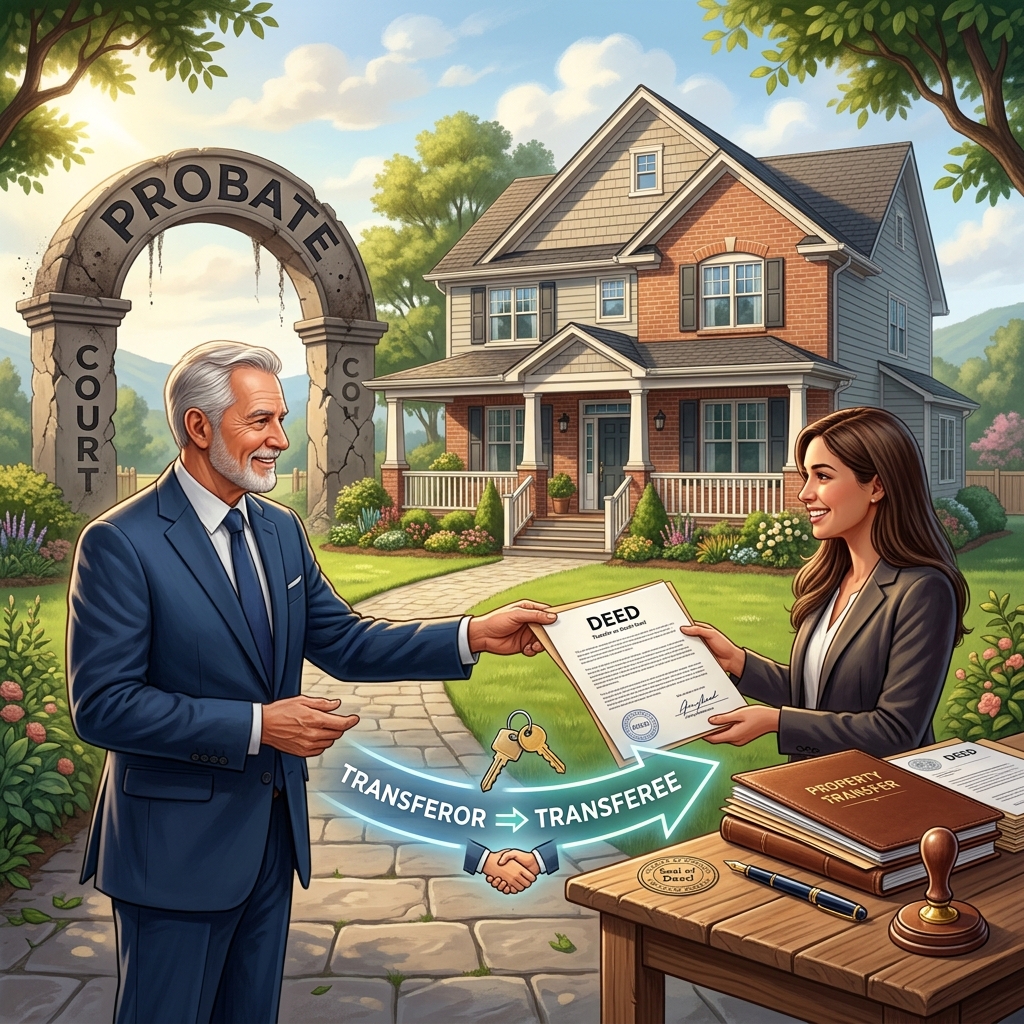
How Real Property Can Pass Outside Probate
Many families assume that every house, parcel of land, or inherited residence must go through probate before ownership changes hands. That is not always true. In many situations, real property can move to the next owner through an existing ownership arrangement, a properly drafted deed, or a trust, without the delays and public process of probate court.
Probate is the court-supervised process used to settle a decedent’s estate. When real estate is involved, probate can add time, fees, and administrative complexity. For that reason, estate plans often try to arrange a transfer method that operates automatically or through a simplified filing process. The right option depends on state law, the kind of property involved, and whether the owner wants to keep control during life.
- Some transfers happen automatically at death because of how title was held.
- Some require a deed signed during life that becomes effective later.
- Some rely on a trust that owns the property instead of the individual.
- Some states allow simplified court or recording procedures for qualifying estates.
Why People Try to Avoid Probate for Real Estate
Real property is often the most valuable asset in an estate, which makes it a central issue for heirs and personal representatives. Probate can be useful when assets are disputed or when title is unclear, but many families prefer to avoid it when possible. A nonprobate transfer can preserve privacy, reduce paperwork, and shorten the time before beneficiaries can use or sell the property.
| Goal | Why Nonprobate Transfer Helps |
|---|---|
| Speed | Title may pass more quickly than through full probate administration. |
| Lower cost | Families may reduce filing fees, legal expenses, and court oversight. |
| Privacy | Trust and deed transfers can avoid the public record created by probate filings. |
| Continuity | Some tools let the owner keep using the property during life while planning for transfer at death. |
Not every estate can or should bypass probate. If there are creditor issues, title defects, family disputes, or no valid transfer arrangement, probate may still be necessary. But where planning has been done in advance, real estate can often move outside the traditional court process.
Joint Ownership That Carries Title Forward
One of the simplest ways a home may avoid probate is through joint ownership with survivorship rights. In that structure, when one owner dies, the surviving co-owner usually becomes the sole owner automatically. That result occurs because the transfer mechanism is built into the form of title itself rather than into a will.
This approach is common in married couples and in other family arrangements, but it must be handled carefully. If the deed does not clearly create survivorship rights, the property may still be treated as part of the probate estate. In addition, joint ownership can create tax, creditor, and control issues, because adding another owner changes the legal rights attached to the property.
- It can work well where two people want automatic transfer on death.
- It may not be ideal if the owner wants flexible control over future inheritance.
- It can expose the property to another owner’s personal financial problems in some situations.
Transfer-on-Death Deeds and Similar Deed-Based Tools
Many states now recognize a transfer-on-death deed, sometimes called a beneficiary deed. This instrument lets a property owner name a beneficiary who will receive the real estate when the owner dies, while the owner remains in control during life. The owner can generally sell, refinance, revoke, or change the designation before death, depending on state law.
This tool is attractive because it combines flexibility with simplicity. Unlike a will, it does not direct property through probate. Unlike an immediate gift, it does not force the owner to give up use or control right away. When properly executed and recorded, the deed generally takes effect only at death.
That said, the details matter. State laws differ on whether the deed must be recorded, how many beneficiaries can be named, what property can qualify, and how to revoke the deed later. If the deed is not drafted according to the governing statute, the transfer may fail and the property may end up in probate anyway.
Using a Life Estate or Enhanced Life Estate Deed
Another common strategy is the life estate deed. Under this arrangement, the owner transfers a future interest to another person while keeping the right to use the property for life. The person who receives the property after death is often called the remainderman. Because the future transfer is already built into the deed, the property can pass without probate when the life tenant dies.
Some states and practitioners also use enhanced life estate deeds, often called ladybird deeds. These deeds are designed to preserve more flexibility for the current owner. In many versions, the owner can still sell, mortgage, or change the arrangement during life without needing the future beneficiary’s approval.
These deeds can be useful, but they are not universally available and may have different legal consequences than a trust or beneficiary deed. They should be reviewed carefully because property tax treatment, Medicaid planning implications, and creditor concerns can differ by jurisdiction.
Living Trusts as a Probate-Avoidance Strategy
A revocable living trust is one of the most versatile ways to transfer real estate outside probate. In a trust structure, the trust—not the individual personally—holds title to the home or land. The owner usually serves as trustee and beneficiary during life, which means the owner can continue to live in the property and manage it. After death, a successor trustee distributes or manages the property according to the trust terms.
This method often works well for people who want broad estate planning control. A trust can hold multiple assets, not just one house, and can provide instructions for minor children, blended families, or beneficiaries who need staged distributions. Because the property is already titled in the trust, there is no need for probate merely to change ownership after death.
The main drawback is that the trust must be properly created and funded. If the home is not retitled into the trust, the probate-avoidance benefit may be lost. That makes follow-through just as important as drafting the trust document itself.
State-Specific Shortcuts for Certain Estates
Some states offer simplified procedures for transferring real property when the estate is small or the property falls within a special category. These rules vary widely. In some places, heirs may file an affidavit or petition that allows title to be updated without a full probate proceeding. In others, the real property may qualify only if it is a homestead or primary residence.
For example, some states limit simplified real property transfers to the decedent’s main home or set a maximum property value. Other states require that a certain amount of time has passed since death, that no personal representative has been appointed, or that the court approve the request before the deed can be recorded.
Because these procedures are highly state-specific, the key question is not whether a shortcut exists somewhere, but whether the property and estate fit the rules where the land is located. Real estate law is governed by the state where the property sits, not necessarily the state where the owner lived.
Choosing the Right Method
The best nonprobate transfer method depends on the owner’s goals. Someone who wants a simple automatic transfer may prefer a transfer-on-death deed. Someone who wants to manage several assets and set detailed instructions may prefer a revocable trust. A married couple may use survivorship ownership, while another family may need a deed strategy that preserves lifetime use and keeps transfer flexible.
Before choosing, it helps to ask a few practical questions:
- Does the owner want to keep full control during life?
- Is the goal to transfer just one home or an entire estate plan?
- Will the beneficiary be ready to take title immediately after death?
- Are there creditor, tax, or Medicaid issues that could affect the choice?
- Does state law permit the desired transfer method for this type of property?
A thoughtful answer to those questions can prevent future disputes and reduce the chance that heirs will have to undo a poorly planned transfer.
Common Mistakes That Can Send Property Back Into Probate
Even when a family tries to avoid probate, mistakes can defeat the plan. A deed may be unsigned, improperly recorded, or missing essential language. A trust may exist on paper but never receive the home title. A beneficiary designation may be obsolete because the named person died first. In some cases, spouses or co-owners may believe a property passes automatically when it does not.
Another common error is failing to coordinate the deed with the rest of the estate plan. If a will says one thing and the deed says another, the deed usually controls the property transfer, which can create confusion or conflict among heirs. Because real property transfers are formal and state-dependent, precision matters.
What Heirs Should Do After the Owner Dies
If a property owner died and there is a nonprobate transfer tool in place, the beneficiary still has some administrative steps to complete. That may include recording an affidavit, presenting a death certificate, filing a certified deed, or updating the county land records. If the property was held in trust, the successor trustee may need to sign and record documents to show the change in authority.
If no transfer method was set up before death, heirs should not assume that a shortcut exists. They should review the deed, the trust, beneficiary documents, and applicable state procedures before taking action. A title company, probate attorney, or local recorder’s office can often help determine what proof is needed to establish ownership.
Frequently Asked Questions
Can a will transfer real property without probate?
A will can direct who should receive property, but it usually does not avoid probate by itself. If title was not already arranged to pass outside probate, the will generally must be administered through the probate process.
Is a transfer-on-death deed better than a trust?
Neither is universally better. A transfer-on-death deed is often simpler for one property, while a trust is usually more flexible for a larger estate or more detailed planning. The right choice depends on the owner’s goals and the state’s rules.
Can real property be transferred without giving up control during life?
Yes. Some tools, such as revocable trusts and certain deed-based arrangements, allow the owner to keep control while alive and still avoid probate at death.
Do all states allow the same nonprobate transfer methods?
No. States differ significantly. Some recognize transfer-on-death deeds or enhanced life estate deeds, while others rely more heavily on trusts or separate statutory procedures.
Should the deed be reviewed by a lawyer?
Yes, especially if the property has multiple owners, a mortgage, a tax issue, or a blended-family plan. A small drafting error can create larger problems later.
Practical Takeaway for Property Owners
Real property can often pass outside probate when the owner uses the right legal structure in advance. The available options include survivorship ownership, transfer-on-death deeds, life estate arrangements, trusts, and state-specific simplified procedures. Each has strengths, limits, and formal requirements.
For many families, the safest approach is not simply choosing the cheapest option, but selecting the transfer method that best matches the owner’s goals, the property type, and the governing state law. Planning ahead is usually far easier than asking heirs to fix title problems after death.
References
- Transferring the Deceased’s Property Without Going to Court — Texas Law Help. 2025-01-01. https://texaslawhelp.org/article/transferring-the-deceaseds-property-without-going-to-court
- Check if you can use a simple process to transfer property — California Courts Self-Help Center. 2025-01-01. https://selfhelp.courts.ca.gov/probate/simple-transfer
- Affidavit for Transfer of Real Property without Probate — Nebraska Judicial Branch. 2025-01-01. https://nebraskajudicial.gov/self-help/estates/affidavit-transfer-real-property-without-probate
- Transferring Property Outside Probate & Legal Considerations — Justia. 2025-01-01. https://www.justia.com/probate/transferring-property-outside-probate/
- How to Give Real Property to a Loved One at Your Death Without Probate Court Involvement — Wagner Legal. 2025-01-01. https://www.wagnerlegalmn.com/how-to-give-real-property-to-a-loved-one-at-your-death-without-probate-court-involvement/
- 5 Legal Ways to Transfer Property Without Probate — LegalShield. 2025-01-01. https://www.legalshield.com/blog/transfer-property-without-probate
Similar Articles








Read full bio of Sneha Tete


