
Transfer-on-Death Deeds and Taxes: What Heirs Need to Know
Understand how transfer-on-death deeds affect income tax, capital gains, estate tax, and probate so you and your heirs can plan wisely.
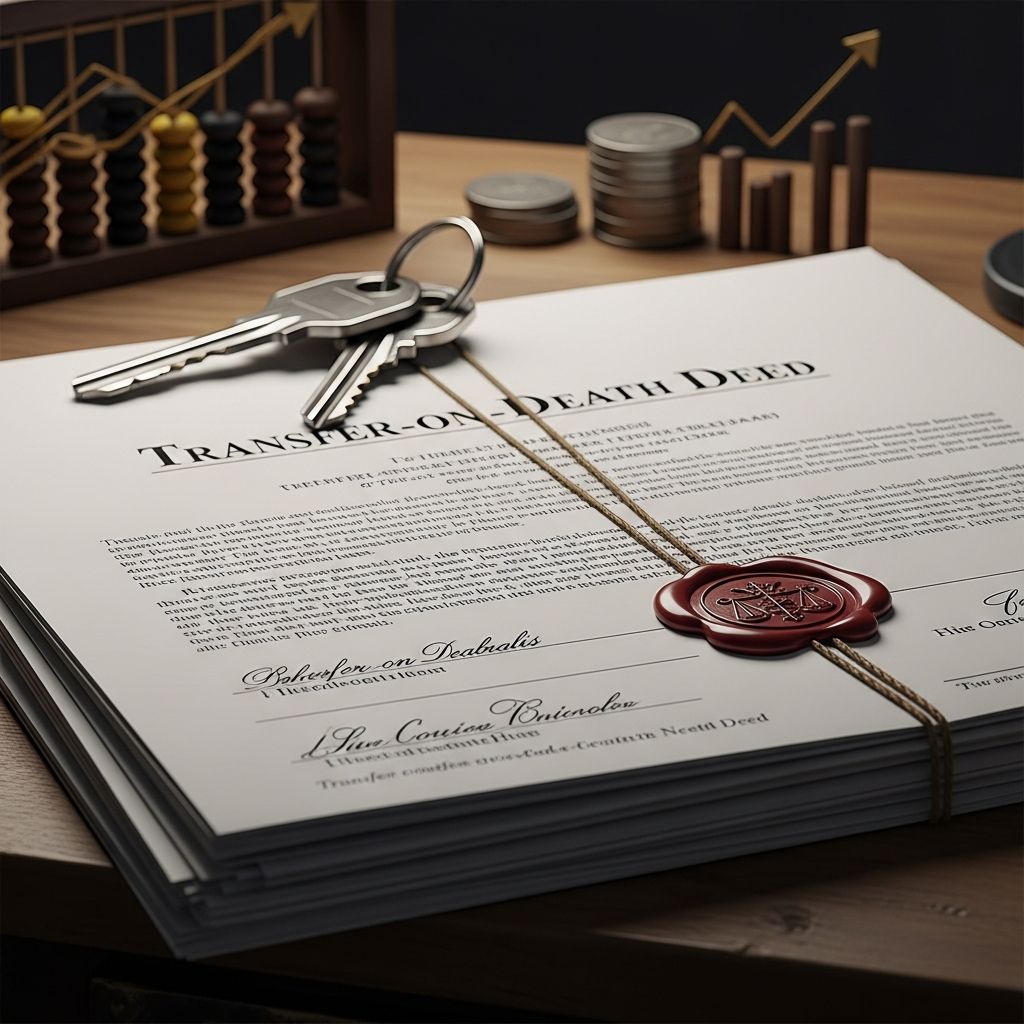
Using a transfer-on-death (TOD) deed can be a powerful way to pass real estate directly to heirs without going through probate. A TOD deed (sometimes called a beneficiary deed) lets you keep full ownership and control of your property during life, while naming one or more beneficiaries who automatically become owners when you die. But skipping probate does not mean skipping taxes. Beneficiaries may still face income, capital gains, estate, or property tax consequences, depending on how and when they use the property.
This guide explains how TOD deeds work, the main tax issues involved, and practical steps to help you and your heirs avoid unpleasant surprises.
1. How Transfer-on-Death Deeds Work
A TOD deed is a special form of real estate ownership allowed only in certain states. It operates much like a beneficiary designation on a life insurance policy: nothing changes during the owner’s life, but ownership passes automatically at death.
Key Legal Features of TOD Deeds
- No present transfer: The beneficiary has no ownership rights while the owner is alive. The owner can sell, refinance, or revoke the TOD deed at any time.
- Automatic transfer at death: When the owner dies, the property passes directly to the named beneficiary (or beneficiaries), usually by filing a death certificate and any required forms in the land records.
- Probate avoidance: The property typically bypasses the court-supervised probate process, saving time and legal fees.
- State-specific rules: Not all states permit TOD deeds, and those that do may have strict statutory forms and execution requirements.
| Feature | TOD Deed | Will |
|---|---|---|
| When transfer occurs | Automatically at the owner’s death | After probate, under court supervision |
| Probate required for the property | Usually no | Generally yes, unless property is otherwise nonprobate |
| Control during lifetime | Owner keeps full control and can revoke | Owner keeps control but will terms only apply after death |
| Visibility | Recorded in land records; often less detail than a full estate | Will becomes part of the public probate file in most states |
2. Probate Savings: What a TOD Deed Does and Does Not Do
The main attraction of a TOD deed is skipping probate for the specific property covered by the deed.
Advantages Related to Probate
- Faster access for heirs: Beneficiaries can usually take title more quickly than if they waited for a full estate administration.
- Lower administrative costs: Avoiding probate for a high-value property can reduce court fees and attorney’s fees.
- Greater privacy: Because the property transfers outside probate, there may be fewer public details about the property’s value and who inherits it.
Important Limitations
- No protection from creditors: Liens, mortgages, and other valid claims against the property typically still follow it into the beneficiary’s hands.
- Only covers the deeded property: Other assets (bank accounts, vehicles, investments) may still need probate unless they have their own beneficiary designations or are held in trust.
- Possible conflicts with a will: If a will says one thing and a TOD deed says another, the recorded TOD deed generally controls for that property.
3. Federal Income Tax Basics for TOD Beneficiaries
In most cases, simply inheriting real estate through a TOD deed does not create immediate federal income tax for the beneficiary. The main income tax issue usually arises later if the beneficiary rents, sells, or uses the property for business.
What Does Not Trigger Income Tax
- Receiving the property itself: The IRS generally does not tax inheritances as income to the beneficiary.
- Title-only changes: Recording the death certificate and updating the deed typically has no direct federal income tax effect.
When Income Tax May Become Relevant
- Rental income: If the beneficiary rents out the property, rental income and expenses must be reported on their federal return according to IRS rules.
- Business use: If the property is used in a trade or business, related income and deductions are subject to more complex rules.
State and local tax laws may impose their own forms of income or transfer tax, so beneficiaries should confirm the rules in the state where the property is located.
4. Capital Gains and the Step-Up in Basis
For many families, the most significant tax issue connected to a TOD deed is capital gains tax if the beneficiary sells the inherited property.
Step-Up in Basis at Death
Under federal law, property transferred at death usually receives a “step-up” (or occasionally step-down) in tax basis, meaning the beneficiary’s basis is generally the property’s fair market value on the date of death, not what the decedent originally paid for it.
- This rule often reduces capital gains if the heir sells shortly after inheritance, because much of the lifetime appreciation is never taxed as a gain.
- If property values dropped, the step-down in basis can also limit the beneficiary’s potential loss deduction.
Example: How Capital Gains Might Work
Imagine a home purchased years ago for $150,000 that is worth $400,000 on the owner’s date of death:
- Owner’s basis before death: $150,000
- Fair market value at death (new basis for beneficiary): $400,000
- If the beneficiary sells immediately for $400,000 (ignoring fees), taxable capital gain is typically $0, because the sale price matches the new stepped-up basis.
If the beneficiary holds the property and it later sells for $450,000, the approximate gain is $50,000 (sale price minus stepped-up basis), which is generally subject to capital gains tax.
How a TOD Deed Affects Basis
- Similar to other inheritances: For federal capital gains purposes, property received via TOD deed is typically treated the same as property inherited through a will or intestacy. The step-up rules apply because the transfer occurs at death.
- Different from lifetime gifts: If the owner had gifted the property while alive, the beneficiary would generally take the carryover basis (the donor’s original basis), often leading to higher capital gains on a later sale.
5. Federal Estate and Gift Tax Considerations
Using a TOD deed is primarily a probate-avoidance tool, not a tax-avoidance strategy. For most families, federal estate tax is not an issue because of the high exemption levels in recent years.
Estate Tax
- Included in gross estate: Real estate passing by TOD deed is generally included in the decedent’s gross estate for federal estate tax purposes, just like any other property owned at death.
- Exemption thresholds: Whether any federal estate tax is owed depends on the total value of the estate and the current exemption amount under federal law.
- No special break for TOD: A TOD deed does not by itself reduce the size of the taxable estate; it only changes how the asset is transferred procedurally.
Gift Tax
- No gift at creation: Creating a TOD deed usually does not trigger federal gift tax because the beneficiary does not receive a present interest in the property; the transfer is revocable and effective only at death.
- Different from adding a co-owner: Adding someone as a joint tenant during life may be treated as a taxable gift of part of the property, depending on state law and the circumstances.
6. Property Tax, Liens, and Local Assessments
State and local rules often govern property tax and reassessment when ownership changes. These rules can differ significantly from federal income or estate tax rules.
Property Tax During the Owner’s Life
- No change while owner is alive: Recording a TOD deed generally does not affect annual property taxes or special property tax exemptions while the owner is living.
- Exemptions preserved: Many homestead or senior exemptions remain in place as long as eligibility requirements are met and the owner continues to occupy the home.
Reassessment and Tax Changes After Death
- Possible reassessment: When the owner dies and the property passes to a beneficiary, some states reassess the property’s value for property tax purposes.
- Beneficiary obligations: After transfer, the beneficiary is generally responsible for property taxes, insurance, and any homeowner association dues.
- Liens carry over: Mortgage liens, tax liens, and other recorded encumbrances against the property usually remain attached, even though the owner has changed.
7. State Law Variations and Eligibility for Public Benefits
TOD deeds are created and regulated by state statute, so the details can vary widely. These differences can also affect how inherited property interacts with needs-based programs such as Medicaid.
Not All States Allow TOD Deeds
- Some states have enacted specific TOD deed laws for real estate.
- Others use alternative tools (such as enhanced life estate deeds or beneficiary designations on other asset types) to achieve similar results.
- Each state that allows TOD deeds may prescribe an official form and set strict signing, witnessing, and recording requirements.
Effect on Public Benefits
- Owner’s eligibility: Because the owner keeps full control and legal ownership during life, simply signing a TOD deed usually does not count as a completed transfer for needs-based programs.
- Beneficiary’s eligibility: Inheriting the property may increase a beneficiary’s assets and potentially affect their eligibility for Medicaid or other means-tested benefits once they become the owner.
8. Practical Tips for Owners Considering a TOD Deed
Before recording a TOD deed, owners should think through both the non-tax and tax-related consequences.
Questions to Ask Yourself
- Is my primary goal avoiding probate, or do I also need more complex asset protection and tax planning that might be better served by a trust?
- Do I have multiple beneficiaries with different needs or abilities to manage real estate?
- Could transferring this specific property outside probate unintentionally treat some heirs more favorably than others?
- Are there existing mortgages, liens, or tax debts that will pass along with the property?
Steps Owners Can Take
- Confirm state law: Verify that TOD deeds are authorized in your state and obtain any required statutory form from a reliable source, such as a state court or legislative website.
- Coordinate with your will and trust: Make sure your TOD deed does not undermine your overall estate plan or unintentionally disinherit someone.
- Talk with beneficiaries: Explain that they will inherit not only the property but also its ongoing costs and any attached debts.
- Review regularly: Major life changes (marriage, divorce, death of a beneficiary, or relocation to another state) are good times to re-evaluate or revoke a TOD deed.
9. Guidance for Beneficiaries Receiving Property by TOD Deed
If you become the owner of real estate through a TOD deed, the decisions you make in the first year can significantly affect your finances and taxes.
Immediate Steps After the Owner’s Death
- Obtain and record the death certificate in the land records as required by your state.
- Confirm outstanding obligations, including mortgages, property taxes, utilities, and insurance.
- Check with the personal representative of the estate to ensure that any estate-level debts or taxes are being handled appropriately.
Tax-Focused Considerations
- Establish basis: Obtain documentation of the property’s fair market value on the date of death (such as an appraisal) to support your stepped-up basis for future capital gains calculations.
- Decide whether to keep, rent, or sell: Each option carries different income and capital gains consequences.
- Consult advisors: For higher-value properties or complex estates, speaking with a tax professional and an estate-planning attorney can help you avoid missteps.
10. Frequently Asked Questions (FAQs)
Q1: Does a transfer-on-death deed eliminate all taxes on the property?
No. A TOD deed mainly avoids probate for the specific property; it does not erase federal income tax, capital gains tax, estate tax, or state and local property taxes. Those tax rules generally apply much the same way they would to other inherited real estate.
Q2: Will I owe capital gains tax immediately when I inherit a home by TOD deed?
Typically, no capital gains tax is due just because you inherit the property. Capital gains tax generally becomes an issue only if you later sell or otherwise dispose of the property, and it is based on the difference between the sale price and your stepped-up basis (usually the value at the decedent’s death).
Q3: Is creating a TOD deed treated as a taxable gift?
In most cases, no. Because the owner retains full control and the beneficiary has no present interest, recording a TOD deed is usually not treated as a completed gift for federal gift tax purposes. The transfer occurs at death and is handled under the estate and inheritance rules rather than gift tax rules.
Q4: Can creditors still go after property that passes by TOD deed?
Yes. Avoiding probate does not generally wipe out valid creditor claims or mortgages. Liens and secured debts attached to the property usually remain in place, and in some states creditors may have a specific period after death to assert claims against nonprobate transfers.
Q5: Are TOD deeds better than living trusts for tax planning?
TOD deeds and revocable living trusts can both avoid probate for real estate, but they serve different purposes. TOD deeds are relatively simple and low-cost, while trusts offer more flexibility for managing multiple assets, controlling distributions over time, and coordinating complex tax and family objectives. For many tax-planning goals, a trust may offer broader tools than a single TOD deed, but the right choice depends on your situation.
References
- Transfer on Death Deed: Overview and Guide — NerdWallet. 2023-08-22. https://www.nerdwallet.com/estate-planning/learn/transfer-on-death-deed
- Transfer on Death Deed: What It Is and How It Works — LegalZoom. 2023-05-10. https://www.legalzoom.com/articles/understanding-the-transfer-on-death-deed
- LegalZoom Estate Planning Basics — Transfer on Death Deeds — Kent County Recorder of Deeds (Delaware) summarizing LegalZoom content. 2021-06-15. https://www.kentcountyde.gov/My-Government/Departments/Deeds-Office/Transfer-on-Death-Deeds/Transfer-on-Death-Deeds-In-the-News/LegalZoom-Estate-Planning-Basics-Online
- What is a Transfer on Death Deed & How Do I Use One? — Trust & Will. 2022-11-02. https://trustandwill.com/learn/transfer-on-death-deed
- Transfer Property after Death: Transfer on Death Deeds — Texas State Law Library. 2023-04-19. https://guides.sll.texas.gov/wills-and-directives/transfer-property-after-death
Similar Articles








Read full bio of medha deb




