
Topless Laws and Gender Equality in Minnesota
How Minnesota’s indecent exposure rules collide with constitutional equality and evolving views on public toplessness.
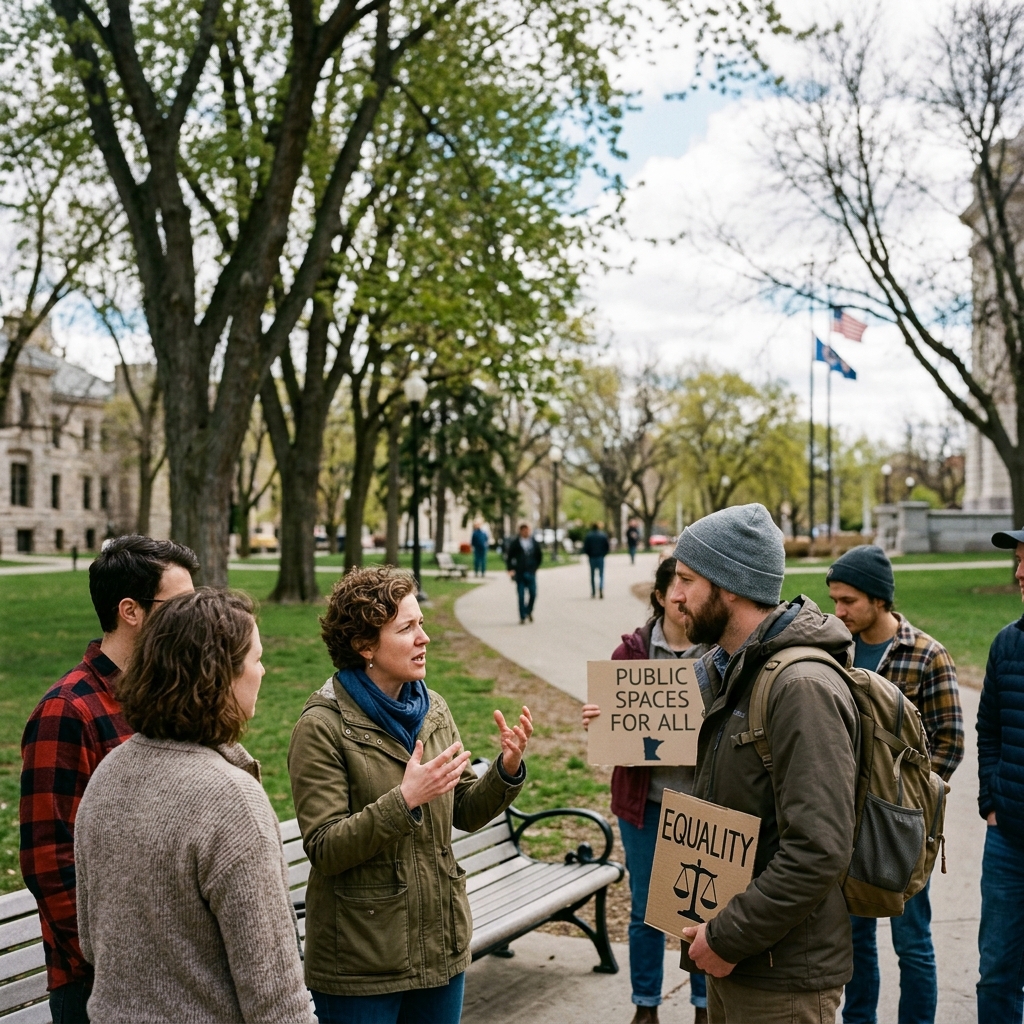
Debates over whether women may legally appear topless in public spaces raise difficult questions about how the law defines indecent exposure, nudity, and gender equality. Minnesota has confronted these issues directly in recent years, as courts and lawmakers wrestle with the meaning of “lewd” conduct and whether women are treated differently than men when they bare their chests in public.
This article examines Minnesota’s legal framework on toplessness, the constitutional concerns it triggers, and how recent decisions have reshaped the conversation about equal protection and gender-based distinctions.
Indecent Exposure in Minnesota: The Legal Basics
To understand toplessness debates, it is essential to start with Minnesota’s indecent exposure statute. Under Minnesota law, indecent exposure covers willful and lewd exposure of the body or private parts in public or in the presence of others.
| Key Concept | General Legal Meaning in Minnesota |
|---|---|
| Indecent exposure | Willful, lewd exposure of the body or private parts, usually in public or where others are present. |
| Lewd conduct | Behavior connected to sexual activity or sexual intent, not mere nudity or bare skin. |
| Nudity | Showing genitals, pubic area, buttocks, or the female breast below the top of the nipple with less than an opaque covering. |
In practice, this means Minnesota law does not automatically criminalize simple exposure of the body; the exposure must be lewd, and courts have linked lewdness to conduct of a sexual nature.
How Female Toplessness Became a Constitutional Question
For many years, women who exposed their breasts in public could face indecent exposure charges in Minnesota, even when men in similar situations did not. This raised concerns under the Equal Protection Clause of the U.S. Constitution, which prohibits states from treating similarly situated individuals differently without adequate justification.
Advocates argued that laws or enforcement practices that punish women—but not men—for exposing the chest rest on outdated, gendered assumptions about morality and sexuality. These arguments drew on broader national discussions about topless ordinances and gender equality.
- Unequal enforcement: Women cited for exposing breasts while men go uncharged for bare chests in comparable settings.
- Gender stereotypes: Legal standards that treat female breasts as inherently sexual, while male chests are deemed non-sexual.
- Transgender and nonbinary concerns: Questions about how sex-based topless laws apply to individuals whose gender identity does not fit traditional male/female categories.
These issues culminated in cases where defendants challenged their charges not only under the indecent exposure statute, but also under constitutional equal protection principles.
The Role of “Lewdness”: When Is Toplessness Criminal?
Recent Minnesota Supreme Court decisions have clarified that toplessness alone—without sexual behavior—does not satisfy the lewdness requirement for indecent exposure. In a key case, the court overturned a woman’s conviction after she was arrested for walking around a parking lot with her breasts exposed, holding that there was no evidence of sexual conduct.
In its opinion, the court made several important findings:
- To “lewdly” expose oneself under the statute, a person must engage in conduct of a sexual nature.
- Mere exposure of the body or private parts—even breasts or other areas defined as nudity—is not automatically lewd.
- Without evidence of sexual behavior, the state cannot prove the lewdness element required for indecent exposure.
This ruling effectively decriminalized non-sexual toplessness for all genders under the statewide indecent exposure law. A person may be topless in public without violating that statute, as long as their behavior is not sexual in nature.
State Law vs. Local Ordinances: A Patchwork of Rules
Although Minnesota’s highest court clarified that non-sexual toplessness is not indecent exposure under state law, the legal landscape remains complicated because local governments may impose their own restrictions. Municipal ordinances, such as those governing parks and recreational areas, have historically regulated toplessness more strictly.
For example, park rules in Minneapolis once prohibited women—defined by reference to the “female breast”—from appearing topless on park property, while not applying the same restriction to men. The language focused on exposure of the female breast below the top of the areola with less than an opaque covering, and applied to females above a specified age.
Some features of local topless regulations include:
- Separate standards for men and women regarding how much of the chest may be exposed.
- Definitions that rely on biological markers, such as the areola, to distinguish female breasts from male chests.
- Different enforcement environments between general public spaces and designated areas like parks, pools, and beaches.
Local bodies have defended these ordinances as legitimate exercises of authority to maintain public order or community standards. However, they remain vulnerable to constitutional challenges if they treat genders differently without adequate justification.
Equal Protection: Are Women and Men “Similarly Situated”?
Equal protection analysis often hinges on whether women who expose their breasts in public are similarly situated to men who bare their chests. Some courts have concluded that they are not similarly situated because the law or community norms view female breasts as more sexualized than male chests.
Opponents of sex-based topless rules argue that this reasoning relies on cultural stereotypes rather than objective differences. They contend that:
- Sexualization of female breasts is socially constructed, not inherently biological.
- Government reinforcement of those assumptions perpetuates inequality and discrimination.
- Equal protection requires governments to justify gender distinctions with strong reasons, not mere discomfort or tradition.
Nationally, courts and policymakers have been reluctant to extend full equal protection rights to toplessness claims, and the U.S. Supreme Court has repeatedly declined to review such cases, leaving conflicting lower-court decisions in place.
Broader Implications for Gender and Bodily Autonomy
Topless laws are not just about dress codes; they touch on deeper questions of bodily autonomy, gender identity, and social norms. In Minnesota and elsewhere, debates over toplessness serve as a lens for examining how the law regulates bodies differently based on sex or perceived gender.
Several broader implications emerge:
- Sex-based moral standards: Treating female bodies as inherently more indecent may reinforce gendered notions of shame and modesty.
- Transgender and nonbinary experiences: When ordinances define “female” or “male” bodies in narrow biological terms, they can marginalize or confuse protections for people whose genders or bodies do not fit traditional categories.
- Public health and safety messaging: Some public campaigns about sun exposure or breastfeeding intersect with toplessness rules, raising questions about when exposure is encouraged versus penalized.
These concerns show that topless laws are part of a larger conversation about who controls the meaning of nudity and sexuality in public spaces.
Practical Takeaways for Minnesota Residents
Given the evolving jurisprudence, residents and visitors in Minnesota should be aware of both what statewide law allows and what local rules may restrict. While non-sexual toplessness is not indecent exposure under the statewide statute, local ordinances can still impose limits.
Key Points to Remember
- Under Minnesota’s indecent exposure law, toplessness alone is not a crime if there is no lewd, sexual behavior.
- Local ordinances—especially in parks, beaches, and recreational facilities—may still restrict toplessness, particularly for women.
- Equal protection arguments against sex-based topless restrictions remain active but unresolved at the national level.
- Enforcement practices may vary, so awareness of local rules is crucial.
Frequently Asked Questions
Is it legal for women to go topless in public in Minnesota?
Under the statewide indecent exposure statute, a woman being topless in public, without engaging in sexual conduct, does not automatically constitute lewd exposure and is not criminal indecent exposure. However, local ordinances can restrict toplessness in specific areas, such as parks or recreational facilities.
Do men and women face the same rules for toplessness?
State indecent exposure law applies the lewdness requirement to everyone, regardless of gender. Yet some local rules have historically imposed stricter standards on women than men, which has led to equal protection challenges and ongoing debate.
What does “lewd” mean in the context of indecent exposure?
In Minnesota, courts have interpreted “lewd” to require conduct of a sexual nature, not just the fact that a body part is visible. Simply exposing the chest or other areas defined as nudity is not automatically lewd; there must be evidence of sexual behavior or intent.
Could topless ordinances be challenged as unconstitutional?
Yes. Advocates have argued that ordinances treating female toplessness more harshly than male toplessness violate equal protection by reinforcing gender stereotypes and imposing sex-based distinctions without sufficient justification. Courts have reached differing conclusions, and the U.S. Supreme Court has not yet resolved the issue nationwide.
How should individuals navigate toplessness rules in practice?
Individuals should:
- Review state law to understand that non-sexual toplessness is not, by itself, indecent exposure.
- Check local ordinances for parks, beaches, and municipal spaces, which may set additional restrictions.
- Be aware that law enforcement and community norms can influence how rules are applied in specific settings.
References
- Minnesota Statutes § 617.292 — Office of the Revisor of Statutes, State of Minnesota. 2024-01-01. https://www.revisor.mn.gov/statutes/cite/617.292
- Minnesota Supreme Court rules that women’s bare breasts in public do not qualify as “lewd” — CBS Minnesota. 2025-05-21. https://www.cbsnews.com/minnesota/news/minnesota-supreme-court-women-bare-breasts-lewd-ruling/
- Opinion: Toplessness is legal now. But keep your shirt on, please. — Star Tribune. 2025-07-01. https://www.startribune.com/mn-women-legal-shirtlessness-uv-awareness/601394250
- Why It’s Time for the Supreme Court to Rule on Topless Ordinances — Minnesota Law Review. 2020-04-01. https://journals.law.umn.edu/mlr/2020/04/01/tits-up-why-its-time-for-the-supreme-court-to-rule-on-topless-ordinances
- Does the Prosecution of a Topless Woman Expose Gender Inequality in Minnesota Law? — FindLaw Legal Blogs (Courtside). 2024-03-15. https://www.findlaw.com/legalblogs/courtside/does-the-prosecution-of-a-topless-woman-expose-gender-inequality-in-minnesota-law/
Similar Articles








Read full bio of medha deb




