
Title IX Exemptions: What Students And Families Need To Know
A clear guide to when schools may be exempt from Title IX rules.
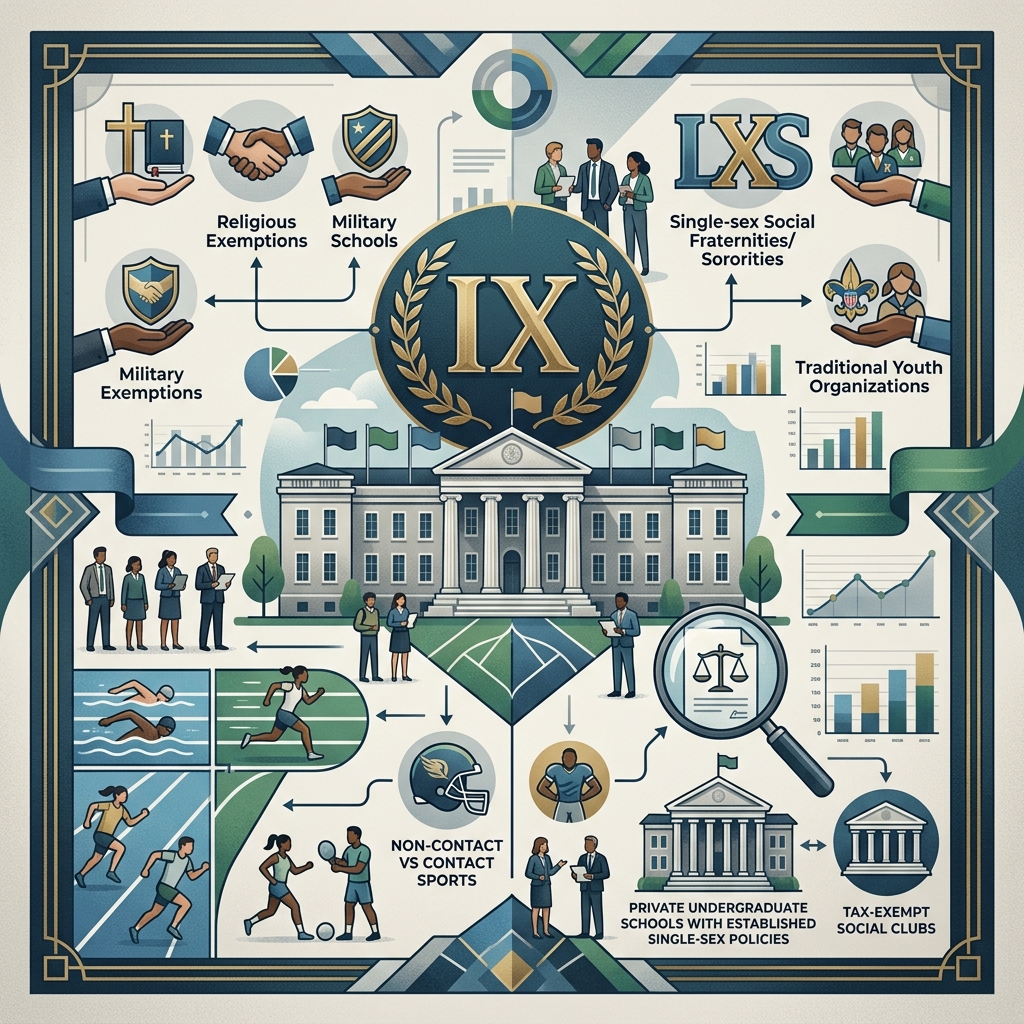
Title IX is one of the most important federal civil rights laws in American education, but it is not absolute. While it generally bars sex-based discrimination in federally funded education programs, some schools and programs may fall within specific exemptions that limit how the law applies.
Understanding those exceptions matters because Title IX reaches far beyond admissions and athletics. It also affects harassment complaints, housing, pregnancy-related accommodations, classroom treatment, and access to school services.
What Title IX generally requires
Title IX of the Education Amendments of 1972 says that no person in the United States may be excluded from participation in, denied benefits from, or subjected to discrimination under an education program or activity that receives federal financial assistance.
That broad rule applies to elementary schools, high schools, colleges, and many other educational programs when they receive federal money. The law is designed to prevent unequal treatment based on sex and to protect students from forms of discrimination that interfere with access to education.
Common conduct covered by the law
Federal guidance makes clear that Title IX covers a wide range of behavior, not just obvious exclusion from class or school activities.
- Sex-based harassment
- Sexual violence
- Pregnancy discrimination
- Unequal athletic opportunities
- Different treatment in STEM programs
- Unequal dress-code enforcement
- Retaliation for reporting discrimination
These examples show that the law is not limited to one kind of misconduct. It reaches policies, practices, and individual decisions that create unequal educational access on the basis of sex.
Why exemptions exist
Even though Title IX has a strong nondiscrimination rule, Congress and federal regulators have recognized that some institutions operate in ways that do not fit a one-size-fits-all model.
Exemptions are limited carve-outs. They do not erase Title IX across the board; instead, they can narrow the law’s application in particular settings or for specific conflicts, especially where compliance would interfere with an institution’s religious tenets or where the law itself excludes certain programs.
Religious exemptions: the most discussed exception
One of the best-known Title IX exceptions involves religious institutions. A school controlled by a religious organization may seek an exemption when complying with Title IX would conflict with its religious beliefs or practices.
This does not mean every religious school is automatically exempt from every part of Title IX. Instead, the exemption is tied to the specific conflict between the school’s religious doctrine and the Title IX requirement at issue.
In practice, that means a school may claim an exemption for a policy affecting admission, student conduct, housing, or another education-related practice if it can show the requirement would violate its religious principles.
How religious claims differ from ordinary school policies
A religious exemption is not the same as a school simply preferring a certain rule. The institution must rely on its religious character, not convenience or tradition alone.
For example, a school’s leadership may argue that certain standards on relationships, sex, or gender roles are part of its faith-based identity. If those standards conflict with a Title IX obligation, the school may ask for an exemption for that area.
Which institutions are usually covered
Most public schools, public colleges, and many private institutions fall within Title IX when they accept federal financial assistance. Coverage can extend to a school’s operations, including recruitment, admissions, courses, housing, counseling, financial assistance, health services, and employment-related support tied to education.
Because the law is attached to federal funding, the threshold question is often whether the institution receives covered assistance. Once it does, the school must comply unless a specific exemption applies.
Situations that may be outside the law altogether
Some institutions are discussed as outside the usual Title IX framework, either because they do not receive federal funds or because other legal rules apply. Military schools and private religious schools are often cited in discussions of exceptions, though the exact analysis depends on the school and the program involved.
It is important to distinguish between a true exemption and a school that simply is not covered in the first place. Those are related ideas, but they are not identical.
How exemptions affect students in real life
When an exemption applies, a student may not be able to use Title IX to challenge the specific policy or practice covered by that exemption. That can affect issues such as housing access, conduct rules, or treatment based on sex-related status.
At the same time, an exemption is usually narrow. Students may still have rights under other federal, state, or institutional rules even if a Title IX claim is unavailable.
Pregnancy and related protections still matter
Outside the exemption context, federal guidance makes clear that Title IX protects students who are pregnant, have given birth, or have related medical conditions.
Schools receiving federal funds must treat pregnant and parenting students the same as other students who are similarly able or unable to participate in school activities. They also must provide equal access to school programs and extracurricular opportunities.
That means a school cannot use sex-based rules to push pregnant students out of education, and it cannot apply parental or family-status policies differently because of sex.
How to evaluate whether an exemption may apply
Answering the exemption question usually requires a careful, fact-specific review.
| Question | Why it matters |
|---|---|
| Does the institution receive federal financial assistance? | Title IX usually applies only to covered programs and activities. |
| Is the institution controlled by a religious organization? | Religious control may support a limited exemption claim. |
| Does the specific policy conflict with religious doctrine? | The exemption typically depends on a concrete conflict, not a general preference. |
| Is the issue covered by a separate legal rule? | Some practices may be governed by other federal or state protections. |
What schools often get wrong
Schools sometimes assume they can rely on a broad exemption when the law is narrower than that. Others assume Title IX always requires identical treatment in every setting, when in fact the statute and regulations allow certain distinctions and exceptions.
The most accurate approach is to look at the specific policy, the school’s funding status, and the exact basis for the claimed exemption.
Practical steps for students and families
If a Title IX issue arises, the first step is often to identify whether the school is covered and whether the challenged rule is part of an exempted area.
- Ask the school whether it has claimed a Title IX exemption.
- Request the policy in writing.
- Identify how the rule is being applied in practice.
- Compare the treatment to how other students are treated.
- Review whether another law may also apply.
These steps can help clarify whether the issue involves unlawful discrimination, a valid exemption, or a different legal framework altogether.
Why Title IX remains significant even with exemptions
Exemptions do not weaken the basic importance of Title IX. For most students at covered institutions, the statute still provides a powerful protection against sex-based discrimination in education.
Its reach includes not only classrooms but also the broader educational environment, making it a central tool for fairness in access, treatment, and opportunity.
Frequently asked questions
Does Title IX apply to all schools?
No. Title IX generally applies to education programs and activities that receive federal financial assistance. Coverage can vary depending on the institution and the program involved.
Can a religious school ignore Title IX entirely?
No. A religious institution may seek an exemption only for specific conflicts between Title IX and its religious beliefs or practices.
Does Title IX protect students from harassment?
Yes. Federal guidance recognizes sex-based harassment, sexual violence, and retaliation as covered forms of conduct under Title IX.
Are pregnant students protected?
Yes. Schools that receive federal funds must not discriminate against students based on pregnancy, childbirth, or related conditions, and they must provide equal access to educational opportunities.
What should I do if I think an exemption is being misused?
Start by asking for the policy, the basis for the exemption, and the school’s Title IX position in writing. If necessary, compare the facts against federal guidance and seek legal review of the specific situation.
References
- Sex Discrimination in Education Exemptions Under Title IX — FindLaw. 2026-07-09. https://www.findlaw.com/education/discrimination-harassment-at-school/sex-discrimination-in-education-exemptions-under-title-ix.html
- Title IX and Sex Discrimination — U.S. Department of Education. 2026-07-09. http://www.ed.gov/laws-and-policy/civil-rights-laws/title-ix-and-sex-discrimination
- Title IX of the Education Amendments of 1972 — U.S. Department of Health and Human Services. 2026-07-09. https://www.hhs.gov/civil-rights/for-individuals/sex-discrimination/title-ix-education-amendments/index.html
- Sexual Misconduct/Title IX Laws — The Ohio State University Civil Rights Compliance Office. 2026-07-09. https://civilrights.osu.edu/about/focus-areas/sexual-misconduct-and-title-ix/sexual-misconducttitle-ix-laws
- Title IX and Pregnancy Discrimination — The Ohio State University Civil Rights Compliance Office. 2026-07-09. https://civilrights.osu.edu/about/focus-areas/sexual-misconduct-and-title-ix/sexual-misconducttitle-ix-laws
- Education Department Finalizes New Title IX Regulations: Sexual Harassment and Religious Exemptions — Congressional Research Service. 2026-07-09. https://www.congress.gov/crs-product/LSB11175
Similar Articles








Read full bio of Sneha Tete


