
Testator Intent and Holographic Wills in California
How California courts balance handwritten wills, formal requirements, and the testator’s true intent.
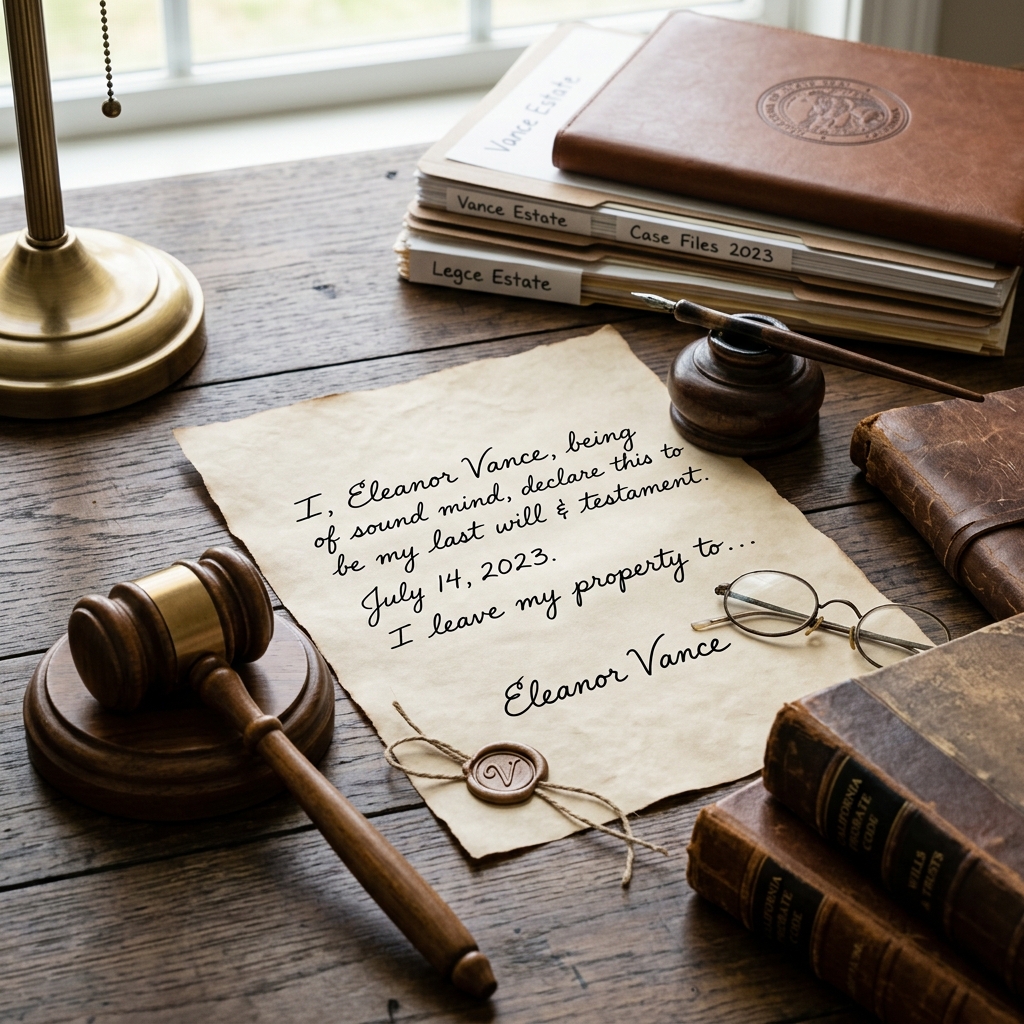
In California, a holographic will—a handwritten will—offers a simple way for someone to express their final wishes without lawyers or witnesses. Yet the apparent simplicity hides complex legal questions, especially when courts must decide whether the document truly reflects the testator’s intent and meets statutory requirements.
This article explains how holographic wills work under California law, why intent is central to their validity, and how courts use both the text of the will and external evidence to understand what the testator meant to do at the time of writing.
What Is a Holographic Will in California?
California recognizes holographic wills in its Probate Code as a distinct category of will that is valid even if it does not meet all formal witnessing requirements applicable to typed or attorney-drafted wills.
In practical terms, a holographic will is:
- Handwritten by the testator (the person making the will), at least as to the material provisions.
- Signed by the testator in a way that indicates they are authenticating the document as their will.
- Intended to dispose of property upon death—this is the testator’s testamentary intent.
California Probate Code section 6111 specifically provides that a will that does not comply with more formal requirements can still be valid as a holographic will if the signature and material provisions are in the testator’s handwriting.
Key Statutory Elements
Under Probate Code § 6111, a holographic will is valid if all of the following are satisfied:
- The signature is in the testator’s handwriting.
- The material provisions (substantive gifts and dispositions) are in the testator’s handwriting.
- The document reflects a statement of testamentary intent, which may appear in handwriting or as part of a pre-printed form.
Unlike many other states, California does not require witnesses for a holographic will. The focus is instead on handwriting and intent.
Why Testator Intent Matters So Much
The concept of testator intent answers a basic but crucial question: did the person intend the handwritten document to be their will, and what did they mean to accomplish?
In the holographic will context, intent has several dimensions:
- Intent to create a will – Did the testator intend this document to operate as a will, rather than a note, draft, or memorandum?
- Intent regarding specific dispositions – What property did the testator intend to leave, and to whom?
- Intent about timing and priority – If more than one will exists, which document did the testator intend as their final operative plan?
Intent and Testamentary Capacity
Intent does not exist in a vacuum. The testator must also have testamentary capacity when the holographic will is executed. Capacity generally means the testator understands the nature of the testamentary act, the extent of their property, and the claims of those who might benefit from or be disinherited by the will.
Under Probate Code § 6111, if a holographic will lacks a date and there is evidence that the testator lacked capacity during part of the period when it may have been executed, the will can be invalid unless it is proven that it was made at a time when the testator had capacity.
Formal Requirements Versus Actual Intent
California courts face a recurring tension: should they enforce the handwritten document as written, strictly following statutory requirements, or should they prioritize evidence of the testator’s actual intent, even if formalities are imperfect?
Material Provisions in Handwriting
One central requirement is that the material provisions—the substantive gift clauses—must be in the testator’s handwriting. Printed words on a commercial form can help demonstrate intent, but handwritten words must supply the core dispositive content.
This requirement exists to reduce fraud and provide assurance that the dispositions truly originate with the testator. Handwriting serves as a built-in form of authentication, especially when no witnesses are involved.
Signature Location and Form
California law gives courts flexibility regarding the placement and style of the signature in holographic wills. The signature:
- Does not need to appear at the end of the document; it can appear elsewhere so long as it is intended to authenticate the will.
- Can be written in block letters, if that is how the testator regularly signs or if it is clear the name is meant as a signature.
These rules illustrate how courts tend to avoid invalidating wills over technicalities if there is strong evidence that the testator meant the document to operate as a will.
Importance of the Date
A date is not absolutely required, but Probate Code § 6111 treats an undated holographic will as potentially problematic in two situations:
- When it conflicts with another will and the timing of execution cannot be established.
- When there is evidence of incapacity during the possible period of execution.
In those scenarios, courts may refuse to enforce portions of an undated holographic will because they cannot reliably determine the testator’s intent as to which document should control or whether the testator was competent at the key time.
Extrinsic Evidence and Reformation of Wills
Historically, courts were reluctant to change the text of a will or consider extrinsic evidence to reform its meaning. However, modern California decisions have softened that stance in certain circumstances.
A recent California Supreme Court decision recognized that an otherwise unambiguous will may be reformed—that is, modified by the court—if clear and convincing evidence shows the written words contain a mistake in the expression of intent and establishes the testator’s actual specific intent when the will was drafted.
What Counts as Extrinsic Evidence?
Extrinsic evidence comprises materials or testimony outside the four corners of the will, such as:
- Letters or emails from the testator explaining their estate plan.
- Handwritten notes, drafts, or alternative versions of the will.
- Statements to relatives, friends, or advisors about intended beneficiaries.
- Financial records or beneficiary designations that show a consistent pattern of intent.
Courts may rely on such evidence to resolve ambiguities or correct obvious drafting mistakes, but they typically require a high evidentiary standard to avoid undermining the integrity of written wills.
How Courts Prove Validity of Holographic Wills
When a handwritten will surfaces after death, the court must determine whether it is valid under California law and should be admitted to probate.
Core Questions for the Court
Judges and probate practitioners usually focus on the following questions:
- Authorship: Is the handwriting genuinely the testator’s?
- Authenticity: Is the document genuine, not forged or altered?
- Intent: Does the text show that the testator meant this as their last will and testament?
- Capacity: Was the testator competent at the time of execution?
- Consistency: How does this will interact with any earlier or later wills, trusts, or beneficiary designations?
Evidence Commonly Used
To answer these questions, courts may consider:
- Handwriting expert testimony or familiarity testimony from friends or relatives.
- The presence of a clear title such as “My Will” or “Last Will and Testament,” which strongly indicates testamentary intent.
- Internal structure: how assets and beneficiaries are described, whether the language is dispositive (“I give,” “I leave”).
- Statements of intent contained in commercially printed form language that the testator completed by hand.
Practical Guidance for Writing a Holographic Will
Although holographic wills are legally recognized in California, they often create litigation risk, especially when intent is unclear or statutory requirements are imperfectly met. Those who nonetheless choose this route can reduce problems by following practical best practices.
Best Practices Checklist
Individuals considering a holographic will may wish to:
- Write the entire document in their own handwriting, including material provisions and signature.
- Include a clear opening statement such as “This is my last will” to signal testamentary intent.
- Specify beneficiaries and assets in an organized way to limit ambiguity.
- Date the document clearly, in full (month, day, year).
- Avoid mixing typed text and handwriting in dispositive clauses.
- Review and update the will if circumstances change (marriage, divorce, birth of children, major asset changes).
Despite these recommendations, consulting an attorney and preparing a formal will or trust is generally more reliable, particularly for complex estates or where disinheritance is contemplated.
Holographic Wills Compared to Formal Attested Wills
The table below summarizes key differences between holographic wills and formally attested wills under California law.
| Feature | Holographic Will | Formal Attested Will |
|---|---|---|
| Form | Handwritten, material provisions and signature by testator. | Typically typed, prepared by attorney or with standard templates. |
| Witnesses | Not required by statute. | Usually requires witnesses who observe the testator sign. |
| Authentication | Based on handwriting, signature, and extrinsic evidence. | Based on witnessing formalities, not handwriting. |
| Risk of Ambiguity | Higher, due to informal language and structure. | Lower, due to professional drafting and standard clauses. |
| Litigation Risk | Often higher; disputes over intent and capacity more common. | Typically lower if formalities were properly observed. |
Frequently Asked Questions (FAQs)
1. Are handwritten wills always valid in California?
No. A handwritten will is valid only if it meets the requirements for a holographic will under Probate Code § 6111, including handwriting for material provisions, a signature, and evidence of testamentary intent.
2. Do I need witnesses for a holographic will?
Witnesses are not required for a holographic will in California. However, having witnesses or other corroborating evidence can make it easier to prove authenticity and capacity if the will is later contested.
3. What if my holographic will does not include a date?
An undated holographic will can still be valid, but it becomes vulnerable in cases where there is another will or evidence of incapacity. In such situations, the court might treat parts of the undated will as invalid if it cannot determine the timing or ensure the testator had capacity.
4. Can a court change the wording of my will based on evidence of my intent?
In limited situations, California courts may reform an unambiguous will if clear and convincing extrinsic evidence proves that the written words contain an error in expressing the testator’s intent and establishes what the testator actually intended.
5. Should I rely on a holographic will for a complex estate?
Generally, no. Holographic wills are more suitable for simple estates and straightforward distributions. Complex estates, significant tax considerations, or contentious family dynamics usually call for a formally drafted will or trust and professional legal advice.
References
- California Probate Code § 6111 (Holographic Wills) — State of California. 2023-01-01. https://codes.findlaw.com/ca/probate-code/prob-sect-6111/
- Holographic and Nuncupative Wills — California Law Revision Commission. 1989-01-01. https://clrc.ca.gov/pub/Printed-Reports/Pub136.pdf
- Are Handwritten Wills Valid in California? — 48 Hour Probate. 2024-01-01. https://48hourprobate.com/guides/california/are-handwritten-wills-valid-in-california
- How to Write a Will: Holographic Will in California — Bazikyan Law Group. 2023-10-02. https://bazikyanlaw.com/2023/10/02/holographic-will-in-california/
- California Recognizes Evidence Extrinsic to Wills — Bar Association of San Francisco. 2015-08-06. https://www.sfbar.org/blog/california-recognizes-evidence-extrinsic-to-wills/
- Sleight of Handwriting: The Holographic Will in California — Hastings Law Journal (U.C. Law SF). 1966-01-01. https://repository.uclawsf.edu/cgi/viewcontent.cgi?article=2691&context=hastings_law_journal
Similar Articles








Read full bio of Sneha Tete


