
The Fragility of Temporary Protected Status: Law & Policy
Shifting federal policies threaten long-standing humanitarian TPS protections.
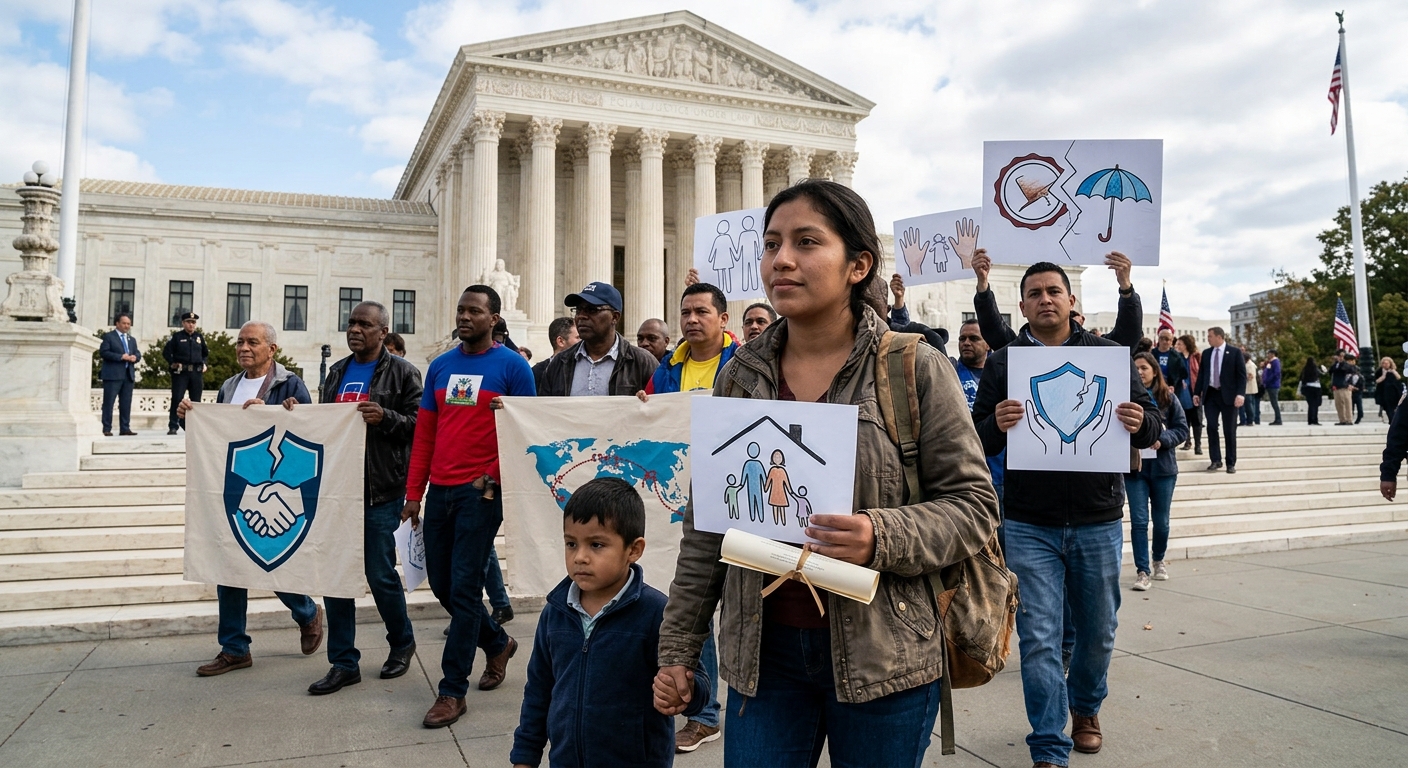
The Origins and Intent of Humanitarian Protection
For decades, the United States has served as a beacon of safety for individuals fleeing armed conflict, devastating natural disasters, and extraordinary conditions in their home countries. The primary legal mechanism for providing this humanitarian safe harbor is Temporary Protected Status (TPS). Established under the Immigration Act of 1990, TPS allows foreign nationals already residing in the United States to live and work lawfully without the looming threat of deportation, provided their home countries are deemed too dangerous for a safe return.
However, the defining feature of the program—its temporary nature—has increasingly become a focal point of intense political and legal friction. In recent years, shifting federal policies and abrupt administrative decisions have threatened to dismantle these long-standing protections. The U.S. government, which once extended a lifeline to hundreds of thousands of vulnerable individuals, is now embroiled in contentious efforts to take those protections away. This precarious situation has thrust families, employers, and communities into a state of deep uncertainty, raising profound questions about the intersection of immigration enforcement, executive authority, and human rights.
To understand the current crisis, one must first examine the legislative foundation of TPS. Codified under 8 U.S.C. § 1254a, the statute grants the Secretary of Homeland Security the discretionary authority to designate a foreign country for TPS. This designation occurs when the Secretary determines that a nation is experiencing an ongoing armed conflict, an environmental disaster, or other extraordinary and temporary conditions that prevent nationals from returning safely.
Once a country is designated, its nationals who are already physically present in the United States can apply for protection. If approved, beneficiaries receive a temporary stay of deportation and employment authorization, allowing them to participate in the formal economy. Historically, designations have been issued for periods of 6, 12, or 18 months, with the Secretary retaining the power to extend or terminate the status based on a periodic review of country conditions.
The policy was originally envisioned as a short-term stopgap—a way to manage immigration pressures while adhering to international humanitarian norms. But global realities rarely align with statutory timelines. Many crises that initially prompted TPS designations have proven intractable. As a result, administrations from both major political parties have routinely renewed designations for years, and in some cases, decades.
When Temporary Becomes a Lifetime
The core tension surrounding TPS lies in the stark disconnect between the statutory definition of the program and the lived reality of its beneficiaries. Because many countries have remained dangerous for prolonged periods, TPS holders have legally resided in the United States for an extensive amount of time. For instance, individuals from El Salvador have held TPS continuously since a series of devastating earthquakes in 2001. Hondurans and Nicaraguans have been protected since Hurricane Mitch tore through Central America in 1998.
Over the span of two decades, these temporary residents have deeply rooted themselves in the American fabric. They have purchased homes, built businesses, paid taxes, and integrated into their local communities. Most notably, they have established families. Hundreds of thousands of U.S. citizen children have been born to parents who hold TPS.
For these families, the threat of TPS revocation is not merely an abstract policy shift; it is an existential crisis. The termination of status forces individuals into an impossible choice: return to a country they have not seen in decades—a country still grappling with violence or economic collapse—or remain in the United States undocumented, surrendering their ability to work legally and living in constant fear of deportation and family separation. The psychological toll of living life in short increments, perpetually awaiting the next federal decision, creates a chronic state of anxiety.
The Policy Shift: Revocations and the Reversal of Protections
The vulnerability of TPS holders was starkly exposed when federal policy began to shift dramatically away from routine renewals toward aggressive terminations. Arguing that the statutory mandate requires a strict, narrow interpretation of the word temporary, the executive branch has periodically moved to end protections for several nations.
The rationale provided by the Department of Homeland Security in these instances is typically that the original conditions that justified the initial TPS designation—such as the specific aftermath of a 2001 earthquake or a 2010 hurricane—have technically concluded, regardless of whether new, unrelated crises have subsequently destabilized the country. By adhering strictly to the original catalyst for designation, DHS secretaries have ordered the termination of TPS for large populations, including those from Haiti, Sudan, Nicaragua, and El Salvador.
Recent actions in the mid-2020s have continued this trend, with DHS officials revoking protections for various countries on the grounds that extending them is contrary to the national interest. These administrative actions immediately strip away the legal safety net for hundreds of thousands of people, turning a legally authorized workforce into a vulnerable, deportable population almost overnight.
The Courtroom Battleground: Litigation and Injunctions
Unsurprisingly, the aggressive push to terminate TPS designations has triggered massive legal resistance. The fate of TPS holders currently hangs in the balance across multiple federal courtrooms, where civil rights organizations and affected families are challenging the legality of the revocations.
One of the most consequential legal battles is Ramos v. Mayorkas. In this landmark case, plaintiffs argued that the termination of TPS for several countries was arbitrary, capricious, and unlawfully motivated by discriminatory animus, thus violating the Administrative Procedure Act and the Equal Protection Clause of the Constitution. Lower federal courts initially granted preliminary injunctions, temporarily halting the terminations and providing a fragile lifeline to beneficiaries. However, appellate courts have frequently reversed these injunctions, leading to a protracted legal tug-of-war.
The litigation process is fraught with delays, appeals, and shifting judicial interpretations. While court-ordered stays have occasionally forced DHS to automatically extend employment authorization documents for affected immigrants, this relief is entirely provisional. If the courts ultimately side with the executive branch’s broad discretionary authority to end the program, the temporary stays will dissolve, triggering mass deportations.
Furthermore, the legal landscape for TPS holders was significantly narrowed by the U.S. Supreme Court in 2021. In Sanchez v. Mayorkas, the Court unanimously ruled that a grant of TPS does not constitute an admission into the United States for the purposes of adjusting to lawful permanent resident status. Therefore, TPS holders who originally entered the country unlawfully cannot use their TPS status as a stepping stone to permanent residency. This ruling underscored the strict limitations of the program and highlighted the inability of the judicial system to offer a permanent solution.
The Economic Ripple Effects of Terminating TPS
The implications of stripping away Temporary Protected Status extend far beyond the immediate humanitarian impact on immigrant families. The mass revocation of work authorizations poses a severe threat to the U.S. economy, which relies heavily on the labor and contributions of TPS beneficiaries.
TPS holders boast high labor force participation rates and are deeply embedded in essential industries. They make up a significant portion of the workforce in construction, agriculture, food processing, healthcare, and hospitality. In many states, businesses depend on these experienced, legally authorized workers to maintain operations. The sudden withdrawal of their employment authorization would trigger a severe labor shock, exacerbating existing worker shortages and disrupting supply chains.
Beyond labor shortages, the economic fallout includes substantial losses in tax revenue. TPS holders contribute billions of dollars annually to federal, state, and local coffers, including significant payments into Social Security and Medicare—programs from which they are largely ineligible to benefit. Additionally, as homeowners and consumers, their removal from the economy would result in defaulted mortgages, vacant properties, and reduced local spending, disproportionately impacting states with large TPS populations such as Florida, Texas, California, and New York.
The Path Forward: A Call for Congressional Action
The ongoing volatility surrounding TPS highlights the inherent flaws in utilizing temporary executive measures to address long-term human realities. As long as TPS remains subject to the broad discretion of the executive branch, hundreds of thousands of people will remain trapped in legal limbo, their futures subject to the changing winds of political administrations.
Legal experts, economic analysts, and human rights advocates increasingly agree that the judicial system cannot permanently resolve the crisis. While lawsuits like Ramos may buy time, they cannot fundamentally alter the statutory framework that makes TPS temporary. The Supreme Court’s ruling in Sanchez further cemented the reality that executive protections are not a substitute for comprehensive legislative reform.
The only definitive resolution lies with the United States Congress. Legislative action is urgently needed to provide a pathway to lawful permanent residency and eventual citizenship for long-term TPS holders. By acknowledging the deep roots these individuals have planted and the continuous contributions they have made to American society, Congress has the power to end the cycle of uncertainty. Until lawmakers act, the U.S. government remains in the contradictory position of threatening to tear away the very humanitarian protection it once recognized as essential, leaving hundreds of thousands of lives hanging by a thread.
Frequently Asked Questions (FAQs)
What is Temporary Protected Status (TPS)?
TPS is a temporary immigration status granted to nationals of countries that the Department of Homeland Security deems unsafe due to armed conflict, environmental disasters, or extraordinary conditions.
Does TPS lead to a green card or citizenship?
No. TPS is a temporary benefit. The Supreme Court ruled in Sanchez v. Mayorkas that obtaining TPS does not cure an unlawful entry, meaning many holders cannot adjust their status directly.
Who grants or terminates TPS?
The Secretary of Homeland Security holds the discretionary authority to designate, extend, or terminate a country’s TPS designation after consulting with other government agencies.
What happens if a TPS designation is terminated?
Beneficiaries revert to the immigration status they held before receiving TPS. For many, this means becoming undocumented and vulnerable to deportation, uprooting long-established lives in the U.S.
References
- 8 U.S. Code § 1254a – Temporary Protected Status — U.S. Government Publishing Office. 2011. https://www.govinfo.gov/app/details/USCODE-2011-title8/USCODE-2011-title8-chap12-subchapII-partV-sec1254a
- Temporary Protected Status (TPS) — U.S. Citizenship and Immigration Services (USCIS). 2026-05-28. https://www.uscis.gov/humanitarian/temporary-protected-status
- Sanchez v. Mayorkas, 593 U.S. 115 (2021) — Supreme Court of the United States. 2021-06-07. https://www.supremecourt.gov/opinions/20pdf/20-315_q713.pdf
- Temporary Protected Status and Deferred Enforced Departure — Congressional Research Service. 2025-08-28. https://crsreports.congress.gov/product/pdf/RS/RS20844
- Hundreds of Thousands at Imminent Risk of Deportation and Family Separation After Negotiations in Ramos v. Mayorkas Collapse — American Civil Liberties Union (ACLU). 2022-10-26. https://www.aclu.org/press-releases/hundreds-of-thousands-at-imminent-risk-of-deportation-and-family-separation-after
Similar Articles








Read full bio of Sneha Tete


