
Teen Curfew Laws: What They Are and How Enforcement Works
Understand how teen curfew rules work, when they are enforced, and what rights and exceptions minors and parents have.
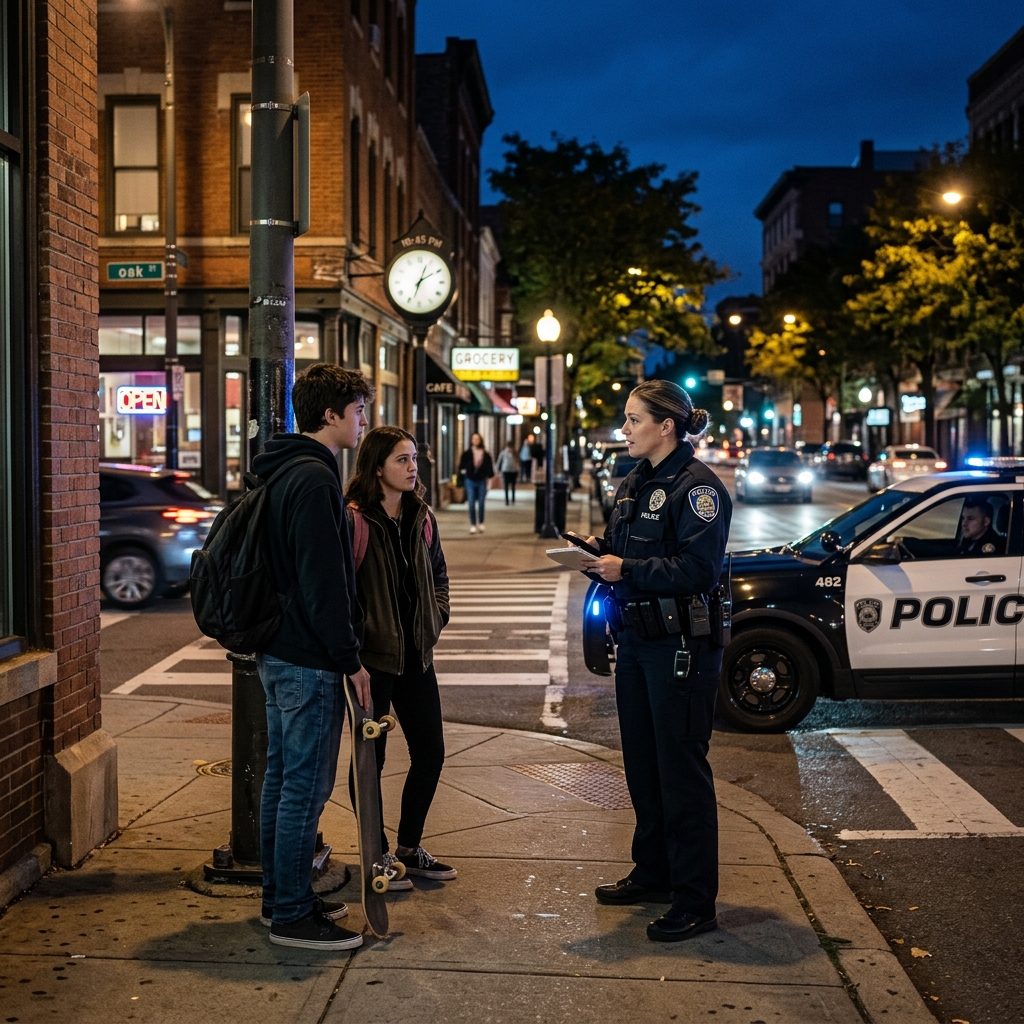
Across the United States, many cities and counties use juvenile curfew laws to regulate when minors can be in public places at night. These rules can lead to police contact, fines, and sometimes court involvement, but they do not function the same way as adult criminal laws. Understanding how curfew ordinances work, when teens can legally be out, and what happens if they violate a curfew is crucial for both minors and parents.
What Is a Teen Curfew Law?
A teen or juvenile curfew law is usually a local ordinance that limits the hours during which minors can be in public spaces such as streets, parks, or businesses. Most curfew rules are adopted by cities, counties, or towns rather than by the federal government.
Typical features include:
- Age limits (often covering youth under 18 years old).
- Specific hours at night or early morning when minors may not be in public without an exception.
- Covered locations such as streets, sidewalks, parks, shopping areas, and other public places.
- Exceptions or defenses for work, emergencies, school events, or First Amendment activities.
Many jurisdictions describe curfew rules as tools to reduce youth crime and protect minors from victimization, although research has questioned how effective they are.
Common Curfew Hours and Age Limits
Curfew schedules vary from place to place, but they usually focus on late-night and early-morning hours. Some cities distinguish between younger and older teens, giving older minors slightly more freedom.
| Jurisdiction | Age Covered | Curfew Hours (Typical) | Notes |
|---|---|---|---|
| Los Angeles, California | Under 18 | 10:00 p.m. to sunrise (daily) | Applies to public streets and many public places, with multiple exceptions. |
| Maricopa, Arizona | Under 18 | Under 16: 10:00 p.m. to 5:00 a.m.; 16–17: 12:00 a.m. to 5:00 a.m. | Different hours based on age; includes numerous defenses. |
| Florida (statewide example) | Under 18 | Sun–Thu: 11:00 p.m. to 5:00 a.m.; Fri–Sat & holidays: 12:01 a.m. to 6:00 a.m. | Also restricts suspended or expelled students during daytime near schools. |
Other countries may have nationwide curfew rules for minors. For instance, Iceland restricts younger minors from being outdoors after 8 p.m. and older minors after 10 p.m., with later hours allowed in summer. In the U.S., however, curfew rules primarily come from local or state law.
Where Do Curfew Laws Apply?
Curfew ordinances usually focus on public spaces rather than private homes. These laws often cover:
- Public streets, roads, and sidewalks.
- Parks, playgrounds, and other public grounds.
- Shopping areas and places of entertainment, such as movie theaters or restaurants.
- Business establishments open to the public.
Some ordinances specify that minors may be on the sidewalk directly outside their own homes or a neighbor’s property with consent. Private property generally is not covered unless it is open to the public like a store or mall.
Are Teens Really Arrested for Curfew Violations?
Whether a teen can be arrested for violating a curfew depends on how local law classifies the offense. Curfew violations can be treated as:
- Civil infractions with fines or warnings.
- Status offenses under juvenile law (conduct that is unlawful only because of the minor’s age).
- In some contexts, minor offenses handled through juvenile probation or diversion programs.
For example, Florida law states that a minor’s first curfew violation leads to a written warning, and later violations are civil infractions with a fine, not criminal charges. However, the statute also allows law enforcement to take a minor into custody and transport them to a police station or designated facility while contacting a parent. This shows that physical custody is possible even when the violation is not a traditional criminal arrest.
In many jurisdictions, officers use curfew stops to briefly detain teens, verify their age, contact parents or guardians, and then release them. Whether it is formally called an “arrest” can vary, but teens may experience it as being detained and taken to a station. If curfew violations are repeatedly ignored or combined with other illegal behavior, juvenile court involvement can follow.
Typical Penalties and Consequences
Curfew laws usually aim to correct behavior rather than impose harsh punishment. Common consequences include:
- Warnings for the first violation, often in writing.
- Fines or civil penalties against the teen or, in some places, against a parent.
- Transportation to a police station or youth center until a parent can pick up the minor.
- Referral to juvenile court if violations are repeated or mixed with other delinquent acts.
- School or community program referral in some alternative approaches.
In Florida, for instance, fines of around $50 can apply to later violations, and the law describes how officers must record information about the minor and attempt to reach a parent promptly. In other cities, parents may receive citations for not supervising their children during curfew hours.
Key Exceptions and Defenses for Minors
Curfew rules are rarely absolute. Most ordinances include a list of situations where minors are allowed to be out even during curfew hours.
Common exceptions include:
- With a parent, guardian, or authorized adult – A minor accompanied by a responsible adult usually is not violating curfew.
- Traveling to or from work – Many laws allow minors to commute directly to or from lawful employment.
- Attending school, religious, or recreational activities – Events like school plays, church services, or organized sports often fall within exceptions.
- Emergencies – When a minor is responding to a fire, accident, or another urgent situation, curfew rules generally do not apply.
- Exercising constitutional rights – Some ordinances explicitly exempt minors engaged in activities protected by the First Amendment, such as peaceful demonstrations or public meetings.
- Interstate travel – Being in a motor vehicle involved in interstate travel can sometimes be a defense.
For example, the Los Angeles municipal code lists exceptions for minors attending public entertainment, being involved in lawful business, responding to emergencies, or exercising free speech rights. Similarly, the Maricopa City Code provides defenses where the minor has a parent’s prior permission to be engaged in legitimate activities, including school, religious, or other supervised events.
Role of Parents and Guardians
Curfew laws often place responsibilities and potential liabilities on parents or guardians. While the details vary, common themes include:
- Parents are expected to supervise minors and ensure they comply with curfew hours.
- Parents may need to pick up their child from a station or facility if the teen is taken into custody for a curfew violation.
- Some laws allow fines or citations for parents who knowingly permit repeated curfew violations.
- Parents’ permission is often crucial to many exceptions, such as work, travel, or organized events.
These rules create a legal framework where parents share responsibility for minors’ nighttime activities and where officers are required to contact parents quickly when a curfew incident occurs.
Do Curfew Laws Improve Safety?
Policymakers frequently justify curfew ordinances as tools to reduce crime and keep teens safe at night. However, research has raised doubts about how effective these laws are in meeting those goals.
Evidence summarized by the Coalition for Juvenile Justice and other researchers indicates:
- Curfew laws typically restrict youth during hours when serious youth crime and victimization are relatively uncommon.
- A study of curfew rules in Washington, D.C. found that gun violence increased during non-curfew hours after a curfew was enacted, suggesting unintended consequences.
- A major review by the Campbell Collaboration of thousands of studies concluded that youth curfew laws rarely produce clear reductions in crime or victimization.
These findings suggest that while curfews may help prevent certain risks such as late-night driving injuries, their impact on overall youth crime and safety is far less certain. Critics also argue that curfew laws expand opportunities for youth to enter the justice system without addressing deeper causes of delinquency.
Alternatives to Strict Curfew Enforcement
Because of concerns about effectiveness and fairness, some advocacy organizations and researchers recommend focusing on supportive measures rather than relying heavily on curfew penalties.
Suggested alternatives include:
- More positive activities for youth, such as safe recreation, arts, and community events.
- School-based prevention programs that address conflict, substance use, and academic challenges.
- Community-based after-school programs that go beyond sports and provide mentoring and educational support.
- Youth centers offering social, educational, recreational, and counseling services.
These approaches aim to reduce risky behavior by giving teens constructive options and support, rather than primarily relying on police enforcement of curfew hours.
Practical Tips for Teens and Parents
Because curfew laws differ by jurisdiction, it is important for families to know the rules where they live. The following practical steps can help minimize problems:
- Check local ordinances on city or county websites for exact curfew hours and age limits.
- Ask about exceptions for work, school events, emergencies, and First Amendment activities.
- Keep written permission for work or organized activities when local law requires parent approval as a defense.
- Discuss expectations within the family, including where teens may go and how they will contact parents if plans change.
- Seek legal advice if a curfew incident leads to court involvement or if there are questions about rights.
Frequently Asked Questions (FAQ)
Can a teen be handcuffed or taken to jail for a curfew violation?
Procedures vary by jurisdiction and by the circumstances of the incident. Some laws, like Florida’s, authorize officers to take minors into custody and transport them to a station or youth facility until a parent arrives. Whether handcuffs or jail are used may depend on department policy and whether other alleged offenses are involved.
Is a curfew violation a crime?
In many places, curfew violations are treated as civil infractions or juvenile status offenses rather than adult criminal crimes. Teens may receive warnings, fines, or be referred to juvenile authorities, but the classification is often different from that of criminal charges.
Do curfew laws apply to private homes?
Curfew ordinances typically regulate being in public places such as streets, parks, or businesses, not staying inside one’s own home. Some laws permit minors to be on the sidewalk directly outside their residence or a neighbor’s property with consent.
What if a teen is working late?
Many curfew rules include exceptions for lawful employment, allowing teens to travel directly to or from work during curfew hours, often with a requirement to take the most direct route and avoid detours.
Can teens attend nighttime events legally?
Yes, when local ordinances provide exceptions for school, religious, or supervised recreational activities. In these situations, a teen who goes directly to and from the event, sometimes with parent permission, is typically not in violation of curfew.
How can I find out my local curfew rules?
Curfew laws are usually listed in municipal codes or state statutes available on official government websites. Searching for “juvenile curfew” or “minor curfew” along with your city or county name is often effective.
References
- Los Angeles Municipal Code § 45.03 Nighttime Curfew Restrictions for Minors — City of Los Angeles. 2023-01-01. https://codelibrary.amlegal.com/codes/los_angeles/latest/lamc/0-0-0-131399
- Curfew — General overview of curfew laws and practices. 2023-05-01. https://en.wikipedia.org/wiki/Curfew
- Maricopa City Code § 9.50.010 Curfew Hours for Minor — City of Maricopa. 2022-06-01. https://maricopa.municipal.codes/MCC/9.50.010
- Florida Statutes § 877.22 County and Municipal Ordinances; Curfew for Minors — State of Florida. 2025-01-01. https://www.leg.state.fl.us/Statutes/index.cfm?App_mode=Display_Statute&URL=0800-0899/0877/Sections/0877.22.html
- Purpose or Portrayal: The Dangers of Youth Curfew Laws on Public Safety and Youth Delinquency — Coalition for Juvenile Justice. 2021-08-15. https://juvjustice.org/blog/purpose-or-portrayal-the-dangers-of-youth-curfew-laws-on-public-safety-and-youth-delinquency/
- Juvenile Curfew Laws: The Basics — FindLaw. 2020-03-10. https://www.findlaw.com/criminal/criminal-charges/juvenile-curfew-laws-the-basics.html
Similar Articles








Read full bio of Sneha Tete




