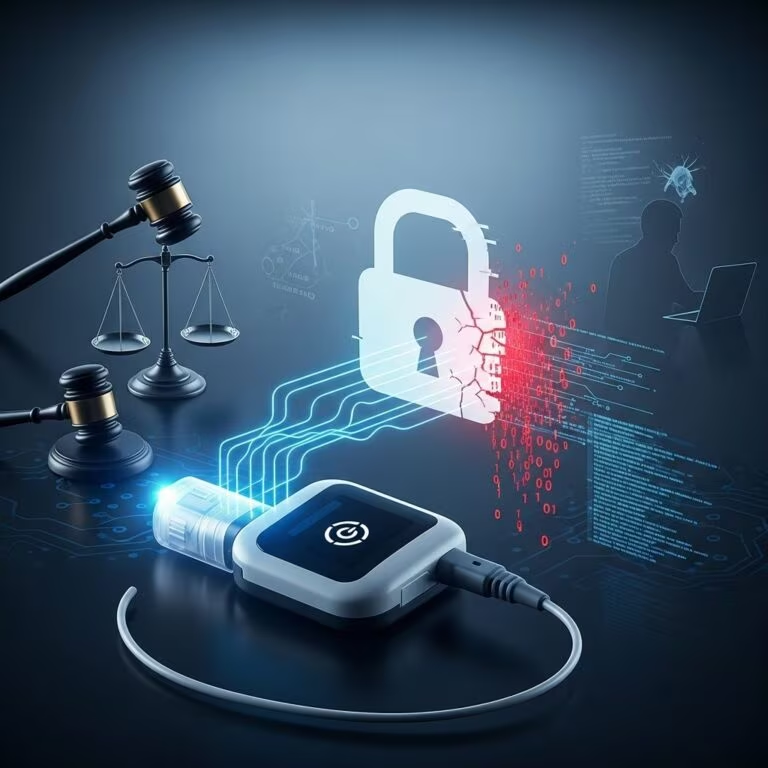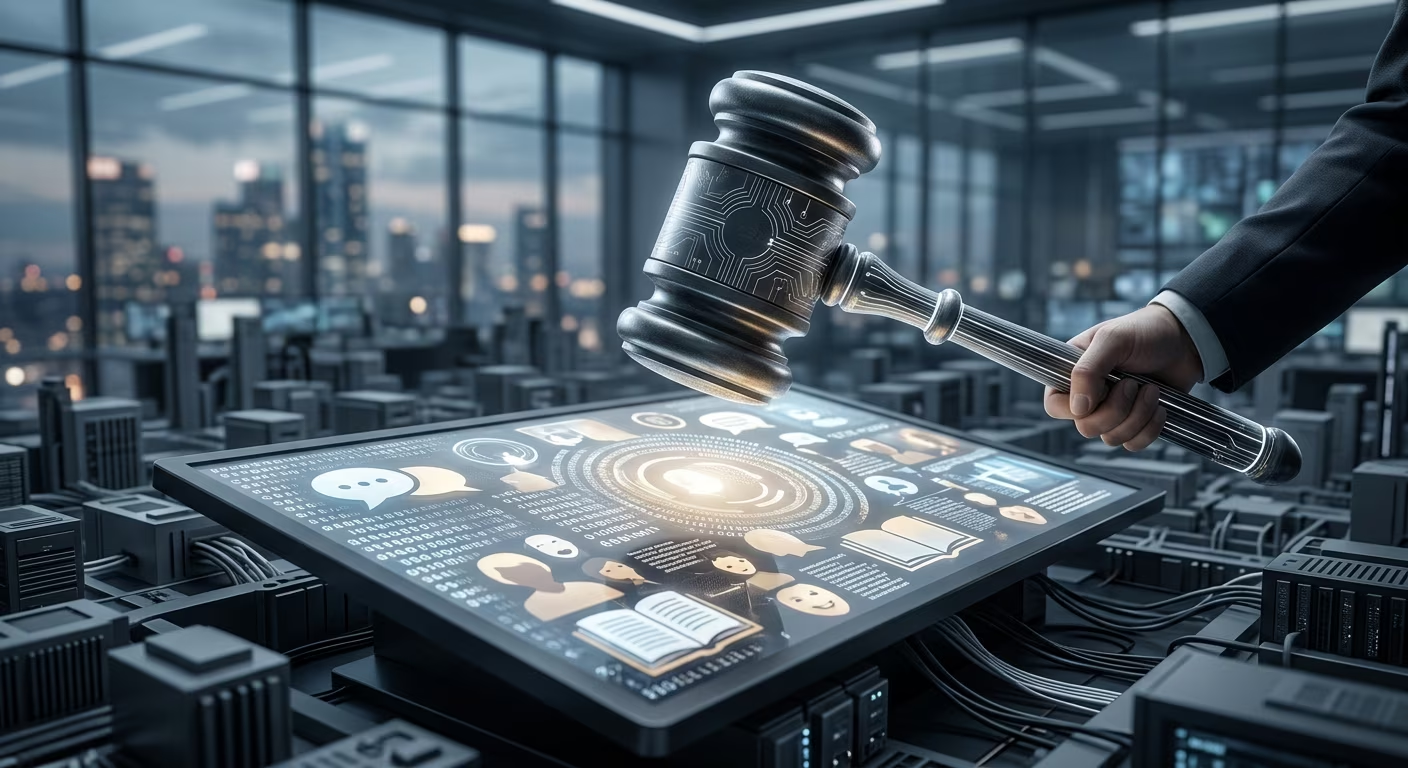
The digital public square is undergoing a profound crisis of confidence. Over the past decade, a growing consensus has emerged among policymakers, civil rights advocates, and the general public: massive technology companies wield too much unaccountable power. From the rapid spread of algorithmic disinformation to the pervasive harvesting of consumer data, the societal harms generated by unchecked digital monopolies are undeniable. In response, lawmakers have aggressively pursued various regulatory frameworks aimed at reigning in the influence of these digital behemoths. However, in the zeal to hold technology platforms accountable, a dangerous legislative trend has emerged—one that threatens to fundamentally erode the bedrock of online free expression.
Many of the legislative proposals currently circulating in the halls of Congress focus heavily on forcing platforms to alter their content moderation practices by threatening their core legal liabilities. While the intention to foster a safer digital environment is laudable, tying corporate accountability directly to the regulation of user-generated speech creates a precarious legal tightrope. When the government dictates what kind of speech private networks must host or remove, it inevitably chills free expression, disproportionately harming marginalized communities, independent journalists, and grassroots activists. True platform accountability must address the underlying business models—such as predatory data collection and opaque algorithmic amplification—without sacrificing the First Amendment rights of everyday internet users.
The Crucial Role of Section 230 in Digital Ecosystems
To understand the current debate over digital free expression, one must first understand the legal architecture that made the modern internet possible. At the center of this architecture is Section 230 of the Communications Decency Act of 1996. Often referred to as the most important law in technology, Section 230 contains a simple but revolutionary provision: “No provider or user of an interactive computer service shall be treated as the publisher or speaker of any information provided by another information content provider.”
Before Section 230 was enacted, internet service providers faced an impossible legal paradox created by two contrasting judicial rulings. In one case, a platform that chose not to moderate user content was deemed a mere distributor, free from liability. In another, a platform that actively moderated its forums to keep them family-friendly was legally categorized as a publisher, making it legally responsible for every defamatory statement that slipped through the cracks. This created a perverse incentive: platforms were legally safer if they turned a blind eye to all toxic content, leaving the internet a completely unmoderated wasteland.
Section 230 solved this paradox by providing a “sword and shield.” The shield protects platforms from being sued into oblivion for the speech of their users, while the sword empowers them to make good-faith efforts to remove objectionable, violent, or illegal content. As the Electronic Frontier Foundation (EFF) has frequently noted, this foundational legal protection has allowed the internet to flourish into a global medium for self-expression, political organization, and community building . Without it, the interactive web—from massive social media feeds to independent local news comment sections—would cease to function.
The Bipartisan Crusade for Platform Accountability
Despite its historical success, Section 230 has increasingly become a lightning rod for bipartisan political frustration. Lawmakers on both sides of the aisle are united in their desire to dismantle or heavily modify the law, albeit for entirely contradictory reasons. This paradoxical political alignment highlights the fundamental difficulty of regulating digital speech through liability reform.
On one side of the political spectrum, critics argue that tech platforms hide behind Section 230 to avoid taking responsibility for the real-world violence, hate speech, and medical misinformation that proliferates on their networks. These advocates seek to carve out broad exceptions to the law, effectively forcing companies to aggressively police user speech under the threat of catastrophic civil litigation. On the opposing side, critics argue that platforms use the law to actively censor conservative viewpoints and silence political dissent. Their proposed reforms would condition Section 230 immunity on a platform’s adherence to “political neutrality,” essentially forcing private companies to host speech they find morally reprehensible.
Both approaches share a fatal flaw: they attempt to use the threat of existential legal liability to coerce private companies into adopting the government’s preferred speech standards. This is a profound misunderstanding of how liability shapes corporate behavior. If Congress succeeds in transforming intermediary liability into a weapon for speech control, the result will not be a balanced, utopian digital square. Instead, it will be a sanitized, highly restricted internet where platforms preemptively ban any conversation that might invite a lawsuit.
Collateral Damage: How Altering Liability Harms Marginalized Voices
When policymakers consider weakening intermediary liability, they often imagine they are striking a blow against monolithic technology giants. However, the reality of corporate risk management dictates that the heaviest burdens of these policy shifts will fall squarely on the most vulnerable users of the internet. Modifying Section 230 to increase platform liability carries severe, unintended consequences for digital free expression:
- Overzealous Automated Moderation: Faced with the prospect of multimillion-dollar lawsuits over user posts, platforms will inevitably over-moderate. To manage the sheer volume of daily posts, companies will deploy highly aggressive, risk-averse algorithmic filters. These automated systems lack the nuance to distinguish between a user promoting a hate group and a civil rights activist documenting hate crimes. Historically, broad algorithmic sweeps disproportionately silence LGBTQ+ creators, racial minorities, and human rights monitors.
- The Heckler’s Veto: Lowering the barrier for intermediary liability empowers bad-faith actors to silence their opponents. If a platform knows it can be sued for hosting controversial speech, orchestrated reporting campaigns can be used to flag a targeted user’s content. To avoid legal friction, platforms will simply delete the contested content and ban the user, granting trolls an effective “heckler’s veto” over legitimate political discourse.
- Cementing Big Tech Monopolies: Perhaps the greatest irony of the push to repeal Section 230 is that it would ultimately protect the very monopolies Congress wishes to rein in. Massive corporations possess the deep pockets, armies of lawyers, and proprietary AI systems necessary to survive a post-230 landscape. Startups, independent message boards, and open-source decentralized networks—the very entities capable of challenging Big Tech—would be crushed by compliance costs and legal threats before they could ever get off the ground .
First Amendment Complexities in the Digital Age
The contemporary debate over social media regulation is frequently derailed by widespread misunderstandings of the First Amendment. As research from the Brookings Institution has highlighted, a significant portion of the public mistakenly believes that private digital platforms are constitutionally prohibited from moderating user speech . In reality, the First Amendment protects citizens against government censorship, not against the editorial decisions of private corporations.
Platforms have their own First Amendment rights to curate the content they host, much like a newspaper has the right to choose which op-eds to publish. This editorial discretion is vital for creating distinct online communities; it is the reason why a forum dedicated to childhood education can ban profanity without violating the law. However, when the government threatens to revoke a platform’s legal immunity unless it adopts state-approved moderation standards, it crosses a dangerous constitutional line. Using legislative coercion to indirectly force platforms to censor legal speech—or to mandate the hosting of harmful speech—violates the fundamental separation between state power and private expression.
By focusing regulatory efforts solely on the content of user speech, Congress risks entangling itself in unconstitutional mandates that will inevitably be struck down in court, wasting valuable time that could have been spent implementing effective structural reforms.
Constructive Alternatives: Regulating Conduct, Not Content
If stripping away speech protections is the wrong approach, how can society effectively hold digital platforms accountable? The answer lies in shifting the regulatory focus away from what users say and toward how companies operate. Congress must address the structural and economic incentives that drive tech monopolies to amplify harmful content in the first place. Meaningful accountability can be achieved through robust, content-neutral policy levers.
| Proposed Policy Solution | Mechanism of Action | Impact on Free Expression |
|---|---|---|
| Comprehensive Privacy Legislation | Restricts the invasive harvesting and monetization of user data. | Neutral/Positive. Starves the “engagement algorithms” that amplify outrage without censoring user speech. |
| Algorithmic Transparency | Mandates regular disclosures and independent audits of how platform recommendation engines function. | Highly Positive. Allows researchers to identify systemic amplification of harm without dictating what content is allowed . |
| Antitrust and Interoperability | Breaks down digital monopolies and forces platforms to allow cross-network communication. | Highly Positive. Empowers users to leave toxic platforms for better-moderated alternatives, creating a competitive market for healthy discourse. |
First and foremost, the United States desperately needs a comprehensive federal data privacy law. The modern digital economy is built on a surveillance model: platforms hoover up vast amounts of personal data to build behavioral profiles, which are then used to serve hyper-targeted advertising. To maximize ad revenue, algorithms are designed to keep users infinitely scrolling, often by promoting the most inflammatory, enraging, and extreme content available. By strictly limiting the data companies can collect and monetize, Congress can fundamentally disrupt the economic engine that drives algorithmic outrage, all without ever having to regulate user speech.
Secondly, lawmakers should pursue aggressive algorithmic transparency. As experts have argued, transparency is a necessary first step in creating a regulatory structure for social media companies . Users, researchers, and regulators deserve to look under the hood of the recommendation systems that shape public discourse. Mandating independent audits and clear disclosures about how content is amplified or demoted allows society to hold platforms accountable for their design choices. Transparency empowers the public to demand better services and provides regulators with the data needed to enforce consumer protection laws, sidestepping the treacherous waters of direct speech regulation.
Finally, antitrust enforcement and interoperability mandates offer a pathway to genuine digital freedom. The current tech landscape is dominated by a handful of inescapable monopolies. If users are dissatisfied with a platform’s moderation practices, the “network effect” makes it nearly impossible for them to leave and start anew. By enforcing competition laws and requiring platforms to utilize interoperable standards, Congress can break the lock-in effect. This would allow a vibrant ecosystem of smaller, decentralized, and diverse digital communities to thrive, each with its own distinct rules and norms, fully protected by the foundational shield of Section 230 .
Frequently Asked Questions (FAQs)
What would happen if Section 230 were fully repealed?
A full repeal of Section 230 would fundamentally alter the internet. Platforms would immediately become legally responsible for everything their users post. To survive the inevitable flood of lawsuits, most platforms would adopt one of two extremes: either they would implement draconian, automated censorship systems that block any remotely controversial statement, or they would completely abandon moderation altogether to claim they are merely passive “dumb pipes,” turning the internet into a toxic, unnavigable space.
Does Section 230 only benefit massive tech monopolies?
No. While large tech companies certainly rely on it, Section 230 is actually the lifeline for small businesses, startups, and independent creators. Massive monopolies have the financial resources to hire thousands of lawyers and absorb the costs of litigation if Section 230 were removed. A startup attempting to build a competitor to established social networks would be bankrupted by a single lawsuit over a user’s comment. The law protects the entire digital ecosystem, from local news blogs to specialized community forums.
How does algorithmic transparency improve accountability without censoring speech?
Algorithmic transparency focuses on the design of the platform rather than the content of the user. Instead of the government deciding what a citizen is allowed to say, transparency laws require platforms to disclose how their internal systems decide which posts to heavily promote or hide. This allows independent researchers to identify if a platform’s software is systematically boosting dangerous content to increase profits, enabling targeted consumer protection actions rather than sweeping speech bans.
As Congress continues its critical work in defining the future of digital governance, it must resist the temptation to use intermediary liability as a weapon for speech control. Holding technology companies accountable for their invasive surveillance practices, anticompetitive behavior, and opaque algorithmic designs is an absolute necessity for the health of modern democracy. However, these structural reforms must be carefully calibrated to avoid undermining the First Amendment. By protecting laws that safeguard intermediary liability and focusing on robust consumer privacy and antitrust measures, we can build a safer, more accountable digital world—one that continues to serve as a vibrant, open frontier for human expression.
References
- On Its 30th Birthday, Section 230 Remains The Lynchpin For Users’ Speech — Electronic Frontier Foundation. 2026-02-09. https://www.eff.org/deeplinks/2026/02/its-30th-birthday-section-230-remains-lynchpin-users-speech
- Transparency is essential for effective social media regulation — Brookings Institution. 2022-11-01. https://www.brookings.edu/articles/transparency-is-essential-for-effective-social-media-regulation/
- Misunderstandings of the First Amendment hobble content moderation — Brookings Institution. 2022-06-06. https://www.brookings.edu/articles/misunderstandings-of-the-first-amendment-hobble-content-moderation/
- The Open Social Web Needs Section 230 to Survive — Electronic Frontier Foundation. 2026-04-28. https://www.eff.org/deeplinks/2026/04/open-social-web-needs-section-230-survive