
Teachers’ Unions, Collective Bargaining, and the U.S. Constitution
How constitutional rights, state laws, and labor statutes shape teachers’ unions, collective bargaining, and strikes in U.S. public education.
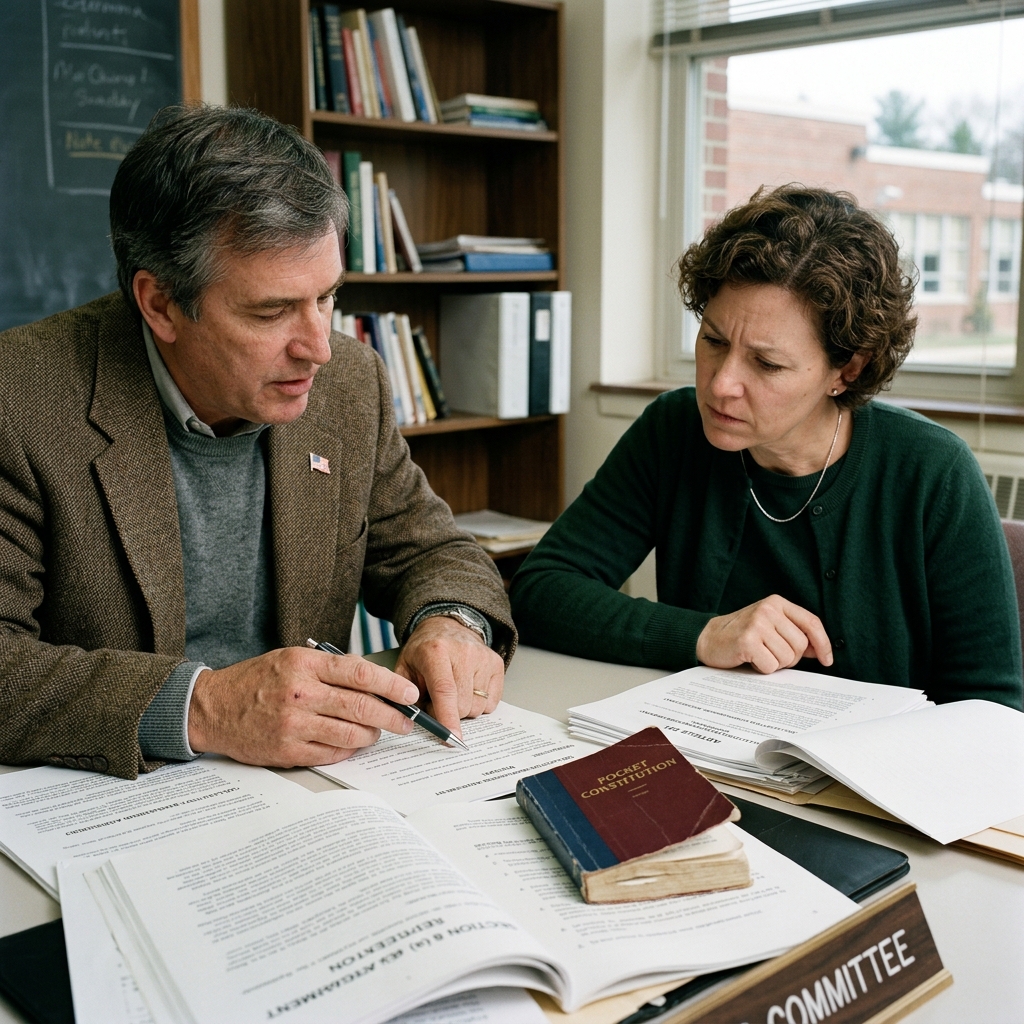
Teachers’ unions occupy a distinctive place in American public life: they are central to debates about school funding, classroom conditions, and academic outcomes, yet their legal authority does not primarily come from the U.S. Constitution. Instead, a mix of constitutional rights, federal statutes, and state laws shapes how teachers organize, bargain, and strike.
This article explains how the U.S. Constitution protects teachers’ freedom of association but stops short of guaranteeing a right to collective bargaining or striking, and how states and federal labor law fill in those gaps. It is designed for educators, school leaders, and parents who want a clear, practical overview of the legal landscape surrounding teachers’ unions.
1. Constitutional Foundations for Teachers’ Union Rights
Although the Constitution does not mention unions by name, several provisions are crucial for understanding teachers’ union rights. The most important are the First Amendment and the Fourteenth Amendment.
1.1 The First Amendment and Freedom of Association
The First Amendment protects, among other rights, the freedom of speech and the right of people to gather peacefully. Courts have interpreted these protections to include a broader freedom of association, meaning individuals may join together to pursue common goals, including forming or joining unions.
- Public school teachers have a constitutional right to join a union or other professional organization.
- They may meet, advocate for better working conditions, and promote union membership, subject to reasonable limits in the workplace and classroom.
- This protection applies in the states through the Fourteenth Amendment, which makes key federal rights binding on state governments.
Importantly, these rights do not guarantee that the government or school district must negotiate with the union or agree to its demands. The First Amendment protects participation and advocacy; it does not itself create a duty to bargain.
1.2 What the U.S. Constitution Does Not Provide
Because teachers often think of unions in terms of contracts and negotiations, it is easy to assume those powers come directly from the Constitution. In reality, the Constitution does not grant:
- A constitutional right to collective bargaining with a school district or state employer;
- A constitutional right to strike or engage in work stoppages;
- A guaranteed role for unions in setting pay, benefits, or working conditions.
Those powers, where they exist, are instead created by state constitutions and statutory labor law at the state and federal levels. That is why the legal status of teachers’ unions can vary dramatically from one state to another.
2. Federal Labor Law and Public-Sector Teachers
Private-sector workers rely heavily on the National Labor Relations Act (NLRA), a federal statute enacted in 1935 that protects union organizing and collective bargaining. But most public school teachers are employed by states, cities, or school districts, and many public employees fall outside the NLRA’s coverage.
2.1 Key Features of the National Labor Relations Act
For workers who are covered, the NLRA provides a structured framework for union activity and negotiations.
- Employees have the right to form, join, or assist unions and to act together for mutual aid and protection.
- Employers must bargain in good faith over wages, hours, and other terms and conditions of employment.
- It is unlawful for employers or unions to interfere with these rights through coercion or unfair labor practices.
The National Labor Relations Board (NLRB) enforces the NLRA, handling disputes about how bargaining takes place and whether either side has violated its legal duties.
2.2 Public School Teachers and the Limits of Federal Coverage
Many teachers work in the public sector, and public employees are treated differently under federal labor law. Congress has generally left it to the states to determine whether public workers, including teachers, may organize and bargain collectively.
- Public school teachers are often not covered by the NLRA, meaning their bargaining rights depend primarily on state law rather than federal law.
- States have adopted widely varying approaches, from robust bargaining regimes to outright prohibitions on union negotiation.
- As a result, a teacher’s legal rights can differ sharply across state lines, even though the underlying constitutional rights of association remain constant.
3. State Constitutions and Statutes: The Real Engines of Teachers’ Rights
Because the federal Constitution and federal labor law leave many gaps, state law plays a central role in defining teachers’ union powers. These laws determine whether collective bargaining is permitted, what topics can be negotiated, and whether strikes are lawful.
3.1 State Constitutions and Explicit Bargaining Protections
Some states have chosen to place worker protections directly into their constitutions. A number of state constitutions affirm a right to organize or bargain collectively for certain categories of workers.
- Several states explicitly recognize a right to collective bargaining for workers, including public employees.
- These constitutional provisions can protect union rights from being easily rolled back by ordinary legislation.
- State constitutional rights must still be consistent with the federal Constitution, due to the Supremacy Clause, but they can go beyond federal minimum protections.
For teachers, this means that in some states, collective bargaining rights have a constitutional footing; in others, they depend entirely on statutes that legislatures can modify or repeal.
3.2 State Bargaining Laws and Coverage Differences
Most states address teachers’ union rights through detailed labor statutes rather than constitutional text. These laws specify whether and how school boards must bargain with teachers’ unions.
| Type of legal regime | Implications for teachers |
|---|---|
| Explicit right to bargain in state law | Teachers may organize unions that have a legal right to negotiate contracts with school boards. |
| Limited bargaining or “meet and confer” laws | Law may require consultation without creating a strong duty to reach binding agreements. |
| Prohibitions on public-sector bargaining | Teachers may form associations but cannot engage in formal collective bargaining with public employers. |
Research from education and labor organizations indicates that a majority of states allow some form of collective bargaining for K–12 teachers, while a smaller group explicitly bans public-sector bargaining or provides only weak alternatives.
4. Collective Bargaining in Practice: What Teachers’ Unions Negotiate
Where collective bargaining is permitted, it functions as a structured process through which unions and school districts negotiate the terms and conditions of educators’ work. Teachers’ unions have become major advocates in these processes, especially since the mid-20th century.
4.1 The Bargaining Process
Collective bargaining typically unfolds through a series of formal steps.
- Each side designates a negotiating team to represent its interests.
- Parties exchange proposals on wages, hours, class size, professional development, and related topics.
- Both sides must bargain “in good faith,” meaning they participate sincerely and avoid tactics that would make agreement impossible.
- If impasse is reached, state law may authorize mediation, fact-finding, or other dispute resolution mechanisms.
The outcome is usually a collective bargaining agreement (CBA), a contract that governs many aspects of teachers’ working lives for a set term. Once in place, neither side may depart from the agreement without following legal procedures or obtaining the other party’s consent.
4.2 Typical Topics of Teachers’ CBAs
Bargaining laws often define which matters are mandatory, permissive, or prohibited subjects of negotiation. For teachers, CBAs frequently address:
- Salary schedules and incremental pay raises;
- Health, dental, and vision benefits and retirement plans;
- Class size limits and student load;
- Preparation time, professional development, and evaluation processes;
- Grievance procedures and due process protections in disciplinary matters.
Studies in education policy emphasize that strong bargaining frameworks can improve job security and working conditions, which may in turn support student learning by stabilizing the teaching workforce.
5. Strikes and Work Stoppages: A Separate Legal Question
The legal right of teachers to strike is distinct from the right to organize or bargain. Even in states that recognize collective bargaining, teachers may face strict limits on work stoppages.
5.1 No Constitutional Right to Strike
The U.S. Constitution does not expressly grant public employees, including teachers, a right to strike. Courts have consistently held that governments may regulate or prohibit strikes by public workers without violating the First Amendment, so long as basic expressive rights remain intact.
This distinction reflects concerns about continuity of essential services, including education. While teachers may speak, assemble, and organize, they cannot rely on the Constitution alone to protect work stoppages.
5.2 State-by-State Rules on Teachers’ Strikes
Whether a teacher strike is lawful depends heavily on state and local law. Some states criminalize public-sector strikes, others allow them subject to strict procedures, and many fall somewhere in between.
- In states that prohibit public-sector collective bargaining, strikes are often treated as unlawful, carrying potential penalties for unions and individual teachers.
- In states with robust bargaining laws, strikes may be permitted after negotiation and impasse, but subject to conditions such as notice requirements or cooling-off periods.
- Even where strikes are barred, teachers may engage in other forms of advocacy, including rallies, testimony before school boards, and political campaigns.
Because consequences for illegal strikes can include fines or disciplinary action, union leaders and teachers must understand their state’s specific legal framework before considering work stoppages.
6. Why the Legal Structure Matters for Schools and Communities
The way laws define teachers’ union rights does more than shape internal school labor relations; it influences educational policy and community life.
- In states with strong bargaining rights, unions often play a major role in debates over school funding, curriculum initiatives, and accountability systems.
- In states with weak or prohibited bargaining, teachers may have fewer formal channels to influence policy, relying more on professional associations or grassroots advocacy.
- Stable bargaining frameworks can reduce conflict by giving teachers and districts clear procedures for resolving disputes.
Ultimately, these legal arrangements reflect broader choices about how society balances workers’ rights, fiscal constraints, and the public interest in continuous, high-quality education.
7. Practical Takeaways for Teachers and School Leaders
Teachers, principals, and district officials do not need to be constitutional scholars to navigate union issues, but several practical points are useful to keep in view.
7.1 Key Points to Remember
- The U.S. Constitution protects your right to join a union, but it does not guarantee that your employer must bargain with that union.
- Collective bargaining and strike rights for teachers are determined mainly by state constitutions and state labor laws, especially in the public sector.
- Federal labor law, including the NLRA, plays a limited but important role, particularly for educators in private institutions.
- Good-faith bargaining, clear statutes, and neutral labor boards help prevent unfair labor practices and stabilize school labor relations.
For any individual teacher or administrator, the bottom line is to know the legal regime of your own state and district, and to seek qualified legal advice when complex disputes arise.
8. Frequently Asked Questions (FAQs)
8.1 Do public school teachers have a constitutional right to join a union?
Yes. The First Amendment’s protections for speech and peaceful assembly, applied to the states through the Fourteenth Amendment, have been interpreted to include the right of public employees, including teachers, to join unions or other associations.
8.2 Does the U.S. Constitution guarantee teachers the right to collective bargaining?
No. The Constitution does not create a specific right to collective bargaining for teachers or other workers. Bargaining rights arise from state constitutions, state statutes, and, in some cases, federal labor law for private-sector employees.
8.3 Are teacher strikes protected by the First Amendment?
Not as such. While teachers have constitutional rights to speak and assemble, the Supreme Court has allowed governments to regulate or prohibit strikes by public employees. Whether a strike is lawful depends primarily on state and local law, not on the First Amendment alone.
8.4 Why do teachers’ union rights differ from state to state?
Because federal law leaves broad discretion to the states regarding public-sector labor relations, each state can adopt its own policies on collective bargaining and strikes. Some provide strong protections, others allow limited negotiation, and a few prohibit public-sector bargaining altogether.
8.5 How can teachers find out what rights they have in their state?
Teachers can consult state education department resources, state labor relations boards, union legal materials, and local school district policies. When questions involve potential legal risks or complex disputes, it is wise to seek advice from a qualified attorney familiar with education and labor law in that jurisdiction.
References
- Teachers’ Unions and Collective Bargaining: The U.S. Constitution — FindLaw. 2023-05-01. https://www.findlaw.com/education/teachers-rights/teachers-unions-and-collective-bargaining-the-u-s-constitution.html
- Teachers Unions & Collective Bargaining — LawInfo. 2022-09-15. https://www.lawinfo.com/resources/labor-law/teachers-unions-collective-bargaining.html
- Collective Bargaining and Teachers’ Unions — EBSCO Research Starters. 2019-06-10. https://www.ebsco.com/research-starters/education/collective-bargaining-and-teachers-unions
- State Constitutions and Public Sector Collective Bargaining Rights — Harvard Law School Center for Labor and a Just Economy. 2022-03-01. https://clje.law.harvard.edu/publication/building-worker-power-in-cities-states/state-constitutions-and-public-sector-collective-bargaining-rights/
- Collective Bargaining Rights — National Labor Relations Board (NLRB). 2021-11-30. https://www.nlrb.gov/about-nlrb/rights-we-protect/the-law/employees/collective-bargaining-rights
- Benefits of Collective Bargaining in Education — National Education Association (NEA). 2022-01-01. https://www.nea.org/sites/default/files/2022-01/28263%20Benefits%20of%20Bargaining%20in%20Education%20v5.pdf
Similar Articles








Read full bio of medha deb




