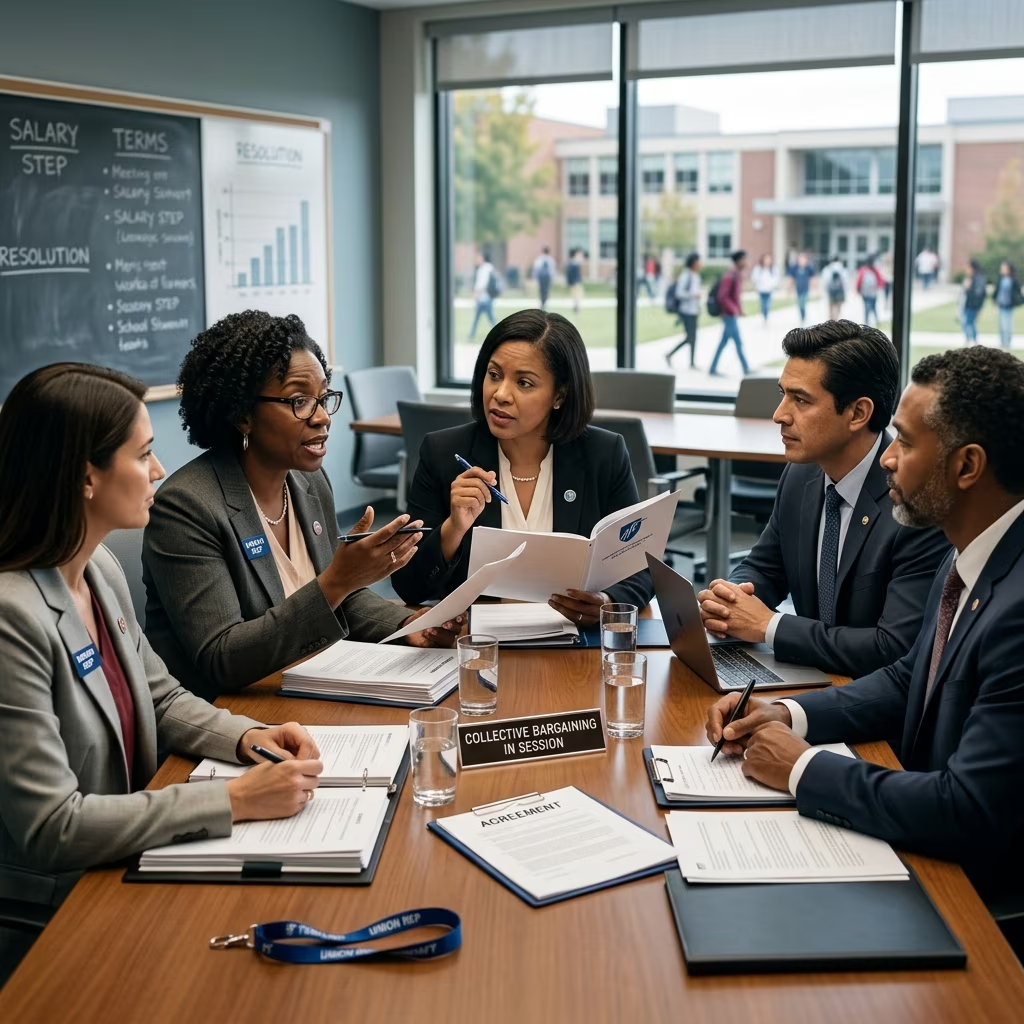
Teachers’ unions occupy a central place in public education, shaping how school districts negotiate pay, set working conditions, and resolve workplace conflicts. Through collective bargaining, unions represent educators in formal negotiations with school districts, producing contracts that govern everything from class size and salary schedules to grievance procedures and dispute resolution mechanisms. Understanding how these systems work is essential for teachers, school leaders, and families who want to navigate education policy and labor relations effectively.
Core Roles of Teachers’ Unions in Public Education
A teachers’ union is a specialized labor organization that represents educators in their dealings with school districts and other public employers. While unions advocate politically and publicly, their most powerful tools are collective bargaining and contract enforcement. These unions are distinct because they operate in the public sector, where labor law is heavily shaped by state statutes rather than a single federal framework.
- Representation – Unions serve as the designated bargaining representative for teachers and, often, other school employees, negotiating on their behalf with school districts.
- Contract negotiation – They develop and negotiate collective bargaining agreements (CBAs) that set legally enforceable terms of employment.
- Grievance support – Unions help members use contractual grievance procedures when disputes arise over discipline, evaluation, or workplace conditions.
- Policy advocacy – At state and local levels, unions lobby for legislation on funding, class size, tenure, and bargaining rights themselves.
Because union contracts are binding, they often function as the most immediately relevant “law” in a teacher’s workplace, supplementing state statutes and constitutional protections.
Legal Foundations of Collective Bargaining for Teachers
Collective bargaining is the structured process by which unions and employers negotiate employment terms and memorialize them in written agreements. In the private sector, bargaining rights are primarily governed by the federal National Labor Relations Act (NLRA). For public school employees, however, the picture is far more complex.
Key legal foundations for teachers’ bargaining and union activity include:
- State collective bargaining laws – There is no federal statute that grants public school teachers a nationwide right to bargain collectively; instead, states decide whether and how teachers can bargain. Some states affirmatively authorize bargaining, others heavily restrict it, and a small number prohibit it outright.
- Constitutional rights of association – Courts have recognized that the First Amendment protects public employees’ right to join associations, including unions, and to select representatives for collective bargaining without employer coercion.
- State-specific frameworks – Laws such as New York’s Taylor Law establish detailed systems for public-sector collective bargaining, impasse resolution, and unfair labor practice enforcement.
Because these legal frameworks differ so drastically, teachers in one state may enjoy robust bargaining rights and strong contractual protections, while educators in another state rely primarily on informal advocacy and political organizing.
What Collective Bargaining Agreements Typically Cover
Collective bargaining agreements are the written contracts resulting from negotiations between a school district and the union representing its employees. These CBAs define rights and responsibilities for both teachers and administrators and often include detailed dispute-resolution procedures.
Common subjects in teacher CBAs include:
- Compensation – Salary schedules, stipends for extra duties, and rules for pay increases based on experience or education.
- Benefits – Health insurance, retirement or pension plans, paid leave, and other benefits such as dental and vision coverage.
- Workload and conditions – Class size limits, preparation time, duty assignments, and the length of the school day or year.
- Evaluation and tenure – Procedures for performance evaluations, pathways to tenure or continuing contracts, and protections against arbitrary dismissal.
- Grievance and arbitration processes – Step-by-step mechanisms for handling disputes, sometimes culminating in binding arbitration.
Not every state allows bargaining over all of these issues. Some states limit the topics that can be negotiated, such as restricting bargaining to base wages while leaving benefits or workload to employer discretion.
Illustrative Overview of Bargaining Topics
| Area of Contract | Typical Teacher Concerns | Why It Matters |
|---|---|---|
| Salary & Pay Structure | Fair compensation, transparent pay scales, pay equity. | Impacts recruitment, retention, and perceived fairness among staff. |
| Benefits | Health coverage, retirement security, paid time off. | Provides economic security and long-term stability for educators. |
| Working Conditions | Class size, prep time, assignments, safety protocols. | Affects both teaching quality and teacher well-being. |
| Job Protections | Due process, evaluation standards, tenure rules. | Helps prevent arbitrary or politically motivated employment decisions. |
| Dispute Resolution | Clear grievance steps, timelines, impartial review. | Offers structured pathways to resolve conflicts without immediate resort to litigation. |
State Differences: Where Bargaining is Strong, Weak, or Prohibited
Because states control public-sector labor policy, the strength of teachers’ collective bargaining rights varies significantly across the country.
General patterns include:
- States with strong bargaining rights – Many states explicitly authorize school districts to bargain with teachers’ unions over multiple topics and require employers to negotiate in good faith.
- States with limited bargaining – Some states permit bargaining only on narrow issues such as base wages, or they limit contract length and prohibit strikes.
- States where bargaining is prohibited or effectively unavailable – In a small number of states, public school employees are not permitted to bargain collectively, or courts have ruled that there is no right to bargain even if statutes do not expressly forbid it.
In states where bargaining is limited or prohibited, unions and professional associations often rely more heavily on political advocacy, public campaigns, and collaborative conferencing to influence working conditions.
How Collective Bargaining Influences Teacher Pay and School Spending
A substantial body of research has examined how teachers’ unions and collective bargaining agreements affect salaries and overall school spending. Several studies suggest that unionization and strong CBAs are associated with higher teacher pay and increased education expenditures.
Key findings from recent analyses include:
- Salary impacts – Teacher salaries often increase by approximately 4% to 12% when unions gain bargaining rights or when districts become newly unionized. When collective bargaining rights are substantially restricted, teacher salaries can decline by 3% to 9%.
- Expenditure patterns – School districts that adopt collective bargaining for teachers tend to increase overall expenditures; one analysis found spending rises by around 12.3% following unionization.
- Response to new revenue – Districts with strong unions allocate more of new state revenue to teacher salaries compared with districts that have weaker union power.
These patterns do not necessarily mean that unions always increase costs without benefits. Advocates argue that higher pay and improved working conditions help retain experienced teachers, reduce turnover, and support instructional quality. Critics, however, worry that some contract provisions may limit administrative flexibility or constrain how resources are allocated among competing priorities.
Conflict Resolution Tools Inside Union Contracts
One of the most important functions of union contracts is offering a structured way to resolve disputes between teachers and administrators. These dispute-resolution pathways reduce the need for immediate court involvement and create predictable procedures for addressing conflicts.
Common conflict resolution mechanisms include:
- Grievance procedures – Teachers who believe a contract was violated can file a grievance. The contract typically outlines steps such as informal discussion, written complaints, administrative review, and, in some cases, arbitration.
- Impasse processes – When district and union negotiators cannot reach agreement on a new contract, state law or the existing CBA may require mediation, fact-finding, or other neutral processes before more drastic actions are considered.
- Unfair labor practice mechanisms – State boards or commissions oversee compliance with bargaining laws, investigating claims that either side has failed to negotiate in good faith or interfered with lawful union activity.
These systems help ensure that conflicts move through defined channels and that both parties understand their rights and obligations at each stage of the dispute.
Typical Steps in a Contractual Grievance Process
Although every contract is different, a typical teacher grievance process might include:
- Informal resolution – The teacher raises the concern with a principal or supervisor and attempts to resolve the issue informally.
- Formal written grievance – If informal efforts fail, the teacher files a written grievance describing the alleged contract violation and the remedy sought.
- Management review – The school district responds, often through successive levels of management, within timelines set by the contract.
- Union involvement – The union reviews the grievance, may represent the teacher in meetings, and decides whether to advance the case further.
- Arbitration or other neutral review – Some contracts provide for review by an independent arbitrator whose decision can be binding on both parties.
Because these steps are contractual, they interact with, but do not replace, teachers’ broader legal rights in areas such as discrimination, speech, or due process under state and federal law.
When Teachers Lack Formal Bargaining Rights
In states that restrict or prohibit collective bargaining for teachers, union-like associations still exist, but their strategies must differ. Without binding CBAs, these organizations rely more on persuasion, organizing, and political leverage.
Educator groups in such environments may:
- Engage in collaborative conferencing or meet-and-confer practices that allow educators to discuss workplace issues with administrators, even if the outcomes are not formal contracts.
- Mobilize members to contact legislators and school board officials to advocate for better pay, benefits, and working conditions.
- Support political action committees and electoral campaigns that aim to change laws governing bargaining rights and education funding.
- Organize public awareness efforts, including town halls, media outreach, and coalition building with parents and community groups.
While these strategies can produce real change, the absence of enforceable contracts means that gains may be more vulnerable to policy shifts and administrative turnover.
Practical Tips for Teachers Navigating Union and Contract Issues
Whether you work in a strongly unionized state or one with limited bargaining rights, understanding how unions and contracts operate can make a significant difference in your professional life.
Teachers can take several practical steps:
- Read your contract or local policies – If you are covered by a CBA, familiarize yourself with key sections on salary, evaluation, discipline, and grievance procedures.
- Use union representation – When facing serious disputes, such as potential discipline or contract violations, consult your union representative early to understand your options.
- Document conflicts – Keep written records of incidents, communications, and timelines related to workplace disputes; this documentation is often crucial in grievances or legal actions.
- Stay informed about state law – Because bargaining rights can change with new legislation or court decisions, stay current with state-level developments.
- Engage in advocacy – Even where bargaining exists, political decisions about funding and policy shape the environment in which contracts are negotiated.
Frequently Asked Questions (FAQs)
Do all teachers in the United States have a right to collective bargaining?
No. There is no federal law granting public school teachers nationwide bargaining rights. Each state decides whether and how teachers can unionize and bargain collectively, leading to substantial variation in rights and contract structures.
Can teachers form unions even in states that limit bargaining?
Yes. Teachers generally retain constitutional rights to join associations and unions for representation and advocacy. However, in some states those unions cannot negotiate binding CBAs, meaning their influence rests on political and collaborative efforts rather than formal contracts.
What is the difference between union representation and collective bargaining?
Union representation refers broadly to the role of unions in supporting members, including advice, advocacy, and organizing. Collective bargaining is the specific formal negotiation process that results in written contracts between unions and employers.
How do collective bargaining agreements affect students?
CBAs often shape working conditions that indirectly affect students, such as class size, teacher retention, and instructional time. While the primary focus is on employment terms, many contract provisions aim to support stable, well-resourced classroom environments.
What should a teacher do if they believe their contract rights have been violated?
Teachers should promptly review relevant contract sections, document the issue, and contact their union representative or association for guidance. Formal grievance procedures typically impose strict timelines, so early action is important.
References
- Teachers Unions & Collective Bargaining — LawInfo. 2022-06-01. https://www.lawinfo.com/resources/labor-law/teachers-unions-collective-bargaining.html
- Collective Bargaining Map — National Council on Teacher Quality. 2021-09-01. https://teacherquality.nctq.org/contract-database/collectiveBargaining
- State Collective Bargaining Policies for Teachers — Education Commission of the States. 2014-01-01. https://www.ecs.org/clearinghouse/99/78/9978.pdf
- Teachers’ Unions and Collective Bargaining — AEFP Live Handbook. 2023-03-01. https://livehandbook.org/k-12-education/workforce-teachers/unions-and-collective-bargaining/
- No Bargaining Rights? You Can Still Win! — National Education Association. 2020-08-15. https://www.nea.org/nea-today/all-news-articles/no-bargaining-rights-you-can-still-win
- Collective Bargaining: The Taylor Law/Civil Service Law — New York State United Teachers. 2019-05-01. https://www.nysut.org/members/member-guide/collective-bargaining
- Understanding Collective Bargaining — National Education Association. 2021-02-01. https://www.nea.org/your-rights-workplace/union-educator-voice/collective-bargaining