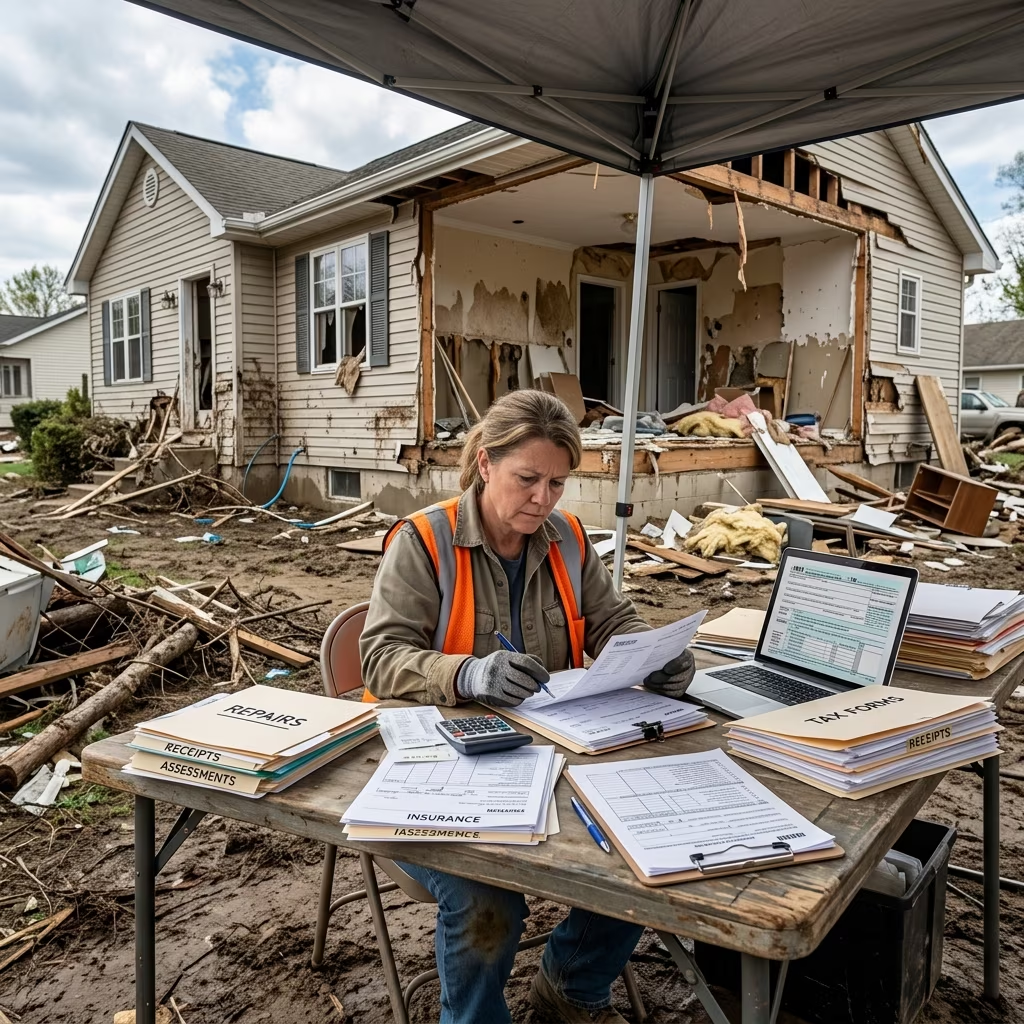
When a storm, wildfire, flood, or other major event damages your home or belongings, the tax code may offer some relief. In certain federally declared disaster situations, taxpayers can claim a casualty loss deduction for uninsured losses and may even speed up a refund by filing for the prior tax year. The rules are technical, but the basic idea is simple: if disaster damage left you with out-of-pocket losses, the IRS may allow you to reduce your taxable income or recover some of what you paid.
What the disaster loss deduction is designed to do
The casualty loss deduction is meant to help taxpayers who suffer property losses from sudden, unexpected events. It does not cover routine deterioration, normal aging, or damage that happens gradually over time. The deduction is generally limited to losses that are not reimbursed by insurance or another source of payment.
For taxpayers in a federally declared disaster area, the rules can be more favorable than the standard casualty loss rules. In qualifying disasters, the IRS allows special treatment that can make the deduction more valuable and easier to use, including the possibility of claiming the loss on an amended return for the previous year in some cases.
Who may qualify for federal disaster tax relief
Eligibility is not limited only to homeowners whose houses were physically damaged. Federal disaster tax relief may reach several types of people and situations, including taxpayers whose main home, work location, records, or tax preparer are located in a disaster area. Relief may also apply to certain relief workers serving in the affected area.
In practice, the most important question is whether the loss is tied to a federally declared disaster and whether the taxpayer has taxable income against which the deduction can be claimed.
| Possible qualification factor | Why it matters |
|---|---|
| Your home is in a declared disaster area | Damage to the home or personal property may qualify for disaster loss treatment. |
| Your records or main workplace are in the affected area | Tax relief may still apply even if the taxpayer was temporarily away from the disaster zone. |
| You are a relief worker in the area | Some relief workers may be able to use disaster-related filing relief. |
| The event was federally declared | This is the trigger for the special disaster rules and IRS procedures. |
What kinds of losses can be deducted
The deduction generally applies to physical property losses caused by the disaster. That can include damage to a house, furniture, appliances, vehicles, and other personal property, as long as the loss is sudden and directly tied to the qualifying event. The deduction does not apply to losses covered by insurance or other reimbursement, because the tax system is designed to offset unrecovered losses rather than compensate taxpayers twice.
It is also important to separate casualty losses from business losses. Although the basic idea of measuring damage is similar, the tax forms and treatment can differ depending on whether the property is personal, income-producing, or business property.
- Damage must be sudden, accidental, or unusual, not the result of wear and tear.
- Losses must be reduced by insurance payments and other reimbursements.
- Property losses caused by gradual deterioration are generally not deductible as casualty losses.
- Qualified disaster losses receive special federal treatment under current IRS rules.
How the IRS measures the amount of loss
The deduction is not based on what you wish the property were worth or on the replacement cost alone. Instead, the IRS uses a formula that looks at the smaller of two numbers: your adjusted basis in the property before the disaster, or the decrease in the property’s fair market value caused by the disaster. From there, you subtract any reimbursement you received or reasonably expect to receive.
Adjusted basis usually means your investment in the property, such as the original purchase price plus certain improvements, adjusted for items like depreciation where relevant. Fair market value is the price a willing buyer would pay a willing seller under normal conditions.
Basic loss calculation steps
- Determine the adjusted basis of the property before the casualty.
- Measure the decrease in fair market value caused by the disaster.
- Use the smaller of those two figures as the starting point for the loss.
- Subtract insurance proceeds and other reimbursements.
- Apply the required dollar threshold and any special disaster rules.
Special rules for federally declared disasters
Federal disaster losses can receive more favorable treatment than ordinary casualty losses. According to the IRS, qualified disaster losses may be subject to a higher flat reduction amount and may avoid the usual percentage-of-income limitation that applies to some other casualty losses. In addition, taxpayers may have the option to claim the loss on the return for the year the disaster happened or to elect treatment on an amended return for the immediately preceding tax year when the loss occurred in an eligible federally declared disaster area.
That timing option can matter because it may produce a faster refund. If a taxpayer amends the previous year’s return, the IRS can process the refund sooner than waiting for the current year’s filing season to end.
| Topic | General rule | Special disaster rule |
|---|---|---|
| When to claim the loss | Usually in the year the loss occurred | May be claimed on the prior year’s amended return for qualifying disasters. |
| Reduction amount | Standard casualty loss rules may apply | Qualified disaster losses may receive more favorable dollar treatment. |
| Income threshold | Some casualty losses are limited by adjusted gross income | Qualified disaster losses may avoid the usual 10% AGI floor. |
Which IRS forms are usually involved
Most taxpayers use Form 4684, Casualties and Thefts, to report disaster-related losses. The form is attached to the tax return where the loss is claimed, whether that is the current year return or an amended return for the prior year.
Depending on the taxpayer’s situation, the deduction may then flow to Schedule A if itemizing is allowed or to another applicable form for business or income-producing property. If the loss is claimed on an amended return, Form 1040-X is typically used.
- Form 4684 reports the casualty or theft loss amount.
- Form 1040-X is used when amending a prior-year return.
- Schedule A may be used for certain itemized deductions.
Why documentation matters after a disaster
Tax relief is easier to claim when you can prove what you owned, what was damaged, and how much you lost. Taxpayers are generally encouraged to keep purchase receipts, photographs, repair estimates, insurance correspondence, bank statements, and any other records showing the condition and value of the property before and after the disaster.
Documentation is especially important when insurance only partially covers the damage. The IRS is looking for the net loss, not the gross damage estimate, so records showing reimbursement amounts are just as important as records showing the original loss.
Common mistakes that reduce or eliminate the deduction
One frequent error is assuming that any disaster-related expense automatically qualifies. The IRS requires a direct property loss, not simply inconvenience or extra spending after the event. Another common mistake is forgetting to reduce the loss by insurance or government reimbursement. Taxpayers also sometimes claim losses for damage that happened gradually, which usually does not meet the casualty loss standard.
Failing to file an insurance claim can also be a problem. If property was insured but the taxpayer did not file a timely claim, the unreimbursed amount may not be deductible as a casualty loss in the way the taxpayer expects.
How disaster relief can affect other tax items
Disaster relief may do more than reduce federal income tax. In some cases, taxpayers in federally declared disaster areas may also receive filing extensions, payment relief, or other administrative help from the IRS. That can matter for estimated tax payments, installment obligations, or the time needed to gather records after a major loss.
Because many states tie parts of their income tax rules to federal adjusted gross income, a federal disaster loss deduction may also influence state tax liability. The effect will depend on the state’s own conformity rules and filing requirements.
Practical steps to take after a qualifying disaster
After the immediate safety concerns are addressed, the next step is to assemble a paper trail. Taxpayers should identify affected property, gather insurance claims information, estimate the decline in value, and confirm whether the event appears on the IRS or FEMA lists of eligible disasters. If the disaster qualifies, a taxpayer can then decide whether the best strategy is to claim the loss on the current year return or to amend the prior year return for a potentially faster refund.
- Make an inventory of damaged personal and business property.
- Save photos, videos, receipts, and repair estimates.
- Track insurance claims and reimbursement notices.
- Check whether the event is a federally declared disaster.
- Determine whether claiming the loss now or on an amended return is more beneficial.
Frequently asked questions
Can I deduct disaster losses if I use the standard deduction?
In some federally declared disaster situations, taxpayers may be able to claim qualified disaster losses even if they normally take the standard deduction. The exact treatment depends on the type of loss and current IRS rules.
Do I need to wait until I file my yearly return?
Not always. If the disaster qualifies and the election is available, you may be able to file an amended return for the previous year instead of waiting for the current filing season to close.
Are insurance proceeds taxable?
Insurance proceeds generally reduce the amount of the deductible loss because the tax deduction applies only to unreimbursed damage. Whether a specific payment is taxable can depend on the nature of the payment and the applicable disaster relief rule, so taxpayers should review the exact payment category carefully.
What if I lost documents in the disaster?
Taxpayers should reconstruct records as much as possible using bank records, digital photos, prior returns, mortgage statements, and insurance files. The IRS expects reasonable proof, but it also recognizes that disasters can destroy original paperwork.
Can disaster losses affect my state return?
Often, yes. Some states use federal figures as a starting point for state tax calculations, so a federal disaster deduction may lower state tax liability as well. State rules still need to be checked separately.
References
- Publication 547 (2025), Casualties, Disasters, and Thefts — Internal Revenue Service. 2025-01-01. https://www.irs.gov/publications/p547
- Tax relief for federally declared disaster areas — USA.gov. 2025-01-01. https://www.usa.gov/tax-disaster-relief
- Tax relief in disaster situations — Internal Revenue Service. 2025-01-01. https://www.irs.gov/newsroom/tax-relief-in-disaster-situations
- Casualty Loss Tax Deductions – Disaster Relief — Texas Law Help. 2025-01-01. https://texaslawhelp.org/article/casualty-loss-tax-deductions-disaster-relief
- Tax Relief After a Disaster — Legal Services Corporation Disaster Website. 2025-01-01. https://www.ladrc.org/tax-relief-after-a-disaster/
- Using Form 4684 to report casualty and theft losses — H&R Block. 2025-01-01. https://www.hrblock.com/tax-center/irs/forms/form-4684/