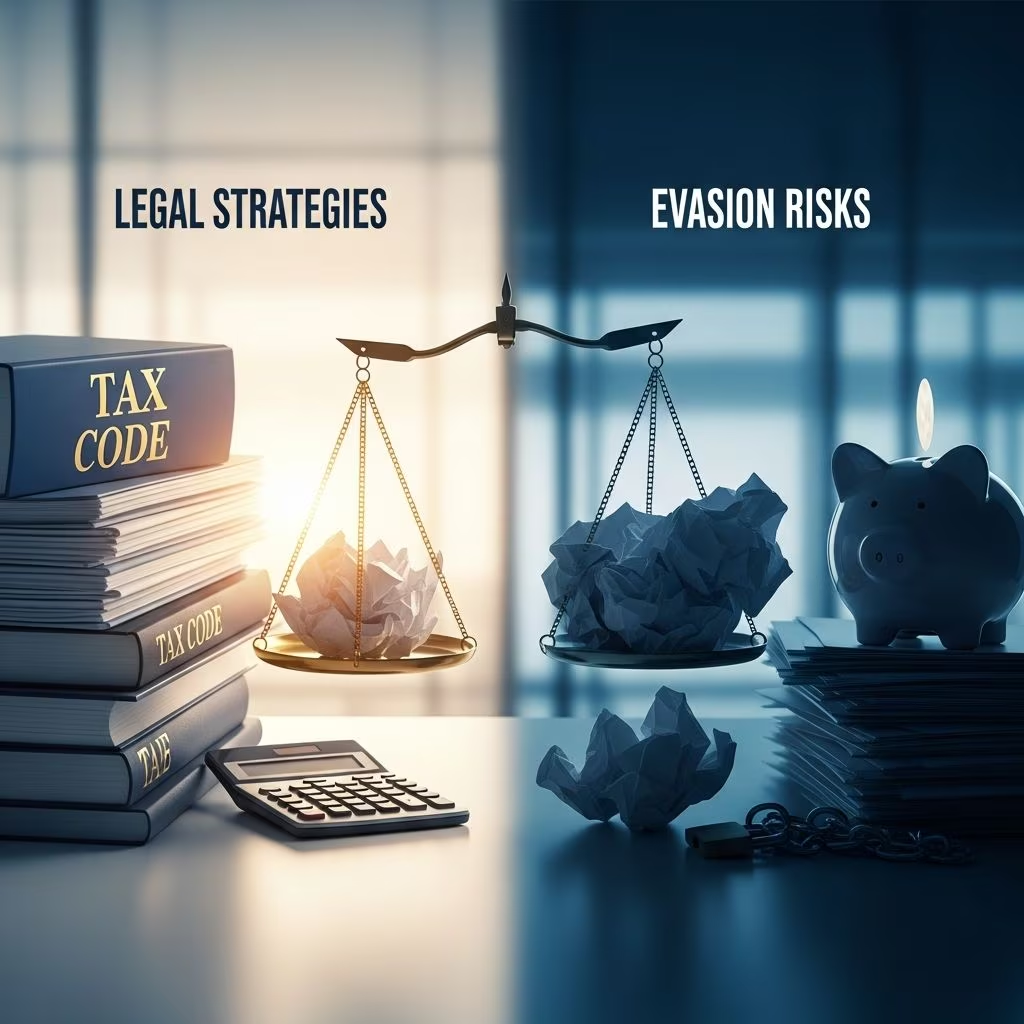
Navigating the complexities of tax obligations requires a clear understanding of what constitutes permissible planning versus prohibited conduct. Tax avoidance involves employing strategies explicitly allowed by the tax code to lower liabilities, whereas tax evasion relies on deception and is a serious federal crime. This article delves into these concepts, drawing from authoritative legal precedents and IRS guidelines to equip taxpayers with knowledge for compliant financial management.
Defining the Core Concepts in Taxation
At its essence, the U.S. tax system encourages efficient use of available provisions. Tax avoidance means structuring affairs to take full advantage of deductions, credits, and exemptions provided under the Internal Revenue Code. In contrast, tax evasion entails willful misrepresentation or omission to dodge taxes owed.
The landmark Supreme Court case Gregory v. Helvering (293 U.S. 465, 1935) established that taxpayers have the right to organize transactions in ways that minimize taxes, as long as they adhere to the law’s letter and spirit. The Court affirmed: taxpayers may “decrease the amount of what otherwise would be his taxes, or altogether avoid them, by means which the law permits.” This principle underscores that motive alone—such as a desire to pay less—does not invalidate a strategy if it meets statutory requirements.
Legal Foundations of Tax Avoidance
Congress designs the tax code with incentives to promote behaviors like investing in renewable energy, education, or retirement savings. Common avoidance techniques include:
- Maximizing deductions for mortgage interest, charitable contributions, and business expenses.
- Contributing to tax-deferred accounts like 401(k)s or IRAs.
- Utilizing tax credits for energy-efficient home improvements or child care.
- Structuring business entities (e.g., LLCs or S-corps) to optimize pass-through taxation.
These methods are not only legal but often promoted through IRS publications and forms. For businesses, restructuring operations to qualify for lower rates or incentives—such as relocating to opportunity zones—falls squarely within avoidance.
However, the IRS scrutinizes arrangements lacking economic substance. Under Internal Revenue Code Section 269, if the primary purpose of acquiring control of a corporation is to secure undue tax benefits, those advantages may be denied.
The Criminal Nature of Tax Evasion
Tax evasion violates Section 7201 of the Internal Revenue Code, classifying it as a felony. Conviction requires proving three elements beyond a reasonable doubt: (1) existence of a tax liability, (2) an affirmative act to evade it, and (3) willful intent.
Affirmative acts include underreporting income, inflating deductions with falsified receipts, or concealing assets offshore. Penalties are steep: fines up to $100,000 for individuals ($500,000 for corporations), imprisonment up to five years, or both, plus prosecution costs.
| Aspect | Tax Avoidance | Tax Evasion |
|---|---|---|
| Legality | Permitted by law | Federal felony |
| Methods | Deductions, credits, legal structures | Deceit, concealment, false reporting |
| Penalties | Possible civil audits/fines | Prison, heavy fines, restitution |
| Intent | Tax minimization via code | Willful evasion of known duty |
This table highlights the stark divide, emphasizing why intent and method determine outcomes.
Real-World Examples: Avoidance Done Right
Consider a small business owner who incorporates as an S-corporation to avoid double taxation on profits passed through to personal returns. This leverages Subchapter S provisions legally.
Another example: A family invests in municipal bonds, exempt from federal income tax, reducing their bracket without evasion. High earners might harvest tax losses by selling depreciated stocks, offsetting gains elsewhere—a standard strategy.
Even complex reorganizations qualify if they serve a legitimate business purpose beyond taxes, as upheld in Gregory v. Helvering. The taxpayer there transferred assets to a new entity before selling, fitting reorganization statutes despite tax savings motive.
Red Flags: When Avoidance Crosses into Evasion
The line blurs with “abusive” schemes. The IRS lists “listed transactions”—tax shelters requiring disclosure. Failure to report participation invites severe penalties, including career-ending consequences for promoters.
Common evasion pitfalls:
- Under-the-table payments to evade payroll taxes.
- Fabricating invoices for bogus deductions.
- Using shell companies to hide income.
- Offshore accounts without proper reporting (e.g., FBAR violations).
Courts examine economic reality over form. If a transaction exists solely for tax benefits without business purpose, it may be recharacterized.
IRS Enforcement and Penalties
The IRS Criminal Investigation Division pursues evasion aggressively, often alongside civil actions. Statutes of limitations vary: six years for false returns, indefinite for willful evasion.
Advisors face liability too; Section 7201 covers aiding evasion, even for others’ taxes. The Ninth Circuit requires proof that tax fraud was the objective.
Civil penalties for aggressive avoidance include accuracy-related fines (20% of underpayment) or negligence penalties, but no jail time.
Strategies for Compliant Tax Minimization
To stay safe:
- Document all transactions with business purpose.
- Consult credentialed tax professionals.
- Disclose listed transactions promptly.
- Use IRS resources like Publication 17 for allowable strategies.
- Keep meticulous records for audits.
Businesses should review operations annually for credits like R&D or Work Opportunity Tax Credits.
International Dimensions and Expatriation
Global activities complicate matters. U.S. citizens owe taxes worldwide, but avoidance includes foreign tax credits. Abusive schemes trigger Alternative Minimum Tax or expatriation taxes if avoidance motivates renunciation (net worth over $622,000 or high income).
Evasion via unreported offshore accounts risks money laundering charges alongside tax felonies.
Evolving IRS Scrutiny on Tax Shelters
The IRS mandates reporting for potentially abusive shelters. Non-disclosure of listed transactions carries the harshest penalties, deterring aggressive planning.
Recent enforcement focuses on high-net-worth individuals and corporations using complex structures without substance.
Frequently Asked Questions
Is tax avoidance ethical?
Yes, as it utilizes congressionally intended incentives. Ethical concerns arise in gray areas lacking substance.
Can tax preparers be prosecuted for client evasion?
Absolutely; aiding evasion is a crime under Section 7201, regardless of who owes the tax.
What proves willful intent in evasion cases?
Prosecutors show knowledge of duty, plus acts like falsifying returns—beyond reasonable doubt.
Are offshore accounts always evasion?
No, if reported properly; but concealment is evasion.
How does the IRS differentiate abusive avoidance?
Via economic substance doctrine and listed transaction rules; principal purpose matters.
Conclusion: Empower Yourself with Knowledge
Mastering tax avoidance empowers legal savings, but evasion destroys lives. Prioritize compliance, leverage experts, and align strategies with code provisions for sustainable results.
References
- Tax Evasion — Legal Information Institute, Cornell Law School. Accessed 2026. https://www.law.cornell.edu/wex/tax_evasion
- The Difference Between Tax Avoidance vs. Tax Evasion — Klasing & Associates. Accessed 2026. https://klasing-associates.com/tax-attorney/criminal-defense/tax-evasion/tax-avoidance-vs-tax-evasion/
- Tax Evasion vs Tax Avoidance: What Businesses Need to Know — Ondato. Accessed 2026. https://ondato.com/blog/tax-evasion-vs-tax-avoidance/
- Tax Avoidance vs. Tax Evasion — Werksman Jackson & Quinn LLP. Accessed 2026. https://werksmanjackson.com/blog/the-difference-between-tax-avoidance-and-tax-evasion/
- Tax Avoidance — Wikipedia (citing IRS sources). Accessed 2026. https://en.wikipedia.org/wiki/Tax_avoidance
- Is tax avoidance legal? How is it different from tax evasion? — Tax Justice Network. Accessed 2026. https://taxjustice.net/faq/is-tax-avoidance-legal-how-different-from-tax-evasion/