
Is Taking Pictures While Driving a Traffic Offense?
Taking photos behind the wheel can trigger distracted-driving laws, even when the driver thinks the moment is harmless.
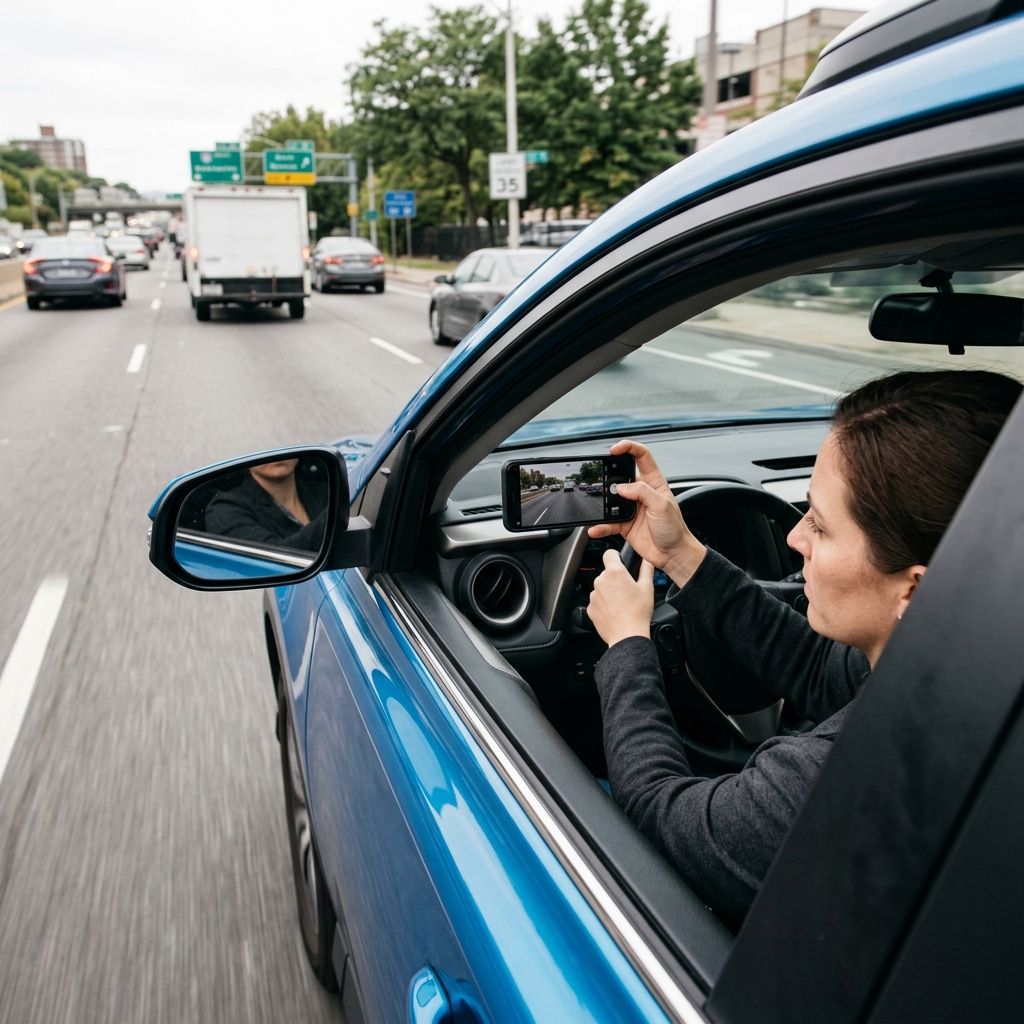
Taking a quick photo from the driver’s seat may feel harmless, but in many places it can lead to a traffic ticket or worse. Depending on the state, the conduct may be treated as distracted driving, handheld device use, or unsafe operation of a motor vehicle.
The legal risk usually turns on two questions: whether the driver was using a handheld electronic device and whether the act interfered with safe control of the vehicle. Even if the car was stopped briefly at a light, the answer is not always simple.
Why a photo can become a legal problem
Traffic laws are built around the idea that a driver must keep attention on the roadway. A camera gesture, selfie, or quick snapshot can pull a driver’s eyes, hands, and mind away from traffic for several seconds. That short break can be enough to create liability if the state’s law prohibits handheld device use or any conduct that distracts from safe driving.
Many traffic statutes are written broadly enough to cover more than texting. They may reach emailing, browsing, social media use, video recording, and taking still images. In practice, a police officer or judge may view a photo-taking incident as part of the larger category of distracted driving rather than as a separate photographic offense.
What laws commonly apply
Most cases fall into one or more of the following legal categories:
- Handheld device violations: laws that ban holding a phone or other electronic device while operating a vehicle.
- Distracted driving rules: provisions that prohibit any action that prevents full attention to driving.
- Unsafe driving citations: broader traffic laws used when a driver’s behavior creates a risk, even if no device-specific statute is violated.
- Local ordinances: city or county rules that may add stricter limits on phone or camera use in a vehicle.
Because the exact wording differs by jurisdiction, the same conduct may be a minor infraction in one state and a more serious moving violation in another. Some states focus on whether the driver was physically holding a device. Others care more about whether the device was used in a way that impaired driving.
Stopped at a red light: does that change the answer?
Drivers often assume that being stopped at a red light creates a safe exception. In some situations, it may reduce the risk of a ticket, but it does not automatically eliminate it. Many enforcement laws apply when a vehicle is in motion, yet officers and prosecutors may still argue that the driver was “operating” the vehicle even while paused in traffic.
A brief stop at a light may also be part of a larger driving sequence. If the driver was handling a phone just before the vehicle moved again, the case may still fit within a distracted-driving rule. In addition, some police departments treat repeated device use at intersections as unsafe even if the car is momentarily stationary.
| Situation | Possible legal issue | Typical risk level |
|---|---|---|
| Taking a photo while the car is moving | Handheld device use, distracted driving, unsafe operation | High |
| Taking a selfie at a stoplight | Possible device or distraction violation | Medium to high |
| Using voice commands without holding the device | Depends on state law and whether hands-free use is allowed | Lower, but not always safe |
| Passenger takes the photo | Usually no driver violation, unless the driver is otherwise distracted | Lower |
Why officers take photo-related conduct seriously
Police officers and traffic safety agencies view photo-taking behind the wheel as dangerous because it combines visual, manual, and cognitive distraction. The driver must look away from the road, grip a device, and shift attention from traffic conditions to the image on the screen. That creates the same type of hazard associated with texting and recording video.
Even if no crash occurs, officers may issue a citation to prevent future harm. Traffic enforcement often aims not only to punish bad driving after an incident, but also to deter conduct that predictably increases the chance of injury.
When the facts matter most
Small details can affect whether a citation stands. The officer may describe the driver holding a phone up near the steering wheel, looking down repeatedly, or using the camera app. The driver may say the phone was mounted, the photo was taken by a passenger, or the vehicle was parked rather than moving.
Courts often examine the total context:
- Was the car moving or fully parked?
- Was the driver holding the device or using a hands-free feature?
- Did the conduct happen for one second or over an extended period?
- Did the officer have a clear view of the driver’s actions?
- Was there an actual safety issue, such as swerving or delayed braking?
Those details can make the difference between a dismissed ticket and a conviction.
Possible defenses to a citation
Defenses depend on the state law and the exact facts, but several arguments appear frequently in traffic court.
- No actual violation: the driver was not holding a device, or the photo was taken before the vehicle entered traffic.
- Vehicle was parked: the car was legally parked, and the driver was not operating it at the time.
- Passenger use: someone else in the car took the picture.
- Insufficient proof: the officer did not clearly observe the conduct, or the evidence does not show that the driver used a prohibited device.
- Necessity or emergency: the action was tied to an urgent situation, such as contacting help after a collision or documenting an emergency scene.
Some defenses are stronger than others. A simple claim that “I was only taking a picture” may not help if the law clearly bans handheld device use. On the other hand, a real factual dispute about whether the driver was moving, whether the device was in hand, or whether the officer had a reliable view can be powerful.
What evidence can help your side
If you receive a ticket, documentation can be important. Useful evidence may include photographs, dashboard camera footage, phone records, witness statements, and location data. These materials can help show whether the vehicle was stopped, whether another person held the device, or whether the timeline offered by the officer is inaccurate.
In some cases, phone metadata may show when the camera app opened or when an image was saved. That information does not automatically prove innocence, but it can support an argument that the driver did not violate the law in the way alleged.
How prosecutors usually view the case
Traffic prosecutors generally look for proof that the driver handled a prohibited device or engaged in conduct that directly caused distraction. If the statute is clear and the officer’s observation is credible, the state may press the case even when the distraction lasted only a moment.
If the statute is vague, a defense lawyer may challenge whether a camera action fits the wording of the law. For example, a statute aimed specifically at texting may not automatically cover every use of a camera app, while a broader statute targeting handheld electronic use may do so with little difficulty.
Why the location of the incident matters
State law is only part of the story. Local traffic rules, court procedures, and enforcement habits can vary widely. A driver cited in one city may face a different legal process from a driver cited elsewhere in the same state. School zones, construction areas, and intersections with heavy enforcement can bring more scrutiny and fewer chances for informal warnings.
That means the same behavior may lead to different outcomes depending on where it happened. A case that is easy to resolve in one courthouse may be contested aggressively in another.
Practical ways to reduce risk
The safest approach is to avoid taking photos from the driver’s seat entirely. If a picture must be taken, the best option is to pull over legally and park the vehicle before using the phone or camera. Voice-activated tools and passenger assistance can also reduce the chance of violating a hands-free law.
- Set navigation and camera features before starting the trip.
- Use a passenger to capture photos whenever possible.
- Pull over safely before handling the phone.
- Know whether your state bans handheld device use at all times or only while moving.
- Keep proof of parking if you need to show that the car was not in motion.
These steps do not guarantee that a citation will never happen, but they can significantly reduce the risk.
Frequently asked questions
Is taking a photo while driving always illegal?
No. The answer depends on state law, local rules, and the facts of the incident. In many places, however, holding a phone to take a picture while driving can violate distracted-driving or handheld-device laws.
Can I be ticketed if I was stopped at a red light?
Yes, in some situations. A stoplight may reduce the risk, but it does not automatically create a safe harbor. If the law covers operating a vehicle or using a handheld device, an officer may still issue a citation.
Does a passenger taking the picture create a problem for the driver?
Usually not by itself. But if the driver is otherwise distracted, reaches for the device, or loses control of the vehicle, the driver may still face liability under general unsafe-driving rules.
What if I was taking a picture of a crash, police scene, or emergency?
That situation may raise separate issues. In some cases, a necessity or emergency argument may help if the driver acted to avoid harm or respond to an urgent event. The strength of that defense depends on the exact facts and local law.
Can a citation be challenged in court?
Yes. A driver may challenge the officer’s observations, argue that the law does not cover the conduct, or show that the vehicle was parked or that another person used the device. The available defense will depend on the evidence.
Why these cases matter beyond the ticket
A citation for taking pictures while driving is not always a minor annoyance. Depending on the jurisdiction, it may carry fines, court costs, license points, or insurance consequences. Repeated violations can affect a driver’s record and lead to higher premiums or additional penalties.
Beyond the legal consequences, the issue also matters because the behavior is genuinely risky. A driver who spends even a few seconds focusing on a camera instead of traffic can miss a changing light, a pedestrian stepping into the crosswalk, or a sudden stop from the car ahead. That is why enforcement agencies treat camera use behind the wheel as more than a harmless habit.
References
- Distraction.gov: Distracted Driving — U.S. Department of Transportation. 2024-01-01. https://www.transportation.gov/distraction
- Distracted Driving — National Highway Traffic Safety Administration. 2025-03-01. https://www.nhtsa.gov/risky-driving/distracted-driving
- Cellphone and Texting Laws — Governors Highway Safety Association. 2025-02-01. https://www.ghsa.org/state-laws/issues/cellphone-and-texting-laws
- Driver Distraction — Centers for Disease Control and Prevention. 2024-05-15. https://www.cdc.gov/transportationsafety/distracted_driving/index.html
- Driving Laws and Cell Phones — Insurance Institute for Highway Safety. 2025-04-01. https://www.iihs.org/topics/distraction/cellphones
Similar Articles








Read full bio of medha deb


