
Systemic Police Violence and the Right to Protest
Examining the overlooked realities of law enforcement overreach at protests.
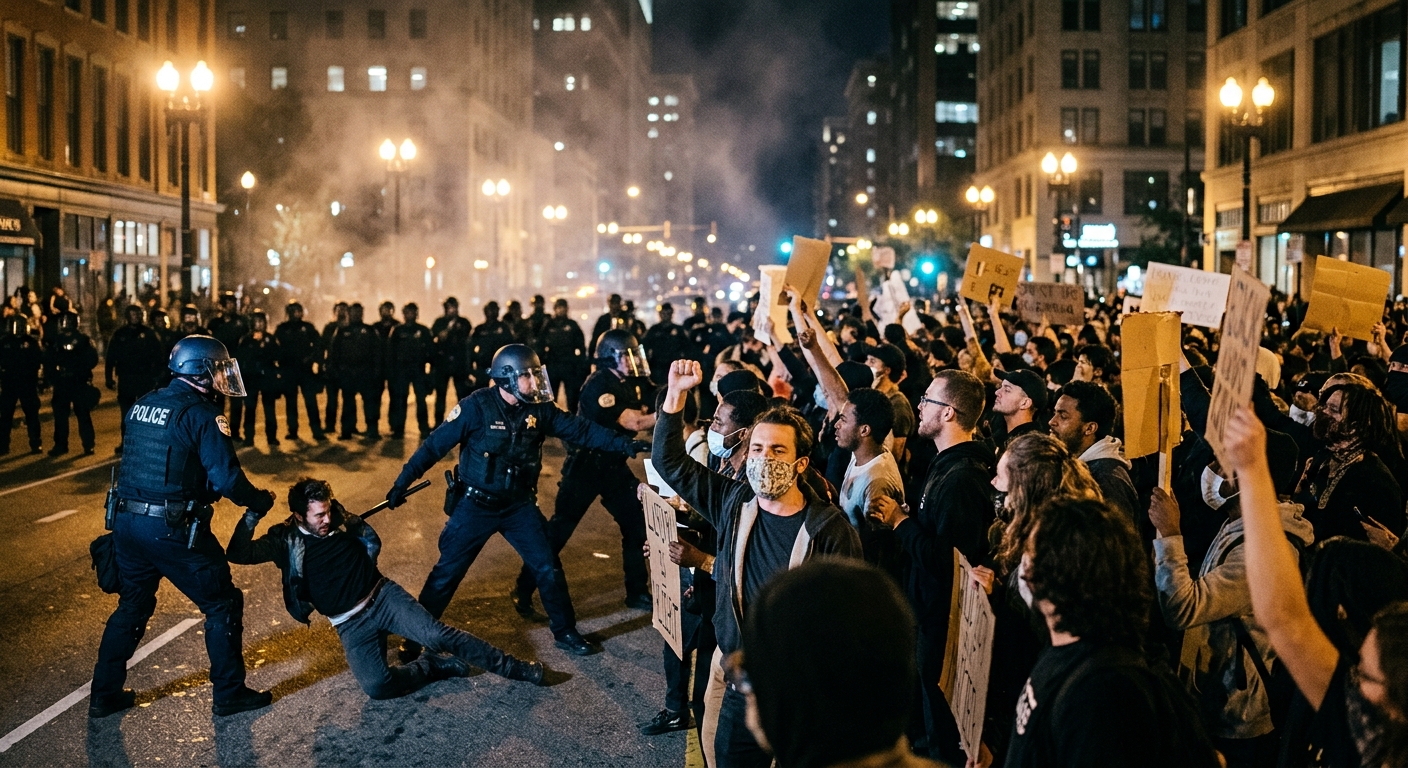
In contemporary political discourse, the phrase “law and order” is frequently weaponized by elected officials to emphasize crackdowns on civilian crime, particularly in densely populated urban centers. However, an often-ignored corollary to this narrative is the systemic and disproportionate violence utilized by domestic law enforcement agencies against the public they are sworn to protect. When political figures selectively highlight civilian unrest while turning a blind eye to excessive force deployed by police and federal agents, it distorts the foundational principles of justice. This deliberate omission allows state-sanctioned violence to flourish unchecked, fostering a culture where constitutional rights are treated as secondary to the demonstration of state power.
The narrative surrounding crime often focuses exclusively on the actions of individual civilians, completely bypassing the institutional violence perpetrated by the state. This paradigm creates a dangerous environment where marginalized communities, civil rights advocates, and ordinary citizens are penalized for exercising their democratic rights. By examining the realities of police militarization, federal intervention in local demonstrations, and the deliberate targeting of the press and legal observers, a clearer picture emerges of the law enforcement violence that many leaders refuse to discuss.
The Constitutional Right to Assembly vs. Ground Reality
The bedrock of democratic societies lies in the ability of citizens to vocalize grievances without fear of violent state retaliation. The First Amendment of the United States Constitution explicitly guarantees the right of the people to peacefully assemble and petition the government for a redress of grievances. Despite these constitutional assurances, modern protest movements—especially those advocating for civil rights and racial justice—are frequently met with aggressive countermeasures that starkly contradict the spirit of free expression. While the courts have historically protected symbolic speech and peaceful gatherings, the reality on the streets often involves law enforcement acting as an occupying force rather than a public safety entity.
Law enforcement agencies are legally permitted to maintain order and ensure public safety during large gatherings. However, there is a distinct and troubling line between crowd control and the suppression of constitutionally protected speech. Time and again, peaceful demonstrators have been subjected to flash-bang grenades, tear gas, and kinetic impact projectiles (such as rubber bullets) before any genuine threat to public safety has materialized. This aggressive posture not only inflicts severe physical trauma on participants but also creates a chilling effect designed to deter future participation in democratic processes. The preemptive use of force transforms civic engagement into a physical risk.
The Militarization of Domestic Law Enforcement
The aesthetic and operational shift of local police departments from community guardians to paramilitary forces has profoundly altered domestic law enforcement. Fueled by federal initiatives such as the Department of Defense’s 1033 Program, which authorizes the transfer of surplus military equipment to state and local police forces, communities across the nation have witnessed a dramatic escalation in police armaments. The deployment of mine-resistant ambush-protected (MRAP) vehicles, military-grade body armor, and assault rifles in response to civilian protests highlights a fundamental shift in police psychology: viewing the public as combatants rather than citizens to be served.
This militarization goes beyond mere equipment; it deeply influences police training and operational tactics. Academic studies indicate that militarized police units are more likely to employ aggressive tactics, exacerbating tensions and often escalating peaceful assemblies into violent confrontations. When officers arrive at a demonstration outfitted for a war zone, the inherent presumption is one of hostility, virtually guaranteeing a disproportionate and violent response to civil disobedience.
| Resource Category | Civilian / Protestor Equipment | Law Enforcement Equipment |
|---|---|---|
| Protection | Helmets, makeshift shields, respirators | Military-grade Kevlar, riot shields, gas masks |
| Communication | Megaphones, smartphones, social media | Encrypted radios, surveillance drones, stingrays |
| Crowd Control | Chants, human chains | Tear gas, flash-bang grenades, sound cannons (LRAD) |
| Transport | Public transit, personal vehicles | Armored personnel carriers, MRAPs, unmarked vans |
Federal Intervention and Homeland Security Overreach
The deployment of federal agents to quell local demonstrations represents a significant escalation in state-sanctioned violence and raises severe constitutional concerns. During the widespread civil rights demonstrations of recent years, the Department of Homeland Security (DHS) controversially dispatched federal officers to cities such as Portland, Oregon. This intervention occurred largely against the wishes of local and state officials, blurring the lines of jurisdiction and accountability. Federal agents were observed utilizing unmarked vehicles to detain individuals far from federal property, a tactic that spread panic and mirrored authoritarian suppression techniques.
Subsequent congressional investigations and public reports revealed that these federal operatives engaged in severe surveillance overreach. DHS officials compiled dossiers on protestors that included personal travel histories and social media associations—data completely unrelated to securing federal property or genuine homeland security threats. This intelligence-gathering operation against U.S. citizens exercising their First Amendment rights underscores the dangers of unchecked federal power. The consequences of such interventions include:
- The erosion of trust between local communities and all tiers of government.
- The normalization of utilizing federal counter-terrorism apparatuses against domestic political movements.
- The physical endangerment of unarmed civilians due to the aggressive deployment of crowd-control munitions by federal officers unfamiliar with local policing guidelines.
The Targeting of Observers: Journalists and Medics in the Crosshairs
The impact of law enforcement violence extends beyond the immediate participants of a demonstration; it severely impacts the foundational freedom of the press and the safety of medical volunteers. Data collected by the U.S. Press Freedom Tracker highlights an alarming surge in the arrests, detainments, and physical assaults of journalists covering protests. Despite carrying clear press credentials and remaining separated from active clashes, reporters and photojournalists have been subjected to physical beatings, chemical irritants, and targeted arrests by officers attempting to control the narrative.
Similarly, volunteer street medics—individuals who attend protests specifically to provide first aid—have faced repeated assaults. Law enforcement officers have been documented destroying medical supply stations, confiscating water and eyewash solutions, and physically detaining those attempting to treat injured civilians. The intentional targeting of these neutral observers is a grave violation of civil liberties. It removes independent witnesses from the scene, making it significantly harder to document police misconduct and hold perpetrators accountable in court. When the state attacks the press and caregivers, it signals a desire for complete impunity.
The Political Rhetoric Excusing State Violence
The narrative surrounding law enforcement violence is often meticulously curated by politicians to fit a rigid agenda. By continuously framing protestors as anarchists, rioters, or existential threats to national security, political leaders provide tacit approval for aggressive policing tactics. This rhetoric is strategically designed to shift the focus away from systemic police brutality and onto the alleged criminality of those demanding justice. When leaders refuse to condemn the excessive use of force by the state, they effectively weaponize law enforcement agencies against political dissent.
This top-down messaging has a profound impact on the ground. When officers hear executive leaders praising aggressive tactics and promising pardons or legal immunity for violent actions, it emboldens bad actors within police departments. It creates a feedback loop where state violence is not only tolerated but politically rewarded. Breaking this cycle requires a fundamental shift in how society discusses public safety, moving away from militarized enforcement and towards genuine community investment and harm reduction.
Reimagining Public Safety and Accountability
Addressing the unspoken crisis of law enforcement violence requires comprehensive, systemic reform rather than superficial policy adjustments. True accountability begins with the dismantling of legal shields such as qualified immunity, which has historically protected officers from civil liability even when they violate clearly established constitutional rights. Furthermore, there must be a concerted effort to demilitarize local police departments by ending the transfer of military-grade hardware and strictly regulating the use of crowd-control munitions.
Ultimately, a just society cannot exist when the state retains the unchecked authority to brutalize its citizens. Achieving genuine public safety means recognizing that the right to protest is non-negotiable. It necessitates independent oversight bodies with the power to subpoena and prosecute offending officers, and a cultural shift within law enforcement away from a warrior mentality toward a guardian ethos. Until these changes are implemented, the violence inflicted by those sworn to protect will remain a glaring failure of the democratic experiment.
Frequently Asked Questions (FAQs)
What does the First Amendment protect during a protest?
The First Amendment protects the right to peacefully assemble, speak freely, and petition the government for a redress of grievances. This includes the right to march in public spaces, distribute literature, and verbally express dissent. However, it does not protect acts of physical violence, property destruction, or the blocking of emergency services. While the government can impose reasonable time, place, and manner restrictions, these rules cannot be used to suppress the content of the speech or outright ban peaceful protests.
What is police militarization and why is it controversial?
Police militarization refers to the process by which civilian law enforcement agencies adopt the equipment, tactics, and mindset of the military. This includes the use of armored vehicles, assault weapons, and paramilitary training. It is highly controversial because it alters the dynamic between police and the community, shifting it from a protective relationship to an adversarial one. Studies have shown that militarized departments are more likely to use violent tactics, which disproportionately harm minority communities and escalate tensions during peaceful protests.
Can federal agents legally intervene in local protests?
Under standard circumstances, the policing of local protests falls under the jurisdiction of city and state law enforcement. Federal agents, such as those from the Department of Homeland Security, can intervene primarily to protect federal property or if there is a specific, coordinated federal law enforcement operation. However, controversial deployments have seen federal agents overstepping these bounds by operating far from federal buildings, conducting unauthorized surveillance, and detaining civilians without local coordination, raising significant Tenth Amendment and First Amendment constitutional issues.
How does targeting journalists during protests impact democracy?
A free and independent press is essential for government transparency and accountability. When law enforcement officers arrest, assault, or intimidate journalists covering protests, they effectively blind the public to the realities on the ground. This behavior prevents the documentation of civil rights abuses and allows police narratives to go unchallenged. By suppressing media coverage, the state undermines democratic oversight and violates the foundational principles of a free society.
References
- Incident Database — U.S. Press Freedom Tracker / Freedom of the Press Foundation. 2026-05-28. https://pressfreedomtracker.us/
- Police Militarization — Federal Bureau of Investigation (FBI Law Enforcement Bulletin). 2017-08-14. https://leb.fbi.gov/articles/featured-articles/police-militarization
- The Rise of Police Militarization and Impact on Civilians — San Jose State University ScholarWorks. 2021-01-01. https://scholarworks.sjsu.edu/themis/vol9/iss1/1/
- Wyden Releases New Details About Surveillance and Interrogation of Portland Demonstrators by Department of Homeland Security Agents — United States Senate. 2022-10-27. https://www.wyden.senate.gov/news/press-releases/wyden-releases-new-details-about-surveillance-and-interrogation-of-portland-demonstrators-by-department-of-homeland-security-agents
- What Does Free Speech Mean? — Administrative Office of the U.S. Courts. 2023-01-01. https://www.uscourts.gov/about-federal-courts/educational-resources/about-educational-outreach/activity-resources/what-does
- Frequently Asked Questions – Free Speech — Iowa State University Dean of Students Office. 2023-05-15. https://www.studentconduct.dso.iastate.edu/student-rights-and-responsibilities/free-speech/frequently-asked-questions
Similar Articles








Read full bio of Sneha Tete




