
Syndrome and Mental Defect Defenses in California Criminal Law
How California courts treat battered person syndrome, insanity, and mental impairment as affirmative defenses in criminal cases.
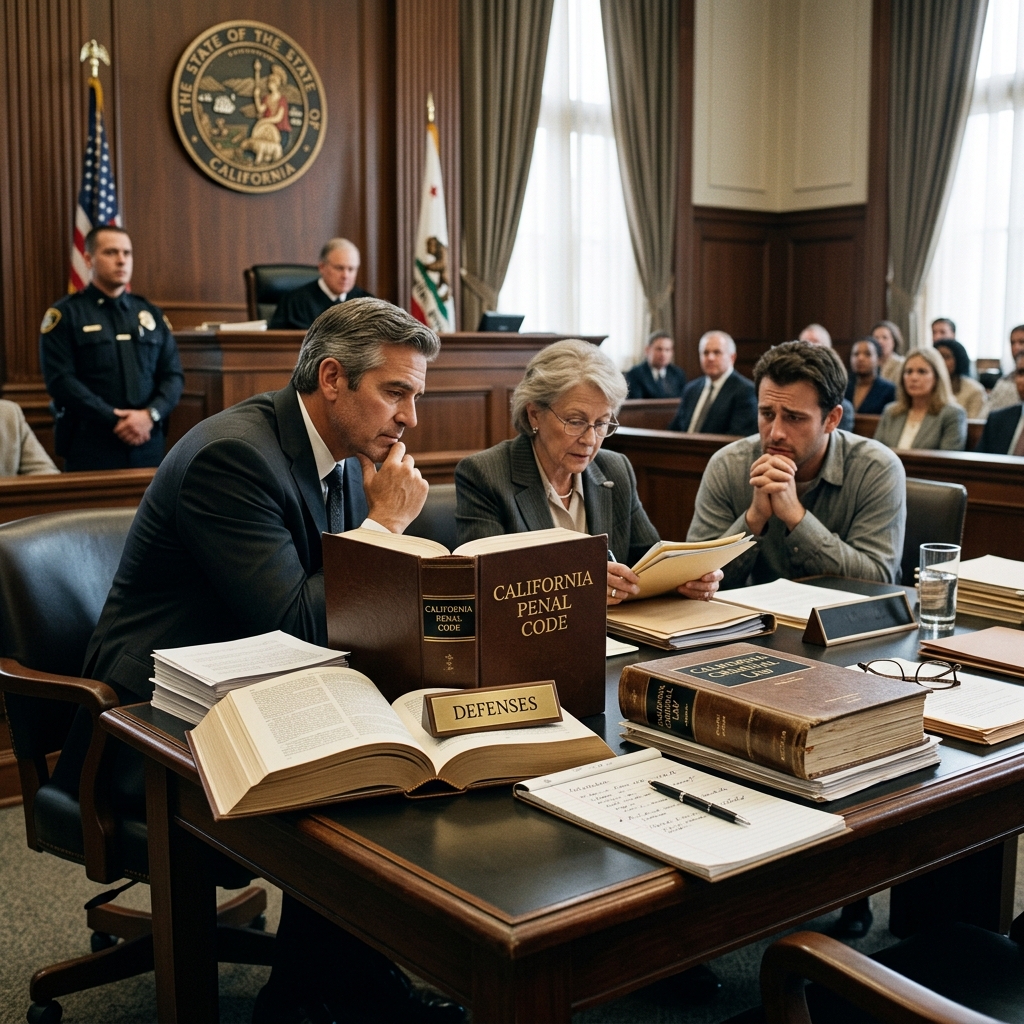
California criminal courts regularly confront cases where a defendant’s mental condition is central to questions of guilt and responsibility. The law recognizes several ways that mental health and psychological syndromes can shape criminal liability, including syndrome-based defenses, the insanity (mental defect) defense, and limited use of mental impairment evidence to challenge specific intent.
This article explains how these defenses work in California, the legal standards courts apply, and what defendants and families should understand before raising a mental health–related defense.
Affirmative Defenses and Mental State: The Big Picture
In criminal law, a defense that relies on mental condition is usually framed as an affirmative defense rather than a simple denial of the facts.
- Traditional defense: Argues the prosecution has not proven one or more elements of the crime beyond a reasonable doubt.
- Affirmative defense: Accepts that the underlying acts may have occurred but offers a legally recognized reason why the defendant should not be held criminally responsible (for example, legal insanity or a qualifying syndrome).
When an affirmative defense is raised, the burden of proof on that defense typically shifts to the defendant, who must prove the defense by a standard such as preponderance of the evidence (more likely than not).
Key Mental-Condition Concepts in California Criminal Cases
| Concept | Main Question | When It Applies |
|---|---|---|
| Insanity / Mental Defect | Was the defendant legally insane at the time of the offense? | At the time of the crime; affects guilt and responsibility. |
| Syndrome Defense | Did a recognized psychological syndrome shape how the defendant perceived danger or necessity? | At the time of the crime; often used with self-defense or duress theories. |
| Mental Impairment | Did a mental disease or defect prevent the defendant from forming specific intent? | At the time of the crime; affects elements of certain offenses. |
| Competency | Is the defendant currently able to understand the proceedings and assist counsel? | During trial; affects whether the case can go forward. |
Syndrome-Based Defenses: Battered Person and Similar Syndromes
The term syndrome defense covers a set of arguments where a defendant relies on expert testimony about a psychological syndrome to explain why they acted as they did. One of the most discussed examples is battered women’s syndrome (BWS), now more commonly described as battered person’s syndrome to recognize that intimate partner violence affects people of any gender.
What Is a Syndrome in the Legal Context?
Medically, a syndrome refers to a cluster of symptoms that tend to occur together. In criminal law, syndromes are relevant when prolonged trauma alters a person’s perception of danger, choices, or ability to escape. For battered person’s syndrome, repeated abuse can create:
- Heightened sensitivity to cues of imminent violence
- Learned helplessness and belief that escape is impossible
- Distorted expectations about how abusers behave
- Chronic fear and hypervigilance
Courts may allow expert testimony explaining these effects so jurors can better understand why someone might use force, sometimes lethal, in circumstances that may not look immediately life-threatening to an outsider.
How Syndrome Evidence Is Used
Syndrome evidence does not typically create a standalone “get-out-of-jail” defense. Instead, it is usually woven into traditional doctrines like:
- Self-defense or defense of others: To show that the defendant reasonably perceived an imminent threat, even if that threat was not obvious to a neutral observer.
- Duress or coercion: To explain why the defendant felt unable to refuse the abuser’s demands.
- State-of-mind evidence: To illuminate how long-term trauma shaped the defendant’s beliefs and reactions.
In battered person cases, an expert may explain how recurring violence and control make a victim reasonably afraid of future attacks, which can be crucial to evaluating whether the defendant’s belief in imminent danger was reasonable.
Limitations of Syndrome Defenses
Courts are cautious about syndrome evidence for several reasons:
- Syndromes are often clinical descriptions, not precise legal categories.
- Expert testimony must satisfy evidentiary rules, including relevance and scientific reliability.
- Judges must guard against transforming broad social science concepts into automatic excuses for criminal conduct.
As a result, syndrome evidence is usually allowed to inform the jury’s understanding of self-defense or other doctrines rather than to replace them.
The Insanity (Mental Defect) Defense in California
The insanity defensemental defect defense—is a central, but narrowly applied, doctrine in California. It is grounded in the principle that criminal punishment is appropriate only when a person is capable of understanding and controlling their behavior within the bounds of law and morality.
Legal vs. Clinical Insanity
Legal insanity is a specific standard defined by statute and case law. It is not equivalent to any particular psychiatric diagnosis. A person can be severely mentally ill yet still legally sane, or have a diagnosis that does not meet the legal test for insanity.
California follows the M’Naghten rule, a long-standing common-law test focusing on what the defendant understood at the time of the offense.
The M’Naghten Test in California
Under the M’Naghten standard, a defendant is legally insane if, at the time of the offense:
- They had a mental disease or defect; and
- As a result, they either:
- Did not understand the nature and quality of the act; or
- Did not know that the act was morally or legally wrong.
The focus is on the defendant’s cognitive understanding—whether they grasped what they were doing and its wrongfulness—rather than on impulse control alone.
Burdens of Proof for Insanity
In California, insanity is an affirmative defense. The defendant bears the burden of proving legal insanity at the time of the crime by a preponderance of the evidence, meaning it is more likely than not that they met the M’Naghten standard.
Evidence in insanity cases may include:
- Psychiatric and psychological evaluations
- History of hospitalizations and treatment
- Records showing delusions, hallucinations, or severe cognitive distortion
- Testimony from mental health professionals and lay witnesses who observed the defendant’s behavior
Outcomes of a Successful Insanity Defense
A defendant found not guilty by reason of insanity (NGRI) is typically:
- Not subject to ordinary criminal punishment for the offense; and
- Committed to a secure mental health facility until they are no longer considered a threat and can be safely released, often based on separate legal standards.
Thus, insanity is not a free pass; it substitutes treatment and confinement for traditional incarceration.
Mental Impairment and Specific Intent in California
California once allowed a broad diminished capacity defense, which permitted defendants to argue that mental illness rendered them incapable of forming the mental state required for certain crimes. That doctrine was abolished and replaced with a narrower concept sometimes known as diminished actuality.
From Diminished Capacity to Diminished Actuality
Under current law, evidence of mental disease, defect, or disorder generally cannot be used to prove that a defendant lacked the capacity to form criminal intent. Instead, such evidence is admissible only to show whether the defendant actually formed a required specific intent or mental state when the law makes that intent an element of the offense.
This distinction is important:
- The law rejects arguments about abstract inability (capacity).
- The law permits evidence addressing what the defendant truly intended or understood in the moment (actuality).
CALCRIM No. 3428: Mental Impairment Instruction
California’s standard jury instruction on mental impairment, CALCRIM No. 3428, explains that jurors may consider evidence of mental disease, defect, or disorder only for the limited purpose of deciding whether the defendant had the specific intent or mental state required for the charged crime.
Key features of this instruction include:
- The evidence may support that the defendant did not have the particular intent the statute requires (for example, premeditation or malice aforethought).
- It may not be used to negate general criminal responsibility or to excuse conduct for crimes that do not require specific intent.
- For general-intent offenses, mental impairment is generally irrelevant unless there is a discrete element, such as knowledge, that entails a specific mental state.
Practical Impact on Charges and Sentencing
Because mental impairment evidence can be used to question whether specific intent existed, it may influence:
- Whether a defendant is convicted of a higher or lower degree of an offense
- Whether certain enhancements, such as premeditation, are proven
- Plea negotiations, as prosecutors assess the strength of intent evidence
However, it rarely results in outright acquittals. Instead, it tends to shape the level and type of conviction rather than the basic question of guilt.
Competency to Stand Trial: A Different Question
Competency to stand trial is distinct from insanity and syndrome defenses. Insanity looks backward to the defendant’s mental state at the time of the offense. Competency looks at their condition now, during the court process.
Under California law, a person is incompetent to stand trial if, due to mental health or developmental disability, they are unable to understand the nature of the criminal proceedings or to assist counsel in their defense in a rational manner. Competency is therefore about the defendant’s ability to:
- Comprehend the roles of judge, prosecutor, defense counsel, and jury
- Understand the charges and possible outcomes
- Communicate effectively with their attorney
If substantial evidence raises a reasonable doubt about competency, the court must suspend proceedings and hold a competency hearing. Criminal cases cannot lawfully continue against someone who is incompetent.
Working With Mental-Health Defenses in Practice
Defendants and families dealing with mental health issues often feel overwhelmed by the complexity of criminal law. While every case is unique, several practical themes recur when considering syndrome or mental defect defenses in California.
Common Steps Defense Counsel May Take
- Early mental health evaluation: Counsel may seek assessments from psychiatrists or psychologists to document diagnoses, history, and current functioning.
- Gathering treatment records: Hospitalizations, medications, and therapy records can help establish a long-standing mental condition.
- Identifying relevant legal theories: Counsel will determine whether the facts support insanity, syndrome-informed self-defense, mental impairment affecting specific intent, or a combination.
- Coordinating expert testimony: Experienced experts are central to explaining psychiatric concepts to judges and jurors.
Risks and Challenges
- Invasive scrutiny: Raising mental health defenses invites examination of the defendant’s history, which can feel deeply intrusive.
- Potential confinement in treatment facilities: A successful insanity plea may lead to commitment in a state hospital rather than prison, but often for an extended period.
- Public misunderstanding: Juries may harbor misconceptions about mental illness and crime, requiring careful education through expert testimony.
Frequently Asked Questions (FAQs)
Is battered person’s syndrome a separate legal defense in California?
No. Battered person’s syndrome is a form of evidence typically used to support self-defense or related arguments. Expert testimony helps jurors understand why a defendant reasonably perceived serious danger in a long-term abusive relationship, but the basic legal framework remains self-defense or duress.
Can anyone with a mental illness claim insanity?
No. Many people with mental illness are legally sane. To succeed with an insanity defense in California, a defendant must show that a mental disease or defect made them unable to understand the nature of their act or to know that it was wrong under the M’Naghten rule.
What is the difference between insanity and mental impairment in jury instructions?
Insanity is a full affirmative defense that can result in a verdict of not guilty by reason of insanity, focusing on overall criminal responsibility. Mental impairment instruction (such as CALCRIM No. 3428) allows jurors to consider mental disease or defect solely in deciding whether the defendant actually formed a specific intent or mental state required for the crime.
Can mental health issues reduce charges instead of eliminating guilt?
Yes. While insanity might excuse criminal responsibility entirely if proven, mental impairment evidence can lead jurors to conclude that a defendant did not possess the specific intent needed for more serious forms of an offense, potentially resulting in conviction for a lesser crime.
What happens if a defendant is found incompetent to stand trial?
If a defendant is found incompetent, the criminal case is paused. The court typically orders treatment aimed at restoring competency, such as psychiatric care or placement in an appropriate facility. Proceedings resume only if and when competency is restored.
References
- What Are Syndrome and Mental Defect Defenses in Criminal Cases? — Super Lawyers / Thomson Reuters. 2023-07-11. https://www.superlawyers.com/resources/criminal-defense/california/what-are-syndrome-and-mental-defect-defenses-in-criminal-cases/
- Mental Health and Criminal Defense — Roth Legal, California Penal Code §1026 overview. 2023-03-01. https://www.roth-legal.com/blog/mental-health-and-criminal-defense/
- Insanity — Nate Crowley Law Office, PC (San Diego Criminal Lawyer). 2022-06-15. https://www.natecrowleylaw.com/practice-areas/federal-criminal-defense/possible-federal-defenses/introduction-trial-defenses/insanity/
- The Unintended Impact of the Diminished Actuality Defense in California — Presley Center for Crime and Justice Studies, University of California Riverside. 2019-03-01. https://presleycenter.ucr.edu/media/1581/download
- CALCRIM No. 3428. Mental Impairment: Defense to Specific Intent or Mental State — Judicial Council of California Criminal Jury Instructions. 2026-01-01. https://www.justia.com/criminal/docs/calcrim/3400/3428/
- A Half-Measure Solution to a Long-Standing Crisis — Disability Rights California. 2020-10-01. https://www.disabilityrightsca.org/drc-advocacy/investigations/a-half-measure-solution-to-a-long-standing-crisis
- Mental Health Issues in Criminal Cases — San Diego Appellate Defender, Inc. 2018-07-01. https://www.sdap.org/wp-content/uploads/downloads/research/criminal/psycheval.pdf
Similar Articles








Read full bio of medha deb




