
The Supreme Court’s Power Over America’s Mass Incarceration
How the highest court in the land shapes the realities of the carceral state.
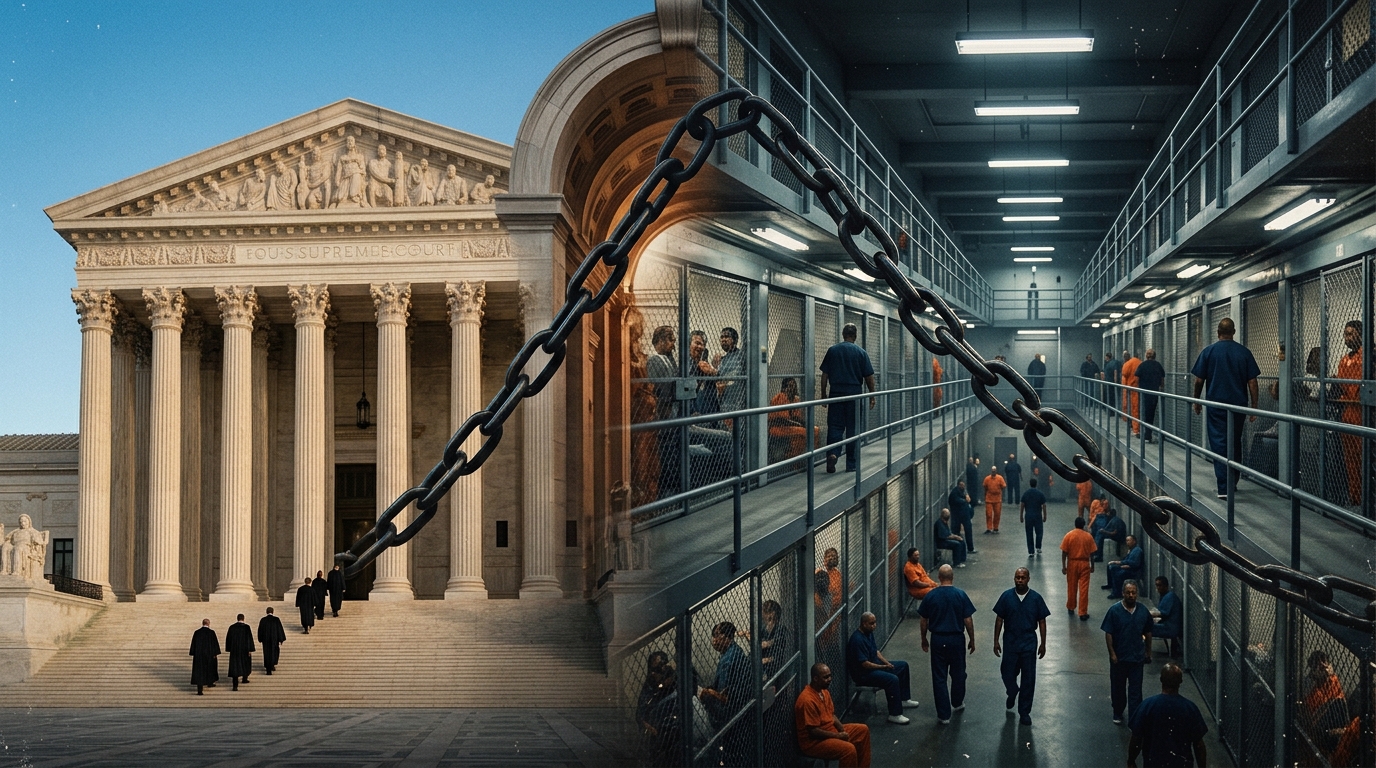
The United States has long held the dubious distinction of leading the world in incarceration rates. With a sprawling network of local jails, state prisons, and federal penitentiaries, the American criminal legal system affects millions of individuals, devastating families and heavily impacting marginalized communities. While public discourse often focuses on lawmakers, city mayors, and local prosecutors as the primary architects of this crisis, the Supreme Court of the United States wields an unparalleled influence over the carceral state. In any given term, the justices hand down decisions that either reinforce the foundations of mass incarceration or begin to dismantle its most egregious components. Understanding what the highest court in the land can—and cannot—do about criminal justice reform requires a deep dive into its constitutional authority, its historical precedents, and its approach to fundamental rights.
The Judicial Branch and the Scope of Mass Incarceration
The scope of mass incarceration is not simply a matter of criminal statutes written by Congress; it is heavily defined by how those statutes are applied in the real world. A single Supreme Court ruling can drastically alter police practices on the streets or dictate the length of a prison sentence handed down in a courtroom. As the Court navigates its ongoing dockets, advocates for criminal law reform constantly look for signals indicating whether the justices will expand civil liberties or defer to the authority of law enforcement and correctional institutions. At its core, the Supreme Court is the ultimate arbiter of the U.S. Constitution. The text of the Constitution provides the baseline rulebook for how the government can investigate, charge, try, and punish its citizens, making the Court’s interpretation highly consequential for every individual entangled in the justice system.
Policing and the Front End of the System
The journey into the criminal legal system almost always begins with a police encounter. When the Supreme Court issues rulings that give law enforcement broad discretion to conduct stops, searches, and arrests, it directly exacerbates incarceration rates. For instance, legal doctrines that allow for pretextual traffic stops or lower the threshold for reasonable suspicion directly contribute to the number of individuals entering the system. The Court’s historical stance on civil liberties dictates how easily law enforcement can surveil and arrest the general public, effectively widening the net of the justice system.
To understand the Court’s impact on policing, one must look at how it shapes daily law enforcement operations:
- Investigatory Stops: By defining the parameters of what constitutes reasonable suspicion, the Court dictates the frequency of stop-and-frisk practices, which disproportionately affect minority communities.
- Vehicle Searches: Judicial precedents allowing officers to search vehicles without a warrant under various exceptions vastly increase drug-related arrests and subsequent incarcerations.
- Digital Privacy: The Court’s rulings on whether police can search cell phones or track location data without a warrant determine how modern technology feeds the carceral state.
Qualified Immunity and Police Accountability
Furthermore, the judicially created doctrine of qualified immunity serves as a powerful shield for police officers accused of constitutional violations. Originally intended to protect government officials from frivolous litigation, it has evolved into a nearly impenetrable defense. By requiring plaintiffs to prove that an officer violated a clearly established constitutional right—a notoriously high and rigid bar—the Court has severely limited police accountability. If officers face little to no civil liability for excessive force or unlawful arrests, the incentive to change their behavior diminishes. Reforming or abolishing qualified immunity is widely considered one of the most powerful actions the Supreme Court could take to deter misconduct and reduce unnecessary arrests.
The Fourth Amendment’s Vital Role
The Fourth Amendment, which protects against unreasonable searches and seizures, establishes the threshold for when a citizen’s liberty can be legally interrupted. Rulings that lower the bar for police intervention directly sweep more individuals into local jails, setting the stage for formal criminal charges. If the Court chose to take a more stringent approach to Fourth Amendment protections in its current and future terms, it could significantly reduce the influx of non-violent offenders and marginalized individuals who are disproportionately targeted by aggressive, proactive policing tactics.
The Court’s Power Over Sentencing and Punishment
Once an individual is swept into the system, the focus shifts to prosecution, conviction, and sentencing. Over the decades, the Supreme Court has maintained a complex relationship with the nation’s sentencing laws, sometimes striking down draconian penalties and at other times upholding mandatory minimums that fuel mass incarceration. Rulings that prohibit mandatory life without parole for juveniles highlight how the Court can actively reduce extreme sentences for vulnerable populations. By extending this judicial logic to other demographics or non-violent offenses, the Court could substantially lower the long-term prison population.
The Eighth Amendment: Cruel and Unusual Punishment
The Eighth Amendment’s prohibition of cruel and unusual punishment serves as the primary constitutional check on government excess during sentencing. The Court uses this amendment to evaluate whether a punishment is proportionate to the crime committed. Historically, the justices have had to weigh whether sentences are excessively punitive compared to evolving standards of decency. When the Court adopts a broad interpretation of the Eighth Amendment, it provides a crucial safety valve against systemic over-punishment, limiting the state’s ability to lock people away for decades for minor infractions.
Addressing Racial Disparities and Mandatory Minimums
However, the Court is often constrained by the rigid structures of federal and state sentencing guidelines. While trial judges typically have discretion, mandatory minimum sentences enacted by lawmakers force their hands. The Court can evaluate whether these laws violate the Constitution, but it cannot simply rewrite them because it finds them overly punitive. Despite this, the Court has historically influenced sentencing reform by acknowledging racial disparities, such as the infamous divide between crack and powder cocaine penalties, prompting lower courts to apply fairer, more equitable standards within the bounds of the law.
Life Behind Bars: Prisoners’ Rights and Legal Barriers
For the millions currently behind bars, the Supreme Court’s decisions dictate the realities of daily life and the possibility of eventually returning home. The conditions inside American prisons frequently border on the inhumane, marked by severe overcrowding, inadequate medical care, and the widespread use of solitary confinement. Without judicial intervention, correctional facilities face minimal oversight regarding the constitutional rights of their incarcerated populations.
Prison Conditions and Civil Rights Litigation
Under the Prison Litigation Reform Act (PLRA), lawmakers placed immense procedural hurdles in front of incarcerated individuals seeking to challenge their living conditions in federal court. The Supreme Court is frequently tasked with interpreting the PLRA’s complex provisions. A narrow interpretation of these administrative hurdles opens the doors for prisoners to hold correctional facilities accountable, while a strict interpretation renders their constitutional rights practically unenforceable, allowing dangerous and unsanitary conditions to persist without consequence.
The Post-Conviction Pipeline and Habeas Corpus
The appeals process and the writ of habeas corpus represent the final avenues for justice for those wrongfully convicted or unconstitutionally sentenced. Federal laws have drastically limited the ability of federal courts to grant habeas relief to state prisoners. The Supreme Court’s interpretation of these restrictions often dictates whether an individual with a legitimate claim of innocence, or a claim of ineffective assistance of counsel, will ever see freedom again. Moreover, the Court’s stance on parole and supervised release heavily influences the back end of mass incarceration. Rulings that bolster due process for parolees can prevent arbitrary re-incarceration for minor technical violations.
What the Court Can Achieve in a Single Term
By establishing the boundaries of acceptable government conduct, the Court sets the baseline for the entire criminal legal system. When the justices choose to hear cases involving police misconduct, exorbitant sentencing, or prison conditions, they have the opportunity to establish precedents that protect liberty and dignity. A single decision redefining fundamental rights can force systemic changes across thousands of jurisdictions. The table below outlines how constitutional interpretations directly impact mass incarceration:
| Constitutional Amendment | Impact on Criminal Justice System | Potential Reform via SCOTUS Interpretation |
|---|---|---|
| Fourth Amendment | Regulates police stops, searches, and arrests. | Stricter limits on warrantless searches and pretextual stops. |
| Fifth Amendment | Protects against self-incrimination and double jeopardy. | Greater scrutiny on coercive interrogations and plea deals. |
| Sixth Amendment | Guarantees the right to counsel and a speedy trial. | Ensuring higher standards for effective legal representation. |
| Eighth Amendment | Prohibits excessive bail and cruel/unusual punishment. | Striking down extreme sentences and addressing inhumane conditions. |
The Limits of the Highest Court: Why Legislation is Vital
It is crucial to recognize the limits of the Supreme Court’s power in the fight against mass incarceration. The Court is a reactionary body; it cannot draft legislation, pass budgets, or initiate proactive policy reforms. It can only rule on the specific cases that come before it. Therefore, relying solely on the judicial branch to solve the incarceration crisis is an incomplete strategy. The structural dismantling of the carceral state requires legislative action at both the federal and state levels. Lawmakers must repeal mandatory minimums, decriminalize non-violent offenses, and redirect funding from punitive systems to community-based resources.
In any given term, the Supreme Court faces a critical juncture, weighing complex legal arguments that mask profound human realities. Whether the justices lean toward expanding individual liberties or maintaining the status quo will reveal much about the future trajectory of criminal justice in America. While the Court alone cannot end mass incarceration, its rulings are indispensable to any comprehensive effort to build a more just and equitable legal system.
Frequently Asked Questions (FAQs)
How does the Supreme Court influence local police behavior?
The Supreme Court influences police behavior by interpreting the Fourth Amendment, which dictates what constitutes an unreasonable search or seizure. When the Court sets strict guidelines on when police can stop, search, or arrest individuals, local departments must adjust their training and policies to comply, effectively regulating their day-to-day operations.
What is qualified immunity and why is it controversial?
Qualified immunity is a judicially created doctrine that protects government officials, including police officers, from civil lawsuits unless they violate a clearly established constitutional right. It is highly controversial because it often shields officers from accountability in cases of excessive force, reducing the deterrent effect against police misconduct.
Can the Supreme Court abolish mandatory minimum sentences entirely?
No, the Supreme Court cannot independently abolish mandatory minimum sentences because these are created by legislative bodies such as Congress and state legislatures. However, the Court can strike down specific sentencing laws if it finds that they violate the Eighth Amendment’s ban on cruel and unusual punishment.
What role does the Eighth Amendment play for incarcerated individuals?
The Eighth Amendment prohibits cruel and unusual punishment, which serves as the primary constitutional safeguard for incarcerated individuals. It is used by civil rights advocates to challenge extreme sentencing lengths, inhumane living conditions, overcrowding, and the denial of adequate medical care within correctional facilities.
Why is legislative action still necessary if the Supreme Court can strike down laws?
The Supreme Court is a reactive body that can only decide on the specific legal issues brought before it. It cannot rewrite laws, allocate funding, or create new social programs. Comprehensive criminal justice reform requires proactive legislation to change underlying statutes and reallocate state resources.
References
- Prisoners in 2022 – Statistical Tables — Bureau of Justice Statistics. 2023-11-30. https://bjs.ojp.gov/library/publications/prisoners-2022-statistical-tables
- Report to the Congress: Mandatory Minimum Penalties in the Federal Criminal Justice System — United States Sentencing Commission. 2011-10-31. https://www.ussc.gov/research/congressional-reports/2011-report-congress-mandatory-minimum-penalties-federal-criminal-justice-system
- Miller v. Alabama, 567 U.S. 460 — Supreme Court of the United States. 2012-06-25. https://www.supremecourt.gov/opinions/11pdf/10-9646g2i8.pdf
- The Color of Justice: Racial and Ethnic Disparity in State Prisons — The Sentencing Project. 2021-10-13. https://www.sentencingproject.org/reports/the-color-of-justice-racial-and-ethnic-disparity-in-state-prisons/
Similar Articles








Read full bio of medha deb




