In a landmark decision on digital privacy, the United States Supreme Court held that law enforcement generally must obtain a warrant supported by probable cause before accessing historical cell tower location records from phone companies. This ruling, most prominently expressed in Carpenter v. United States, significantly reshapes how the Fourth Amendment applies to modern technologies that continuously track people’s movements.
From Phone Calls to Location Trails: What Was at Stake?
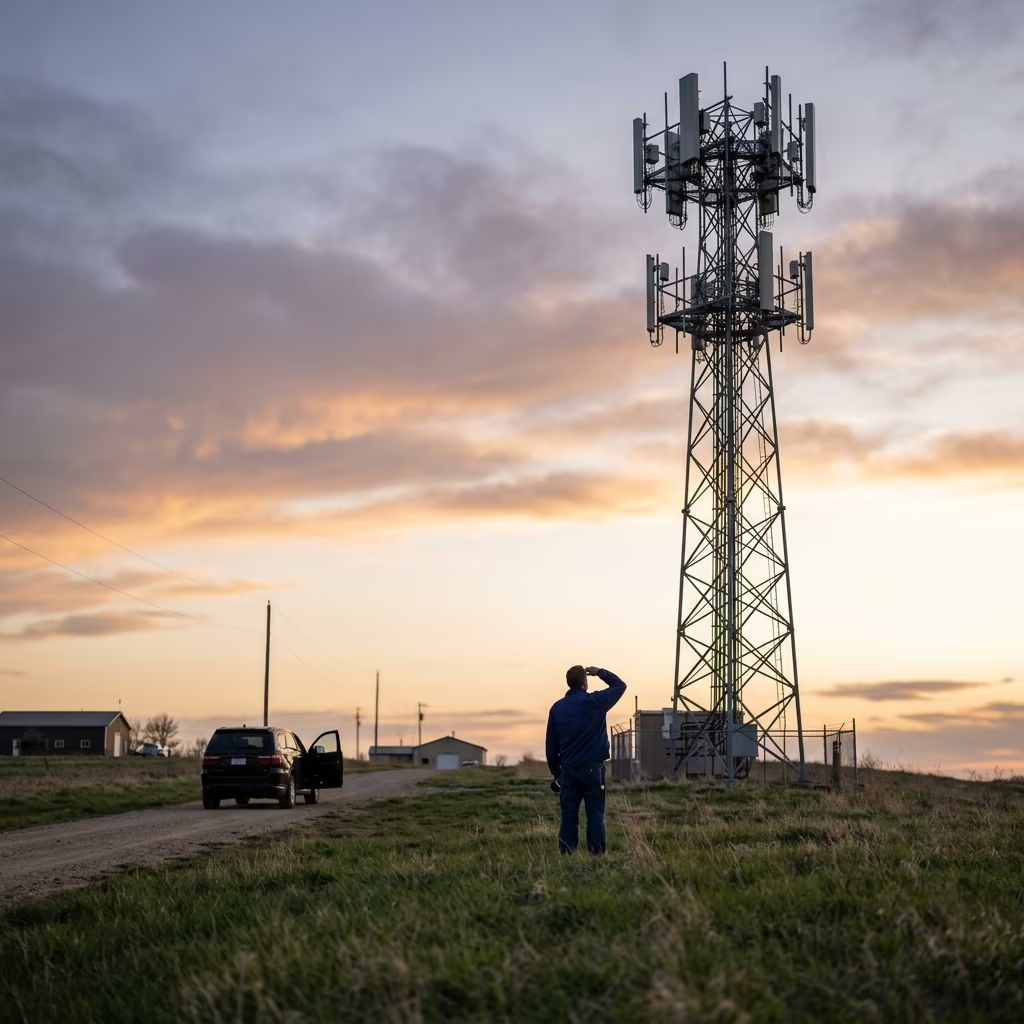
Every time a cellphone connects to a network, it communicates with nearby cell towers. Phone companies log which towers handled calls or data, creating a detailed trail of where a device—and by extension, its user—was over time. These logs are known as cell-site location information (CSLI).
Before the Supreme Court’s intervention, police commonly relied on a federal statute, the Stored Communications Act, to obtain CSLI with a court order based on a relatively low standard: that the records were “relevant and material” to an ongoing investigation, rather than supported by probable cause. That approach treated location records as business documents held by third-party providers, not as intensely personal data about individuals.
- Traditional view: Information shared with a company (like a phone carrier) was often considered outside the core privacy protections of the Fourth Amendment.
- Modern reality: Location records can reveal where people live, work, worship, receive medical care, and socialize—painting an intimate portrait of their life.
- Key question: Does accessing that trail of movements count as a “search” that requires a warrant under the Constitution?
The Carpenter Case: How Cell Tower Data Reached the Supreme Court
The Supreme Court’s most influential ruling on cell tower tracking emerged from Carpenter v. United States, decided in 2018. In that case, federal investigators obtained months of CSLI from phone companies to place a suspect near the scenes of a series of robberies. They relied on the Stored Communications Act—without seeking a traditional search warrant based on probable cause.
The suspect argued that this prolonged tracking of his movements violated his reasonable expectation of privacy and therefore amounted to a search under the Fourth Amendment. The government countered that the records were the phone company’s business documents, voluntarily generated when the user chose to carry and use a cellphone, and thus fell under the so-called third-party doctrine—a line of cases holding that people generally lose Fourth Amendment protection for data they share with third parties.
Key Holding in Carpenter
By a 5–4 vote, the Court sided with privacy protections, holding that individuals have a legitimate expectation of privacy in the record of their physical movements captured through historical CSLI. The Court concluded that obtaining that data is a Fourth Amendment “search” and, in most circumstances, requires a warrant.
| Issue | Court’s Answer |
|---|---|
| Is accessing long-term historical CSLI a Fourth Amendment search? | Yes. Prolonged tracking of movements via CSLI is a search. |
| Does the third-party doctrine automatically apply to CSLI? | No. Sharing data with phone companies does not erase the privacy interest in location records. |
| What standard must police meet? | In most cases, police must obtain a warrant based on probable cause. |
| Scope of the ruling | Described as “narrow,” focused on historical cell tower location data, not all digital records. |
Why Cell Tower Location Data Is Constitutionally Sensitive
The Court’s reasoning rested on how pervasive and revealing location data has become. Unlike occasional records, CSLI can track virtually every movement of a cellphone user, sometimes over months or years. That capability raises constitutional concerns that go beyond ordinary business documents.
- Depth of detail: Long-term tracking can disclose not only where someone lives and works, but also visits to doctors, political meetings, places of worship, or other sensitive locations.
- Continuous monitoring: Because most people carry their phones constantly, CSLI can capture “the whole of their physical movements,” in the Court’s words.
- Involuntary generation: Users do not actively decide to create CSLI; it is generated automatically as a technical consequence of using the network.
The Court therefore treated prolonged access to CSLI as qualitatively different from isolated records like dialed phone numbers or bank statements, which prior third-party doctrine cases had allowed the government to obtain with fewer restrictions.
How the Ruling Changed Police Investigations
The Supreme Court’s warrant requirement has immediate consequences for law enforcement agencies that rely on location data in criminal investigations. Prosecutors must now show probable cause and obtain a warrant from a neutral judge before securing historical CSLI in most routine cases.
Practical Impacts on Investigators
- Higher evidentiary threshold: Investigators must develop more robust factual bases to convince judges that CSLI is needed and likely to reveal evidence of a crime.
- More judicial oversight: Warrant applications invite closer scrutiny of the scope and timeframe of the location data being requested.
- Limits on broad sweeps: The ruling, combined with subsequent decisions addressing geofence warrants, discourages mass collection of location data that sweeps in large numbers of non-suspects.
The Court did acknowledge longstanding exceptions to the warrant requirement, such as urgent threats to life or risks that evidence will be destroyed. Those traditional emergency exceptions remain available when circumstances truly demand swift action.
Relationship to Geofence Warrants and Other Digital Surveillance
After Carpenter, courts and policymakers confronted more novel forms of digital surveillance, including geofence warrants (which seek data on all devices within a geographic area) and location information generated by apps rather than cell towers.
In later cases, the Supreme Court and other courts have drawn on Carpenter’s logic to treat broad location sweeps as searches that implicate the Fourth Amendment. For example, a decision involving geofence data from a technology company concluded that sweeping access to location information across many users requires at least some level of judicial authorization and is subject to constitutional limits.
Digital rights advocates emphasize that location information—even when collected by apps—is closely tied to a user’s private life and should be considered their “own” data, deserving the same constitutional protections recognized for CSLI. That view further undermines the notion that merely sharing data with a company eliminates privacy expectations.
Balancing Privacy and Public Safety in the Digital Age
The Supreme Court used cautious language, characterizing its ruling on CSLI as narrow and leaving open questions about other types of digital records. Still, the decision signals that constitutional protections can evolve to reflect new technologies that carry unprecedented surveillance capacity.
Privacy Interests Recognized by the Court
- Expectations of privacy in movements: People reasonably expect that their everyday movements will not be fully monitored and stored for government use without strong justification.
- Protection for digital records: Some information stored with companies—especially data revealing intimate aspects of life—can fall within Fourth Amendment protections.
- Limitations on third-party doctrine: The Court declined to extend older rules about shared information to the far more revealing context of detailed location tracking.
At the same time, the Court acknowledged that law enforcement retains powerful tools when properly supervised by the courts. A warrant process does not forbid use of CSLI; it structures how and when such data may be lawfully obtained.
Key Takeaways for Individuals, Lawyers, and Policymakers
The ruling on cell tower location data affects multiple groups differently, but its core message is that modern constitutional privacy must account for the realities of digital life.
For Everyday Users
- Your cellphone’s communications with towers generate extensive records of your movements over time.
- The Supreme Court now treats prolonged access to those records as a search that generally requires a warrant.
- Some emergency situations still allow access without a warrant, but those exceptions are limited.
For Lawyers and Judges
- Carpenter and related decisions reshape Fourth Amendment analysis for digital evidence, especially location-based records.
- Arguments about reasonable expectations of privacy must consider the depth, duration, and sensitivity of data, not just its third-party status.
- Courts will likely continue refining standards for new technologies, such as app-based location tracking and geofence warrants.
For Policymakers and Agencies
- Statutes like the Stored Communications Act may require updating to align fully with contemporary constitutional standards.
- Internal policies should reflect the warrant requirement for CSLI and carefully delineate when emergency access is permissible.
- Transparency and oversight mechanisms can help ensure compliance while maintaining investigative effectiveness.
Frequently Asked Questions (FAQs)
1. What exactly is cell-site location information (CSLI)?
CSLI is data generated when a cellphone connects to the network. It records which cell towers handled calls or data sessions and when those connections occurred. Over time, these records can be used to approximate where a device—and its user—was located at particular moments.
2. Does the Supreme Court’s ruling mean police can never access CSLI?
No. The ruling does not prohibit police from using CSLI entirely. Instead, it generally requires law enforcement to obtain a warrant supported by probable cause before accessing extensive historical CSLI. Traditional emergency exceptions to the warrant requirement still apply in limited situations.
3. Why is this decision considered a landmark for digital privacy?
The decision is widely viewed as a landmark because it acknowledges that some modern digital records—especially location data—are so revealing that they deserve strong constitutional protection even when stored by third-party companies. It marks a departure from older approaches that heavily relied on the fact of sharing information with service providers.
4. How does this affect other types of data, like emails or app activity?
The Court described its ruling as narrowly focused on CSLI and did not definitively resolve how all other categories of digital records should be treated. However, subsequent discussions and cases have suggested that highly revealing digital data, including some app-generated records, may similarly warrant Fourth Amendment protection.
5. What should law enforcement agencies do to comply?
Agencies should ensure that investigators seek warrants for historical CSLI in most non-emergency situations, train personnel on the new standards, and develop clear guidelines about when emergency exceptions may be invoked. Coordination with prosecutors and judges is essential to make the process work efficiently.
References
- In Win for Privacy, Supreme Court Rules Police Need Warrants for Cellphone Tracking Data — Governing. 2018-06-22. https://www.governing.com/archive/tns-supreme-court-privacy.html
- U.S. Supreme Court Rules for Privacy Protections in Requiring a Warrant to Access Cell-Tower Location Data — Lowenstein Sandler. 2018-06-25. https://www.lowenstein.com/news-insights/publications/client-alerts/us-supreme-court-rules-for-privacy-protections-in-requiring-a-warrant-to-access-cell-tower-location-data-white-collar-privacy-cybersecurity
- Supreme Court Ruling Adds Privacy Protection for the Digital Age — Government Technology. 2018-06-26. https://www.govtech.com/public-safety/Supreme-Court-Ruling-Adds-Privacy-Protection-for-the-Digital-Age.html
- Victory! Supreme Court Says Constitution Protects People’s Location Data — Electronic Frontier Foundation. 2026-06-xx. https://www.eff.org/deeplinks/2026/06/victory-supreme-court-says-constitution-protects-peoples-location-data
- In Ruling on Cellphone Location Data, Supreme Court Makes Unexpected Allies — The New York Times. 2018-06-22. https://www.nytimes.com/2018/06/22/us/politics/supreme-court-warrants-cell-phone-privacy.html
- What the Supreme Court’s cellphone location data ruling means for privacy — PBS NewsHour (YouTube transcript). 2018-06-22. https://www.youtube.com/watch?v=NMM1rroZNf4
- Supreme Court rules broad cellphone location data sweeps require warrants — NBC News. 2026-xx-xx. https://www.nbcnews.com/politics/supreme-court/supreme-court-rules-geofence-cell-phone-data-warrant-required-rcna345950