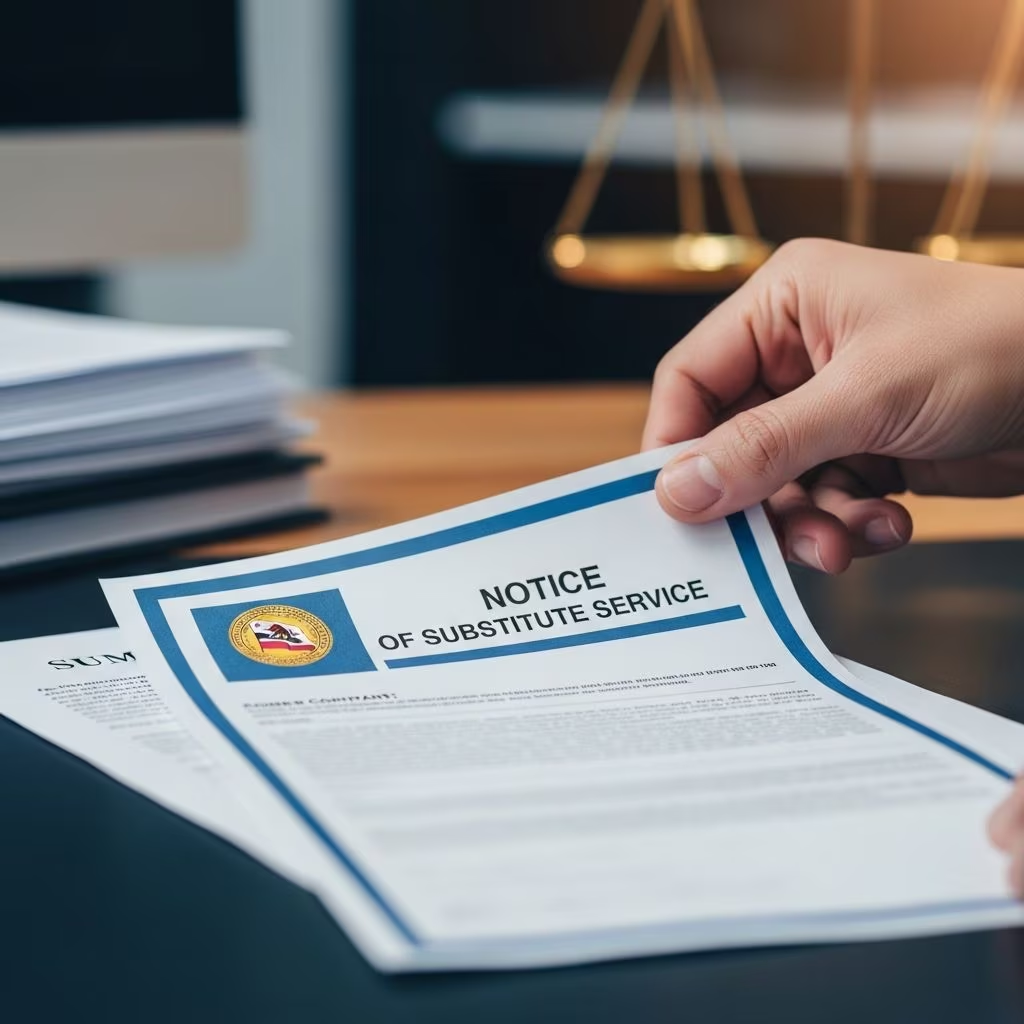
Serving a lawsuit correctly is more than a formality in California civil cases. Proper service of process is what gives the court authority over the parties. When a defendant is hard to reach or actively avoiding service, substituted service (often called substitute service) can be a lawful backup method if very specific rules are followed.
This guide explains, in plain language, how substituted service works in California, when it is allowed, what steps must be taken, and how to document everything so service will hold up in court.
1. Why Service of Process Matters
“Service of process” is the formal delivery of court papers—such as a summons and complaint—to a party, giving them notice of a lawsuit and an opportunity to respond. The U.S. Constitution requires that people receive due process before the government or courts can affect their rights. Proper notice through service is one way courts protect that right.
In California civil cases, if service of process is defective, the court may:
- Refuse to enter a default judgment
- Set aside an existing default or default judgment
- Delay the case while service is redone
- Dismiss the case if deadlines expire before valid service occurs
Because of these risks, lawyers, self-represented litigants, and process servers all need a working understanding of when they can move from personal service to substituted service under California law.
2. Personal Service vs. Substituted Service
California law strongly prefers personal service, which means handing the documents directly to the person being sued or to an authorized representative. Substituted service is designed as a secondary method that may only be used when personal service has been tried with reasonable diligence but has not succeeded.
| Feature | Personal Service | Substituted Service |
|---|---|---|
| Who receives the papers? | The named party or authorized agent | Another responsible adult at a qualifying location |
| When is it allowed? | Preferred and usually first choice | Only after reasonable attempts at personal service fail |
| Extra mailing required? | Generally no, for basic personal service | Yes, a follow-up mailing to the same address is required |
| Legal complexity | Relatively straightforward | More technical; strict statutory requirements |
3. Legal Framework for Substituted Service in California
Substituted service in California is governed by the California Code of Civil Procedure (CCP), primarily sections 415.20–415.95.
- CCP § 415.20: Sets out how to serve individuals and businesses by substituted service, including the need for reasonable diligence and mailing.
- CCP § 415.30–415.40: Address service by mail and on persons outside the state, which may interact with substituted service in some situations.
- CCP § 415.50: Covers service by publication as a last resort when a party cannot be located with reasonable diligence.
California courts and self-help materials emphasize that substituted service is valid only if the statutory steps are followed precisely. Courts analyze closely whether the plaintiff actually used reasonable diligence before resorting to this method.
4. When Can You Use Substituted Service?
Substituted service is not available just because personal service is inconvenient. Instead, California requires reasonable diligence in attempting personal service before switching to substituted service.
4.1 Reasonable Diligence: What It Usually Involves
There is no single magic formula, but California self-help guidance and case law indicate that reasonable diligence typically includes:
- Multiple attempts (often three or more) at different times of day
- Attempts on different days, including weekdays and sometimes weekends
- Attempts at all known addresses (home, work, or other reliable locations)
- Choosing times when the person is likely to be present (evenings at home, business hours at work, etc.)
After these attempts fail, the server can consider substituted service provided the address appears to be a valid place where the person lives, works, or regularly receives mail.
4.2 Situations Where Substituted Service is Common
- The defendant is reported always to “just have left” or “not be home” when the server arrives.
- Neighbors, family, or coworkers suggest the person lives or works there but avoids answering the door.
- The defendant appears to be actively evading service after learning about the case.
In these circumstances, courts may accept substituted service if all procedural steps are met and the efforts at personal service are well documented in a declaration of due diligence.
5. How Substituted Service Works on Individuals
Substituted service on an individual is a two-step process: in-person delivery to another adult at a qualifying location, followed by mailing a copy to that same address.
5.1 Step One: Leaving Papers with a Suitable Adult
Once reasonable diligence has been documented, a process server may leave the documents with another adult who meets all of these requirements:
- Age: At least 18 years old.
- Location: At the defendant’s usual residence, usual place of business, or usual mailing address (but not a post office box).
- Relationship to location: The person must be “apparently in charge” or a member of the household or staff who is reasonably likely to deliver the papers to the defendant.
The server should explain that the documents are legal papers for the defendant and note the person’s name and role (for example, spouse, roommate, coworker, receptionist).
5.2 Step Two: Mailing a Copy
After leaving the documents with another adult, the server or a third party must mail a copy to the defendant at the same address where the substituted service occurred.
- The mailing must be via first-class mail, postage prepaid.
- The copy is usually mailed the same day or as soon as practicable.
- Service is considered complete on the 10th day after the mailing in many California civil cases.
Skipping the mailing step often leads courts to rule that substituted service was invalid, even if the documents were hand-delivered to someone at the correct location.
6. Substituted Service on Businesses and Organizations
California allows substituted service on businesses, corporations, and other entities in slightly different ways than for individuals.
6.1 Targets for Service on a Business
For a business, service is normally made on:
- An officer (such as a president or secretary)
- A manager or person designated in law (for example, statutory agent)
- An employee “apparently in charge” at the office or usual place of business
If personal service on these individuals fails or is not reasonably possible, substituted service is allowed under CCP § 415.20(b) by leaving papers with a person in charge at the office and then mailing a copy to the same business address.
6.2 Special Rules for Registered Agents
Many corporations and limited liability companies in California appoint a registered agent for service of process with the Secretary of State. If the agent’s address is valid and the agent is available, personal service should be attempted there first. If those attempts fail with reasonable diligence, substituted service may be made at the agent’s office on a person apparently in charge, again followed by mailing.
7. Documentation: Declarations and Proof of Service
Even if the service itself is done correctly, a case can be derailed if the proof is incomplete or inaccurate. California courts require detailed documentation of substituted service.
7.1 Declaration of Due Diligence
Before substituted service is accepted, courts typically expect a declaration of due diligence that describes the unsuccessful attempts at personal service.
This declaration commonly includes:
- Dates and exact times of each attempt
- Addresses visited and why they are believed to be valid
- Descriptions of what the server observed (lights on, cars present, people answering, etc.)
- Any information obtained from neighbors, building staff, or others
California’s self-help resources emphasize attaching this declaration to the Proof of Service so the judge can confirm reasonable diligence was used before substituted service took place.
7.2 Proof of Service Form
In many civil cases, parties use the standard Proof of Service of Summons (form POS-010) issued by the California Judicial Council. The server fills in:
- How service was made (checking “substituted service” if applicable)
- The name of the person who received the papers
- The location of service and the date and time
- Details about the follow-up mailing
The server signs the form under penalty of perjury, making it an official statement to the court. Filing this proof with the court is what starts the clock for the defendant’s time to respond.
8. Avoiding Common Mistakes
Substituted service is highly technical. Some frequent errors cause courts to reject service or set aside default judgments.
8.1 Inadequate Attempts at Personal Service
Common problem areas include:
- Only one or two attempts at personal service before switching to substituted service
- All attempts at the same time of day (for example, always mid-morning, when the person is likely working)
- Failing to try at all known addresses or workplaces
Some California materials and practitioners recommend at least three attempts on different days and at different times before using substituted service. While not an absolute rule, it is a useful benchmark.
8.2 Serving the Wrong Person or Location
Substituted service is only valid if the address is a genuine residence, business, or usual mailing address for the defendant. Mistakes include:
- Serving a neighbor’s apartment or unit instead of the defendant’s
- Leaving papers at a location the defendant no longer uses
- Serving a post office box or other address that is not a usual mailing address under the statute
Courts may find such service invalid if there is not enough evidence linking that address to the defendant.
8.3 Skipping the Mailing Step
For substituted service, it is not enough to simply leave the papers with another adult. California law also requires mailing a copy to the same address. If the mailing never occurs, or is sent to a different address, the service may be defective.
8.4 Incomplete or Vague Proof of Service
Court self-help materials note that the server must provide concrete detail in both the declaration of due diligence and the proof of service form. Vague statements like “tried a few times and no answer” may not satisfy a judge. Precise dates, times, and descriptions of each attempt reduce the risk of a defect challenge.
9. Practical Tips for Litigants and Process Servers
Both professional process servers and self-represented litigants can take simple steps to improve the likelihood that substituted service will be upheld.
- Plan attempts strategically: Schedule visits during likely hours (early morning, evening, or weekends at home; business hours at work).
- Record every attempt: Keep a service log noting dates, times, observations, and interactions.
- Confirm addresses: Use reliable sources to verify the defendant’s residence or business before serving.
- Use standard forms: Rely on California Judicial Council forms and instructions when available, such as POS-010 for proof of service.
- Consult rules for special case types: Some cases (family law, small claims, unlawful detainer) have additional or slightly different procedural details.
10. When Substituted Service Is Not Enough
In some situations, even substituted service is impossible—such as when the defendant has moved without leaving a forwarding address or cannot be located despite extensive efforts. In those cases, California law may allow service by publication (for example, publishing notice in a newspaper) after a judge reviews evidence of reasonable diligence.
Service by publication is considered a last resort and usually requires a court order under CCP § 415.50. Courts look carefully at the plaintiff’s efforts to locate the person before authorizing this method.
Frequently Asked Questions (FAQs)
Q1: Is substituted service valid if tried on the first day I attempted service?
Typically no. California requires reasonable diligence in attempting personal service before using substituted service, which usually means multiple attempts on different days and times. A same-day switch to substituted service is often vulnerable to challenge unless there are unusual circumstances.
Q2: Who is considered a “responsible adult” for substituted service at a home?
A responsible adult is generally anyone 18 or older who lives there or appears to be part of the household and is reasonably likely to give the documents to the defendant. The server should note the person’s name, approximate age, and relationship (for example, spouse or roommate) on the proof of service.
Q3: Does the defendant have to actually receive the papers for substituted service to be valid?
No. The test is whether the plaintiff followed the statutory requirements: reasonable diligence at personal service, delivery to an appropriate adult at a qualifying address, and mailing a copy to that same address. Actual receipt is not always required, though it can affect practical notice and later disputes.
Q4: How long does the defendant have to respond after substituted service?
In many California civil cases, the defendant has 30 days to respond after service is deemed complete. For substituted service, completion is often calculated as 10 days after the mailing, plus the 30-day response period. However, deadlines can vary by case type, so parties should confirm the specific time limits that apply.
Q5: Can I serve the papers myself if I am the plaintiff?
No. California requires that service of summons and complaint be done by a person who is at least 18 and not a party to the case. This rule applies to both personal and substituted service.
References
- Serve your lawsuit by substituted service — Judicial Council of California, California Courts Self-Help Guide. 2023-05-01. https://selfhelp.courts.ca.gov/civil-lawsuit/plaintiff/substituted-serve
- Understanding substitute service of process in California — One Legal. 2024-02-07. https://www.onelegal.com/blog/understanding-substitute-service-of-process-california/
- Guidance on Substitute Service Procedures — One Legal Support Center. 2024-03-15. https://contractorsupport.onelegal.com/en/articles/9236729-guidance-on-substitute-service-procedures
- What is Substitute Service of Process? — Law Office of Eric Ridley. 2022-09-12. https://ridleylawoffices.com/what-is-substitute-service-of-process/
- substituted service — Cornell Law School Legal Information Institute (LII) Wex. 2021-06-01. https://www.law.cornell.edu/wex/substituted_service
- Substituted Service, Publication & Unknown Residence — San Diego Law Library. 2023-04-10. https://sdlawlibrary.libguides.com/c.php?g=1290794&p=9477579
- Service of Process: The Basics — Mello & Pickering, LLP, San Jose Family Law. 2023-01-20. https://www.sjfamilylaw.com/practice-areas/divorce/service-of-process-the-basics/