
Strengthening US Voting Rights: A Federal Blueprint
A comprehensive guide to federal actions protecting American voting rights.
nn
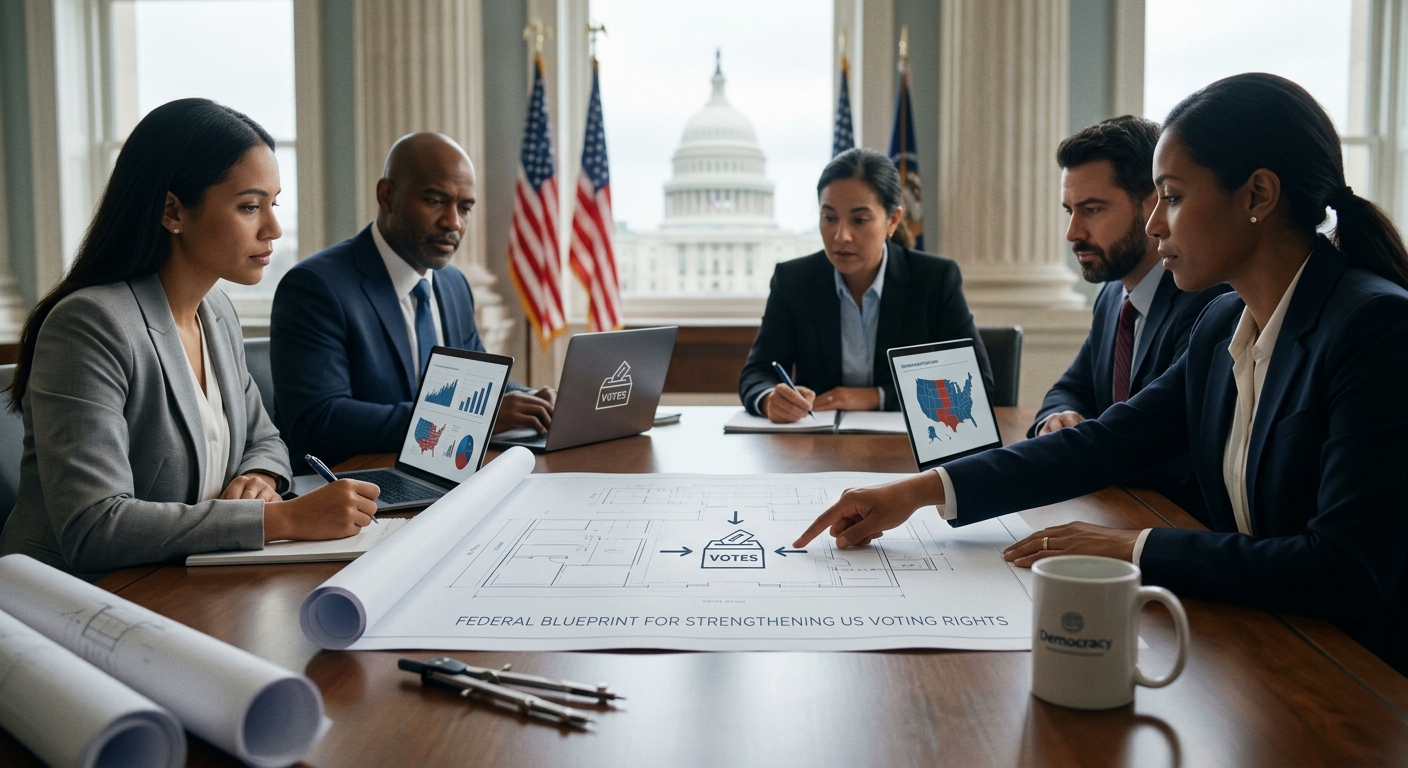
The foundation of American democracy rests upon the fundamental right of its citizens to participate in free, fair, and accessible elections. However, the landscape of ballot access in the United States is continuously shifting, often characterized by a complex interplay between state-level administration and federal oversight. In recent years, ensuring equitable access to the ballot box has required a multifaceted approach, extending far beyond simple policy recommendations. A robust federal strategy to protect voting rights demands aggressive enforcement by executive agencies, structural reforms within essential services like the postal system, and comprehensive legislative action by Congress.
nn
The erosion of federal preclearance mechanisms and the proliferation of restrictive state-level voting laws have underscored the urgent need for a renewed federal commitment to civil rights. This blueprint outlines the critical steps that the federal government must take to fortify the electoral process. By empowering the Department of Justice, optimizing the United States Postal Service for election mail, advancing sweeping civil rights legislation, and utilizing executive authority to expand voter registration, the federal apparatus can actively dismantle barriers to democratic participation.
nn
Empowering the Department of Justice to Defend the Ballot
nn
The United States Department of Justice (DOJ), specifically its Civil Rights Division, serves as the primary federal mechanism for enforcing voting rights laws. To effectively combat voter suppression, the DOJ must utilize its statutory authority proactively and aggressively. The Voting Section of the Civil Rights Division is tasked with enforcing several critical pieces of legislation designed to protect marginalized communities from discriminatory election practices.
nn
To fully realize its mandate, the DOJ must prioritize proactive litigation against jurisdictions that implement restrictive voting measures. This includes challenging policies that disproportionately impact minority voters, such as stringent voter identification laws, aggressive purges of voter registration rolls, and the reduction of polling locations in densely populated urban areas. Recently, the DOJ has demonstrated this commitment by pursuing federal lawsuits against multiple states for failing to adequately maintain and produce full voter registration lists, an action crucial for transparency and accountability.
nn
Statutes Enforced by the DOJ Voting Section
nn
A comprehensive federal strategy relies heavily on the vigorous enforcement of existing statutes. The table below outlines the primary laws under the purview of the DOJ’s Voting Section:
nn
| Statute | Primary Purpose and Protections |
|---|---|
| Voting Rights Act (VRA) of 1965 | Prohibits racial discrimination in voting practices. Section 2 remains a critical tool for challenging discriminatory redistricting and voting barriers nationwide. |
| National Voter Registration Act (NVRA) of 1993 | Often called the “Motor Voter” law, it requires states to offer voter registration opportunities at motor vehicle agencies and public assistance offices, while regulating how states can remove voters from rolls. |
| Help America Vote Act (HAVA) of 2002 | Establishes minimum election administration standards, funds election technology upgrades, and mandates provisional voting options for individuals whose eligibility is questioned at the polls. |
| Uniformed and Overseas Citizens Absentee Voting Act (UOCAVA) | Requires states to allow active-duty military personnel, their families, and U.S. citizens residing abroad to register and vote absentee in federal elections. |
nn
Beyond litigation, the DOJ must robustly deploy federal election observers. The monitoring of elections is an indispensable aspect of the Division’s enforcement efforts. By assigning neutral, impartial federal observers to jurisdictions with a history of discrimination or ongoing civil rights concerns, the DOJ can deter voter intimidation and ensure compliance with federal law on Election Day. Expanding this program requires adequate funding and seamless coordination with the Office of Personnel Management (OPM) to recruit and train a sufficient number of monitors.
nn
Safeguarding Election Mail Through USPS Reforms
nn
The transition toward widespread vote-by-mail and absentee voting has fundamentally altered the mechanics of American elections. Consequently, the United States Postal Service (USPS) has become an essential component of the nation’s electoral infrastructure. Ensuring the timely delivery and tracking of election mail is a matter of national security and civil rights. While the USPS has implemented “extraordinary measures” during recent election cycles to expedite ballot processing, structural vulnerabilities remain.
nn
Institutionalizing Election Mail Priority
nn
Audits conducted by the USPS Office of Inspector General (OIG) have provided critical insights into the system’s performance. During recent general elections, the Postal Service processed Political and Election Mail with high on-time processing scores. However, the OIG identified ongoing challenges, noting that USPS personnel did not always comply with established policies, leading to localized confusion regarding temporary changes in mail flow. To rectify this, the federal government must institutionalize Election Mail as a permanent priority class. This means guaranteeing First-Class delivery standards for all ballots, regardless of the postage rate paid by local election jurisdictions. The temporary “extraordinary measures” utilized in the days leading up to an election must be codified into standard operating procedures well in advance of election cycles.
nn
Enhancing Transparency and Ballot Tracking
nn
One of the most pressing issues identified in federal audits is the lack of comprehensive tracking for mail-in ballots. Recent reports estimated that nearly 40 million ballots mailed to and from voters lacked performance tracking data. This inability to track ballots throughout the postal network significantly undermines visibility for both election officials and voters, potentially eroding public trust in the absentee voting process.
nn
To strengthen the system, the USPS must implement a universal barcode tracking system for all election mail, seamlessly integrated with state and local election databases. This would allow voters to track their ballots from the moment they are mailed to the moment they are counted, much like a commercial package. Furthermore, the federal government should mandate and fund standard envelope designs for ballots nationwide to ensure compatibility with USPS automated sorting machinery, thereby minimizing the risk of ballots being delayed, damaged, or diverted.
nn
The Legislative Imperative: Codifying Voter Protections
nn
While executive actions and agency reforms are vital, they are inherently limited and subject to the changing priorities of different administrations. To achieve permanent, structural safeguards for voting rights, Congress must fulfill its constitutional duty by passing comprehensive civil rights legislation. The cornerstone of this legislative agenda is the restoration and modernization of the Voting Rights Act.
nn
Restoring Preclearance Mechanisms
nn
In 2013, the Supreme Court’s ruling in Shelby County v. Holder effectively dismantled the Section 5 preclearance formula of the VRA. This mechanism previously required jurisdictions with a history of discriminatory voting practices to obtain federal approval before implementing any changes to their election laws. The absence of this protection has led to an immediate resurgence of restrictive voting laws across numerous states.
nn
The passage of legislation such as the John Lewis Voting Rights Advancement Act is essential to repair this damage. This legislation seeks to establish a new, modernized geographic coverage formula based on recent histories of voting rights violations. Under proposed frameworks, a state might become subject to preclearance if a specific number of voting rights violations occurred within the previous 25 calendar years. By restoring preclearance, the federal government can proactively block discriminatory gerrymandering, polling place closures, and restrictive identification requirements before they disenfranchise voters.
nn
Establishing National Baseline Standards
nn
In addition to restoring the VRA, federal legislation must establish national baseline standards for ballot access to prevent the dangerous fragmentation of democratic rights based on geography. Congress must mandate minimum requirements for early voting, ensuring all citizens have access to the polls for a standard number of days, including weekends, prior to Election Day.
nn
Furthermore, federal law should require all states to implement Automatic Voter Registration (AVR) and Same-Day Voter Registration. AVR streamlines the process by electronically registering eligible citizens when they interact with government agencies, such as the Department of Motor Vehicles, unless they explicitly opt out. These standardized federal protections would effectively neutralize the impact of state-level voter suppression tactics and guarantee a minimum threshold of access for every American citizen.
nn
Executive Actions to Expand Voter Registration
nn
Beyond the DOJ and USPS, the broader executive branch possesses significant, often underutilized, authority to expand ballot access. Under Section 7 of the National Voter Registration Act, federal agencies can be designated as voter registration sites. An aggressive federal voting rights strategy must mandate the integration of voter registration services across all public-facing federal agencies.
nn
For example, the Department of Veterans Affairs (VA) should integrate registration services into its health facilities and benefits offices, ensuring that individuals who served the country are fully empowered to participate in its democracy. Similarly, the Indian Health Service (IHS) and the Social Security Administration (SSA) interact daily with millions of Americans, particularly marginalized and rural populations who often face the steepest barriers to registration. By issuing executive orders directing these agencies to actively facilitate voter registration—providing assistance with completing and submitting forms—the federal government can dramatically expand the electorate without requiring new congressional legislation.
nn
Conclusion
nn
Protecting the right to vote requires constant vigilance and proactive intervention at the federal level. A comprehensive strategy cannot rely on a single agency or a solitary piece of legislation. It requires a synchronized effort: a Justice Department willing to aggressively litigate against suppression, a Postal Service structurally optimized to handle the demands of modern elections, an executive branch leveraging its vast network to register citizens, and a Congress committed to restoring the full power of the Voting Rights Act. Only through this holistic, multi-agency blueprint can the United States ensure that its democratic processes remain accessible, equitable, and secure for all eligible voters.
nn
Frequently Asked Questions (FAQ)
nn
- n
- What is federal preclearance in the context of voting rights?
n Federal preclearance is a legal requirement originally established by the Voting Rights Act of 1965. It mandates that certain states and local jurisdictions with a history of discriminatory voting practices must receive approval from the DOJ or a federal court before changing their election laws. This ensures new laws do not disproportionately disenfranchise minority voters. - How does the DOJ enforce the National Voter Registration Act (NVRA)?
n The DOJ enforces the NVRA by ensuring states comply with its requirements, such as offering voter registration at motor vehicle agencies (Motor Voter) and public assistance offices. The DOJ can file lawsuits against states that fail to provide these registration opportunities or that unlawfully purge eligible voters from their registration rolls. - Why is ballot tracking so important for the USPS?
n Ballot tracking provides crucial visibility and security for vote-by-mail processes. Without proper performance tracking barcodes, election officials and voters cannot verify where a ballot is in the mail stream. Improving tracking reduces the risk of lost ballots and increases voter confidence that their mailed vote will be successfully counted. - Can federal agencies automatically register voters?
n While federal agencies can facilitate voter registration under the NVRA by providing forms and assistance, fully automatic voter registration (AVR) generally requires legislative action or specific state-level implementation. However, executive orders can maximize the role federal agencies play in guiding citizens through the registration process during routine interactions.
n
n
n
n
nn
References
n
- n
- Statutes Enforced By The Voting Section — Civil Rights Division, U.S. Department of Justice. 2024-08-15. https://www.justice.gov/crt/statutes-enforced-voting-section
- Service Performance of Election and Political Mail During the 2024 General Election — United States Postal Service Office of Inspector General (USPS OIG). 2024-10-16. https://www.uspsoig.gov/reports/audit-reports/service-performance-election-and-political-mail-during-2024-general-election
- H.R.4 – Voting Rights Advancement Act of 2019 — Congress.gov. 2019-11-29. (Note: This foundational primary source is cited to illustrate the canonical legal framework for restoring VRA preclearance mechanisms). https://www.congress.gov/bill/116th-congress/house-bill/4
n
n
n
n
n
Similar Articles








Read full bio of medha deb


