
Street‑Legal Golf Carts, ATVs and Low‑Speed Vehicles
Understand how golf carts, ATVs and low‑speed vehicles can be legally driven on public roads, and what safety, licensing and equipment rules apply.
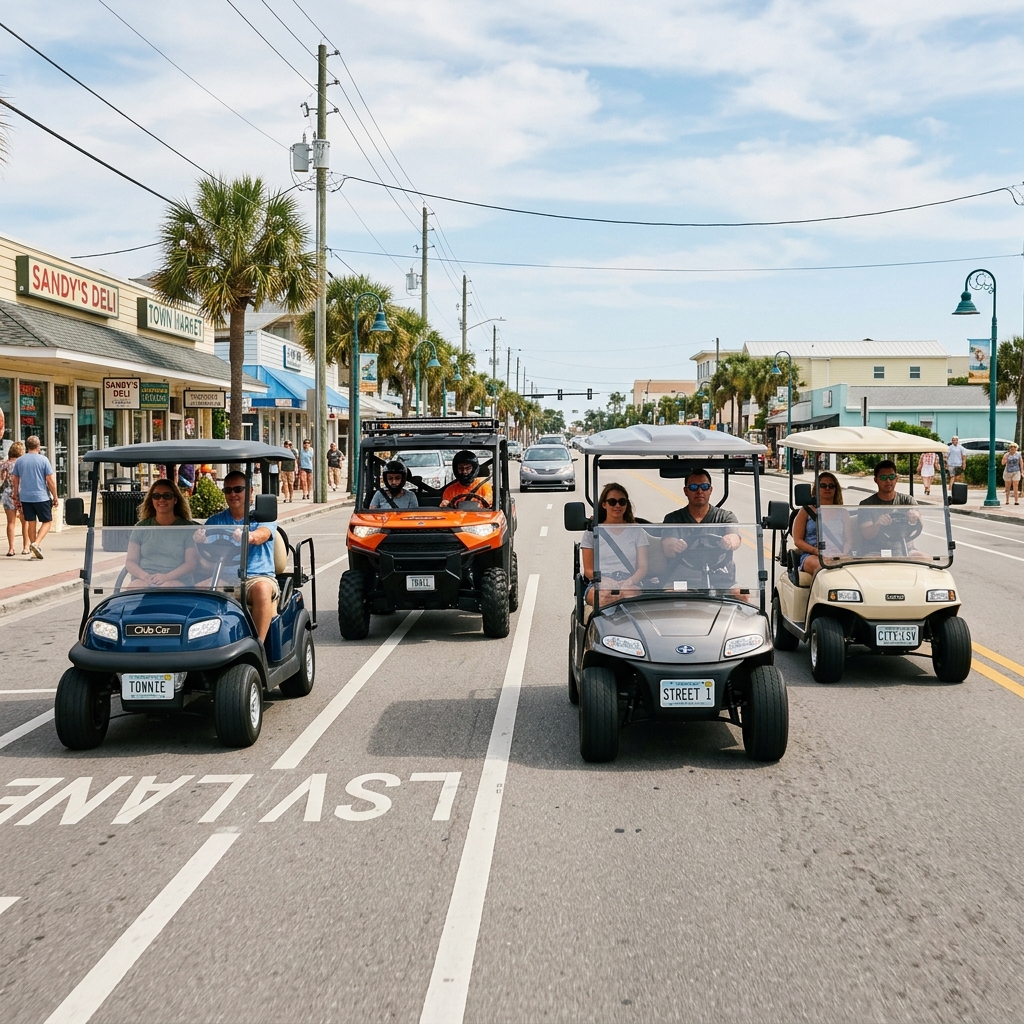
Small motorized vehicles such as golf carts, all‑terrain vehicles (ATVs), and low‑speed vehicles (LSVs) are increasingly used for neighborhood transportation, resort travel, and short errands. Many owners want to drive these vehicles on public roads, but doing so legally requires understanding a complex mix of federal safety rules and state or local traffic laws.
This guide explains when these vehicles can be street legal, what equipment and licensing rules normally apply, and how regulations differ among common categories. It is for general information only and is not a substitute for legal advice about your specific situation.
1. Key Vehicle Categories and Legal Differences
Before looking at legal requirements, it is essential to distinguish between the main types of vehicles, because the rules change based on how a vehicle is classified.
| Vehicle Type | Typical Use | Street‑Legal Potential |
|---|---|---|
| Golf Cart | Golf courses, private communities, short trips on private roads | Limited road use if allowed by state/local law and equipped properly; often restricted to low‑speed streets. |
| Low‑Speed Vehicle (LSV) | Neighborhood commuting, planned communities, short errands | Generally designed to be street legal on roads posted at 35 mph or lower, if they meet federal and state requirements. |
| ATV / Off‑Highway Vehicle | Off‑road recreation, utility work on farms or private land | Usually not legal on public roads; some jurisdictions allow limited use on specified routes with conditions. |
The same physical vehicle can sometimes be reclassified. For example, a golf cart that is upgraded and titled as an LSV may gain broader access to public roads, while a basic golf cart without safety features might be restricted to private property.
2. Federal Rules for Low‑Speed Vehicles
Golf carts and LSVs are primarily regulated at the state and local level, but low‑speed vehicles are also subject to federal standards. The National Highway Traffic Safety Administration (NHTSA) defines an LSV as a four‑wheeled vehicle with a maximum speed of more than 20 mph but not more than 25 mph.
To be marketed and sold as a street‑legal LSV, a vehicle must comply with specific safety requirements under federal regulations.
2.1 Core Federal Safety Features
NHTSA rules set a minimum safety baseline that manufacturers must meet for LSVs intended for use on public roads.
- Vehicle Identification Number (VIN) so the vehicle can be correctly titled, registered, and traced.
- DOT‑approved windshield for driver protection and consistent visibility.
- Lighting and signals:
- Headlamps
- Tail lamps
- Stop lamps (brake lights)
- Front and rear turn signals
- Front and rear reflectors
- Mirrors and rear visibility sufficient to see behind the vehicle, including rear‑view mirrors and, for some newer vehicles, rear visibility technology.
- Parking brake capable of holding the vehicle in place when stopped.
- Seat belts (Type 1 or Type 2) for each seating position.
- Acoustic alert or slow‑moving vehicle warning for quiet vehicles to ensure that pedestrians and other drivers can detect the vehicle.
These features are required for a vehicle to be sold and labeled as a compliant LSV. States then add their own additional rules on registration, licensing, and exactly where an LSV may operate.
3. Typical State Rules for Street‑Legal Use
Even when a vehicle meets federal LSV standards, it cannot simply drive anywhere. States generally limit LSVs and equipped golf carts to lower‑speed roads and impose licensing and insurance requirements similar to those for passenger cars.
3.1 Speed Limits and Road Types
Most jurisdictions restrict street‑legal golf carts and LSVs to streets with relatively low speed limits to reduce the risk of severe crashes.
- Maximum speed capability of the vehicle is usually capped around 25 mph for LSVs.
- Roads they may use often have a posted speed limit of 30–35 mph or less, depending on state law.
- Vehicles are typically allowed to cross higher‑speed roads at intersections when necessary, but not travel along them.
For example, one state transportation chart notes that properly equipped LSVs may be street‑legal on roads posted at 35 mph or less, while personal transportation vehicles or golf carts are limited to even lower‑speed roadways. Neighborhood ordinances may further restrict use inside city limits or prohibit golf carts from state highways altogether.
3.2 Licensing and Insurance
When a golf cart or LSV is operated on public roads, most states treat it similarly to other motor vehicles and apply standard licensing and financial responsibility rules.
- Valid driver’s license is commonly required to drive an LSV or street‑legal golf cart on public streets.
- Vehicle registration and license plate may be required, particularly when a golf cart has been upgraded and titled as an LSV.
- Liability insurance is often mandatory to operate an LSV or similar vehicle on public roads.
- Operators must obey all traffic laws that apply to conventional cars, including right‑of‑way rules, stop signs, and DUI prohibitions.
Some states draw a distinction between basic golf carts that remain unregistered and are used only in tightly defined areas, and upgraded vehicles registered as LSVs, which can be driven more broadly on public roads so long as they meet full legal requirements.
4. How Golf Carts Become Street Legal
Many owners start with a standard golf cart that lacks safety features, then consider modifying it for road use. Doing so usually involves both technical upgrades and legal steps.
4.1 Common Equipment Upgrades
To move from a golf course to local streets, a cart typically needs to be equipped with basic road‑use safety features that mirror LSV rules.
- Lighting package:
- Headlights for night and low‑light visibility
- Brake lights to signal stopping
- Tail lights and turn signals
- Reflectors to improve visibility from multiple angles
- Mirrors on at least the driver’s side and sometimes both sides, plus an interior rear‑view mirror.
- Windshield that meets safety standards, especially when reclassifying the vehicle as an LSV.
- Parking brake capable of holding the cart securely in place.
- Seat belts for every seating position.
- Slow‑moving vehicle emblem and, in some jurisdictions, an alert sound device.
After these upgrades, the vehicle may qualify as an LSV if it also meets speed capability requirements and obtains the proper documentation.
4.2 Speed and Performance Requirements
To be classified as an LSV under federal rules, a modified golf cart must be able to travel more than 20 mph but not more than 25 mph, and be designed for use on low‑speed roads.
- Minimum speed threshold: over 20 mph is generally required for LSV classification.
- Maximum speed: limited to 25 mph, even when the vehicle is capable of faster performance.
- The vehicle is usually allowed only on roads with posted limits of 35 mph or less, so its speed band aligns with surrounding traffic.
Some states use slightly different speed thresholds or special categories for personal transportation vehicles, but the basic concept is the same: low‑speed vehicles are meant for short trips in mixed‑use zones, not fast‑moving highways.
4.3 Documentation, Registration and Inspection
Once a golf cart is upgraded, owners often need to work through several administrative steps to make the vehicle legal for public road use.
- VIN assignment: many states require a vehicle identification number before they will issue a title or registration.
- Title documentation: the cart may need to be formally titled as an LSV or similar category.
- Registration and license plate: states may issue a special plate for LSVs or for golf carts authorized to use certain public roads.
- Safety inspection: some jurisdictions require inspection to verify that required equipment is installed and functional before registration is approved.
Where a cart remains unregistered, its use is typically limited to private property or very specific low‑speed routes defined by local ordinances.
5. ATVs and Off‑Highway Vehicles: Why Road Use Is Usually Limited
ATVs and other off‑highway vehicles are designed primarily for off‑road environments. As a result, they typically lack the safety systems and crash protection that passenger vehicles and LSVs are expected to provide.
5.1 Common Restrictions on ATVs
State and local laws usually prohibit ATVs from general road use, with narrow exceptions.
- ATVs are regularly classified as not street legal under any circumstances on public highways, including many public dirt roads.
- Use is often limited to private land, designated trail systems, or specific routes where local ordinance allows ATV travel.
- Some states allow short distance road travel (such as crossing a roadway or traveling on a shoulder) when necessary to reach a trail, subject to strict conditions.
Because ATVs lack many of the safety features required for LSVs, upgrading them for full street use may not be possible or may require extensive modifications and reclassification under state law.
5.2 Operator Rules and Safety Concerns
Where limited ATV road use is allowed, authorities usually stress that riders must obey all traffic laws and often require licensed, adult supervision for minors.[10]
- Licensed drivers only: some jurisdictions make clear that the requirement to hold a valid driver’s license applies to ATV and golf cart operation on public roads just as it does to cars.[10]
- Protective gear: helmets and other equipment may be mandated for off‑highway vehicle use even off the road, depending on state law.
- DUI and speeding laws: standard criminal and traffic provisions generally apply when ATVs are used on or near public roads.
6. Local Ordinances and Community‑Specific Rules
Beyond federal and state regulations, many cities, counties, and planned communities adopt their own rules governing golf carts, LSVs, and ATVs. These ordinances often focus on speed limits, where vehicles can operate, and who may drive them.
6.1 Examples of Local Restrictions
While details vary widely, many local rules share common features.
- Street access limited to roads with speed limits of 35 mph or less within city limits.
- Prohibitions on state highways inside a city, with an exception for crossing at perpendicular intersections.
- Requirements for a licensed driver to be present whenever a golf cart, UTV, or similar vehicle is operated on public streets.
- Designated routes where golf carts may travel to and from a golf course or amenities within a specified distance of their usual parking location.
Because these rules can differ dramatically from one community to another, owners should carefully review local ordinances before driving on public roads, even if their vehicle meets federal LSV standards.
7. Common Mistakes and Legal Risks
Owners of golf carts, ATVs, and LSVs frequently underestimate the legal complexity of driving on public roads. Several recurring errors can lead to traffic citations, fines, or more serious legal consequences.
- Assuming a golf cart is a toy: in many jurisdictions, using a cart on public roads without a license, registration, or insurance can result in violations similar to those imposed on car drivers.[10]
- Ignoring speed limit restrictions: driving an LSV on roads posted above 35 mph or failing to limit travel to authorized routes can trigger traffic tickets.
- Failing to equip the vehicle properly: missing lights, seat belts, or mirrors can prevent a cart or LSV from being street legal and may lead to enforcement action.
- Allowing minors to operate on public roads: many states prohibit unlicensed minors from operating golf carts and off‑highway vehicles on roadways.[10]
- Overlooking insurance needs: driving an LSV or upgraded golf cart without required liability coverage can expose the driver and owner to significant financial risk after an accident.
Consulting an attorney familiar with motor vehicle and traffic laws can help owners avoid these pitfalls and better understand how regulations apply in their area.
8. Practical Steps for Owners Considering Road Use
Owners who want to use small vehicles on public roads can follow a structured approach to determine what is legally possible and what modifications may be required.
8.1 Evaluate Your Intended Use
- Are you primarily driving inside a private community or resort, or will the vehicle regularly use public streets?
- Will you need to cross higher‑speed roads to reach amenities, or remain entirely within low‑speed zones?
- How far will you travel and how often? This affects battery range, seating capacity, and whether LSV classification is necessary.
8.2 Confirm the Vehicle Category
- Check whether the vehicle is sold as an LSV and already has a VIN, safety equipment, and documentation.
- Identify if you are starting with a basic golf cart that must be upgraded to meet road‑use requirements.
- Determine whether the vehicle is an ATV/off‑highway vehicle that may be limited to trails and private land.
8.3 Research Local Laws and Ordinances
- Review state statutes on low‑speed vehicles, personal transportation vehicles, and golf carts.
- Check city or county codes for speed‑limit restrictions, highway prohibitions, and licensing rules.
- Contact local law enforcement or your motor vehicle department for clarifications about permitted routes and required documentation.
8.4 Work With Qualified Professionals
- Use reputable dealers or service centers to install required safety equipment and verify compliance with LSV standards.
- Consult a traffic or vehicle law attorney if you are uncertain about classification, insurance obligations, or potential liability.
- Seek guidance from your insurance provider about coverage requirements and exclusions for LSVs and golf carts.
9. Frequently Asked Questions (FAQs)
9.1 Can I drive a golf cart on any public road if it has lights and seat belts?
No. Even with safety equipment, golf carts and LSVs are usually limited to roads with relatively low speed limits, such as 30–35 mph, and may be barred from highways. Exact rules depend on state and local law.
9.2 Do I need a driver’s license to operate an LSV on public streets?
In most jurisdictions, yes. A valid driver’s license is generally required to operate LSVs and street‑legal golf carts on public roads, and unlicensed minors are typically prohibited from driving them on streets.[10]
9.3 Is insurance required for low‑speed vehicles?
Many states require liability insurance for LSVs and similar vehicles when used on public roads, much like standard automobiles. Insurance requirements can vary, so check your state law and speak with your insurer.
9.4 Can I turn my ATV into a street‑legal vehicle by adding lights?
Generally not. ATVs are usually classified as off‑highway vehicles and are not street legal under most state laws, regardless of added equipment. Some limited exceptions exist for designated routes or crossings, but full road use is uncommon.
9.5 What happens if I ignore local golf cart ordinances?
Driving a golf cart or LSV contrary to local ordinances—such as on prohibited roads or without a licensed driver—can result in traffic citations, fines, and, in some cases, vehicle impoundment. Serious violations like DUI can carry the same penalties as in a car.
References
- Is It Street Legal? Driving Golf Carts, ATVs, and LSVs on Public Roads — Super Lawyers. 2024-03-26. https://www.superlawyers.com/resources/traffic-violations/street-legal-atv-golf-carts-lsv/
- Federal Motor Vehicle Safety Standards for Low-Speed Vehicles — National Highway Traffic Safety Administration (NHTSA). 2011-09-28. https://www.nhtsa.gov/vehicle-manufacturers/low-speed-vehicles
- MPOHVs, ATVs, Golf Carts, LSVs, and PTVs Comparison Chart — Georgia Department of Public Safety. 2020-08-01. https://dps.georgia.gov/document/document/mpohv-atv-golf-carts-lsv-ptv-comparison-chart/download
- Street Legal Golf Cart Requirements Explained — Oasis Carts. 2023-06-15. https://www.oasiscarts.com/blog/street-legal-golf-cart-requirements-explained
- LSV vs Golf Cart: Which Is Best for Your Lifestyle? — E‑Z‑GO Authorized Carts (EAC). 2023-04-10. https://www.eacarts.com/blogs/blog/lsv-vs-golf-cart-which-is-best-for-your-lifestyle
- Low-Speed Vehicles — GEM (Polaris Inc.). 2022-09-01. https://www.gemcar.com/low-speed-vehicles/
- ARTICLE 11.09: Golf Carts, Utility Terrain Vehicles (UTV) — City Code Library. 2021-05-05. https://ecode360.com/40758808
Similar Articles








Read full bio of Sneha Tete


