
Stingray Cell Phone Tracking and the Warrant Requirement
How courts are reshaping Fourth Amendment law in response to secret cell-site simulator surveillance.
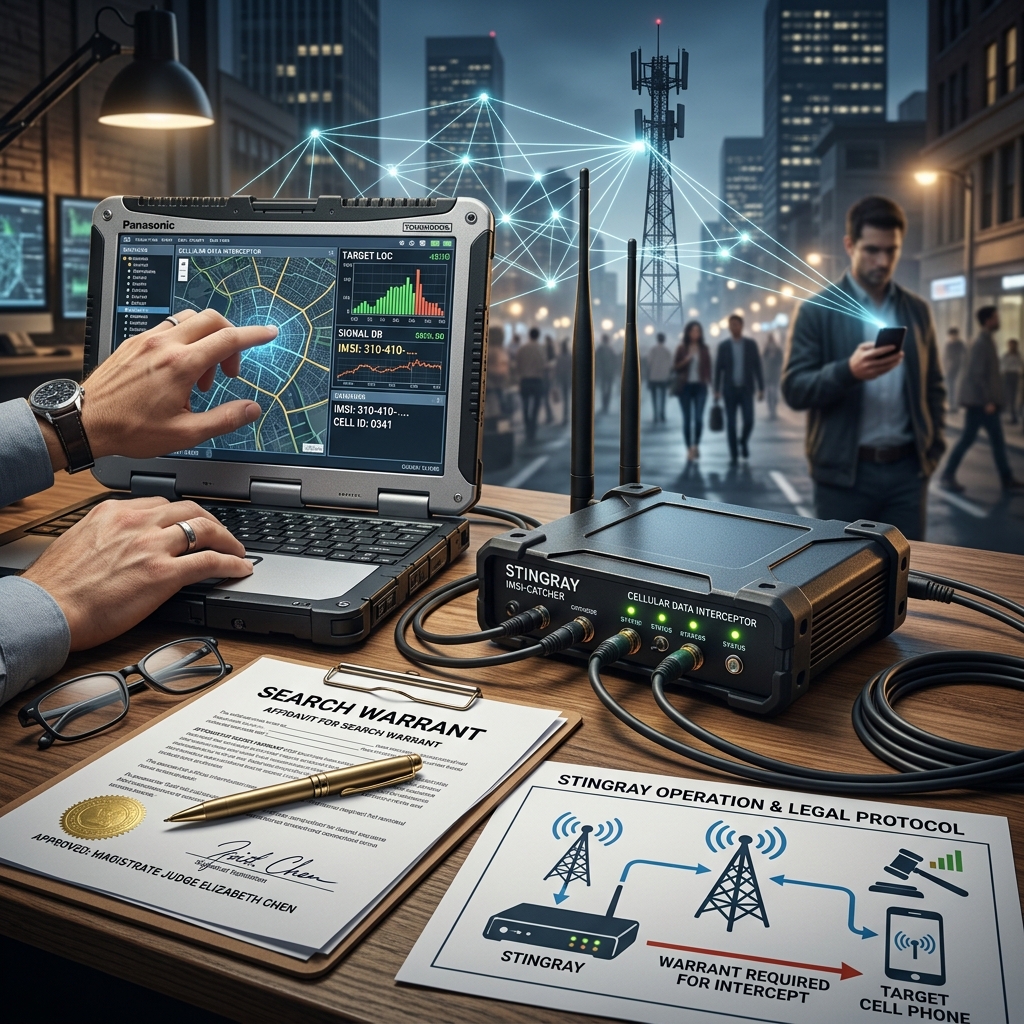
Cell phones constantly communicate with nearby towers, quietly broadcasting signals that reveal where we are and when we move. Law enforcement agencies have learned to exploit this behavior using devices known as Stingrays, or cell-site simulators, which can impersonate a legitimate cellular tower and draw in data from every phone in range. As these devices become more common, courts across the United States are wrestling with a critical question: does Stingray surveillance require a warrant under the Fourth Amendment?
This article explains what Stingrays are, how they work, why they raise serious constitutional concerns, and how judges, lawmakers, and civil liberties groups are shaping the emerging rule that a warrant supported by probable cause is usually required for their use.
Understanding Stingrays: How Cell-Site Simulators Work
A Stingray is a portable electronic device that mimics the behavior of a cell tower and forces nearby phones to connect to it. Once a phone connects, the Stingray can capture identifying information and, in many cases, location data. Advanced versions can also interfere with communications or, in some configurations, access the content of calls and messages.
- Impersonation: The Stingray broadcasts as a powerful “tower” so phones prioritize it over legitimate infrastructure.
- Induced communication: Phones are induced to reveal identifiers like IMSI (International Mobile Subscriber Identity) and other signaling data.
- Location tracking: By measuring signal strength or using multiple positions, a Stingray can pinpoint a phone’s location with high precision.
- Mass collection: When activated, it sweeps in data from all nearby phones, not just the intended target, creating a digital dragnet.
This technology differs fundamentally from traditional cell-tower records obtained from phone companies. Instead of passively requesting stored data, a Stingray actively creates a new surveillance event by interacting with devices in real time.
Key Technical Capabilities
| Capability | What It Does | Privacy Impact |
|---|---|---|
| Device Identification | Collects unique identifiers like IMSI or ESN from phones. | Links a physical person to a specific device and network identity. |
| Location Determination | Uses signal strength and triangulation to determine phone location in real time. | Enables tracking of a person’s movements and presence inside private spaces. |
| Bulk Data Capture | Collects data from all devices in range, not only suspects. | Surveils many innocent people without individualized suspicion. |
| Content Interception (in some configurations) | Can interfere with or capture communications in transit. | Raises concerns similar to wiretapping or general searches of communications. |
Because Stingrays can uncover where you are, whom you are near, and potentially what you are saying, courts have begun to treat their deployment as more than a minor investigative step—it is increasingly recognized as a search subject to Fourth Amendment protections.
Fourth Amendment Basics: Why Stingrays Raise Constitutional Questions
The Fourth Amendment to the U.S. Constitution protects people against “unreasonable searches and seizures” and generally requires law enforcement to obtain a warrant supported by probable cause before conducting a search. Whether Stingray use qualifies as a “search” turns on reasonable expectations of privacy and the intrusive nature of the technology.
Reasonable Expectation of Privacy in Cell Phone Location
Modern Supreme Court decisions have recognized that people have a strong privacy interest in the location data generated by their phones. In Carpenter v. United States (2018), the Court held that obtaining historical cell-site location information from a phone company is a search and ordinarily requires a warrant. The Court emphasized that comprehensive location tracking reveals an “exhaustive chronicle” of a person’s life, including visits to homes, workplaces, medical facilities, and religious or political gatherings.
Stingrays raise similar concerns, but often in more acute form:
- They can pinpoint where a person is right now, including inside a residence, dorm room, or other private space.
- They may capture information about many people at once, none of whom are suspected of wrongdoing.
- They involve government manipulation of network behavior, not simply a records request to a third party.
These features align Stingray surveillance with other intrusive technologies—like GPS trackers and phone-content searches—that courts have found require strong judicial oversight.
Stingrays as a Fourth Amendment “Search”
Several appellate courts and legal scholars have concluded that Stingray deployment qualifies as a Fourth Amendment search. Courts have noted that the device:
- Actively induces phones to share information they would not otherwise disclose in that place and time.
- Can lead officers inside constitutionally protected spaces, such as a suspect’s home or a third party’s apartment.
- Creates new data specially generated for law enforcement, rather than using data already exposed to a company.
In one state case, a court emphasized that cell phone users have a reasonable expectation of privacy in their real-time location, and that this expectation is widely recognized as reasonable. Another court in Washington, D.C., described cell-site simulator surveillance as a search requiring a warrant, rejecting warrantless use to locate a suspect.
Evolving Legal Landscape: Warrants, Policies, and Case Law
The legal framework surrounding Stingrays has changed significantly over the last decade, driven by judicial decisions, federal policy shifts, and aggressive advocacy by civil liberties organizations.
Federal Policy: DOJ Warrant Requirement
In 2015, the U.S. Department of Justice adopted a policy instructing federal agents to obtain a warrant supported by probable cause before using cell-site simulators in typical criminal investigations. The policy reflects recognition at the highest levels that Stingray surveillance raises substantial privacy risks, and that warrantless use should be the exception rather than the rule.
- Default rule: A warrant is required, except in limited exigent circumstances such as immediate threats to life.
- Minimization: Agents are directed to avoid retaining data from non-target phones and to delete it promptly when feasible.
While this policy directly governs federal investigations, many state and local departments have adopted similar internal rules, although these are less uniform and sometimes less stringent.
Judicial Decisions: Warrant Requirement in Practice
Courts have gradually built a body of case law addressing whether Stingray use is lawful without a warrant. Some notable themes include:
- Recognition of Stingray use as a search: Multiple courts have explicitly stated that deploying a cell-site simulator constitutes a Fourth Amendment search.
- Warrant requirement: In many instances, judges have ruled that Stingray searches are unconstitutional if conducted without a warrant and no exigent circumstances apply.
- Suppression of evidence: When courts find illegal Stingray use, they have suppressed resulting evidence, including both direct location data and derivative evidence discovered as a result.
In addition, the Supreme Court’s reasoning in Carpenter has been widely understood to extend beyond historical cell-site records to real-time tracking methods such as Stingrays. Legal commentators and practitioners now routinely argue that Carpenter’s logic makes warrantless Stingray use unconstitutional in most circumstances.
Civil Liberties Litigation and Transparency
Organizations like the American Civil Liberties Union (ACLU) and the Electronic Privacy Information Center (EPIC) have played a major role in uncovering how Stingrays are used and pushing courts toward requiring warrants.
- The ACLU has challenged warrantless Stingray deployments and fought for release of police records, revealing that some departments used the devices without telling judges or defendants.
- EPIC has litigated against federal agencies to obtain documents that explain the technology, its capabilities, and its deployment in cases such as United States v. Rigmaiden.
These efforts have exposed extensive secrecy agreements between law enforcement agencies and device manufacturers, under which officers were sometimes instructed to withhold details of Stingray use from courts, even if it meant dropping charges rather than revealing the technology. Increased transparency has made it easier for judges to recognize the constitutional stakes and insist on robust judicial oversight.
Practical Implications for Criminal Cases
For defendants and defense attorneys, the expanding recognition that Stingray use is a search has concrete procedural consequences.
Challenging Evidence Obtained Through Stingrays
When the government admits that a Stingray was used—or when its use is inferred from unusual patterns in the investigation—defense lawyers can file motions to suppress the resulting evidence. Common arguments include:
- Stingray surveillance is a Fourth Amendment search that requires a warrant based on probable cause.
- Carpenter applies to real-time location tracking, making warrantless use unconstitutional.
- If the warrant did not disclose the use of a Stingray, it may be invalid under misleading-affidavit doctrine (e.g., Franks v. Delaware).
- Evidence discovered via Stingray tracking is fruit of the poisonous tree and should be suppressed along with the initial location data.
Where courts agree that a Stingray search was illegal, they have suppressed both the primary data and any subsequent discoveries—such as contraband found in a home located via Stingray tracking.
Civil Remedies for Unconstitutional Stingray Use
Even outside the criminal context, individuals may pursue civil remedies when law enforcement uses Stingrays unlawfully. Federal law (42 U.S.C. § 1983) allows suits against officials who violate constitutional rights under color of state law.
- People subjected to warrantless Stingray tracking may seek damages for Fourth Amendment violations.
- Civil cases can proceed even if no criminal charges were filed or if the defendant was acquitted.
Such litigation not only compensates victims but also incentivizes police departments to adopt stronger safeguards, improve training, and ensure that officers seek warrants when using cell-site simulators.
Broader Policy and Ethical Concerns
Beyond courtroom battles, Stingray technology raises broader questions about digital privacy, mass surveillance, and the appropriate limits of investigative power in a networked society.
Dragnet Surveillance and Innocent Bystanders
Because Stingrays collect data from all phones in range, their use often entails surveillance of large numbers of people who are not suspected of committing any crime. This “digital dragnet” effect raises concerns about:
- Proportionality: Is it acceptable to surveil hundreds of people to locate one suspect?
- Discrimination and targeting: Could communities already subject to heavy policing be disproportionately exposed to Stingray sweeps?
- Data retention: How long is data about innocent users stored, and who can access it?
Many critics argue that these risks make warrant requirements and minimization protocols essential, not optional.
Secrecy and Judicial Oversight
Historically, law enforcement agencies have often sought to keep Stingray use hidden from courts, defense lawyers, and the public. In multiple jurisdictions, police entered nondisclosure agreements with manufacturers that discouraged revealing technical details—even to judges.
As more information has become public through records requests and litigation, judges have increasingly insisted that they must know what surveillance tools officers are using so they can properly evaluate warrant applications and suppression motions. Transparency is now widely viewed as a prerequisite to meaningful Fourth Amendment oversight.
FAQs: Stingrays, Warrants, and Your Rights
Do police always need a warrant to use a Stingray?
In many jurisdictions, courts and federal policy require a warrant supported by probable cause for routine Stingray use, with narrow exceptions for exigent circumstances such as imminent threats to life. However, case law and local policies vary, and the legal standard continues to evolve.
How can I know if a Stingray was used in my case?
Often, Stingray use is not clearly disclosed in police reports. Clues may include unusually precise real-time location information or vague references to “electronic surveillance.” Civil liberties litigation has pushed agencies to be more transparent, and defense attorneys increasingly ask detailed questions in discovery to uncover Stingray use.
Is Stingray surveillance different from getting cell-tower records from my phone company?
Yes. Requesting historical records from a carrier is a passive process, while Stingrays actively impersonate towers and induce phones to create new data at the government’s direction. Both raise privacy concerns, but courts tend to view Stingray use as more intrusive and more clearly a search.
Can Stingrays capture the content of my calls and messages?
Advanced cell-site simulators have the technical capability to interfere with communications and, in some configurations, intercept content. Official policies typically limit use to identifying and locating devices, but the mere possibility of content access heightens constitutional and statutory concerns.
What should I do if I suspect unlawful Stingray surveillance?
If you are facing criminal charges, discuss this possibility with your attorney and consider filing a motion to compel disclosure of surveillance methods and to suppress any evidence derived from unconstitutional searches. If you are not in criminal court, you may consult a civil rights lawyer about potential claims under federal or state law.
Looking Ahead: The Future of Stingray Regulation
As mobile technology advances and law enforcement tools become more sophisticated, legal standards are likely to continue shifting. Scholars anticipate further Supreme Court guidance on how the Fourth Amendment applies to real-time digital surveillance, with Stingray technology serving as a test case for balancing investigative needs against privacy in the networked age.
The emerging consensus is that:
- Stingray use is a search under the Fourth Amendment.
- A warrant based on probable cause is usually required, absent true emergencies.
- Transparency and minimization are crucial to protecting the rights of non-targeted individuals.
For now, anyone concerned about digital privacy—and anyone involved in criminal or civil cases where cell-site simulators may have been used—should pay close attention to how local courts and legislatures are responding to this powerful and controversial technology.
References
- New Cases Hold that Using a Stingray Is a Search — UNC School of Government, North Carolina Criminal Law Blog. 2017-10-16. https://nccriminallaw.sog.unc.edu/new-cases-hold-using-stingray-is-a-search/
- Stingray Searches and the Fourth Amendment: Implications of Modern Cellular Surveillance — McCullough, American Criminal Law Review (Georgetown Law). 2018-02-01. https://www.law.georgetown.edu/american-criminal-law-review/wp-content/uploads/sites/15/2023/02/53-0-McCullough-stingray-searches-and-the-fourth-amendment-implications-of-modern-cellular-surveillance.pdf
- Stingray Cell Phone Tracking: What You Need to Know About Your Rights — NY Criminal Attorneys. 2023-01-01 (approx.). https://www.nyccriminalattorneys.com/stingray-cell-phone-tracking/
- Victory: Judge Releases Information about Police Use of Stingray Cell Phone Trackers — ACLU of Texas. 2014-06-20. https://www.aclutx.org/news/victory-judge-releases-information-about-police-use-stingray-cell-phone-trackers
- Court Cases: Stingray Tracking Devices — American Civil Liberties Union. 2022-01-01 (updated). https://www.aclu.org/cases?issue=stingray-tracking-devices
- EPIC v. FBI – Stingray / Cell-Site Simulator — Electronic Privacy Information Center (EPIC). 2013-09-10. https://epic.org/documents/epic-v-fbi-stingray-cell-site-simulator/
- Your Phone Is Being Tracked Without Your Knowledge — YouTube (educational segment on Stingrays and Carpenter v. United States). 2023-08-01 (approx.). https://www.youtube.com/watch?v=4p7le7H_qnM
Similar Articles








Read full bio of medha deb


